
Image: GIJN
Changing the Journalism Community and Beyond, Part II: How GIJN’s Reporting, Training, and Resource Guides Impact Investigative Work Globally
In this second installment of our two-part series, GIJN digs into how our organization’s editorial coverage, ongoing training and webinars, and Resource Center guides have helped to empower investigative journalism and accountability projects worldwide, particularly in the Global South. (Part one of our series covered the impact of our Global Conferences.)
Here, we share the testimonies of six watchdog journalists who describe how our organization’s work in between our biennial Global Conferences has given their live investigations a digging edge. Indeed, in response to a question about the impact of GIJN itself in a major recent GIJN survey at GIJC25 in Kuala Lumpur, 280 of 347 respondents — nearly 81% of investigative journalists — revealed that GIJN had helped build their investigative capacity.
For instance, independent Russian journalist Valeriia Chegge reveals that GIJN’s tipsheets on free, high-resolution satellite image access — in particular: Why Any Reporter Can Now Source Free, Quality Satellite Images of Almost Anywhere on Earth — inspired and enabled her to pursue a 2025 investigation into Russia’s above-ground oil reservoirs policy: “How Russia Exposed Oil Depots to Ukrainian Drones.”
Other journalists revealed that they use GIJN resources in real-time — as a way to move an existing investigation forward. For instance, Bangladeshi journalist Sadia Mahjabin Imam used the investigative approaches outlined in a newly published GIJN tipsheet on linking pesticides and cancer to make a breakthrough in what became the first in-depth investigation into health risks for women farmers from pesticide use in Bangladesh.
Sadia Mahjabin Imam — assistant editor, Samakal (Bangladesh)
“I read the GIJN Bulletin [GIJN’s twice-monthly newsletter] article on Tips to Investigate Links Between Pesticide and Cancer in July, just after completing fieldwork, and while preparing my final report on the health risks for female Bangladeshi farmers exposed to pesticides.
“The article’s emphasis on the difficulty of establishing a direct link between pesticides and cancer prompted me to investigate further. [The story offered tips on getting around the ‘correlation-versus causation’ problem, and noted that expert opinion on likely links between pesticides and disease is important.] I consulted public health experts, doctors, and pesticide researchers, incorporating their insights into the report alongside interviews with women farmers. I also conducted follow-up interviews to strengthen the findings.
“As mentioned in the GIJN article, getting farmers to speak openly about pesticide use can be challenging. I faced the same difficulty, as women involved in commercial vegetable production were often reluctant to acknowledge their pesticide use.
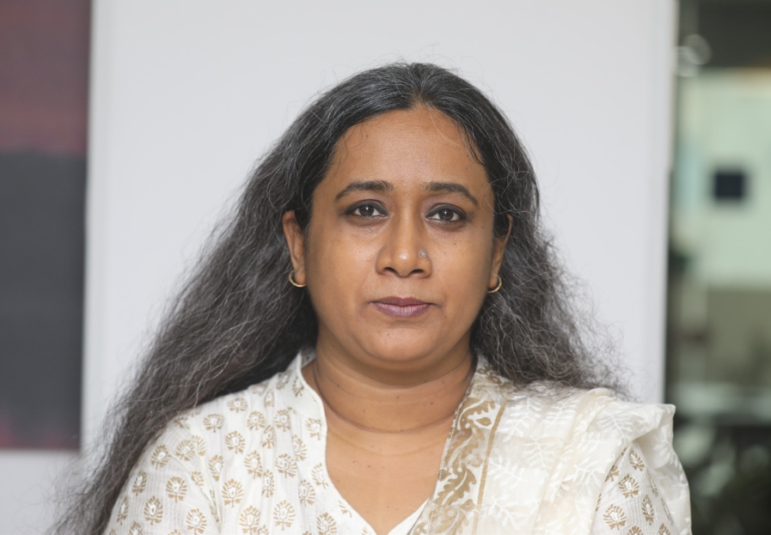
Sadia Mahjabin Imam, assistant editor at the Bangladeshi site Samakal, Image: Courtesy of Imam
My approximately 2,000-word investigation was published as a front-page story in Samakal, with contributions from 10 other correspondents. It combined interviews, a survey, and reviews of national and international literature. To my knowledge, it was Bangladesh’s first in-depth investigation into pesticide use among women farmers and its associated health risks. The report also prompted editorials in other media outlets. I encountered several other important issues during the fieldwork that I hope to explore in future investigations.
“That tipsheet featured research by Mark Horvit’s student team, which suggested that areas with higher pesticide use also had more cancer patients. This has inspired me to consider a similar investigation in Bangladesh, using medical records from healthcare facilities. Although accessing these records would be challenging, the investigation could explore cancer cases in high-pesticide-use areas and potentially lead to further stories on weaknesses in the healthcare system.
“GIJN’s resources have been valuable brainstorming tools, helping me approach issues from different perspectives, and its practical guidance is invaluable to journalists in Bangladesh.”
Sameh El-Laboody — investigative journalist and academic faculty member (Egypt)
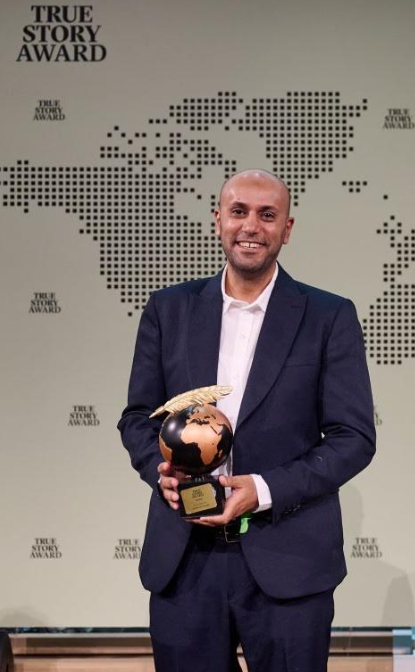
Sameh El-Laboody, Egyptian investigative journalist, Image: Courtesy of El-Laboody
“The insights, tools, and connections gained through GIJN’s network directly empowered our reporting on migration routes and human rights accountability, adding a vital layer of precision and safety to our investigative process.
“As an investigative journalist working on cross-border migration, maritime routes, and human rights violations — such as my investigations into Mediterranean shipwrecks and border dynamics — the practical techniques and networks facilitated by GIJN have given my reporting a crucial edge. Specifically, integrating OSINT tools and spatial analysis learned and discussed through GIJN’s platform significantly strengthened the methodology behind my recent investigative projects — including The Kalamata Trap [published by ARIJ] — and my ongoing work on environmental and migration ecosystems.
“And attending the Global Investigative Journalism Conference (GIJC25) in Kuala Lumpur and speaking on the migration reporting panel was a truly enriching experience. Beyond the panel discussions, the sessions covering open source intelligence (OSINT), satellite tracking, and digital verification in conflict zones provided me with advanced, cutting-edge methodologies that directly enhanced my investigative workflow.”
Md Ibrahim Khalilullah — executive editor, The Climate Watch (Bangladesh)
“I was a GIJC21 Fellow, and GIJN has stayed a practical reference for me ever since. As executive editor of The Climate Watch, a Bangladesh-based outlet covering climate and environment, and as voluntary “climate editor” of Renew Earth News, a Bangladesh-based environmental news portal, I still go back to GIJN materials when I need fresh ideas on investigative methods, data work, tracking money, and pushing institutions for answers. Those approaches have changed how I plan stories and how I edit and mentor the reporters in our newsroom.
“One clear takeaway from GIJN is that climate-finance reporting cannot stop at official announcements or budget allocations. You have to chase the actual figures, dig into the original documents, notice what is missing, and ask who ends up benefiting.
“That approach shows up in two recent interactive investigations I published with Renew Earth News: Does Climate Money Follow Risk? and Follow the Green Money.
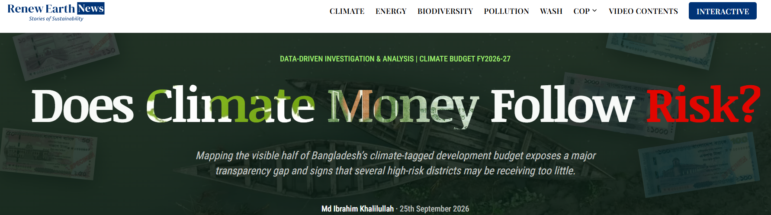
Does Climate Money Follow Risk, from Renew Earth News. Image: Screenshot, Renew Earth News
In the first, we looked at 521 climate-tagged development projects in Bangladesh’s FY2026-27 budget, mapped what we could of their geographic spread, and compared those numbers against climate vulnerability, poverty, and population data. The piece asked basic questions about transparency and whether the money is actually reaching the most exposed communities.
In the second, we examined Bangladesh Bank’s green-finance records to see where the sustainable investments were going. We turned the dense financial data into interactive charts so readers could explore the findings themselves.
“Both pieces follow the same habits GIJN has stressed: work from original datasets, test official claims against the underlying evidence, and pair the numbers with reporting from the ground.
“The GIJN resources I have drawn on most often for the stories:
- Basic Data Journalism Tips for Editors
- Holding Your Government Accountable for Climate Change Pledges
- Introduction to Investigative Journalism: Data Journalism
- GIJC21 Resources
“We used a similar method in Forests on Paper, Gaps on Ground, which looked at a US$175 million World Bank-financed forest restoration program. By checking Anti-Corruption Commission files, project evaluations, claimed plantation figures, and official replies, the story documented an apparent 350-hectare gap between allocated areas and what investigators found. The same evidence-first habits have guided our reporting on Bangladesh’s stalled wind-power projects and on the quiet losses faced by girls dropping out of school in climate-hit coastal areas.”
Valeriia Chegge — independent investigative journalist and correspondent for Mozhem Obyasni (Russia/Croatia)

Valeriia Chegge, independent investigative journalist and correspondent for Mozhem Obyasni. Image: Courtesy of Chegge
Independent Russian journalist Valeriia Chegge reveals that GIJN’s tipsheets on free, high-resolution satellite image access — in particular: Why Any Reporter Can Now Source Free, Quality Satellite Images of Almost Anywhere on Earth — inspired and enabled her to pursue a 2025 investigation into Russia’s above-ground oil reservoirs policy: “How Russia Exposed Oil Depots to Ukrainian Drones.”
“I periodically follow new GIJN materials, read articles, watch webinars, and try out the tools,” says Chegge. “I used instruments from this, and they helped me in some publications and training.”
“In one story, I used images that were partly found thanks to these GIJN materials — for example, NASA Worldview, Copernicus, EO Browser etc. — although not all the analyzed materials were included in the publication itself. In future, I want to try to investigate more complicated issues with the help of these tools, or maybe something new from GIJN.”
Víctor Luis Rodríguez-Velázquez — investigative reporter at Centro de Periodismo Investigativo (CPI) (Puerto Rico)
“My relationship with GIJN began long before I became a [conference] fellow in 2025. For several years, I have closely followed the organization’s work, especially the guides, tools, and workshops it makes available to investigative journalists around the world. Those resources, many of them available in Spanish, became a constant reference for my work at the Centro de Periodismo Investigativo (CPI) in Puerto Rico. One example is the workshop Mapas satelitales para investigar delitos ambientales (Satellite Maps to Investigate Environmental Crimes), organized together with Mongabay Latam, along with complementary materials on how to investigate environmental crimes and climate change.
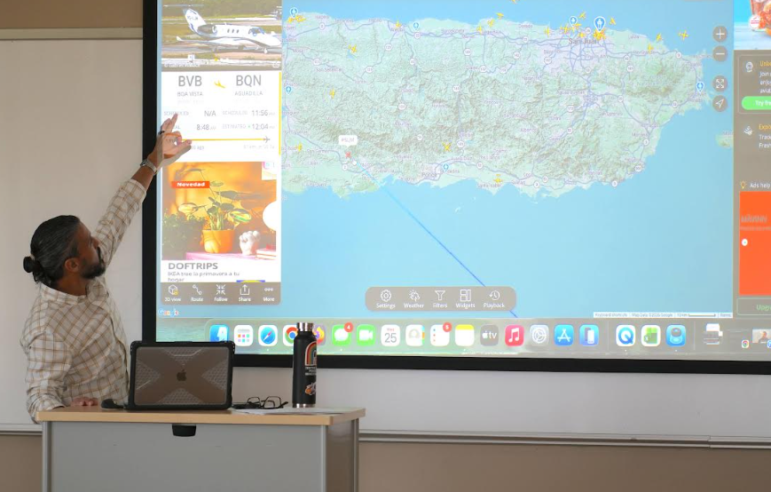
Investigative reporter Víctor Luis Rodríguez-Velázquez presents a workshop on investigating in Puerto Rico, based in part on GIJN resources. Image: Courtesy of Rodríguez-Velázquez
“Tools like these helped us dig deeper into an investigation I had been working on with Omaya Sosa Pascual, in which we exposed an environmental crime in the Jobos Bay National Estuarine Research Reserve, in the town of Salinas on Puerto Rico’s southern coast. Using aerial photos, documents, and testimonies from community members and local fishermen, we documented how (construction) damage accelerated unchecked between 2017 and 2020, and how local and federal agencies had known about the situation for years without taking action. As a result of our reporting, the government of Puerto Rico stepped in and ordered the removal and demolition of the structures and the restoration of the natural area.
“Also, GIJN’s educational efforts on covering the climate crisis and sea-level rise gave us context and tools to fill gaps in recent CPI investigations, such as the series Islas sin playas, Islas a la deriva, Se seca el Caribe, y Paraíso perdido.
“GIJN’s willingness to collaborate and make its content accessible has been a meaningful support for our work, and a reminder that investigative journalism grows stronger when knowledge is shared.”
Charles Mafa — editor, MakanDay (Zambia)
“GIJN has had a practical influence on how we approach investigative journalism. The value of GIJN goes well beyond attending the conferences. Its guides, webinars, newsletters, resource stories, and network have become useful reference points when we are developing investigations or trying to work out how to pursue a difficult story,” explains Mafa. “They have helped reinforce our use of open source research, following money and corporate structures, interrogating public records and data, source development, and thinking more carefully about cross-border dimensions to stories that may initially appear purely local.
“Just as important, GIJN provides access to a global community. For a relatively small investigative newsroom in Zambia, knowing that expertise, methodologies, and potential collaborators are available beyond our borders can make a significant difference when deciding whether an ambitious investigation is possible.
“One area where this approach has been particularly important is our reporting on Zambia’s mining sector. Our investigations increasingly combine community testimony with company information, environmental records, court documents, financial information and responses from regulators. In our continuing coverage of the Sino Metals pollution case, for example, we have followed the story beyond the immediate environmental disaster to examine questions of corporate accountability, regulation, litigation, and the experiences of affected communities.
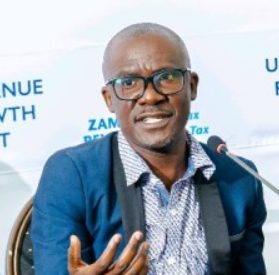
Zambian editor Charles Mafa, of MakanDay. Image: Courtesy of Mafa
“That kind of reporting reflects an important lesson reinforced through GIJN: an investigation should not end with documenting what happened; journalists should keep following the evidence to establish who was responsible, how systems failed, who benefited or suffered, and whether anything changed afterwards.
“Perhaps the most important impact for us is that the knowledge does not remain with the person who attended a GIJN conference or webinar. At MakanDay, we try to pass it on. We have trained and mentored hundreds of journalists, and lessons, tools, and approaches picked up through GIJN feed into our editorial discussions, story development, and training. The multiplier effect is therefore significant: one journalist may attend a GIJN event or use a GIJN guide, but the knowledge can subsequently influence the work of many other journalists and, ultimately, the investigations they produce.”
 Rowan Philp is GIJN’s global reporter and impact editor. Rowan was formerly chief reporter for South Africa’s Sunday Times. As a foreign correspondent, he has reported on news, politics, corruption, and conflict from more than two dozen countries around the world, and has also served as an assignments editor for newsrooms in the UK, US, and Africa.
Investigative Journalism Week 2026 Resources
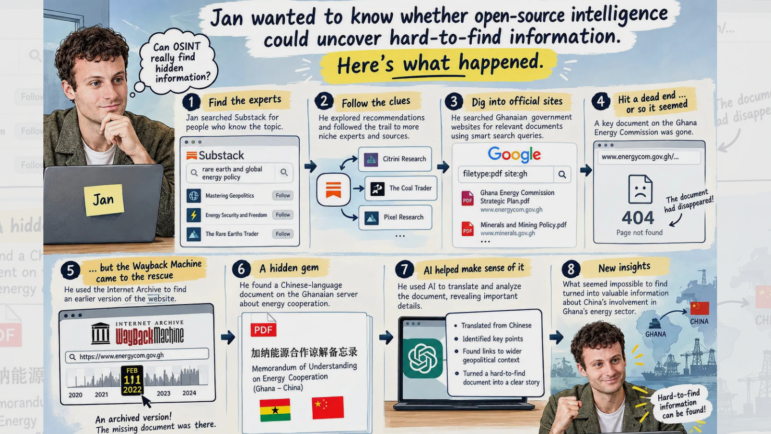
International Research Guide: How to Find Experts and Hidden Documents on Any Topic

Guide to Investigating Tech and AI in Modern Warfare
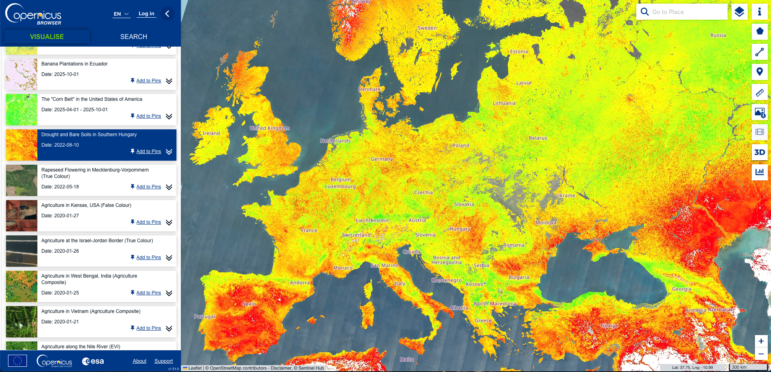
Turning Copernicus Satellite Data Into Public-Interest Climate Stories
Changing the Journalism Community and Beyond, Part I: How GIJN’s Global Conferences Have Made an Impact Around the World
Global Ripple Effect: How GIJC23 Impacted GIJN Fellows Around the World

How Digital Threats Training Has Powered Innovative Cyber Investigations Around the World

GIJN in 2025, by the Numbers

This work is licensed under a Creative Commons Attribution-NoDerivatives 4.0 International License
Republish our articles for free, online or in print, under a Creative Commons license.
Republish this article
This work is licensed under a Creative Commons Attribution-NoDerivatives 4.0 International License
Read Next
GIJN Impact
Changing the Journalism Community and Beyond, Part I: How GIJN’s Global Conferences Have Made an Impact Around the World
GIJN followed up on the detailed testimonies of five reporters who have come to past Global Conferences to better understand and hear, in their own words, how these events have furthered their journalism.
Awards, Grants, & Fellowships GIJC23
Global Ripple Effect: How GIJC23 Impacted GIJN Fellows Around the World
At GIJC23, GIJN sponsored more than 100 fellows from dozens of developing and transitioning countries.
GIJN Impact
How Digital Threats Training Has Powered Innovative Cyber Investigations Around the World
Alumni of GIJN’s four Digital Threats training courses have produced a number of exposés on online scams and political disinformation, from India to Kenya to the Philippines.
GIJN Impact News & Analysis
GIJN in 2025, by the Numbers
The year 2025 was a groundbreaking moment for the Global Investigative Journalism Network. Here are some of the key metrics from all of our work around the world last year.