

Illustration: Smaranda Tolosano for GIJN
Investigative Journalism Trainer’s Guide, Part I: Introduction



This guide is built for a three to four-hour “Introduction to Investigative Journalism” workshop, with a clear path for expanding any module into a full session of its own for a semester-length course. It draws on GIJN’s own Introduction to Investigative Journalism Guide as a foundation, while drawing case studies and reading recommendations from a global set of outlets, so the training doesn’t lean on any single region’s journalism.
The training runs across seven modules:
Module 1: What Is Investigative Journalism? (20 minutes) – Defines the field and introduces six overlapping lenses for approaching a story idea, from following the money to power and impunity.
Module 2: From Idea to Story Pitch (20 minutes) – Covers turning a raw idea into a testable hypothesis, planning for the minimum and maximum version of a story, and assessing feasibility and risk before reporting begins.
Module 3: Finding and Assessing Sources (40 minutes) – A framework for identifying, ranking, and interviewing human sources, including when to bring in experts as collaborators rather than just interview subjects.
Module 4: A Documents State of Mind (and FOIA Requests) (25 minutes) – What counts as a usable document, how to judge its reliability, and how to file a Freedom of Information request.
Module 5: Using Data, and Data-Driven Investigations (25 – 30 minutes) – A basic discipline for working with data honestly, where to find it, and a full case study built entirely from a purpose-constructed dataset. Includes a midpoint knowledge check on Modules 1 through 5.
Module 6: Open Source Research (often called OSINT) (15 minutes) – Using publicly available material, satellite imagery, registries, and verification tools to establish facts a reporter can’t access directly.
Module 7: From Raw Material to Publication (20 – 25 minutes) – Organizing your reporting, editing for accuracy and balance, fact-checking, legal review, and knowing when a story is ready.
Total running time is roughly 175 minutes, but trainers can decide how many of the in-class exercises and discussions to introduce depending on flow and available time. Homework is assigned only in Modules 1 and 4, since a single workshop doesn’t allow trainees time to complete it between sessions; trainers running this as a multi-day or semester course can add homework to any other module. Reading and viewing material is flagged for flexible timing throughout, to be assigned before class, during class, or after, at each trainer’s discretion, and a fuller, globally representative reading list appears at the end of the guide for anyone building this out further.
Module 1: What Is Investigative Journalism?
Overview
What separates investigative journalism from other types of journalism, be it daily reporting or features and analysis? This opening module gives trainees a definition in addition to a guide for how to think about investigative stories and the different shapes that they might take.
Suggested time: 20 minutes (expand freely for a semester-length course).
1. Core Definition
According to the Introduction to Investigative Journalism Guide, the oldest formal definition of investigative journalism was adopted by Investigative Reporters and Editors (IRE) in the United States in 1975. It centers on reporting done through a journalist’s own initiative — original digging, not just relaying what an official or a source hands you — into matters that someone in a position of power would rather keep hidden.
Another common way to define investigative journalism is that it begins with a hypothesis and sets out to prove it methodically using systematic inquiry.
“Good investigative journalists tend to think like a public prosecutor or a good police detective; they form a hypothesis about what is going on,” says GIJN’s founder and former Executive Director David E. Kaplan in this video titled What is Investigative Journalism. “You use, in effect, the scientific method, you form a theory, and then you test it.”
In-Class Exercise
Give trainees a short news item (a story about an “accident”: for example, a construction worker dying on site or a fire in an informal housing settlement), and ask them to work in pairs to identify what additional reporting would need to be added to turn it into an investigation. Let them present and discuss.
2. Forms an Investigation Can Take
Investigative journalism isn’t only a multi-year project. It can take several shapes:
- The quick-hit or breaking news investigation: a few days of focused work because that’s all the story needs. Think reporting that happens after catastrophes like a building collapse that results in casualties. A quick-hit investigation would be able to reveal in a few days why this happened and who should be held accountable.
- A short investigation: a few weeks.
- A rolling or serial investigation: a series of stories that build on each other over time.
- The major project: months or years, often involving a large team.
3. Investigation Types
Present the following as potential lenses through which to approach an investigative idea, not a comprehensive list of mutually exclusive categorizations. Most investigations combine two or three of them. Trainers are encouraged to discuss other types and examples relevant to their own region and trainees.
Ask trainees: when you hear “investigative journalism,” what type of stories come to mind? Most will say something like “exposing corruption,” which is accurate, but too broad to plan a story around. The types below allow trainees to have more references to enable them to formulate starting questions.
- Following the Money
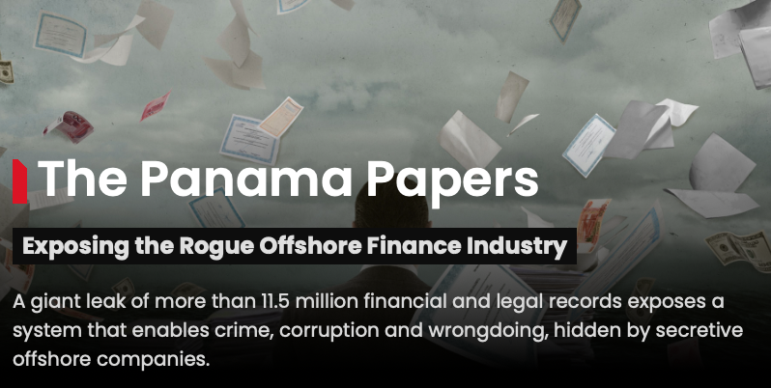
Panama Papers, ICIJ. Image: Screenshot, ICIJ
Financial trails: ownership structures, procurement records, offshore holdings, beneficial ownership. This is the classic type (GIJN’s own Following the Money guide covers it in depth). Example: The Panama Papers (ICIJ and more than 100 media partners, 2016), which involved 11.5 million leaked documents from the Panamanian law firm Mossack Fonseca and exposed how offshore shell companies were used to hide wealth. One of the prominent stories from this big leak to walk trainees through: Iceland’s prime minister, Sigmundur Davíð Gunnlaugsson, was found to have co-owned an undisclosed offshore company holding close to US$4 million in bonds in the same Icelandic banks that collapsed in 2008; the crisis he had built his political career campaigning against. He had sold half of his company to his wife for one dollar shortly after entering parliament, without disclosing the original ownership. ICIJ’s global team identified his name in the leaked data, then brought in a local Icelandic reporter, Jóhannes Kr. Kristjánsson, who spent months investigating in near-total secrecy before publication. The story led to mass street protests and Gunnlaugsson’s resignation within 48 hours of publication, a useful example of investigative impact as well as of the money trail itself.
Investigations based on large leaks have become more common and prominent in the past 10 years. But it’s important to clarify to trainees that publishing a leak on its own, with no additional reporting, is not an investigation. A leak becomes an investigation only once it’s tested against other sources: court records, property records, company filings, and interviews with people who understand the subject.
- Corporate / Systemic Harm
Investigations into a company’s or industry’s conduct, often environmental or health-related, and the human cost of that conduct. Example: the “Forever Lobbying Project” (award-winning French journalist Stéphane Horel and partners across 16 European countries investigated PFAS chemical pollution and the tactics the chemical industry used to fight regulation.
Another example: The Examination’s investigation into lead pollution in Ogijo, Nigeria, tracing contamination back through a global auto-parts supply chain to US carmakers. (Brief mention here because we return to this story in Module 4 to look at how the team built its evidence.)
- Double Standards / Regulatory Arbitrage
The same company behaving differently in different jurisdictions, not necessarily because of a legal loophole, but sometimes because of weaker public pressure or media scrutiny in one market than another. Example: Public Eye’s investigations on Nestlé selling infant formula/cereal products with more added sugar in some regions than others. It’s worth mentioning here that Public Eye is an NGO, not a media outlet, but their investigative work on this meets the criteria for investigative journalism, and has inspired numerous media stories after its publication.
- Hidden Motive / Conflict of Interest
A stated public position (e.g., “we want to reduce smoking”) undermined by an undisclosed or under-examined interest (e.g., dependence on tobacco tax revenue). Example: 7iber’s investigation into why anti-smoking policy has failed in Jordan despite repeated tobacco tax increases; the reporting shows government reliance on tobacco tax revenue as one factor working against serious enforcement, alongside weak enforcement of existing public health law.
- Systemic Failure / Negligence
Investigating an accountability chain after a disaster or ongoing failure; who knew what, and when. These stories usually trace a chain of decisions across several actors.
Example: BBC Panorama’s investigation into the Grenfell Tower fire examined the causes of the disaster by tracing back through several points of failure at once. For instance, the insulation manufacturer, Celotex, allegedly tested a safer version of its product to obtain fire-safety certification while marketing and selling a more flammable version for real-world use in tower-block refurbishments. The lead contractor won the refurbishment contract by undercutting rival bids and substituted cheaper, combustible materials for the non-combustible ones originally specified. In total, 72 people died. You can use this to show trainees that “systemic failure” stories usually mean tracing a chain of separate decisions rather than placing blame on one actor.
- Power, Monopoly, and Impunity
An individual or network that has captured control of a critical resource or chokepoint and exploits it, often with tacit state protection.
Example: Mada Masr’s “The Argany Peninsula“, an investigation into how one businessman built near-total control over both paid exit coordination for Palestinians leaving Gaza and the transport of aid and goods entering it, through separate companies. (We return to this story in Modules 3 and 4 to look at its reporting method.)
In-Class Exercise
Ask each trainee to think of a story idea they genuinely care about, a corruption scandal, an environmental case, an abuse of power, something local. Working individually or in pairs, have them map their idea against the typology in Section 3: which lens(es) apply? It could be more than one. Have a few trainees present their idea and their lens-mapping to the group.
Homework
Trainees keep the story idea from the in-class exercise and think through:
Who or what would they need to talk to or consult to report this story?
What kinds of sources and stakeholders might be involved; remind them explicitly that sources can be human (interviews) and non-human (documents, databases, physical evidence, satellite imagery, etc.). Remind them also to think about what they can personally observe for this story, and what sort of field reporting they might need to do.
This is meant to give them a live example to test against the people-trail/paper-trail concepts that will be introduced in Modules 3 and 4.
Required Reading
- Mada Masr, The Argany Peninsula (we will build on this in upcoming modules so it would help to have the trainees read it ahead).
Additional Reading/Viewing
(trainer’s choice on timing: before class, during class, or after; see trainer note):
- 7iber, Why does tobacco control fail in Jordan? (Arabic سيجارة لا تنطفئ: لماذا تفشل مكافحة التدخين في الأردن؟) (hidden-motive example)
- Public Eye, Africa’s Baby Food Sugar Scandal (double-standards example)
- The Examination, The Poisonous Lead Trade (corporate harm)
Videos
Module 2: From Idea to Story Pitch
Overview
This module moves from defining what investigative journalism is, to how journalists can start an investigative story; the thinking that has to happen before any reporting begins.
Suggested time: 20 minutes
1. Conceiving the Idea: Hypothesis and Story Pitch
Every investigation starts somewhere concrete: an observation by the reporter, a tip from a source, a document, another published story, or a pattern noticed in data. What turns a raw idea into something reportable is a hypothesis, a specific claim or question that a journalist can test and prove (or disprove) beyond “he said, she said.”
Contrast “I want to look into corruption in the health ministry” (too vague to plan around) with “I want to test whether the health ministry’s procurement process has been steering contracts to companies with undisclosed ties to officials” (a clear hypothesis that you can begin to test).
A hypothesis becomes a story pitch once it’s written up formally. The pitch should answer:
- What is the key point of the investigation? What’s the hypothesis the journalist is setting out to test?
- What documents and human sources will be needed?
- What officials or institutions will ultimately be held accountable?
Two Important Ideas to Introduce
- The minimum story: the story that’s still worth publishing even if the original hypothesis doesn’t fully pan out or the investigation can’t be completed as planned. Trainees should be taught to identify this before reporting begins, not scramble to downsize the piece after weeks of work turn up less than hoped.
- The maximum story: what you’d have if the reporting doesn’t just confirm the hypothesis, but uncovers abuses or failures bigger than originally suspected.
2. Deciding on Feasibility
The pitch should also address the question of feasibility:
- Do you have the resources, contacts, expertise, and time the story actually requires?
- Have you done a risk assessment, recognizing the physical or legal threats that could emerge during reporting or after publication?
This feasibility check could result in modifying the original story idea or narrowing its scope.
In-Class Exercise
Take an investigation that the trainees have read (one suggestion is the Argany/Mada Masr case from the previous module. If you choose another example, try to make it one that you can go back to in module 4 for the methodology exercise), and ask them to list the different safety considerations and physical and legal threats the journalists and editors may have run through.
Once a story clears the feasibility check, research begins. We will cover the investigative reporting methods in the next module, but remind trainees here that their reporting will depend on three main ways of gathering evidence and building a narrative:
- Information obtained through research: datasets and documents (the paper trail)
- Information obtained through interviews (the people trail)
- Information obtained through firsthand observation and direct in-person fieldwork (the reporter as a witness)
Module 3: Finding and Assessing Sources
Estimated time: 40 minutes
Overview
Every investigation rests on two kinds of evidence: documents and people. This module focuses on the human side. It gives trainees a framework for deciding what kind of source they need, how to judge a source’s reliability and motive, and how to sort sources by strength before they start reporting.
Framework: Sorting Sources by Purpose
One useful way to organize sources is by what role they play in the story.
- Sources who speak to the present or the problem. These are people close to the situation as it stands now: employees, residents, officials, or anyone directly affected by or involved in what is happening.
- Sources who speak to the past or the cause. These are people who can explain how the situation came to be: former employees, retired officials, people involved in an earlier decision, or anyone with institutional memory.
- Sources who speak to the future, the impact, or the solution. These are people who can explain what happens next, who is affected, or what should change: experts, advocates, affected communities, or policymakers.
A well-sourced story usually draws from all three categories. A common mistake is relying too heavily on present-tense sources, the people easiest to reach, while skipping the harder work of finding someone who left the organization years ago and is now free to talk, or someone whose expertise can explain the consequences of what the story has found.
Experts as Team Members, Not Just Sources
The framework above treats an expert as one kind of source among others. But on some investigative teams, experts are embedded in the reporting itself, closer to a collaborator than a source.
In the Forever Lobbying Project, an investigation spanning 46 journalists across 16 European countries, the team worked with 18 embedded academic experts throughout the reporting, not just at the end for comment. Those experts helped stress-test industry lobbying arguments directly, classifying claims into categories such as science-based, “there is no alternative,” and economic, and rating each one as false, misleading, or potentially dishonest, while also reviewing historical documents alongside the reporters. The experts were listed in the team that worked on the investigation. In explaining this process at GIJC 2023 in Sweden, French journalist Stéphane Horel noted that they had to establish with these scientists how rigorous the scientific method of the investigation had to be so that they would feel comfortable having their name on it.
This idea doesn’t have to be limited to large-scale investigations. A smaller newsroom can still bring in a single expert early and ask them to help interpret documents or test a claim, rather than saving all expert input for a single interview from which a few quotes would be used.
Current vs. Former Sources
Journalism researcher Brant Houston pointed out that a source’s relationship to the subject changes what they can and cannot say. A current employee or official may have access to information a former one no longer has, but they also have far more to lose by talking, and they often cannot speak freely without risking their job or worse. A former employee or official has usually lost that access, but they have likely also lost the reason to stay quiet, and they may be more willing to explain things a current source would never say on the record.
Anyone who comes to a journalist with information, especially a whistleblower, has a reason for doing so. Sometimes that motive is a genuine sense of public duty. Sometimes it is personal grievance, professional rivalry, or an attempt to damage a competitor or a former employer. A source’s motive does not automatically make their information false, and a source with a personal grudge can still hand over a real document. But trainees should be trained to ask why a source is coming forward now, what they stand to gain or lose, what information they may be intentionally holding back, and whether their account can be verified independently rather than taken on trust. The rule of thumb worth repeating to trainees is that motive affects how carefully you verify, not whether you listen.
Deciding Whether a Source Can Be Used
Ask trainees what questions they would ask before deciding whether or not to use a source. Take some answers and write them on a board. They should cover the following questions:
- Can what this person says be verified through a document, another source, or direct observation?
- What is this person’s access to the information they are giving? Did they witness it directly, hear it secondhand, or infer it?
- What do they represent, and does the story make that clear to the reader? A source described only as “an expert” without disclosing that they work for an interested party is misleading.
- What would it cost this person to be identified, and does the story’s approach to anonymity match that risk?
Some sources should not be used at all, either because their information cannot be verified by any means, or because using them would expose someone to a risk the story’s importance does not justify. Others can be used only under specific conditions: on background, with their identity disguised, or only to confirm something already established elsewhere.
Brief Note on Interviewing
This can be given as part of handouts if time is limited.
- Ask questions that invite explanation rather than a yes or no answer. Instead of asking whether something happened, ask the source to walk you through what happened, in their own words and in order. This tends to produce more detail and makes it harder for a source to give a rehearsed or evasive answer.
- Do not rush to fill the silence. When a source pauses after answering a question, resist the urge to move on to the next one right away. People often add important detail in that pause, especially if they are deciding how much to say.
- Adjust your approach based on the kind of source you are talking to. A current employee speaking under some risk may need reassurance about how their information will be used before they open up. A former employee with less to lose may need less reassurance but more probing, since they may be inclined to overstate their case or may be recalling a past event from years earlier.
- Finally, verify as you go rather than only afterward. If a source tells you something surprising, ask them how they know it, not just what they know. Pushing for more detail is itself a good test of whether a claim holds up, since a fabricated or exaggerated account tends to fall apart under specific follow-up questions, while a true one usually gets stronger.
In-Class Exercise: Ranking the Sources
Present trainees with the following scenario, or adapt it to a comparable one from their own context.
A local council has approved a contract to build a new public housing complex. The winning bid came from a construction company that, journalists later learn, is partly owned by the mayor’s cousin. The bidding process appears to have excluded at least one lower-cost competitor.
Give trainees the following seven possible sources for this story and ask them to work in small groups to decide, for each one: whether to use them at all, whether they can be used only under specific conditions, and where they rank from strongest to weakest.
- A current employee of the mayor’s office who has seen internal emails about the bid but will only talk anonymously and refuses to hand over the emails.
- A former employee of the construction company who was fired six months ago and is eager to talk on the record.
- The owner of the losing construction company, who believes the process was rigged against them.
- A procurement officer who processed the winning bid and insists everything was done by the book.
- A Facebook page that has posted screenshots claiming to show the mayor’s cousin discussing the deal, but you can’t verify the identity of the page admin.
- A local urban planning expert with no direct connection to the case, who can explain how public bidding processes are supposed to work and where this one appears to deviate.
- A council member who voted against the contract and is willing to speak on the record about her objections.
Ask each group to present their ranking and reasoning to the rest of the room, then compare rankings across groups before revealing the suggested answer key below. The disagreement between groups is often more useful than the answer key itself, since it surfaces the kind of judgment calls reporters have to make in real reporting.
Trainer’s Suggested Answer Key (ranked from top to bottom)
- Council member who voted against the contract (source 7). On the record, has standing to speak, and her objection is itself a matter of public record.
- Urban planning expert (source 6). Not connected to the case, so no personal motive to distort, and useful for establishing what the process should look like. Strong, but only for context, not for the specific allegation.
- Procurement officer (source 4). Worth using to get the official version on record, even though their account should not be taken as the final word.
- Former employee of the construction company (source 2). Potentially valuable, but recently fired so could have an obvious motive (holding a grudge). Usable, but everything they say needs independent verification before it goes in the story.
- Current employee of the mayor’s office (source 1). Likely has real access, but is anonymous and unwilling to produce documents. Can be used as background to guide reporting, but not to support a specific claim on its own.
- Owner of the losing construction company (source 3). Has an obvious commercial motive to allege wrongdoing. Can be used to explain their side of events, clearly attributed, but their claims need the same independent verification as anyone else’s.
- Post on Facebook page (source 5). Cannot be verified and should not be used as a source at all, though the screenshots it posted could be treated as a lead worth chasing down through other means.
This is a suggested ranking. Trainers should feel free to adjust it based on the discussion in the room, since reasonable disagreement about sources 1 through 4 in particular is normal and worth drawing out.
Module 4: A Documents State of Mind (and FOIA Requests)
Overview
An investigative journalist should always assume that a document that can confirm or refute a claim must exist somewhere, since building the discipline of looking for it is integral to accountability reporting. We will look at what counts as a usable document, how to judge whether it can be trusted and used, and how to file a Freedom of Information request when the document needed isn’t public yet. We will also return to the Argany Peninsula investigation from Module 1 to see how a story built mostly on human testimony can still be anchored by documents wherever they could be obtained.
Suggested Time: 25 minutes
What Is a Documents State of Mind?
While there will be investigations where it isn’t possible to get documents, it’s important to instill in trainees early the idea that veteran investigative journalist James Steele articulated: the assumption that there are always documents, and increasingly data, that can confirm or refute a claim made by a public official, business leader, or other authority figure. Trainees should leave this module reflexively asking what the document that proves or disproves this claim would look like, and where it might exist.
In-Class Exercise
Ask trainees to take the story idea they began developing in Module 1 and spend a few minutes brainstorming what documents might exist that could confirm or refute the claim at the center of it. Ask a few trainees to share what they came up with, then discuss as a group where those documents might actually be found, and how they might be obtained.
Follow this exercise by discussing what constitutes a document that can be used in an investigative story, and what criteria trainees should keep in mind before deciding to use one. The point of the discussion is to broaden their thinking about what counts as a document. This includes:
- Public records: court filings, property registries, corporate and company filings, procurement and contract records, budgets, meeting minutes, inspection reports.
- Digital records: emails, internal messages, datasets and databases, spreadsheets, presentations and slide decks.
- Recorded media: audio, video, photographs, satellite imagery.
- Physical objects that carry information: product labels, packaging, signage. For example, in a follow-up investigation about Nestlé’s double standards with sugar content in infant food across different regions, a reporter in Jordan used product labels themselves to examine sugar content. The information was hiding in plain sight.
- Public statements treated as documents: social media posts, press releases, a politician’s own past speeches or interviews.
For documents obtained online, remind trainees to record the date and time they downloaded the document, and to corroborate this with screengrabs, since web pages change constantly. This is also a good place to introduce the Wayback Machine for those who aren’t familiar with it, an archive of the World Wide Web run by the Internet Archive that lets users retrieve websites that no longer exist or pages that have since changed.
Criteria for Determining Usable Documents
- Authenticity. Where did this document come from? And can we verify that it’s genuine? Is it a complete document or an excerpt? Does the document need to be corroborated against other documents?
- Legality of obtaining and using it. This varies by country and jurisdiction. A document that is legally obtainable and publishable in one country may carry real legal risk in another. Legal protection for source confidentiality also varies widely, and even where shield laws exist they are often not absolute; some journalists, including in countries with strong press freedom traditions, have been jailed for refusing to disclose a source. Trainees should check what protections, if any, apply in their own jurisdiction before promising to grant a source anonymity.
- Primary versus secondary. Is this an original record, such as a contract, a filing, or a recording, or is it someone else’s analysis or summary of one? A document obtained through a secondary source can still be used, but it requires more scrutiny to confirm its authenticity.
Filing Freedom of Information Requests
A Freedom of Information request (sometimes called an FOI or FOIA) or Right-to-Information (RTI) request, depending on the country, is a formal inquiry to a government body for records it holds. It is one of the few tools available for turning a document that should exist, by law, into one a reporter can actually put in front of readers. Not every country has a Freedom of Information law that makes these requests possible. Also, not all countries that have them allow non-citizens or foreign entitites to use them.
A few practical points worth giving trainees:
- File early. FOI requests routinely face delays, sometimes weeks or months, that can jeopardize getting documents back in time for publication. A request filed at the pitch stage, rather than once writing has already begun, gives a much better chance of the documents arriving in time.
- Be specific. A vague request inviting a vague or incomplete response is easy for an agency to fulfill technically while giving away very little. Naming a specific document, date range, department, or record type produces better results than asking broadly for everything related to a subject.
- Know the law that applies. Which records are covered, how long an agency has to respond, and what can be legally withheld all vary by country, and trainees should look up the specific law that governs their own jurisdiction rather than assume it works the way it does elsewhere.
- Expect a denial, delay, or a partial response. Know that a request is often just the start of the process rather than the end of it. You can treat an initial refusal as something to appeal or negotiate around.
People Trails and Paper Trails
- The people trail. People lead to other people, and to documents. Always ask a human source who else might know about the topic, and whether they have supporting documents or know how to access files that confirm or add to what they’ve told you.
- The paper trail. Documents and public data lead to other documents, and to people. Academic papers, press releases, and public records can mention people who become sources, and can cite other documents worth chasing. Footnotes often point to this kind of lead.
- Preliminary research on previously published journalism about a topic can surface both potential sources and documents before original reporting even begins.
A paper trail isn’t always secret or hidden. In the lead-up to the Grenfell Tower fire, Module 1’s systemic-failure example, warnings about cladding and insulation safety had already surfaced in specialist trade journals and on social media. These documents existed in plain sight, but nobody had connected them to the risk in time.
Case Study: Hybrid Investigation
Mada Masr, The Argany Peninsula (Murad Higazy): an investigation into how Ibrahim al-Argany, a former fugitive turned tribal militia leader and state-partnered businessman in Egypt, built near-total control over the Rafah crossing. His company Hala controlled paid coordination for Palestinians trying to exit Gaza into Egypt. Coordination fees are scaled by nationality and access to an official channel, leaving Palestinians who hold no other passport to pay the most, from US$5,000 up to $11,000 per person in some cases. Reporting in a hostile environment, the Sinai Peninsula, Mada Masr built the story from dozens of sources in different roles, including Palestinians who tried to pay to exit, coordinators, drivers, a crossing administrator, Red Crescent staff, and tribal sources, and from real documents: Hala’s own pricing announcements and lists, a physical militia membership card, and official crossings-authority data the reporter obtained. It’s a good teaching example of a hybrid investigation that relies heavily on corroborated human testimony, but is still anchored by hard documents wherever they could be obtained.
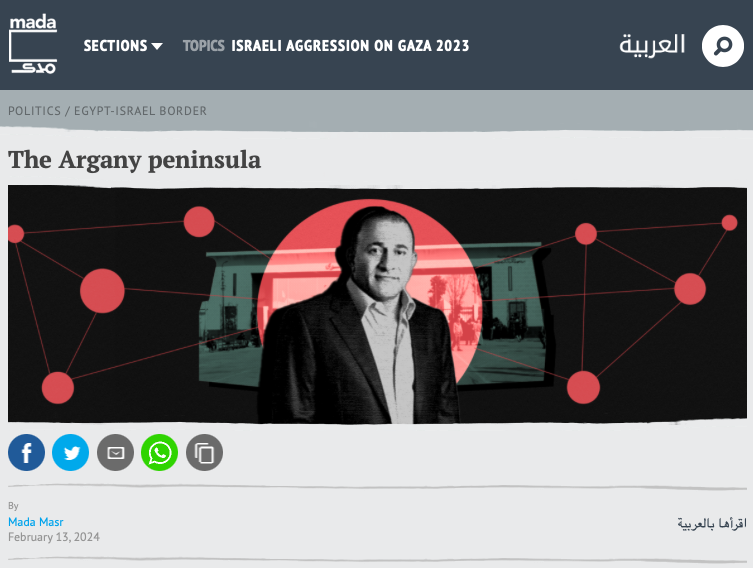
The Mada Masr investigation: The Argany peninsula. Image: Screenshot, Mada Masr
In-Class Discussion
Trainees already read this story as required reading in Module 1. Ask the following questions to guide the discussion:
- If you were reporting this story and couldn’t request a single government document or contract, would you still be able to report it? Why or why not?
- The story quotes Palestinians who paid to cross, coordinators, drivers, aid workers, and tribal contacts. Why do you think the reporter needed sources from several different roles, rather than just interviewing more people who’d paid to cross?
- If two of those sources told a different version of the same event, how would you handle that as a reporter? Would it kill the story? This question opens space to discuss discrepancy as normal and testable, not disqualifying.
- Which parts of this story rely on testimony alone, and which parts have a document behind them?
Homework
Ask trainees to draft an actual Freedom of Information request for their own story idea from Module 1, naming the specific agency, the specific record they are requesting, and the date range it covers.
Module 5: Using Data, and Data-Driven Investigations
Suggested time: 25-30 minutes
Overview
Data-driven investigations are no longer a specialty on the side. A structured dataset is itself a kind of document, and increasingly one of the most important kinds, since it can reveal a pattern across thousands of records that no number of individual interviews would surface on their own. This module gives trainees a basic discipline for working with data, and shows two examples of what that discipline can uncover.
Data as Another Kind of Evidence
Working with data follows the same underlying logic as working with any other document, the criteria from Module 4 still apply. But data comes with its own particular risks, since a dataset can look authoritative while hiding serious problems in how it was collected, coded, or maintained. Before drawing any conclusion from data, a reporter needs to work through a short discipline:
- Know the source. Where did this data come from, and does the source have a reason to make it look better or worse than it is?
- Know whether you have the full dataset or only a portion of it. A partial dataset can produce a pattern that looks real but is really just an artifact of what’s missing.
- Understand the data’s structure and codes. Column headings, abbreviations, and category codes are not always self-explanatory, and misreading them produces confident but wrong conclusions.
- Assess accuracy by actively looking for errors, rather than assuming a dataset is clean because it looks organized. Duplicate entries, inconsistent formatting, and obvious data-entry mistakes are common even in official datasets.
- Allocate time to analysis, and test whatever the data seems to show against interviews and field observation. A number on its own is not a story. It becomes one once it’s put in context and confirmed against what is actually happening on the ground.
Where Do You Find Data?
If you have more time, start by asking students/trainees where they might find data related to a specific investigative question (which can also be the case study for this module). For example: a reporter wants to investigate pharmaceutical industry practices that keep certain lifesaving drugs prohibitively expensive for patients around the world, and is told one tactic that companies use is filing new, narrower patents on an old drug just to keep extending their exclusive control over it well past when the original patent should expire. To test this hypothesis, the reporter needs to map every patent protecting one specific drug worldwide. Ask the group: Where would you start looking?
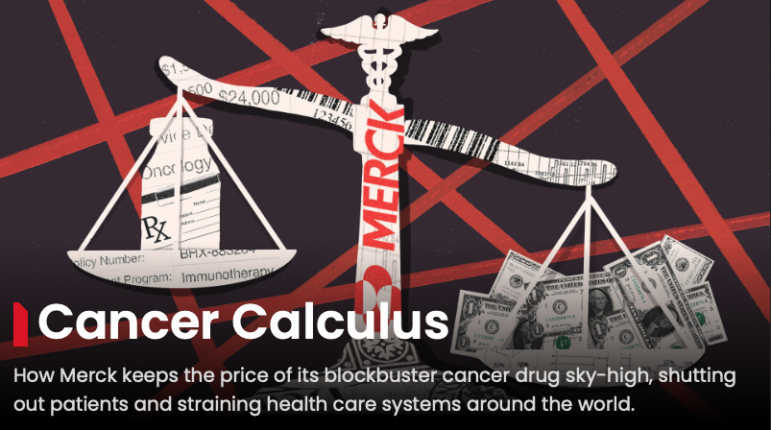
The Cancer Calculus investigation. Image: Screenshot, ICIJ
Some of the points and comments that can be shared with students about ICIJ’s Cancer Calculus investigation about this very question, after they present their answers:
- The ICIJ team that worked on the story began with a baseline list from I-MAK, a nonprofit that tracks patent-system inequities, which had already identified 184 US patent applications tied to the drug.
- That starting list still had to be manually verified, one application at a time, using Google Patents, a free public search tool. This dropped the count to 180 confirmed applications and surfaced who actually held each one.
- A single country’s patents weren’t enough, since the same protection gets filed as a “patent family” across many countries. To map that, the team turned to Espacenet, a database run by the European Patent Office, but Espacenet actively blocks automated scraping, so they couldn’t just pull the data out directly.
- Google Patents allowed automated extraction instead, through a tool called Google BigQuery, but doing this at scale started getting expensive.
- Even once extracted, the data came out as messy, hard-to-read webpage content rather than a clean spreadsheet. The team used AI tools to help write the code needed to turn that mess into something they could actually analyze.
- The final dataset ended up much bigger than the starting point: 1,212 patent applications worldwide, after excluding filings that were duplicates or never resulted in an actual granted patent.
Sources of Data
- Leaks: A source hands over a dataset directly, often the highest-profile way data journalism starts, but far from the most common in day-to-day reporting.
- Freedom of Information requests: Covered in Module 4. Filing a request that names a specific dataset increases the chances of returning a structured dataset rather than a stack of documents.
- Human sources: Covered in Module 3. A source may be able to give you an internal spreadsheet or an export from a system they use at work, so it’s worth directly asking sources directly whether such records exist.
- Existing public datasets: Government open-data portals, corporate and property registries, court records systems, and international databases (from bodies like the World Bank or the WHO) often already contain the data that a story needs.
- Web scraping: Writing a script to systematically pull data from a website, useful when the same kind of information is published repeatedly across many pages, such as individual case listings on a court’s website, but never collected anywhere as a single downloadable file.
- Extracting data from PDFs: Governments and companies often publish what is functionally a dataset, a table of figures, or a list of contracts as a PDF rather than a spreadsheet, sometimes deliberately, since it’s harder to search and analyze that way. Tools like Tabula exist specifically to pull tables back out of PDFs into a usable, structured format.
- Building the data yourself: Sometimes the data a story needs doesn’t exist yet, and the reporting has to generate it. The Poisonous Lead Trade example from Module 4 is a good example: the team commissioned blood tests and soil samples through a nonprofit and a university because no one had ever measured that before.
Basic Toolbox
Trainees do not need to become programmers to start working with data. Introduce the following tools without going into details of how they work (expand in a longer course):
- Spreadsheets (Excel, Google Sheets) remain the starting point for most data journalism, and are often all a story actually needs.
- Open Refine helps clean messy data, such as inconsistent spellings of the same name or place.
- Tabula, mentioned above, pulls tables out of PDFs and into a structured, usable format.
- Python, R, and SQL are the most common programming languages used for larger or more complex datasets, worth naming for trainees who want to go further, without expecting the room to already know them.
- Aleph Pro (built by OCCRP) and Datashare (built by ICIJ) are tools built specifically for cross-referencing large sets of leaked or public documents, used in major collaborative investigations.
Case Study: Data Collaboration
ICIJ and 47 media partners across 37 countries, Cancer Calculus (2025): a year-long investigation into how a US pharmaceutical company, Merck, used the patent system to keep its cancer drug Keytruda extremely profitable and effectively block competition, long after the drug’s original patent protection was due to expire.
The data at the center of this investigation was a purpose-built dataset of patent filings. Working with patent databases and data shared by I-MAK, a nonprofit that studies inequities in the patent system, ICIJ identified 1,212 patent applications tied to Keytruda across 53 countries, regions, and territories. Analyzing these filings chronologically, the team found that 84 percent of all Keytruda-related patent applications were filed after the drug’s original 2014 approval, a pattern known as “evergreening,” where a company keeps filing new, narrower patents, for a different dose, a new combination with another drug, a new formulation, specifically to keep extending its exclusive control well past when the original patent would have expired. The analysis found 211 granted patents extending protection through at least 2042, 14 years beyond the original 2028 expiration date, with 337 more patents still pending.
Patent data alone couldn’t tell the full story, so the team combined it with over 1,000 public records requests filed in 27 countries, which surfaced pricing data, reimbursement decisions, and regulatory records, and with pricing datasets obtained from outside sources, including IQVIA and the Health Care Cost Institute, to compare what the drug actually cost patients and health systems in different countries. That combination is what allowed the team to connect an abstract pattern in patent filings to a concrete, reportable outcome: cumulative Keytruda sales of around US$163 billion since 2014, and list prices for the same drug ranging from roughly US$850 per vial in Indonesia to just over $6,000 in the United States.
This is a strong example of a purely document-and-data-driven investigation, one where the reporting had to construct its own dataset from scratch, since no single existing database tracked “which patents protect this one drug and why they were filed when they were.” It’s also a good illustration of the discipline covered earlier in this module: the patent count alone means little without understanding the structure of a patent family, checking it against the drug’s actual regulatory and sales history, and cross-referencing it with an entirely different kind of data, pricing, to show the real-world effect.
In response to the collaboration’s reporting, Merck defended Keytruda pricing in a letter to ICIJ citing that the company spends billions on research and their pricing is responsible.
In-Class Exercise
- An investigation is only a journalistic story that exposes corruption (true/false)?
- List three different types of documents that might be used in an investigation.
- List three examples of open data sources.
- What’s the first question you need to ask about a dataset or document to determine if you can use it?
- You need to verify a claim central to your investigation. You found a source, a current employee at the company you’re investigating, willing to confirm it but without providing documentation and on condition of anonymity. Can you use him?
Answers
- False (not necessarily)
- Public records (court records, company filings, etc), digital records (emails, datasets, etc), recordings (audio, video, satellite images), product labels, statements
- Company registrars, property registries, departments of statistics, international bodies (WHO, FAO, etc)
- Where did it come from? And can I verify its authenticity?
- No, unless I can corroborate what he’s saying from another source.
Reading
- Cancer Calculus, How Merck turned its wonder drug into a blockbuster – and priced out cancer patients worldwide, ICIJ, 2025
- About the Cancer Calculus Investigation, 2025
- Patents, prices, and court files – How ICIJ used data to investigate an industry that thrives on secrecy, 2025\
Module 6: Open Source Research (OSINT)
Suggested time: 15 minutes
Overview
Open source research draws on satellite imagery, geolocation, and material already circulating publicly, on social media, in commercial imagery, in video, to establish facts a reporter could not otherwise access directly. The skill set it requires is distinct from interviewing or filing a records request.
What Counts as OSINT
OSINT is an acronym that stands for open source intelligence. It means collecting, analyzing, and using data from publicly available sources to answer a specific question or verify a claim. OSINT uses advanced search techniques and resources, but most importantly, it begins with a mindset: what’s an open source where I am likely to find this information?
Remind trainees that search engines only cover a fraction of internet content, pages that have a unique URL and can be crawled and indexed. The vast majority of content sits in the “deep web”; behind a login, a paywall, or a search form, in databases that only return results when you query them directly: court record systems, corporate and property registries, academic journal databases, government portals, or subscription services. A deep research method requires going to these databases directly and knowing how to query them.
In-Class Exercise
Ask trainees to look for a list of companies that a specific person or entity owns (for example, depending on the country you’re in, you could ask them to find a list of companies that the military is a partner in). A general search will yield limited, second-hand results, if any. Let them go into the official company registrar website and search by “shareholder name.” (Note for trainers: test your country’s registrar website to see what parameters it lets you search before giving it to students. If it’s limited, you can always use a global example, like the UK’s Companies House, which is free and lets you search directly by officer or shareholder name, or OpenCorporates, which aggregates registry data from well over 100 countries and often allows a name search even where a country’s own registrar doesn’t. Avoid using a well-known tax haven, such as the British Virgin Islands or the Cayman Islands, as your fallback example: those jurisdictions are attractive for hiding ownership because their registries are not publicly searchable by name, which is why investigations like the Panama Papers had to rely on a leak rather than a registry search.
Further OSINT Resources
- Satellite imagery: Google Earth (free) and Sentinel Hub’s Copernicus browser (free, EU-run, good resolution for tracking change over time, deforestation, construction, damage after a disaster).
- Ship tracking: MarineTraffic or VesselFinder, both track vessel locations via AIS signals, useful for sanctions evasion, illegal fishing, or tracking a specific ship’s movements.
- Flight tracking: Flightradar24 or ADS-B Exchange for flights that try to hide from standard trackers, useful for tracking private jets or unusual flight patterns.
- Reverse image search: Google Images and Yandex, The latter is often better at facial recognition and location matches, especially outside North America and Europe.
- A single index of everything else: OSINT Framework, a categorized directory linking out to hundreds of specialized tools. Worth mentioning to trainees as a place to explore on their own rather than something to demo live.
A few organizations are well known for using this method:
- Bellingcat, an open source, geolocation-driven collective, probably the best-known name in the field.
- Forensic Architecture, which builds spatial and architectural reconstructions, often for legal or tribunal accountability processes rather than publication alone.
- NYT Visual Investigations, an in-house newsroom open source reporting unit, showing that this method has become standard practice at major outlets, not just specialist collectives.
Recommended Reading
- Forensic Architecture, Investigating Israeli Disinformation: The Al-Ahli Arab Hospital Explosion.
- Financial Times, How China is Tearing Down Islam.
Module 7: From Raw Material to Publication
Suggested time: 20-25 minutes
Overview
This module covers the closing stretch of an investigation: organizing what you’ve gathered, editing the draft, verifying it independently, and getting it legally ready to publish. These can be expanded into separate modules if you are teaching this as a semester-long course instead of a single workshop.
Staying Organized
As reporting develops, information needs active tracking through spreadsheets, timelines, and notes on documents. This helps determine when it’s time to stop reporting and start writing or recording, helps identify which sources or pieces of information are still missing, and makes fact-checking the final story draft much faster. A simple tracking sheet, with columns for the lead, the finding, the source, a link to that source, the date, next steps, and notes, is often all this requires.
Here’s a simple tracking-sheet template that trainees can adapt:
Lead | Finding | Source | Link to Source | Reference Date | Next Steps | Notes |
|---|---|---|---|---|---|---|
(example row) |
A tool worth introducing here is Gemini Notebook (formerly known as NotebookLM), a free Google AI tool designed to work from a set of documents you upload; PDFs, transcripts, web pages, spreadsheets, audio or video files, rather than pulling from the open internet. Because it’s restricted to your own uploaded material, it’s less prone to inventing information than a general AI chatbot, citing which of your source documents an answer came from. For an investigation with a large or growing pile of material, it can auto-group and label related documents once you’ve uploaded a handful of them, help you compare how a claim is worded across several documents, and generate quick summaries of long files. It’s a highly effective time-saving method for staying organized, but it doesn’t replace verification. Trainees should be taught not to cite its output directly but to treat it as a lead to check against the original document.
In-Class Demonstration
If time allows, demonstrate to the trainees how to use Gemini Notebook by uploading material related to one story, for example, an audio recording of an interview, a pdf file of a study related to the investigation subject, a dataset, a link to a YouTube video interview, etc. Demonstrate how you would search for specific information in the material. Show them how to use the mindmap function to organize the material and connections between different key points and ideas.
Editing the Investigative Story
As Wahyu Dhyatmika, who led Panama Papers reporting in Indonesia, has wisely put it, the editor’s task is to elevate the story without sacrificing accuracy or crossing legal and ethical lines, and that job starts at the pitch stage covered back in Module 2, not after a draft arrives. By the time a draft exists, the core editorial task is making sure every assertion in it is linked to a piece of supporting evidence, and that the story remains balanced even when the reporter has become personally convinced of a conclusion.
Fact-Checking
Three questions, developed at The Intercept’s fact-checking desk, offer trainees a checklist for any claim in their story:
- Can we say with confidence that this statement is true?
- Can we present evidence that would compel a skeptic to share that confidence?
- Can we conceive of a realistic scenario in which someone presents us with counter-evidence that would force a correction?
If the answer to any of these is uncertain, the claim needs more reporting before it goes into the story.
A warning about AI tools here. In 2023, an attorney representing the plaintiff in Mata v. Avianca, a personal injury suit in a New York federal court, used ChatGPT to help research and draft a legal brief. The tool fabricated multiple case citations, complete with quotations and summaries of court decisions that did not exist. Neither opposing counsel nor the judge could locate any of them, because none of it was real, and the presiding judge sanctioned the lawyers involved. The same risk applies directly to journalism: an AI tool can produce a confident, plausible-sounding citation or quote that is entirely invented. Nothing generated by an AI tool should ever be treated as a source in itself; it always needs to be checked against the original document or record.
Legal Review and Right of Reply
Before publication, the subject of any serious allegation should be given a genuine chance to respond, not as a formality, but as a real opportunity to address the specific claims being made. Where it’s affordable, a legal review of the piece is worth the time, especially given how much legal risk varies by country.
Knowing When to Stop
Know when you have enough to publish. Open-ended investigations can run indefinitely without this discipline, and at some point the story that’s ready to publish is better than the slightly more complete story that never gets finished. It’s good to remind trainees here of the idea we introduced in Module 2: there’s the minimum story, the maximum story, and a range in between.
Organizations Doing Global and Cross-Border Investigative Work
Transnational Groups
- ICIJ (International Consortium of Investigative Journalists): the organization behind the Panama Papers, Pandora Papers, and Cancer Calculus, all referenced earlier in this guide. Trainers and trainees are encouraged to browse its full archive of collaborative investigations.
- OCCRP (Organized Crime and Corruption Reporting Project): heavily focused on Eastern Europe, the Balkans, and Central Asia, and the organization behind the Aleph Pro tool mentioned in Module 5.
- Bellingcat: an open source, geolocation-driven collective, referenced in Module 6.
- Forensic Architecture: spatial and architectural reconstruction for legal and accountability processes, referenced in Module 6.
- The Examination: global health-focused investigative outlet, behind the Poisonous Lead Trade series referenced in Modules 1, 4, and 5.
- Lighthouse Reports: a nonprofit newsroom that builds cross-border investigations, often around algorithmic and data-driven accountability.
- Forbidden Stories: continues the unfinished investigations of journalists who have been killed, imprisoned, or threatened into silence, coordinating international teams to finish their work.
Middle East and North Africa
- ARIJ (Arab Reporters for Investigative Journalism): a regional network training and supporting investigative reporters across the Arab world, and a major source of Arabic-language investigative case studies.
- Siraj: investigative journalism from Syria
- Nairij: Network of Iraqi Investigative Journalists
- Mada Masr (Egypt): independent Arabic and English-language outlet, source of the Argany Peninsula investigation used throughout this guide.
- Inkyfada (Tunisia): known for pairing investigative reporting with strong data visualization and accessible, multimedia presentation of complex political stories.
- Daraj Media (Lebanon): Beirut-based, pan-Arab outlet known for investigative reporting on corruption and women’s rights.
Latin America
- EL CLIP (Latin American Center for Investigative Journalism): a regional consortium coordinating cross-border investigations across Latin America, in the same collaborative model as ICIJ and OCCRP.
- Salud Con Lupa: a health-focused investigative platform covering Latin America, notable for raising the standard of health reporting across the region.
- Ojo Público (Peru): known for its investigative reporting on corruption and human trafficking, and for experimenting with digital storytelling formats.
- Agência Pública (Brazil): a nonprofit newsroom known for its innovative financing and international distribution of its investigative work.
- El Ruido (Argentina, regional): a network of investigative journalists, open-data experts, and civil society organizations working on corruption, transparency, and data-driven investigations across Argentina, Mexico, Ecuador, Guatemala, Brazil, and Colombia.
Europe
- Correctiv (Germany): one of Europe’s best-known nonprofit investigative newsrooms.
- Disclose (France): a nonprofit investigative outlet focused on public-interest and accountability reporting.
- Investigate Europe: a cross-border collective of reporters from multiple European countries working on shared investigations.
- The Black Sea (Romania): a regional investigative outlet covering Romania and the wider Black Sea region.
Africa
- amaBhungane (South Africa): one of the continent’s most established investigative newsrooms, known for exposing political corruption in South Africa and the wider region.
- Oxpeckers (pan-African): Africa’s first investigative unit focused specifically on environmental journalism.
- Africa Uncensored (Kenya): source of the Captured series on public procurement corruption discussed as an alternative case study for Module 5.
- ICIR (International Centre for Investigative Reporting, Nigeria): focused on transparency and accountability reporting in Nigeria.
- CENOZO: a regional network providing training and support for investigative journalism across West Africa.
Asia
- Tempo (Indonesia): banned by the Suharto regime in 1994 for its corruption reporting, and the only Indonesian outlet to have taken part in both the Panama Papers and Paradise Papers. Editor-in-chief Wahyu Dhyatmika’s editing process is referenced in Module 7.
- Rappler (Philippines): known for its investigative and data journalism, and for its reporting on disinformation and platform accountability.
- Newstapa (South Korea): an independent investigative newsroom known for its documentary-style investigations into political corruption and its early Korean-language reporting on the Panama Papers and Paradise Papers leaks.
For more investigative groups, check GIJN’s members.
Overall Recommended Readings and Resources
- GIJN’s Introduction to Investigative Journalism Guide, which includes nine chapters in addition to the introduction.
- GIJN’s Resource Center and Stories have very helpful material, especially useful is the How they did it? series, which goes behind the scenes on some prominent investigations and offers journalists deeper insights into the reporting process.
- GIJN’s Global Shining Light Awards for large media outlets and small and medium media outlets are a great repository of examples of top-notch investigative journalism projects.
 Lina Ejeilat is the co-founder and executive editor of 7iber, a leading independent online magazine that produces in-depth multimedia journalism and critical analysis on Jordan and the Arab region. She also teaches in the MA program at the Jordan Media Institute. Her courses cover audio-visual storytelling, data journalism, and in-depth reporting. Ejeilat also leads training workshops in Jordan and the region on writing and reporting, visual storytelling, data journalism, and media management.

This work is licensed under a Creative Commons Attribution-NoDerivatives 4.0 International License
Republish our articles for free, online or in print, under a Creative Commons license.
Republish this article
This work is licensed under a Creative Commons Attribution-NoDerivatives 4.0 International License
Read Next

Resource
What Is Investigative Journalism?
For a look at current trends, see also The Future of Investigative Journalism. While definitions of investigative reporting vary, among professional journalism groups there is broad agreement of its major components: systematic, in-depth, and original research and reporting, often involving the unearthing of secrets. Others note that its practice often involves heavy use of public […]

Data Journalism Teaching & Training
Test Your Data Visualization Skills With GIJN’s Latest Quiz
GIJN Turkish Editor and data journalism instructor Pinar Dag is back with another quiz to test your knowledge of data visualization.

News & Analysis Teaching & Training
How to Maintain Mental Hygiene as an Open Source Investigator
Practicing good mental hygiene is a continuous process for investigators that requires active input at all times. Bellingcat offers these small steps to minimize and mitigate your exposure to distressing content, to possibly save you from burnout or worse.

Data Journalism Reporting Tools & Tips Teaching & Training
What Data Journalists Need to Know About Application Programming Interfaces (APIs)
What is an application programming interface (API) and how can it help reporters gather information online? Data journalist Paul Bradshaw explains how to use this tool in your next investigation.