
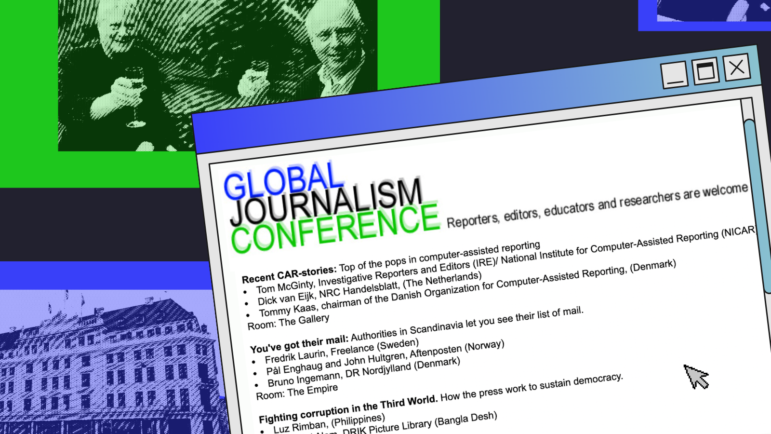
‘Everyone Who Became Leaders of the Global Investigative Journalism Movement was in Copenhagen’: An Oral History Of The First GIJC
On April 26, 2001, investigative journalists from around the world gathered to share their knowledge for the very first time: 300 reporters, editors, and educators from 44 countries.
Held over four days at the Hotel D’Angleterre in Copenhagen, Denmark, the first Global Investigative Journalism Conference (GIJC01) emerged from a shared vision of its co-founders, Nils Mulvad and Brant Houston: “Imagine if we could share skills so that there would be at least a group of capable, connected investigative journalists in every country of the world?”
At the time, Mulvad was a founder of the new Danish Institute for Computer-Assisted Reporting (DICAR), while Houston was executive director of the US-based Investigative Reporters and Editors (IRE)
The timing, in 2001, seemed right, they say, for several reasons: the newly-formed International Consortium of Investigative Journalists (ICIJ) was already proving that collaborative, cross-border projects worked; a critical and investigative press was growing in the Global South; a newly globalized world — as well as its population of bad actors and organized crime groups — was becoming connected by the internet; and the value of data journalism techniques for investigations was finally being recognized at numerous regional conferences.
“The thing I really remember was the astonishment from attendees that journalists would actually share their techniques and some of their sources with other journalists,” Houston recalls thinking on the first morning of the conference. “By the afternoon, I could see people talking in the hallways, getting excited, sharing stuff.”
As pioneering Filipino investigative journalist Sheila Coronel would note later: the age of the lone-wolf investigative journalist was over.
Now, 25 years later — as GIJN begins preparations for GIJC27, its 15th Global Investigative Journalism Conference — the legacy of that first gathering and the 13 others since is evident in accountability projects, new regional journalism associations, innovative newsroom approaches, and collaborative strategies around the globe. The Global Investigative Journalism Network (GIJN) — which now has 266 member organizations in 95 countries — was born at the second event, which was also held at the Hotel D’Angleterre in 2003.
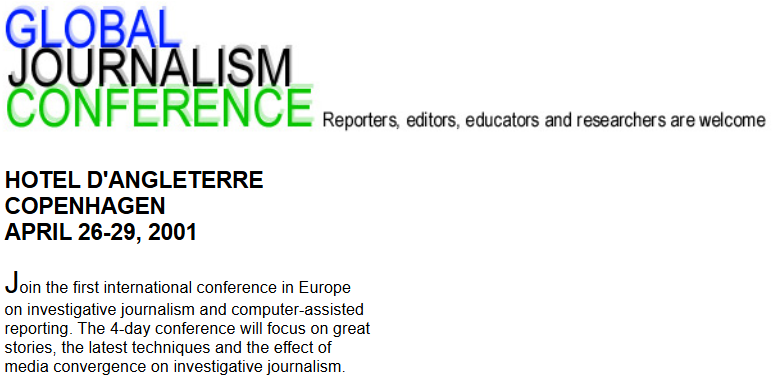
GIJC01 logo. Image: Screenshot
The parallel growth in the global community was well illustrated by the seven-fold growth in conference attendance since 2001 — with more than 2,100 investigative journalists at GIJC23 in Gothenburg, from 130 countries; likely the largest gathering of journalists in history.
While the first event did draw speakers from places such as Nigeria, Bangladesh, Palestine, Botswana, Nicaragua, and the Philippines, attendance from the Global South was still quite modest — but there was also a declared mission to become truly global. That goal has been increasingly realized at subsequent global conferences. And at the most recent GIJC, in Kuala Lumpur in 2025, nearly 100 countries were represented on panels, and 95 of the almost 400 expert speakers were from Asia alone. In addition, a large cohort of Global South attendees included 130 fellows from 80 countries, whose participation was fully sponsored.
To mark the 25th anniversary of the first Global Investigative Journalism Conference, we reached out to a range of speakers and attendees to ask their reflections on the historic event, and on how it affected their careers, and their craft.
Table of Contents
- Why was the timing right for a global conference in 2001?
- How did that first conference come together?
- What were your first impressions of this new conference in 2001?
- What innovations at the conference were notable for you?
- What session from GIJC01 stands out in your memory?
- How did that first conference — directly or indirectly — affect or change your career, or that of the craft in your region?
- What memorable scenes from Copenhagen GIJC01 stick with you?
Why was the timing right for a global conference in 2001?
David Kaplan (In 2001, an investigative reporter at US News and World Report; and later the founding executive director of the Global Investigative Journalism Network): By 2001, mobile phones and the internet had become ubiquitous, the world had globalized, and so many of our stories led overseas. And here we suddenly had colleagues from across the world eager to collaborate. It was mind blowing, and we knew we were on to something big. One of the striking facets of IRE conferences to foreign journalists was the spirit of cooperation — that normally competitive reporters sat together sharing trade secrets, methods, and sources was striking to them. We brought that spirit to Copenhagen, and the results were extraordinary. To have journalists from 40-plus countries sharing their success, scoops, frustrations, and threats was nothing short of extraordinary.
Brant Houston: (In 2001, executive director of Investigative Reporters and Editors; now, the Knight Chair in Investigative and Enterprise Reporting at the University of Illinois, and Chair of the Board of Directors at GIJN). “It turned out that it was the right idea at the right time. I think both Nils [Mulvad] and I had some trepidation, but we believed in it because we had seen some initial conferences and seen the enthusiasm people had when people from different countries got together. We had seen what ICIJ could produce. But who is going to show up? Who knows?
Especially in Europe and with what Chuck Lewis was doing, cross-border things were already going on; it was natural (Lewis founded the Center for Public Integrity (CPI), and also led the creation of the International Consortium of Investigative Journalists in 1997). I remember Marina Walker Guevara doing a thing on lead poisoning — a St. Louis [US] firm, and connecting it back to South America. I’m living in the Midwest, and it’s like the big ag corporations polluting countries and causing suicides in India, or we’re counting on fertilizer from Ukraine. Chuck Lewis was showing that these cross-border stories were possible.
There was a whole part of journalism truly embracing digital technology. (View an Internet Archive version of the GIJC01 conference website.) So in organizing this, you had the people moving forward with innovation and technology, and that meant we were able to do better on the global stage than the aging journalist who would say: ‘I made my career doing things the traditional ways, and the old ways are the best ways,’ and you had lots of people couldn’t wait to figure out how use technology to get across borders; to communicate. That gave us a good start too.
In a prescient speech, Lewis also addressed GIJC01 about the threats and challenges to the profession, which have only grown more critical 25 years later: “We are living in the New Gilded Age. Or put differently, in the complicated, occasionally corrupt coexistence between democracy and capitalism, lately capitalism has been winning, big time. And too often, instead of afflicting the comfortable and comforting the afflicted, media corporations and their journalists have been comforting the comfortable…
“This gathering of hearty souls here in Copenhagen is so important because — whether in our actual work, or in defiant spirit and aspirations — we are the exception to these patterns. It is we who stand at the barricades, along with hundreds of our friends and colleagues around the world deeply worried about the profession of journalism today. This conference — and others like it — acknowledges the significant challenges that globalization presents today to investigative journalism.”
How did that first conference come together?

Brant Houston and Nils Mulvad re-enact their original, 2000 GIJC brainstorming session in the same back yard in Risskov, Aarhus, Denmark. Image: Lone Hougaard, courtesy of Nils Mulvad
Brant Houston and Nils Mulvad re-enact their original, 2000 GIJC brainstorm in the same back yard in Risskov, Aarhus, Denmark. Image: Courtesy Nils Mulvad. Photo: Lone Hougaard
Brant Houston: “Nils had just organized a really good conference with European folks, which I recall was more investigative, but there were a whole number of countries represented. We went back to Nils’ place, we were having celebratory wine, because it had come off well, and we’d developed a really good friendship, and it’s my memory that I said: “Why don’t we invite the world next time?” The spirit of it was: Wouldn’t it be amazing to have journalists from every country in the world? And the vision was: Imagine if we had a group of journalists in every country in the world who could perform some kind of watchdog investigations, whether within their countries or in exile. The idea was there could be scrutiny of a productive kind of governments and businesses in every country.
It was modeled to a great degree on IRE conferences [in the US]. What made it different was that there had to be a global angle; it could not be US-centric. Sessions on “Covering City Hall,” was not going to mean a whole lot. But “Watchdogging municipal governance” and all the common principles — that would work. Interviewing techniques would work: there was a recognition everywhere for the importance of an expanding awareness of different cultures; how to talk to people from different cultures.
The thing with the first one was we didn’t know who was going to show up! I knew I’d feel good about Europe’s response, but could we get people from Africa, from the other continents? That was my biggest concern. I was pretty sure we’d get a good core of people, what was important was that we had people from as many countries as possible. I didn’t feel like we had time to worry, because we were constantly in touch with people, and making all these arrangements. In the end, [getting attendees from] 44 countries was an incredible start.
We had all kinds of contacts. We had connections. For instance, Noemí Ramírez — who went on to be a top level executive in Spain — was a graduate student from Spain who worked in the resource center at IRE, was a speaker. Nils had extensive links throughout Europe. Drew Sullivan – one of my first grad assistants — went on to create OCCRP.
We were aided to a great degree by Chuck Lewis. He had really opened up the idea of peer-to-peer collaborations. He had to do it in a narrow way, that some thought was elitist, but it wasn’t. It was: “We’re going to do sensitive stories, and we have to vet the people we’re going to work with, both in the US and around the world.” So ICIJ established a lot of the principles of collaboration and trust, and it had already shown the power of cross-border global work.
Nils Mulvad (In 2001, the executive director of the Danish International Center for Analytical Reporting (Dicar); now, partner and CEO at KM24): “After a (regional) conference, you’re pretty tired, and we were just sitting and chatting about what we’d do next time, and Brant comes up with the idea for a global gathering.
He needed it to be connected with some other organizations — not only IRE — to make it international. One funny thing — we both noticed that most boards create all these plans and board meetings have discussions but have no consequences; nothing happens. Brant and I were working well together, and we were doers, and he convinced me we could make an international conference.
Already after the first day, I realized that this is going to continue. But it was actually me who set the interval of two years for the global conference going forward, because at the closing session, from the stage, I said: “OK I’ll organize the next conference also, but I can’t do it in a year from now; I need two years.” No one else had volunteered to do it, yet there was this huge interest in further conferences, so I thought we need some message to send out that this will repeat.”
We ended up with a surplus, despite this expensive hotel. At the first conference, we had a revenue surplus of around 10000 krone, (about US$1500), and at the second conference we had a deficit of around 150000 krone (about US$25,000). There were doubts about international travel to the second conference, and speakers who couldn’t come because of that Iraq War.
[See Mulvad’s detailed account on the events in Denmark in the 1990s that led to the launch of that country’s first data journalism institute, and ultimately how Copenhagen came to hold the first global conference.]
What were your first impressions of this new conference in 2001?
Maud Beelman (In 2001, the founding director of ICIJ; now, collaborations editor at the Howard Center for Investigative Journalism): “Twenty-five years is a long time to retain exact details, but when I think of the first Global Investigative Journalism Conference in Denmark, I am bathed in warmth and joy and a sense of camaraderie.
I traveled to Copenhagen to represent the ICIJ, then part of the Center for Public Integrity. I had been hired in 1997 as the consortium’s first executive director and had been building the reporting and membership structure that would become the hallmarks of ICIJ.
Everyone who became leaders of the global investigative journalism movement was in Copenhagen for the conference. It was a heady group of talent and experience and, institutionally, ICIJ was sort of the new kid on the block.
But by 2001, ICIJ had published a few investigations, including one on the murky world of international tobacco smuggling by the globe’s leading tobacco companies. The Guardian gave much of its front page and several inside pages to the investigation, as well as a prominent story in the features section on how ICIJ was addressing the investigative needs of the new century. Impact included a British investigation of its main tobacco multinational and parliamentary hearings. This was ICIJ’s first big global success.
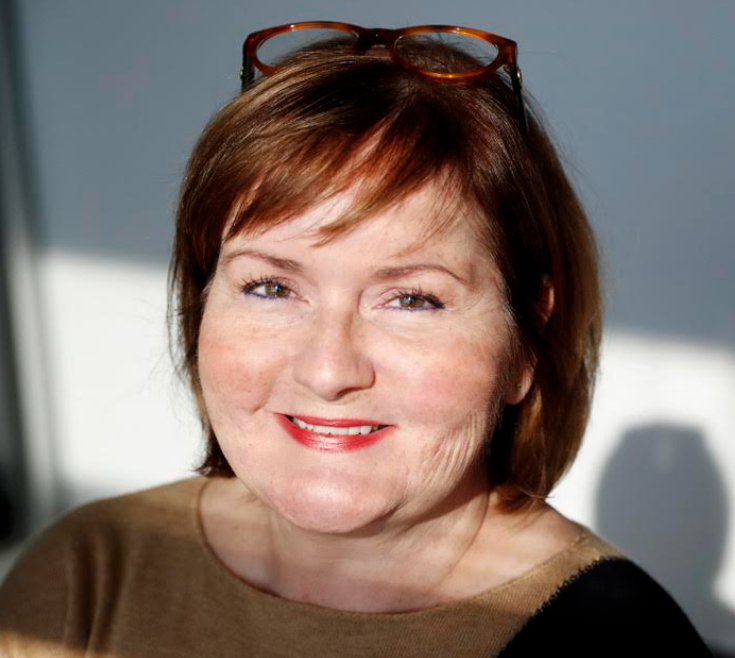
Maud Beelman, ICIJ founding director and GIJC01 presenter. Image: courtesy of Beelman
As a result, rather than being viewed as a new startup, ICIJ was something of the “belle of the ball” in Copenhagen. Or maybe that’s just how my global investigative colleagues made me feel.
We spoke on several conference panels and, in the after-hours discussions, I was approached by dozens of attendees, wanting to know how the consortium had come about, how it was organized and managed, and how it handled the various cross-border details of investigative journalism, such as editing protocols, professional credits, project timelines and legal issues.
To this day, I think of the first Copenhagen [GIJC] as ICIJ’s global coming-out party. It’s where we established important global investigative contacts and learned from the experiences of others in attendance.”
Brant Houston: On the first afternoon, I told someone: ‘This is just like IRE, except everyone smokes.’ I was coming out of a US environment where they’d stopped smoking in newsrooms. And I was like, wow, I’d forgotten what it was to see everything drenched in cigarette smoke. It was everywhere. But the thing I really remember was the astonishment from attendees that journalists would actually share their techniques and some of their sources with other journalists. Which was one of the mantras of IRE. There was some disbelief in the sessions on the first morning, and then, by the afternoon, I could see people talking in the hallways; getting excited; sharing stuff.
I was getting second-hand from my staff that people were saying, in their own language: “Are you kidding me? We compete!” But we led by example. Someone like Andrew Jennings was an open book, and looking for collaborators, and he was working across borders, and there were other people like that. (Andrew Jennings was a legendary British investigative journalist best known for his exposés of corruption in global sports bodies.)
Earlier, at a conference in, I think, Malmö (Sweden), we had people from several Scandinavian countries sitting around a table, and I said: “Well let’s all share our emails.’ And they were, like, ‘I don’t think so.’” So I wrote down my email and gave it to someone, and then we ended up going around the table and getting contacts.”
Carlos Fernando Chamorro (Now, the founder and director of the Nicaraguan outlet Confidencial, who has been working in exile for the past five years): The first Global Investigative Journalism Conference opened the door for me to a new world of international investigative journalism. For instance, I became familiar with the work of the renowned Scottish journalist Duncan Campbell regarding mass espionage, state surveillance, and organized crime.
However, the impression I took away from the conference was that the majority of participants came from European or North American countries, working in contexts vastly different from those in Latin America regarding access to public information, legal protections, and technology.
The exception for me was learning firsthand about the investigations conducted by media outlets and journalists from developing nations — such as the Philippines — into issues of corruption, organized crime, and state violence.
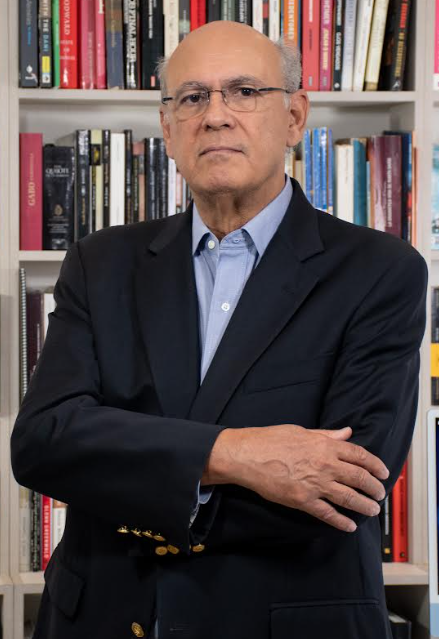
Carlos Fernando Chamorro, founder of Confidencial and GIJC01 presenter. Image: Courtesy of Chamorro
I recall presenting an investigative report on government corruption in Nicaragua — specifically regarding a dual payroll system for high-ranking public officials — though my findings were somewhat superficial. The work of my Filipino colleagues, by contrast, demonstrated exceptional reporting skills and investigative techniques that uncovered corruption in depth and provided irrefutable evidence. Discovering that such journalism was possible was a great source of inspiration for me.
Twelve years later, I attended the 2013 Global Investigative Journalism Conference (GIJC) in Rio de Janeiro. It coincided with several regional events — such as the Latin American Investigative Journalism Conference (COLPIN) and the Brazilian Journalists Congress (ABRAJI) — held simultaneously. The conference brought together leading figures from global and Latin American journalism, effectively addressing the lack of representation I had noted at the Copenhagen conference.
Eva Vajda (In 2001: an investigative reporter and journalism teacher based in Hungary; now: a researcher at the UK-based Media and Journalism Research Centre): I was excited and proud to go to the first investigative journalism conference and I really enjoyed being in Denmark. A bit more than 10 years after the collapse of Communism, it was still a wonderful experience that I could travel freely and I loved the city. Journalism was like a door to me to open the world.
Journalists covering election fraud face immense pressure when politicians are determined to win at any cost, often navigating severe disinformation campaigns and personal safety threats. In our session at the conference [on that topic], we discussed how reporters must look beyond partisan rhetoric by relying strictly on verified data, official tallies, and transparent, boots-on-the-ground investigation to expose corruption.
Kristian Ørnsholt (In 2001, an intern at Denmark’s DICAR; now, head of corporate governance at Denmark’s Ministry of Immigration and Integration): I was a student of political science at the time and worked as an intern at DICAR. We only slept a few hours those days, and I remember Nils always being active on his email from around 4 a.m. and sometimes even before. We had a very low budget, but ambitious goals and great interest from journalists around the world. My role was to help with a lot of the logistics, visas, communication, and coordination with attendees and speakers from all over the world. It was really hard, but exciting work. Particularly I remember a great interest from Eastern European countries — still developing a free and critical press, and not yet having joined the EU. It was an inspiring time; still recent after the fall of the Berlin wall.
Things were not that advanced yet, and I remember how I learned to clean and sort data by copy pasting data back and forth using different commands in Excel, Word, and Access.

Slide from GIJC01 listing conference partners. Image: Screenshot
Mark Lee Hunter (In 2001, a Paris-based researcher and leading author of investigative journalism books; now, co-founder of Story-Based Inquiry Associates, and author of “Story-Based Inquiry: A Manual for Investigative Journalists”): I remember looking around the room and thinking: “We’re so old.” In 2001 I was 49 (which seems less old to me lately). As luck would have it, I’m still investigating this world, but I wasn’t sure at the time that it would be the case. Most of the people around me in Copenhagen were my age, give or take a few years — the Anglo-European, post-Watergate generation of investigators. Our prospects weren’t great. The freelance market was beginning to crumble, and staffers at major news organizations were calling me up to ask how I managed to survive, because their jobs were threatened too. I thought: “If we don’t get some more young people in here, we’re walking dead.”
Bit by bit, and then at startling speed, the evolution of the movement became uninterrupted progress. The Amsterdam GIJC of 2005 consolidated the relationships — of creation, mutual respect and collaboration — that were taking shape in the core group from Copenhagen.
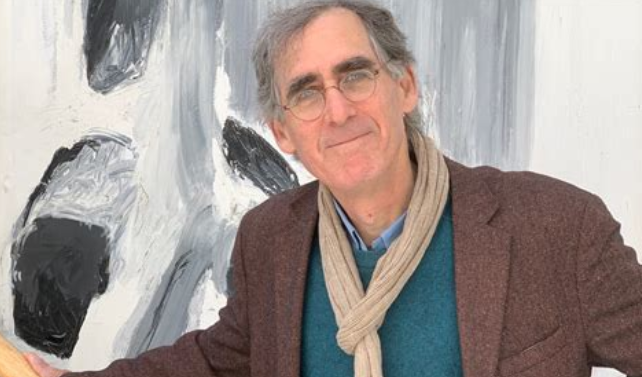
GIJC01 attendee Mark Lee Hunter. Image: Courtesy of Hunter
It also brought hundreds of students and newbies into the tent. Many of them were women, the beginning of a trend. Two decades later, women account for the majority of climate reporters, and they may well be a majority within our movement. There were always great female investigators — think of Ida Tarbell, who hammered Standard Oil, or Anne-Marie Casteret, who broke France’s contaminated blood scandal. But the feminization of investigative reporting on this scale is unprecedented. GIJN, it seems to me, opened a door for those women. Highly visible figures like Sheila Coronel, who’d brought down a president in the Philippines, sent a clear message that they were valued and welcome.”
What session from GIJC01 stands out in your memory?
Oleg Khomenok (In 2001, director of IREX’s Crimean Information and Press Center; now, GIJN board member and a chair of the board of the Regional Press Development Institute): The diversity of the speakers allowed the conference to tackle a staggering array of themes — investigating the Olympics with Andrew Jennings, uncovering the Secret Service archives with Bo G Andersson. Nicky Hager from New Zealand led sessions on investigating the PR industry’s manipulation of the media and the Echelon global surveillance system, while Maud Beelman of the International Consortium of Investigative Journalists (ICIJ) shared methods for probing the global tobacco industry. Together with general panels, the event prioritized small group discussions led by veterans like David Boardman.
Jean-Paul Marthoz (In 2001, the European press director of Human Rights Watch; now, the editorial coordinator of the Safety of Journalists Platform for the Council of Europe): The discussions in Copenhagen showed that human rights researchers and investigative reporters faced similar challenges: repressive regimes, “silent zones,” disinformation, PR, intimidation and threats, abusive lawsuits, opacity, and complexity. Human Rights Watch’s core tool was journalism, and more precisely accountability journalism as it was not only exposing abuses as told by survivors or witnesses but also investigating responsibilities, chains of command, who did what to whom, under whose orders?
And these investigations were transnational. “There is nearly always an international side to a local human rights violation,” I said in my speech. “Who, far from the killing fields, in the backrooms and boardrooms, supported the torturers and the génocidaires? Who supplied the weapons? Who managed and laundered their wealth?”
“Global” was the key word of Copenhagen, but the conference also helped define the nature and purpose of investigative journalism. And the answer was not unanimous. Some saw it as an exciting specialized beat, others as a particularly pertinent form of watchdog “fourth estate” journalism. We, at HRW, were motivated by the not purely journalistic idea that through our deep investigations — on military death squads in Honduras or paramilitaries in Colombia — we could expose dictators and their international allies, make them squirm and change the world for the better.
Nils Mulvad: We had a big session on an accident at a Danish rock concert where nine people died, and on so many errors made in the rescue work. The title itself was memorable: Dying to the sound of Pearl Jam. They gave methods on getting the soundtrack, and synchronizing events: how you can find where people were standing when they played that part of a song. They gave a very precise description on how you can align memories to fix events in time. Forensic reconstruction.
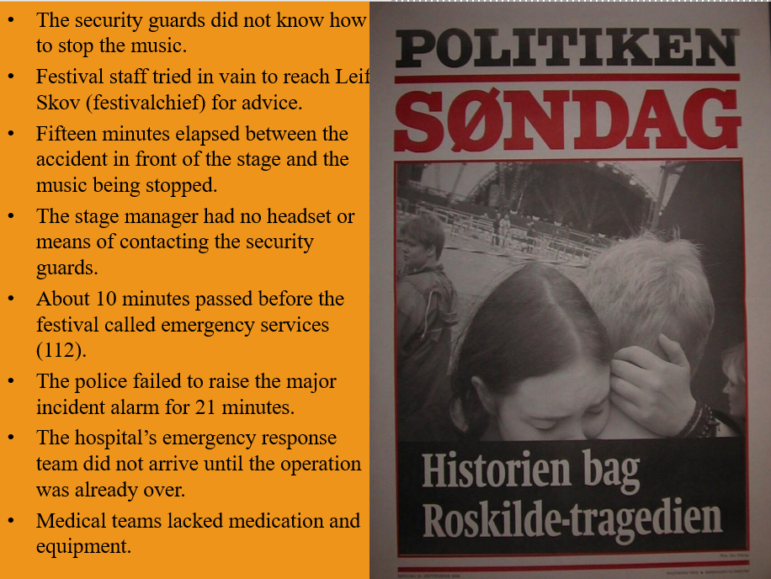
Image: One of the original slides from the hit forensic reconstruction session at GIJC 2001, showing the investigative findings on the Roskilde music festival tragedy. Image: Courtesy of Hans Drachmann
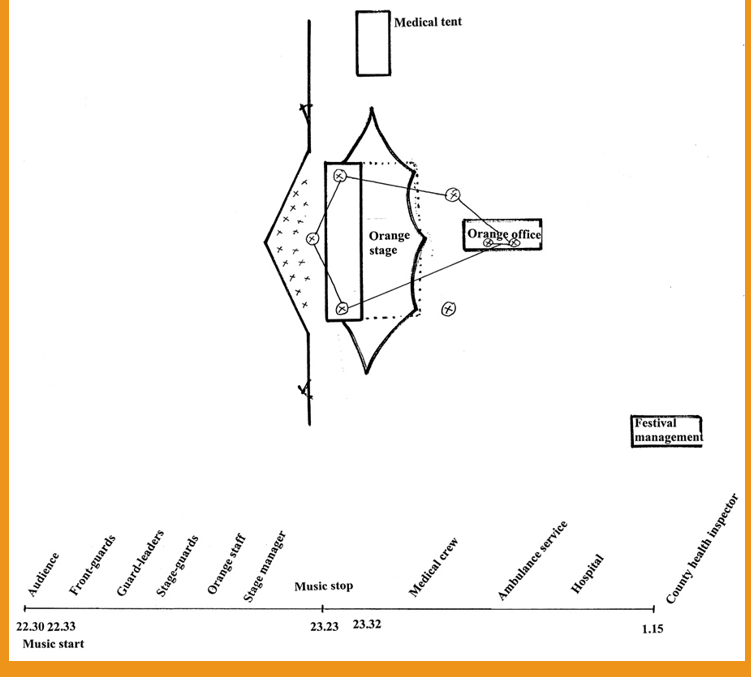
Image: A slide that showed attendees how moments in songs revealed incidents in the ongoing crush tragedy and security lapses at the Roskilde disaster. Image: Courtesy of Hans Drachmann
Helena Bengtsson (In 2001, a researcher and editor for the investigative team at Sweden’s National Broadcasting Company; now, data journalism editor at Gota Media, and a world-renowned data journalism trainer): One thing that I’ll never forget is a presentation by a couple of Danish journalists [Hans Drachmann and Pernille Tranberg]. The year before, there had been a terrible accident at the Roskilde Music Festival, where nine young people died during a Pearl Jam concert. The journalists created a timeline of the events and managed to put the audio track in order by using the music as their guide. I thought it was such an innovative way of doing investigations, and I still remember their presentation vividly.”
Hans Drachmann: (In 2001, an investigative reporter at Denmark’s Politiken, where he still works at today.):“For my part, the international collaboration began in 1998, when Nils Mulvad organized a week-long course at the Danish School of Journalism in Aarhus, Denmark, featuring Eric Nalder from The Seattle Times as the lead instructor. It was the most inspiring experience of my career, and I have applied the techniques Eric told us about almost every single day since. One particular method is a technique for testing a journalistic idea, that Eric said his editor at the time, David Boardman, always used: “You must formulate your idea as a simple question.” If you cannot do that, you need to go back and give it some more thought.
I have tried to apply that method to almost every journalistic story I’ve undertaken since. We also used it systematically, when we were investigating the Roskilde Festival tragedy. I recall explaining at the conference at Hotel d’Angleterre, that we had worked to find the answer to a specific question: “Why wasn’t the music stopped during the 20-plus minutes that elapsed after the first security guards raised the alarm?”
Nils Mulvad: Choosing the sessions for the agenda was a collaboration. I was working with Dave Boardman and Dave Kaplan; there was this discussion between Brant, Dave, me, and Kristian on how we would get speakers from Africa; from Asia; from Russia. We didn’t always agree, but it was easy to get decisions.
What innovations at the conference were notable for you?
Brant Houston: The idea that you would take some time off between sessions was great. In the US it had been — bang! — once one session ended, the next would start. And I took those breaks at Copenhagen back to IRE conferences, realizing that having 15 minutes between sessions was often just as good as the session itself. I could see the value of having these breaks.
The style at that time was very small name tags; there were some conferences in Europe where you’d really have to get close to see. And I think we made larger name tags for the first conference, because I remember saying: “We need larger name tags, especially with people from a lot of different countries.” I also wanted two-sided name tags, because it drives you crazy when they flip – and that’s still happening.
Jean-Paul Marthoz: I attended quite a few IRE conferences on behalf of the IFJ or Human Rights Watch… One of my recollections is that investigative journalism was usually framed as a mission by many US journalists, as a Constitutional fourth estate duty, while European journalists tended to see it more as a technique than a commitment to watchdog journalism.
Nils Mulvad: Nobody ever thought we’d have a global conference of journalists at the most expensive hotel in Denmark. So, for the accommodations, we had to place people at other hotels. But the staff at Hotel D’Angleterre were very nice; they knew we didn’t have a lot of money, so they helped us make savings. The hotel was charging depending on how many people were at the lunch, so it was very important to get precise numbers for the fixed cost and have no extra tables. But because every table was full, you’d have to sit and spend time with other journalists; there was never any room for you to find a free table. So we were all forced to start chatting with each other. For many, there was very much the feeling that “this is my crowd.” Many connections were made in that lunch room.
It’s a very old, famous hotel, so it was funny to have a conference there. We also held the second conference there, in 2003.
But the hotel itself was so expensive that only one of the participants actually stayed there; no other newsrooms could afford to book a room. He was a young reporter from VG in Norway, which at that time was a rich newspaper in Norway. One of the speakers had a problem at the airport, and he called the hotel to get in contact with the organizers, and the only thing the hotel staff knew to do was put this guy through to the room of this young reporter from VG.
Joop Bouma: (In 2001, an investigative reporter at Trouw, and now a freelance investigative journalist.): The first international conference of investigative journalists meant, above all, the discovery that, in many other parts of the world, colleagues were working on exactly the same issues, with exactly the same motivation and drive, and facing exactly the same frustrations and resistance. I also discovered that other colleagues were often already further ahead. I learned from them how I could make progress in my own country.
Investigative journalism can be a relatively lonely line of work. That is one of the greatest advantages of international conferences: you discover that you are not alone, and, more importantly, that international collaboration is much more than the sum of one plus one.
International professional contacts, face to face, remain very important to this day. We now have wonderful systems that allow us to communicate digitally, but in my view, actually meeting each other is the best foundation for successful collaboration.
After my presentation at GIJC01 in Copenhagen, I was invited to join ICIJ in Washington, DC. That has brought me a lot: many international contacts and wonderful projects with colleagues from all over the world.
How did that first conference — directly or indirectly — affect or change your career, or that of the craft in your region?
Jennifer LaFleur (In 2001, a data editor at the St. Louis Post-Dispatch; now, an assistant professor at the UC Berkeley Graduate School of Journalism, and a global data journalism leader.): For me, one of the biggest impacts was seeing the journalism world come together to help one another the way IRE did in the US. The challenges faced by journalists in other places made any complaints I had small. It opened my eyes to the sorts of stories that could be done. I knew I wanted to continue to be part of the GIJC community. I met friends that I am still in touch with today and was so proud of the work Brant Houston and Nils Mulvad did to make the conference happen.
Dick van Eijk (In 2001, editor-in-chief at NRC online, and now the outgoing program manager at NRC Media.): Copenhagen 2001 truly changed our lives. Journalism conferences were an unknown phenomenon in The Netherlands at the turn of the century. I was familiar with the idea, however, as I had attended a NICAR conference in 1994 in San Jose, California and was active as a trainer at smaller events when Nils asked me for help at the conference. I, of course, said yes.
I had the impression that many of the participants in the first Global Conference already had an international network. In that sense it was also about institutionalizing personal experiences into a common framework.
Globalization was not new at the turn of the century, of course, but in that period for journalists, it changed from being just a topic to report on, to being a part of professional life, and, for some, maybe even of identity.
Brigitte Alfter (In 2001, deputy editor-in-chief at Eurolang; now director of Arena for Journalism in Europe): When I attended the first GIJC, I was a young journalist working at a local newspaper right in the border region between Denmark and Germany, doing loads of EU-related stories. I dearly enjoyed that job, but also I had been in that role for four years at that moment and was curious to try something new with a more international outlook.
At GIJC01, I inhaled inspiration. And I got exactly that international outlook I had been wishing for. In the following year, I joined the board of the Danish Association for Investigative Journalism, FUJ, as a volunteer. And in 2003, when the GIJC returned to Copenhagen, I joined as a conference volunteer and as a moderator, and we kicked-off the Scoop Project, which was a collaboration between Danish journalists and colleagues in the Balkans, in Moldova, and Ukraine. I have been working with an international outlook ever since.
Helena Bengtsson: “Personally, I believe this was one of the first times I trained international journalists in data journalism — or CAR, as we called it back then. I led a few workshops during the conference, and it sparked something that I still do today, taking me to many places around the world I otherwise wouldn’t have visited. Training at these international conferences is completely different from teaching when all your students speak the same language. As a trainer, you have to be very aware that half of your students’ brains are occupied with translating your words — so only the other half remains to understand Excel and the methods being taught. Since English isn’t my first language either, I think I had a bit more empathy for this. For me, it was that conference in Copenhagen that started my passion for training other journalists in data journalism.
Jean-Paul Marthoz: The quality of the speakers was just brilliant. There were so many interesting panels that I feared I would miss something “indispensable.” I brought back a full box of business cards of journalists from dozens of countries working on stories with a global reach (corruption, armed conflicts, human trafficking, organized crime…) and relayed them to my colleagues working on corresponding beats at Human Rights Watch.
Thanks in part to the first kick in Copenhagen, the journalistic community (part of it) has developed fantastic new initiatives, from the GIJN to ICIJ, Forbidden Stories, etc. The global press freedom community is stronger and battle-tested.
Mark Lee Hunter: “I remember — though whether in 2001 or at GIJC03, I can’t say — meeting Gavin McFadyen, a giant of a man with an even bigger laugh, who said he was going to create something called the Centre for Investigative Journalism in London. “An American telling Brits how to investigate?” I thought. “We’ll see.” Indeed we did. I had naively underestimated the fact that investigation is a culture, and certain cultures can transcend borders.
What memorable scenes from GIJC01 Copenhagen stick with you?
In his welcome address to GIJC01, then-Danish Prime Minister Poul Nyrup Rasmussen told attendees: “When economic forces are becoming globalized and political forces in some sense too — or I hope they will be — it is time that journalism becomes globalized as well… Once, the hero of journalism was the foreign correspondent… The new journalistic hero is one who knows his or her home base, but at the same time has the contacts and the tools and investigates the local problems, in a global context.”
Brant Houston: “[The conference] opening with the Danish prime minister was an interesting moment. If you go back in time, IRE had a tradition of not wanting to have anything to do with the federal or state government. There were no government grants; no influence or participation by government officials. That’s one of the reasons I felt that the global network would not be US-centric or Euro-centric because there are a whole lot of different viewpoints on government-supported things in other nations. That choice could have been an issue with the global conference, but I just said: “Hey, Denmark is the host of this; they are a partner, and if they’re inviting the prime minister, that’s fine.” One of the things that’s been great in being a part of the global network is you have a difference to how things are done in a particular country, and how Nils was working that.” So it was an interesting beginning because Nils got the prime minister to speak.
Nils Mulvad: It was actually (FUJ president) Jørgen Flindt Pedersen who contacted the prime minister. He had been a member of the same party, and had been the managing editor of a newspaper connected to that party for some years so I think they knew each other, so it was easy for him to reach out.
David E. Kaplan: At night I ventured out with the indomitable Andrew Jennings, the late, great British muckraker who exposed deep-seated corruption in the Olympics and FIFA. We found our way to Christiana, Copenhagen’s freewheeling alternative neighborhood, full of hip bars, shops, and street vendors then openly selling slabs of hashish the size of pizza boxes. We ended up at a jazz club where I somehow ended up on stage, playing harmonica. It remains one of my favorite, most memorable performances.
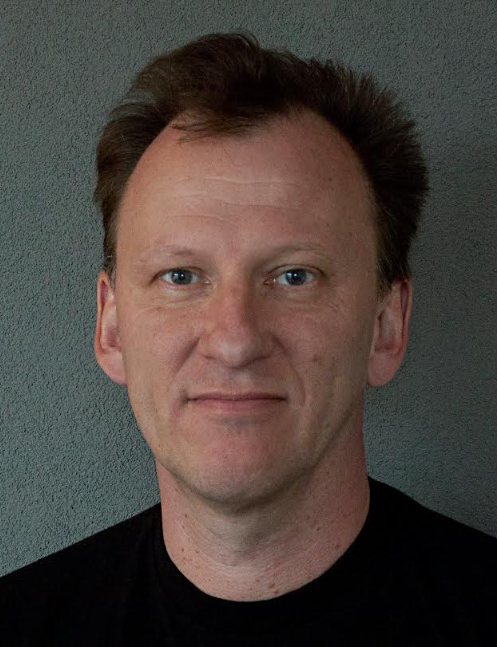
GIJC01 attendee Dick van Eijk. Image: Courtesy of van Eijk
Dick van Eijk: The conference was a very in-person and in-place thing. Intense. The rest of the world was far away. Smartphones did not exist. Mobile phones did, but not everybody had one. Laptops were still uncommon. Social media was unknown. Away from the newsroom, one was cut off from the global news cycle. Having beers with colleagues was being with them, and nobody else. It is the sort of intimacy that does not exist anymore at conferences. Now, participants check their mail during presentations, post on socials live, even from the pub.
Jean-Paul Marthoz: When I see today the names of participants who crowded the rooms and corridors of the Hotel D’Angleterre I am relieved that a number of them are still there, on the frontlines of journalism. Like Nicaragua’s Carlos Chamorro. But I look back at Copenhagen with nostalgia. This was a time when independent journalism and human rights were ascending. There was an atmosphere of confidence in the room that I have not experienced since. In the evenings, the talks in Copenhagen restaurants and bars were mostly uplifting. Four months later, however, the 9/11 terror attacks and their aftermath started a process which led to an apparently irrepressible backsliding in press freedom and human rights, back to pre-1990 levels and its “end of history” euphoria.
Brant Houston: “The conferences in 2001 and 2003 roll together a little in my memory, but I think Tom McGinty and Jo Craven were there from IRE — Tom proposed to Jo during some conference! Sarah Cohen was there; Jennifer LaFleur. Jennifer was an incredible motor on all this.
One of the reasons they called it the golden era of investigative and data journalism was that the people who worked at IRE and NICAR from 94 into the 21st century, all of them were eager to go to the conference. My deal was to figure out how to get them over there. I had a staff that was eager to travel. They loved the excitement of doing training internationally. This wasn’t: “Oh my God, you’re adding to my job.” This was: “Do we have the finances, because we want to go.” This was passion; a movement; a mission. We could see the future; it was exciting. For a lot of the IRE trainers, this was a great stepping stone to something else. They all went on to do incredible things.
Mark Lee Hunter: “I never heard Jim (James Steels) or Andrew (Jennings), nor any of the other giants in the room, boast about themselves. Instead, they talked about higher matters, and they were not stingy in their compliments. One I treasure was when Andrew told me, as we drank whiskey in his hotel room: “You’ve done the job.” I thought: “If Andrew says that, it must be true.” Another was when Jim Steele told me in Amsterdam: “I hear you said something great today.”
When I recall how alone I felt in 2001, conducting investigations as a freelancer for editors who’d never done the job, I can hardly believe how much change happened so quickly. Nor can I quite believe that such a remarkable cadre of professionals and individuals coalesced, despite the decline of the news industry, to create the necessary conditions for our work.”
Brant Houston: The mantra that came about was “local is global; global is local.” Nils and I had great faith in that.
 Rowan Philp is GIJN’s global reporter and impact editor. He was formerly chief reporter for South Africa’s Sunday Times. As a foreign correspondent, he has reported on news, politics, corruption, and conflict from more than two dozen countries around the world.
International Research Guide: How to Find Experts and Hidden Documents on Any Topic
Guide to Investigating Tech and AI in Modern Warfare
Turning Copernicus Satellite Data Into Public-Interest Climate Stories
10 Practical Tips for Verifying Scientific Claims
20 Years On, A Global Network for the World’s Investigative Journalists

GIJN Votes To Register, Create 15-Member Global Board
Uncovering Asia: The First Asian Investigative Journalism Conference, Nov. 22-24, 2014
How Russia Censors Foreign TV, Midterm Battle for US Congress, Venezuela’s Collapsed Housing Towers, France’s Education Protests

This work is licensed under a Creative Commons Attribution-NoDerivatives 4.0 International License
Republish our articles for free, online or in print, under a Creative Commons license.
Republish this article
This work is licensed under a Creative Commons Attribution-NoDerivatives 4.0 International License
Read Next
Inside GIJN
20 Years On, A Global Network for the World’s Investigative Journalists
As we prepare to gather for this year’s Global Investigative Journalism Conference, it seems a good time to share where GIJN and its conferences come from.
GIJN Votes To Register, Create 15-Member Global Board
GIJN members worldwide have voted overwhelmingly to make the Global Investigative Journalism Network a registered nonprofit in the United States, and to restructure its board to ensure geographic representation from six regions. Until now, GIJN has not been registered in any country. “This a great validation of how far we have come since 2003,” said GIJN co-founder Brant Houston. “Once again, we have moved to another stage in GIJN with close to unanimous agreement.”
Uncovering Asia: The First Asian Investigative Journalism Conference, Nov. 22-24, 2014
Mark your calendars! Uncovering Asia: The 1st Asian Investigative Journalism Conference is now happening. Join us in Manila on November 22-24 for this breakthrough event, bringing together top investigative reporters, data journalists, and media law and security experts from across Asia and around the world. Meet award-winning journalists and experts on data analysis and visualization, business investigations, and cross-border collaboration.
Data Journalism Top 10
How Russia Censors Foreign TV, Midterm Battle for US Congress, Venezuela’s Collapsed Housing Towers, France’s Education Protests
Also highlighting police response to demonstrations in India, where European Nobel laureates do their research, and shrinking food budgets in Indonesia.