
Image: Shutterstock
10 Practical Tips for Verifying Scientific Claims
Read this article in
A paper published in a scientific journal can seem like a promising lead for a news story or the beginning of an investigation. Yet peer review does not involve repeating every experiment or verifying every piece of data. Research may contain methodological flaws or unintentional errors; sometimes, the data have been manipulated or fabricated.
In 2025, journalist Frederik Joelving and computer scientists Cyril Labbé and Guillaume Cabanac published the findings of a six-month investigation into so-called scientific paper mills. These paper mills are businesses that produce and sell fraudulent scientific papers, often using fabricated or manipulated data.
Among the cases they examined was one in which a paper was first questioned by cancer researchers Soren Zielske and Danny Welch. The two scientists had tried to build on its findings but could not reproduce the results. Looking more closely, they found identical data in graphs that were supposed to represent different experiments. In 2020, Zielske posted his concerns on PubPeer and contacted the journal’s editor. The paper was later retracted for “falsified materials and/or data.”
Journalists cannot repeat every experiment, but there is plenty they can check. The following 10 best practices explain how to examine a scientific claim before turning it into a news story or starting an investigation.
1. Build Your Own Early-Warning System
PubMed and Google Scholar can help you find new studies. You can also set up Google Scholar alerts for topics, keywords, and researchers, and subscribe to email alerts from journals such as Science and PNAS. EurekAlert gives eligible journalists access to embargoed research, while SciLine connects reporters with independent scientists.
Sandeep Ravindran, president of the National Association of Science Writers (NASW) and a freelance science journalist, told GIJN that journalists should develop a specialist beat: “High-profile journals such as Science, Nature, PNAS, Cell, or Neuron, are usually covered by staff journalists, and are not great places for freelancers to find unique story ideas, but there are lots of other options, such as the PLOS and Royal Society journals.”
2. Start With the News Value, Not the Press Release
A press release landing in your inbox is obviously not, by itself, a reason to write a story.
Press releases can help you make sense of a complex paper or find the researchers’ contact details. But they are no substitute for reading the study itself. They may also make the findings sound more striking or conclusive than they really are.
A 2024 study looked at 84 press releases about ocean plastic and 495 related newspaper stories. More than half borrowed wording from the press releases, and most left out the studies’ funding and limitations.
Read the press release alongside the paper and ask:
- Does the release suggest causation when the study found only an association?
- Does it leave out limitations reported in the paper?
- Does it emphasize a positive secondary outcome after the primary outcome failed?
Alexandra Thompson, news editor at New Scientist, told GIJN: “I don’t take much notice of press releases, unless they’re needed to help understand a complex paper. It should make you say ‘Wow!’ or feel like a move forward on what we already knew, or be ‘news you can use.’”
3. Don’t Treat Peer Review as a Guarantee
Peer review is an important form of quality control, but it does not prove that a paper is correct. Reviewers may miss errors in the analysis, manipulated images, undisclosed conflicts of interest, or problems that emerge only after publication. Even papers in prestigious journals may later be corrected, questioned, or retracted.
Ivan Oransky is a physician and science journalist who co-founded Retraction Watch, which tracks retractions, corrections, and research integrity issues, and is also a distinguished journalist in residence at New York University’s Arthur L. Carter Journalism Institute. He told GIJN: “A lot of publishers, scientists, and universities would like journalists to believe that being peer reviewed means that it’s correct. But when they’re being honest, scientists know that that’s not true.”
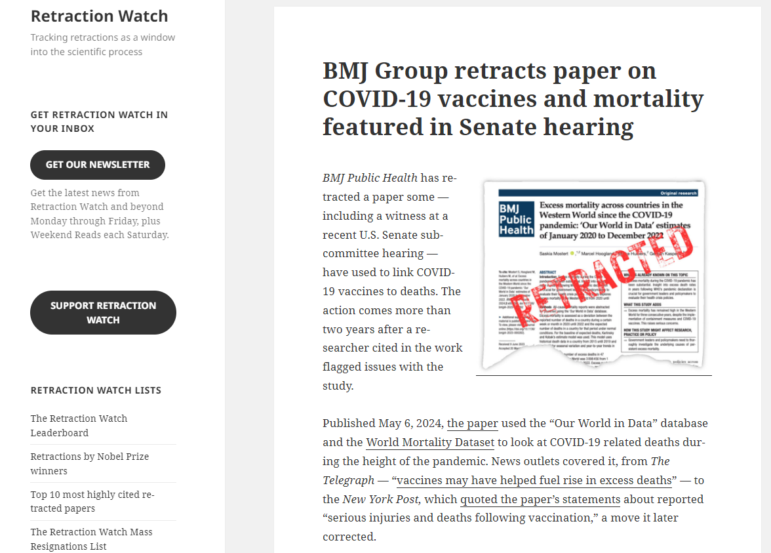
Image: Screenshot, Retraction Watch
Additionally, a study preprint requires extra care because it has not yet been peer reviewed.
John Travis, an editor at Science, told GIJN what journalists should check. “Preprints can be covered, but you should do your own peer review by getting multiple reactions,” he said. “Preprints are better than covering a meeting talk because you can send a full paper to someone for review. You should add a level of skepticism for a preprint but not dismiss covering them — too many important findings are being released first that way.”
4. Read the Study or Paper with an Investigative Journalist’s Perspective
Never write a story from the abstract alone. Identify the paper’s main claim, then dig into the methods, results, and limitations. Check the sample size and selection, control group, study duration, measured outcomes, effect sizes, confidence intervals, participant dropouts, and adverse effects.
For clinical trials, compare the paper’s primary outcome with the trial registration. Look for outcomes that were changed or omitted, or positive secondary findings emphasized after the primary outcome failed.
Finally, read the funding and conflict-of-interest statements, tables, figures, and supplementary files. Report the study’s most important limitation alongside its main finding, not at the end of the story.
5. Test the Study With Independent Experts
Before reporting a study’s findings, ask an independent expert to assess them. Look for someone who was not involved in the research, preferably at another institution and familiar with the subject or methods.
Ask specific questions:
- Do the methods answer the research question?
- Do the findings support the authors’ conclusions?
- What is the study’s most important limitation?
- What claim should journalists avoid making?
To find suitable experts, check the paper’s references, similar studies, and researchers who have cited the authors’ previous work.
Pulitzer Prize-winning science journalist and author Deborah Blum told GIJN: “Once I’ve done the homework, I’ll interview the study authors and then I’ll interview other researchers who know the field. I’ll look for both colleagues and critics.”
“If an expert identifies a serious problem, take it back to the study’s authors and give them a chance to respond,” she added. “Keep reporting until you understand where the weight of the evidence lies.
6. Match Your Language to the Strength of the Evidence
Your story should not sound more certain than the evidence allows. If the study design calls for caution, use “suggests” instead of “proves,” “is associated with” instead of “causes,” and “may reduce the risk” instead of “prevents.”
Distinguish between three things:
- What the data shows.
- How the authors interpret the findings.
- What might be possible to determine in the future.
Check the numbers as carefully as the language. Distinguish between relative and absolute risk, and between a percentage change and a percentage-point change.
Positive language has become far more common even in scientific writing. A BMJ analysis of PubMed abstracts found that the use of positive words rose from 2% during the 1974-80 period to 17.5% in 2014 —a relative increase of 880%. If you describe a finding as “groundbreaking,” “unprecedented,” or a “breakthrough,” explain the reasons that justify this characterization.
Be clear about uncertainty. Tell readers if the study had a small sample or a short follow-up period, has not yet been replicated, or included only a particular group. These details show readers what the research can — and cannot — tell us.
7. Investigate Funding and Conflicts of Interest
Industry funding does not automatically make a study unreliable. The key question is not only who paid for the research, but how much influence the sponsor had over it.
Read the funding, conflict-of-interest, author disclosure, acknowledgments, and funder-role statements. Ask:
- Did the sponsor help design the study?
- Did it collect or analyze the data?
- Was it involved in writing the paper?
- Could it prevent or delay publication?
- Do the authors have financial ties to the product or company being studied?
A Cochrane systematic review found that industry-sponsored drug and medical-device studies were more likely than studies funded by other sources to report results and conclusions favorable to the sponsor’s product.
Check your independent experts, too. They may have financial, professional, or academic ties to the authors, institutions, or companies involved. Ask them directly and confirm their disclosures where possible.
Report relevant conflicts clearly, but do not present them as proof of misconduct. Tell readers who funded the research, what role the sponsor played, and how those relationships might have influenced the study’s design, analysis, or interpretation.
8. Check the Paper’s Current Status
A paper can run into problems even after publication. Before filing your story, search its title and digital object identifier (DOI) to see whether it has been corrected, questioned, or retracted. Check:
- The journal or publisher’s webpage
- Retraction Watch Database
- PubPeer
- Crossref Search
Do not rely on an old PDF. Updates may appear only on the publisher’s page. If several versions exist, use the latest version of record.
Retraction Watch’s Oransky advises journalists: “Read the actual notice that goes with the retraction or the correction. There’ll be a notice that explains what happened. Or there should be.”
Scrutinize these notices carefully because these notice labels do not all mean the same thing. A correction may fix an error without changing the main finding. An expression of concern signals serious questions that remain unresolved. A retraction means the paper’s findings should no longer be considered reliable.
9. Compare the Finding With Earlier Research
A single study rarely overturns years of evidence. Place the new finding in context by looking for systematic reviews, meta-analyses, and similar studies. Remember that a review is only as reliable as the studies it includes.
Ask:
- How many studies have reported similar findings?
- Is there conflicting evidence?
- Have independent research teams replicated the result?
- If the new finding differs from earlier research, could differences in the methods, sample, or population explain why?
Useful resources include:
“You can see who cites them, you can put their finding into the bigger context of the field,” Blum noted.
10. Do a Final Check Before You Publish
Oransky’s advice to journalists is simple: “You can distrust but verify.”
Ask:
- Does the headline accurately reflect the study population and main finding?
- Have I checked the paper’s current status?
- Have I verified the figures, quotations, and key claims against primary sources?
- Have I clearly explained the study’s most important limitations and uncertainties?
Finally, ask yourself: If this study is seriously challenged or corrected next year, will my story still be accurate?
 Esra Öz is a freelance journalist for distinguished publications such as Science Magazine, New Scientist, ScienceAlert, CNN Türk, and The Independent Turkish. She graduated from Eskişehir Osmangazi University’s Department of Biology and Anadolu University’s Department of Radio and TV Programming. She has completed a master’s degree in journalism with a focus on science communication at Ankara University’s School of Communication.

8 Ways Journalists Can Access Academic Research for Free
5 Tips for Using Academic Research in Investigative Journalism
How to Report on Scientific Findings
Tips to Investigate Links Between Pesticide and Cancer

Telltale Data Signs of Bogus Scientific Papers and Fraudulent Academic Research

How to Cover Academic Research Fraud and Errors

How a Canadian Reporting Lab Is Pioneering Academic-Journalist Collaboration
Turning the Threat to a Distant Glacier into a Local Story Through Data Visualization

This work is licensed under a Creative Commons Attribution-NoDerivatives 4.0 International License
Republish our articles for free, online or in print, under a Creative Commons license.
Republish this article
This work is licensed under a Creative Commons Attribution-NoDerivatives 4.0 International License
Read Next
Data Journalism Reporting Tools & Tips
Telltale Data Signs of Bogus Scientific Papers and Fraudulent Academic Research
Two scientists and an editor spent six months investigating so-called paper mills, which churn out bogus scientific papers that impede actual research on lifesaving breakthroughs.
Reporting Tools & Tips
How to Cover Academic Research Fraud and Errors
Tips from three experts who have covered research misconduct or have hands-on experience monitoring or detecting it.
Case Studies
How a Canadian Reporting Lab Is Pioneering Academic-Journalist Collaboration
Fundamentally, journalists and scholars do similar work – diving into documents, crunching numbers, conducting interviews. But their timeframes, and their measures of success, can be quite different. The Global Reporting Centre tries to bridge that gap, both by funding such collaborations and serving as an ambassador between two very different cultures.
Climate Data Journalism
Turning the Threat to a Distant Glacier into a Local Story Through Data Visualization
New York Times climate and environmental graphics reporter Mira Rojanasakul discusses how her team visualized the sea level rise threat from the melting Thwaites Glacier in Antarctica.