
Image: Mediazona
How Russia Censors Foreign TV, Midterm Battle for US Congress, Venezuela’s Collapsed Housing Towers, France’s Education Protests
A Mediazona investigation found that nearly half of the foreign series on Amediateka, Russia’s main streaming gateway to HBO and other US shows, have been censored, with 75 hours of cuts verified across 200 series. Our roundup of the Top 10 in Data Journalism, looking at stories from October 7 to 21, also includes a New York Times investigation showing how flawed design and construction turned Venezuelan public housing towers into death traps during June’s earthquakes and a Kompas analysis of how much less a 100,000-rupiah note (about US$5.50) buys in Indonesian markets than it did a decade ago.
How Russia Censors Foreign TV Shows
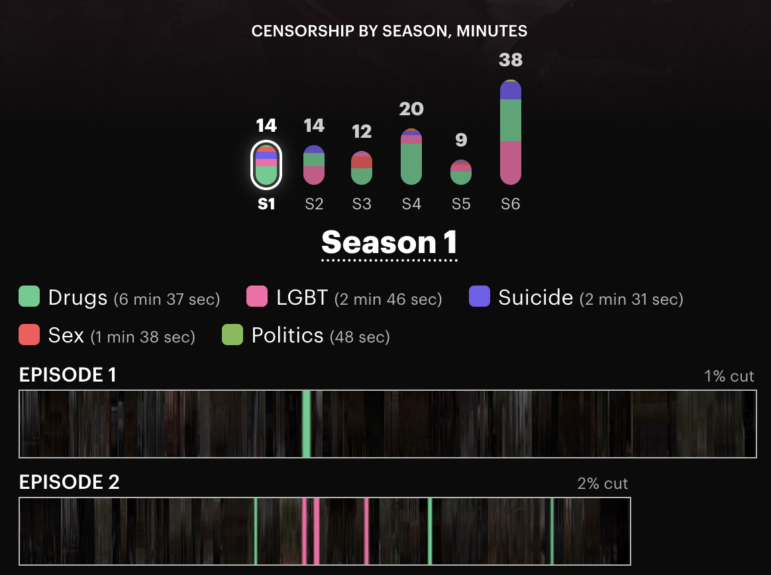
Mediazona analyzes the Russian state-imposed censorship of the first season of the popular HBO series “The Sopranos.” Image: Screenshot, Mediazona
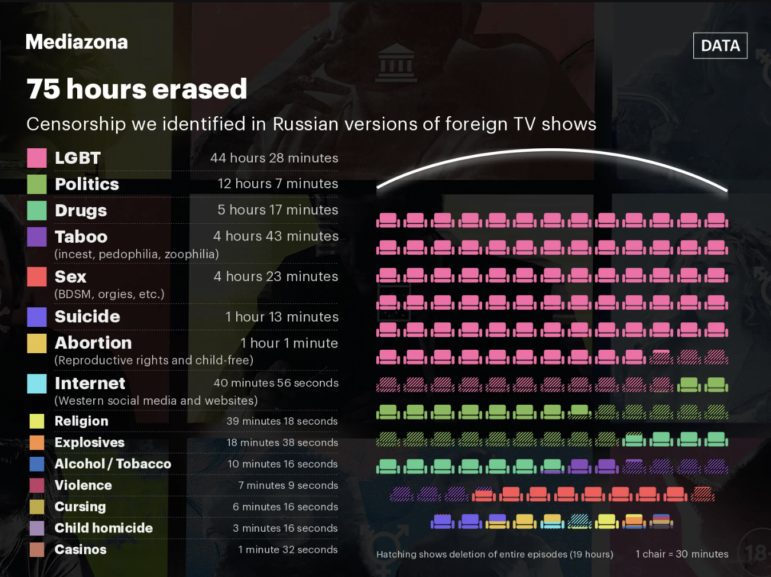
Nearly half the foreign TV series on Amediateka, Russia’s main streaming gateway to shows from HBO and other US networks, have been censored, according to a Mediazona investigation. Reporters built an algorithm that compared each original with its Russian version frame by frame. It found signs of re-editing in 368 of 462 titles, and reporters verified 75 hours of cuts across 200 series. LGBT content accounted for 44 hours of censored content, followed by politics, and then drugs; references to Western social media and websites are also censored. A pictogram arranged as cinema seating showed the cuts by category, each chair representing 30 minutes. Filmstrip timelines highlighted deleted scenes in each episode of shows such as The Sopranos, and a searchable library at the end of the investigation covered the full catalogue of shows analyzed.
Mapping the Battle for US Congress
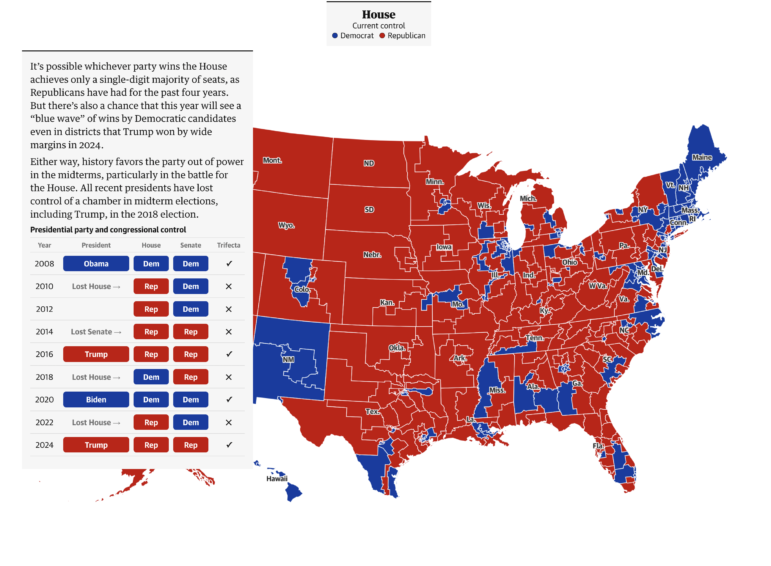
Image: Screenshot, the Guardian
With the US midterms less than two weeks away, the Guardian mapped the races that will decide whether the Democrats can retake control of both the Senate and House of Representatives. A scroll-driven map highlights the 35 Senate seats on the ballot, seven of which are toss-ups, according to the Cook Political Report, including Texas, where no Democrat has won a Senate race since 1988. Every House of Representatives seat is also up for election. Drawing on Ballotpedia data, a unit chart showed new maps in nine states that would give Republicans a net gain of nine seats as a result of redistricting. But more than 40 House races are competitive, according to the Cook report. A line chart showed Democrats leading in national polling, with the story closing on a line chart tracking voters’ top issues, from the economy to immigration.
Crackdowns on India’s Protests
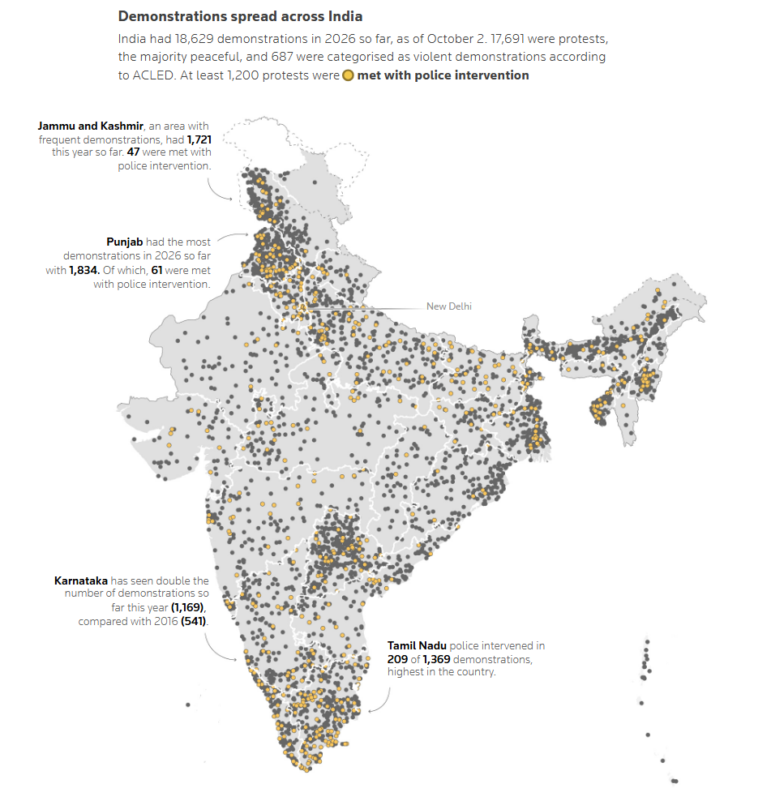
Image: Screenshot, Reuters
India recorded 18,629 demonstrations in 2026 as of October 2, according to a Reuters analysis of Armed Conflict Location & Event Data (ACLED), as the “cockroach” youth movement brought untold numbers of protesters onto the streets in July and October. Both waves drew allegations of excessive force from police, with petitions filed in the Supreme Court. Police intervened in more than 200 protests in August alone, a decade high for a single month. Reporters used illustrations to examine policing guidelines and the phased response that officers must follow, from barricades and batons to water cannons, tear gas, and pellet guns. A national map plotted this year’s demonstrations, and a scatter plot compared monthly protests with police interventions.
Why Social Housing Blocks in Venezuela are Collapsing
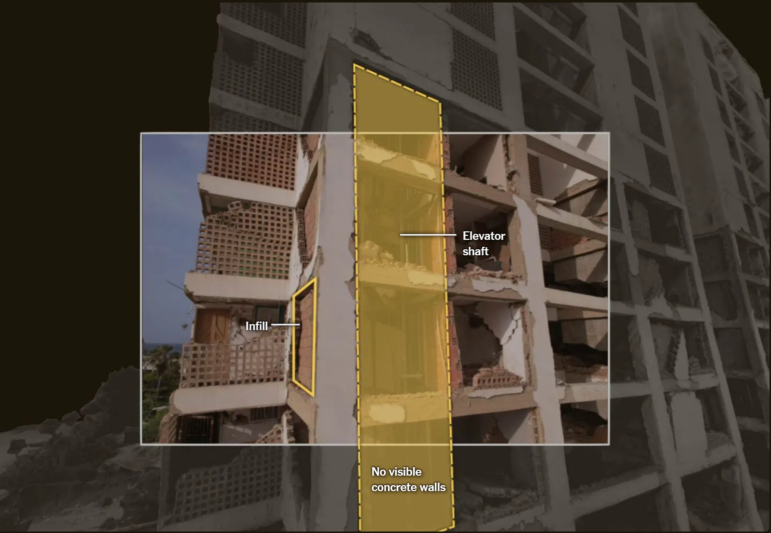
Image: Screenshot, The New York Times
Ten government-built social housing towers in La Guaira, home to some 3,200 people, collapsed in the twin earthquakes that struck Venezuela in June, with a New York Times investigation finding that flawed design and construction “built them to fail.” Reporters examined thousands of images of the rubble and used drone photogrammetry, a method to stitch together thousands of photos from multiple angles, to build a 3D model of the site. They reconstructed the towers from floor plans and found that there were no reinforced shear walls to resist forces such as wind, columns were facing the same weak direction, and steel ties were bent at weaker angles than Venezuela’s building code required. Engineers’ frame-by-frame analysis of CCTV footage showed that the ground shook in the columns’ weakest direction, and the Times found that officials had been warned the towers were potentially risky, but pressed ahead to deliver homes before critical elections.
Data Behind French Student Protests
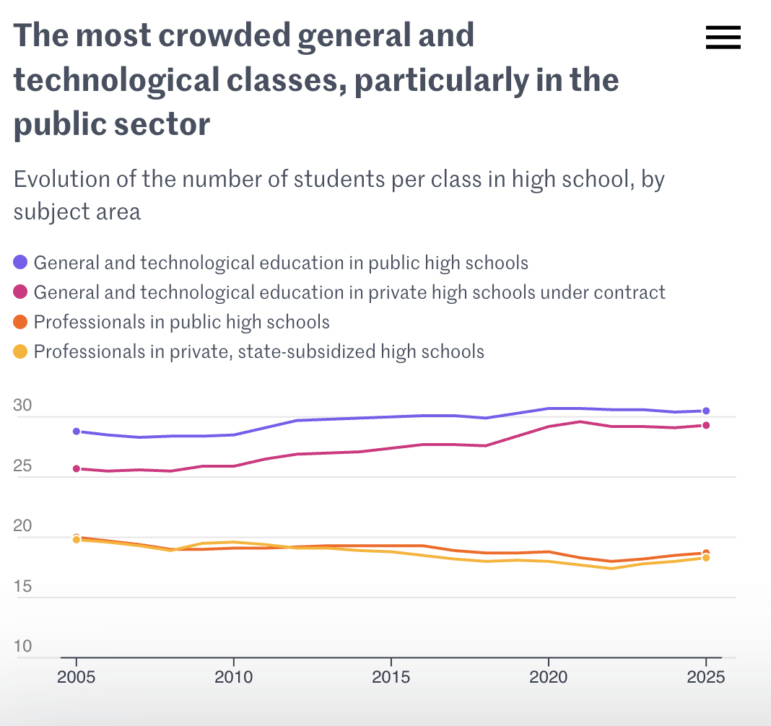
Image: Screenshot, Le Monde
As French high school students entered a second month of protests over crowded classrooms, missing teachers, and crumbling buildings, Le Monde’s data team tested their complaints against official figures. Using data from DEPP, the Education Ministry’s statistics office, charts showed average class sizes in most high schools rising since the mid-2010s to 30.5 in public schools, with a quarter of first-year classes exceeding 35 students. An OECD comparison found French students had more annual class hours than their European peers, packed into fewer weeks. Budget documents showed nearly 10% of secondary teaching hours went undelivered, with charts also tracking fewer places in teacher recruitment exams. Charts also showed that under 15% of public high schools had been renovated in the past decade.
Where Do Nobel Laureates Do Their Prize-Winning Research?
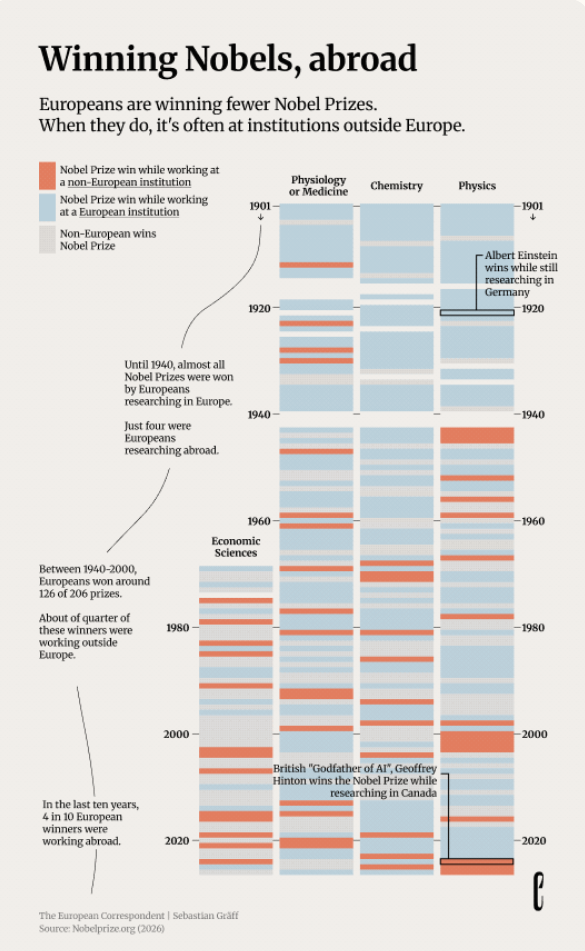
Image: Screenshot, European Correspondent
Of the nine Europeans awarded science Nobel Prizes earlier this month, four made their breakthroughs while working in another country, in most cases the US. The outlet charted every prize in physics, chemistry, physiology, or medicine since 1901, and in economics since 1969, on a color-coded timeline. It showed that before 1940, only four European winners had been based abroad, but that roughly one in four was working beyond Europe between 1940 and 2000. In Economics, over two-thirds of European laureates earned the prize for work done at foreign universities. The outlet linked the pattern to researchers leaving Europe for better-funded posts elsewhere, though the flow may be reversing now.
Also worth a look: this interactive chart by data journalist Elia Kabanov, who plotted every economics laureate from their birth year to the year they won the award, revealing that winners typically wait decades.
Industries at Cyber Risk in the AI Age
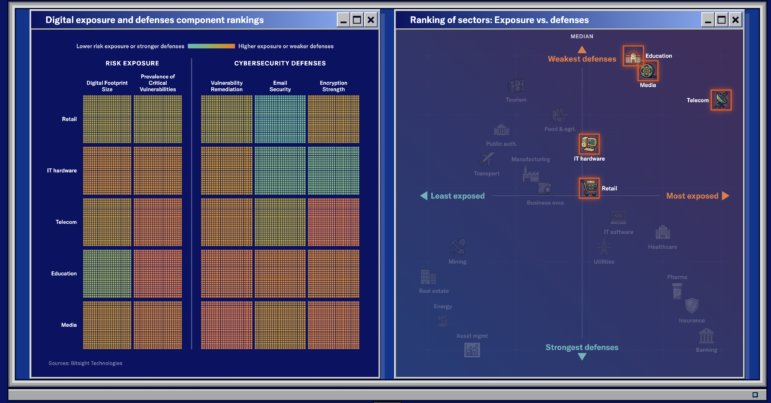
Image: Screenshot, Moody’s
AI is making it easier for hackers to find and exploit weak spots in software, and some industries are far more vulnerable than others, according to Moody’s. The firm warned that organizations may have only four to seven months to fix flaws uncovered by the latest AI models before similar open source tools become widely available. It ranked 21 US sectors using proprietary data from Moody’s Ratings and Bitsight, weighing each sector’s exposure to threats against the strength of its defenses. Readers are quizzed on the rankings through a retro computer-style interface. The findings show that media, education, telecom, retail, and IT hardware carry the highest risk, with a Venn diagram showing media and retail face both high exposure and severe losses, while a heat map tracked each sector’s change in risk since 2024.
Rising Cost of Food in Indonesia
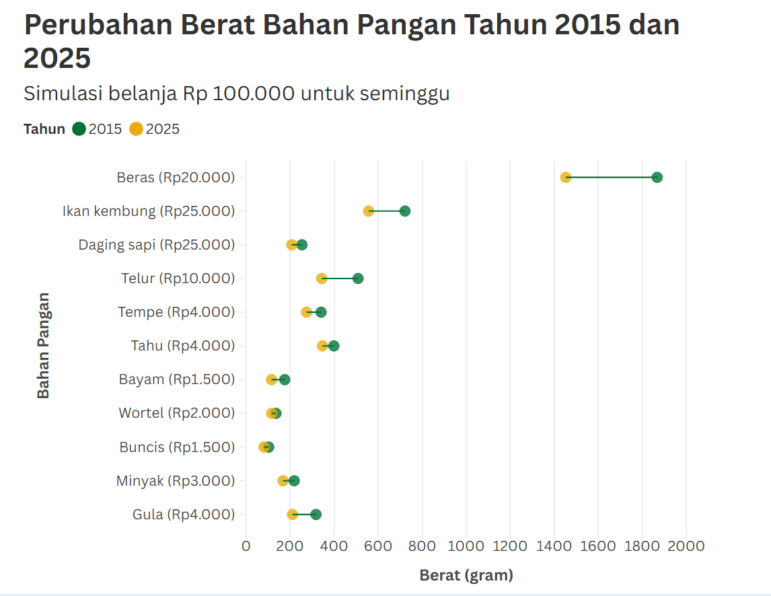
Tracking the declining purchase power of a 100,000 rupiah note for different food staples (by weight) between 2015 and 2026. Image: Screenshot, Kompas
A stronger US dollar is helping drive up food prices in Indonesia, where a 100,000-rupiah note (about US$5.50) now buys far less than it did a decade ago, Kompas found. Analyzing data from Statistics Indonesia (BPS), reporters found that the prices of 47 of 49 staple foods rose between 2015 and 2025 by between 3% and 129%, while wages failed to keep up. A dot plot showed the range of price changes for each item. Kompas then simulated a week’s shopping on the same budget: in 2015, 100,000 rupiah fed one person three balanced meals a day for seven days, but by 2025 it lasted only five. Kompas also created its own version of The Economist’s Big Mac Index, measuring purchasing power across 34 cities by the price of fried chicken, Indonesia’s most popular processed food.
When Mental Health Conditions First Appear
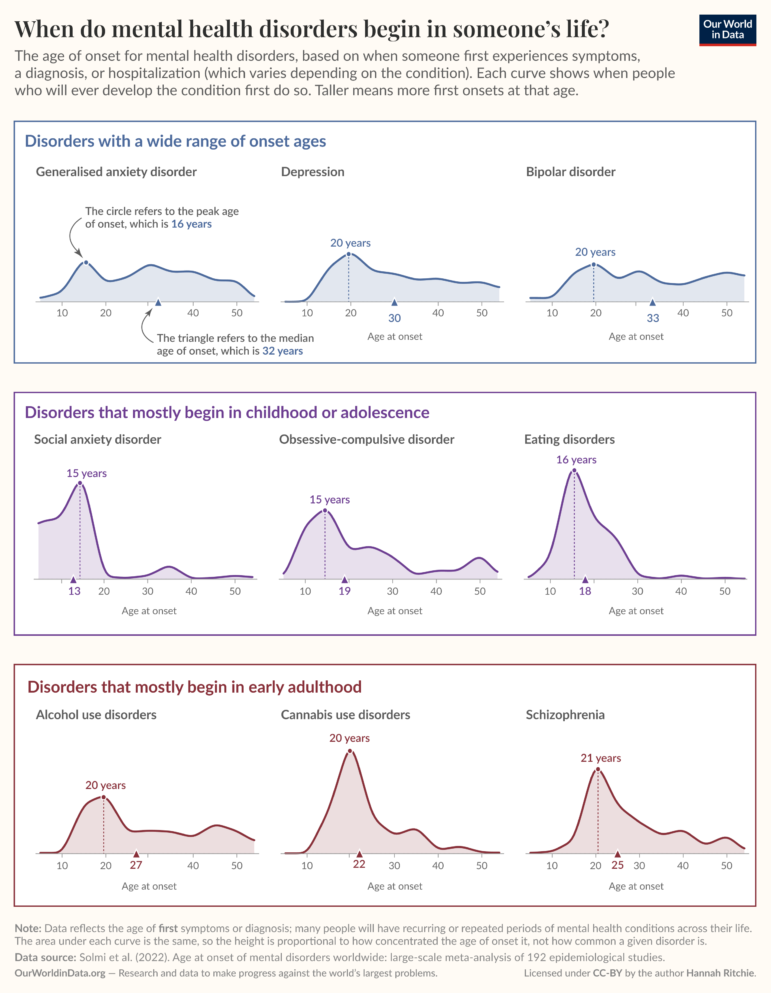
Image: Screenshot, Our World in Data
About one in three people who will ever have a mental health disorder first experience it by age 14, and two in three by 25, according to Our World in Data. Drawing on a meta-analysis of 192 studies, the piece used small-multiple area charts to plot the age of onset for nine conditions, marking each one’s peak and median age. Color-coded panels sorted them into three groups according to what stage of life they usually appear. Anxiety, depression, and bipolar disorder can begin at almost any age. Social anxiety, obsessive-compulsive disorder, and eating disorders cluster in childhood and adolescence, while alcohol and cannabis-use disorders as well as schizophrenia tend to emerge in the early twenties.
Inside the Noah’s Ark of Plants

Image: Screenshot, The Times (UK)
The Svalbard Global Seed Vault now holds more than 1.4 million seed samples, stored more than 100 meters (330 feet) inside a frozen Arctic mountain. Reporters from The Times visited as the vault received its latest deposits, including seeds from Ukraine’s national gene bank in Kharkiv, which crop scientists had saved from Russian bombardment. A 3D model of the vault annotated its features, from an entrance 130 meters above sea level, high enough to remain accessible if the polar ice caps melt, to the “cathedral” hall where shipments are registered and X-rayed. Of its three chambers, cooled to -18º Celsius (-0.4º Fahrenheit), one has already reached capacity, with about 600 million seeds. The Global Crop Trust estimates that sorghum stored there could stay viable for 20,000 years.
Hanna Duggal is the writer of GIJN’s fortnightly Top 10 in Data Journalism column, and a data journalist at AJ Labs, the data, visual storytelling, and experiments team of Al Jazeera. She has reported on issues such as policing, surveillance, and protests using data, and reported for GIJN on data journalism in the Middle East, investigating algorithms onTikTok, and on using data to investigate tribal lands in the US.

International Research Guide: How to Find Experts and Hidden Documents on Any Topic

Guide to Investigating Tech and AI in Modern Warfare
Turning Copernicus Satellite Data Into Public-Interest Climate Stories
10 Practical Tips for Verifying Scientific Claims
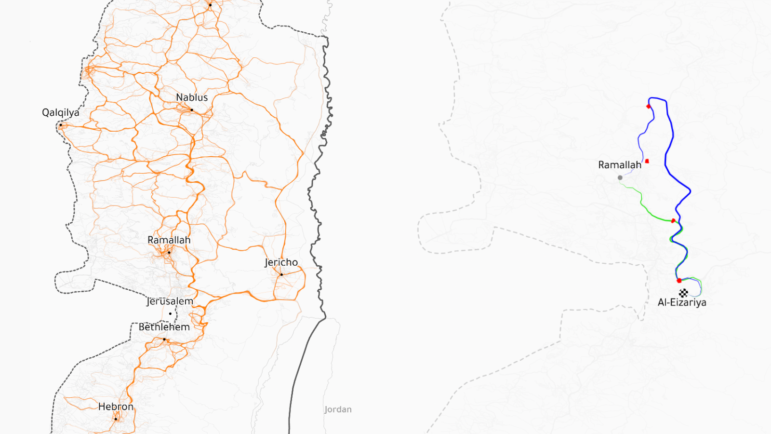
Israeli Checkpoints in the West Bank, Arctic Global Warming, Brazil’s Women Legislators, Inventing a Migrant Crisis in Ukraine
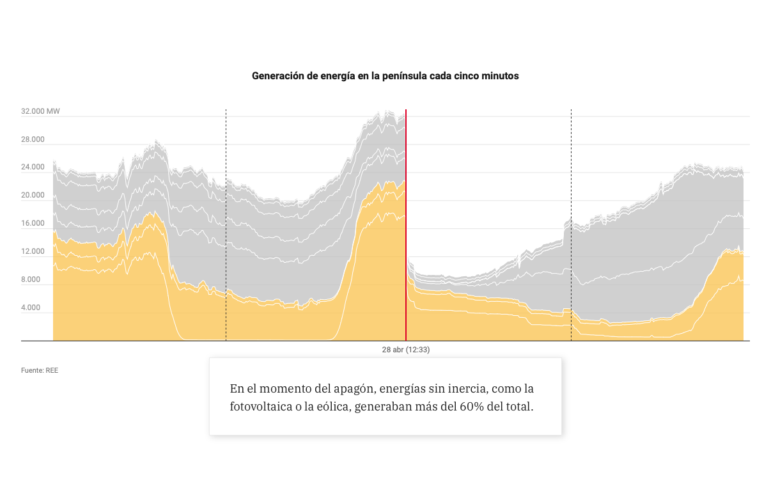
Blackout in Spain and Portugal, Canada and Australia Elections, and a New Pope Elected

Illegal Fentanyl’s Global Smuggling Pipeline, One Year of Destruction in Gaza, and US Migration Trends Confront Natural Disasters

Tracking Hurricane Helene’s Devastation, Conflict Escalation in the Middle East, and the High Energy Costs of AI Chatbots

This work is licensed under a Creative Commons Attribution-NoDerivatives 4.0 International License
Republish our articles for free, online or in print, under a Creative Commons license.
Republish this article
This work is licensed under a Creative Commons Attribution-NoDerivatives 4.0 International License
Read Next
Data Journalism Top 10
Israeli Checkpoints in the West Bank, Arctic Global Warming, Brazil’s Women Legislators, Inventing a Migrant Crisis in Ukraine
Also highlighting how pro-Russian channels fabricated a mass migration threat in Ukraine, charting South Africa’s micro schools, and how beliefs in an afterlife vary around the world.
Data Journalism Top 10
Blackout in Spain and Portugal, Canada and Australia Elections, and a New Pope Elected
This Top 10 in Data Journalism column also highlights the death of a Ukrainian journalist in a Russian prison, Trump’s first 100 days, and India and Pakistan’s nuclear arsenals.
Data Journalism Top 10
Illegal Fentanyl’s Global Smuggling Pipeline, One Year of Destruction in Gaza, and US Migration Trends Confront Natural Disasters
Also featuring a look at climate change’s impact on Japanese cuisine, an investigation into US parts used in Russian missiles, and a final progress report on Mexico’s outgoing president.
Data Journalism Top 10
Tracking Hurricane Helene’s Devastation, Conflict Escalation in the Middle East, and the High Energy Costs of AI Chatbots
Also featured: the 51 men on trial for a case of shocking sexual violence in France, the wildfires raging in the Arctic, and gaming out a winning campaign for the US presidency.