

Members of the Balochistan Union of Journalists protesting for journalists' rights on the eve of World Press Freedom Day, on May 3, 2025 in Quetta, Pakistan. Image: Shutterstock
Strategies for Investigative Journalism Under Pressure: Insights from Pakistan
Read this article in
In November 2024, Pakistani journalist Matiullah Jan and Sadiq Bashir were detained in the capital, Islamabad, by plainclothes operatives during a period of political unrest. For three days, their whereabouts remained unknown. When they reappeared, authorities announced that Jan and a colleague had been charged under counterterrorism and narcotics laws. Press freedom groups, however, widely criticized the charges as intimidation, familiar tools in a system where legal pressure, surveillance, and sudden detention have become part of the cost of doing journalism.
The incident was not an anomaly. Pakistan has a long record of journalists facing sudden detention, legal harassment, and sweeping criminal cases, often followed by quiet release and no official accountability. These conditions shape the most sensitive forms of reporting in Pakistan. Investigative journalists working on corruption, security institutions, militancy, and how elites wield power are forced to operate with limited legal protection and blurred lines of authority within a hybrid political system, creating blurred lines of authority and limited avenues for accountability.
Despite these pressures, Pakistani investigative journalists continue to publish high-impact stories. By adapting how their work is structured, timed, and protected, they have developed practical tools and techniques for reporting under extreme constraints, approaches that not only sustain journalism in Pakistan but also offer lessons for reporters navigating restrictive environments worldwide.
Choosing What to Investigate and What to Withhold Under Risk
For investigative journalists in Pakistan, story selection is inseparable from risk assessment, requiring careful evaluation of evidence, documentation, and legal defensibility, especially when powerful political or security actors are involved. Discretion is central to pursuing such sensitive stories. Umar Cheema, a veteran investigative journalist and founder of the Center for Investigative Reporting in Pakistan, notes that sharing details of a story too widely can increase risk.

Stories like this one, from Pakistani investigative site, Sujag, often run with no byline to protect the journalists who reported it. Image: Screenshot, Sujag
“Don’t ask, don’t tell is the best policy while covering sensitive stories,” Cheema says. Interviews and research should be framed as general inquiries rather than direct investigations, and only those with a clear need to know should be brought into the reporting process. This approach keeps journalists under the radar while preserving access to critical sources.
Rather than abandoning sensitive topics, however, journalists often adjust scope and timing: some stories are delayed until sufficient documentation is collected, while others are published incrementally or shared with trusted editors and international partners to reduce exposure. Cheema further adds: “Always find a relevant outlet for publication. Seeing your story published, even without your byline, helps avoid unnecessary exposure and limits intervention by powerful institutions.”
For investigative journalists, both in Pakistan and worldwide, exercising discretion and prioritizing the story over personal visibility are essential strategies for safely selecting and pursuing sensitive investigations.
Building Investigations from Paper Trails: Documents, Data, and Open Sources
Physical access remains a major challenge for investigative journalists in Pakistan, particularly in areas of Balochistan and Khyber Pakhtunkhwa, which are affected by ongoing insurgency and terrorism. Authorities routinely restrict entry, while militant and separatist groups pose parallel threats to reporters perceived as unsympathetic.
To work around these constraints, journalists increasingly rely on document-driven and data-based reporting. Court filings, procurement records, budget documents, company registries, leaked tenders, and right-to-information requests often form the backbone of investigations. When official responses are delayed or denied, reporters can cross-reference partial datasets with commercial records or international databases. Open source tools, including satellite imagery, geospatial data, social media monitoring, and public datasets are used to establish context, identify patterns, and corroborate claims about land use, development projects, or infrastructure linked to political or military actors.
Adnan Aamir, an Islamabad-based journalist covering politics, economy, development, conflict, and security, describes open-source intelligence and social media monitoring as the first layer of story development. “These tools help establish context and identify patterns before any direct reporting begins,” he notes.
By combining document-driven research with careful verification, journalists can compensate for restricted access and lay the groundwork for building reliable stories, even under extreme constraints.
Mapping Sources Under Constraint: Expertise, Distance, and Editorial Control
Once the documentary and data foundation is in place, reporters can also turn to personal networks to strengthen and contextualize their investigations. Aamir relies on contacts developed over time, calling this process “time-consuming but unavoidable in an environment where access is tightly controlled.”
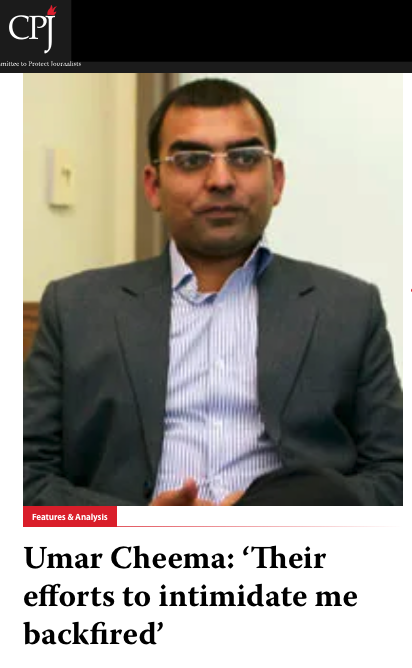
The Committee to Protect Journalists documented the 2011 abduction and beating of journalist Umar Cheema, who was warned during the assault to stop criticizing the government. Image: Screenshot, CPJ
Source mapping must be paired with editorial judgment, though. Umar Cheema, also reinforces this point, “Sometimes you want to do a lot but you don’t have that much information or sources,” he explains. “For evidence gathering, consult experts and your own experience, then ask them for additional contacts. Who knows, people they introduce may become the most valuable sources for your story.”
Cheema also emphasizes the importance of assessing both the reliability and value of sources. “It’s important to see how relevant someone is to your story,” he points out. “Thinking that one person’s view represents an entire institution is wrong. Experts can share perspectives and suggest where to collect data, but they should not guide the scope of your story. You can only use their insights combined with your own journalism experience to see how the story will play out.”
Through structured planning, careful source mapping, and the strategic use of their insights, journalists are able to triangulate information effectively even when physical access is limited, a methodology that holds lessons for investigative reporters operating under restrictive conditions worldwide.
Anticipating Pushback and Retaliation to Your Reporting
For investigative journalists working in high-risk environments, retaliation is not hypothetical, it is increasingly part of the everyday reporting cycle. Legal harassment, surveillance, defamation suits, and threats of detention are treated as foreseeable outcomes, not rare worst-case scenarios. Anticipating these risks has therefore become an integral part of investigative methodology.
In Pakistan, laws such as the Prevention of Electronic Crimes Act (PECA) illustrate how institutional frameworks can amplify dangers. As Azwar Shakeel, a Lahore-based lawyer and consultant with the Human Rights Commission of Pakistan (HRCP) and the International Organization for Migration (IOM) notes: “PECA as it is currently framed has the stated aim of preventing electronic crime but the intended aim of stifling dissent and curbing free speech. In addition, there is a persistent lack of accountability and deep-rooted corruption within law enforcement, which facilitates the abuse of laws like PECA against journalists with impunity. Intelligence agencies’ involvement can have a profound effect on freedom of expression.” While laws like PECA vary and are country-specific, the broader lesson is global: journalists must plan for predictable institutional pressures wherever legal and political systems allow for misuse.
Preparation involves concrete strategies: securing raw data across multiple encrypted locations, coordinating publication timelines, and sharing sensitive material with trusted local or international partners. Adnan Aamir underscores the importance of documentation: “Factual precision and documentary backing are important, not only to strengthen investigations but to prepare for potential legal action.” At the same time, he acknowledges practical limits: “Living in Pakistan, I try to avoid stories that can get me into physical harm.”
Cheema, who himself faced torture and abduction in 2010 for critical reporting on the government, reinforces the principle of measured exposure. “Minimizing public exposure, avoiding social media announcements, limiting bylines, and prioritizing the story over personal recognition reduces the risk of retaliation and protects both the journalist and their work,” he notes.
By treating risk as an integral part of reporting and a realistic threat, rather than an external, afterthought, journalists are able to better structure investigations in ways that preserve both safety and the integrity of the investigation.
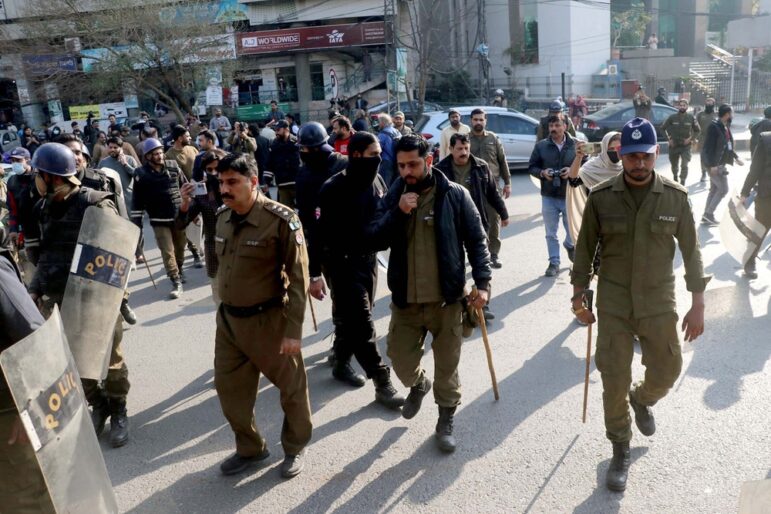
Police in Lahore, Pakistan sweeping up protesters in the wake of the 2024 election. Since the passage of the PECA in 2016, and another restrictive amendment of it in 2025, the press has seen its freedom to report rolled back significantly. Image: Shutterstock
From Lone Reporters to Teams: Collective Authorship and Legal Resilience
Beyond individual precautions, investigative journalists in Pakistan are increasingly adopting team-based reporting. Tasks such as data analysis, document review, field reporting, and verification are divided among specialists, while editors assess risks and decide whether bylines should be anonymized or attributed to the organization rather than individuals. Although collective authorship is still emerging, it has proven effective in reducing the vulnerability of any single journalist and ensuring investigations continue even if a team member faces harassment, legal action, or other pressures. As Cheema observes: “The lone wolf concept in journalism has to change; meaningful change happens as part of a larger evolution.”
Teamwork should be complemented by coordinated legal and professional support, which strengthens overall resilience. The HRCP’s Shakeel highlights the need for “collective, evidence-based support for journalists, legal teams, forums for transparent debate, and public accountability. Officials who abuse laws or intimidate journalists should be identified to create a deterrent effect.”
These internal collaborations not only distribute risk and strengthen investigations locally but also lay the groundwork for effective cross-border partnerships. By establishing clear roles, secure data practices, and coordinated editorial oversight within domestic teams, journalists are better prepared to collaborate with international partners, ensuring that sensitive findings can be safely amplified and protected beyond national borders.
Publishing Across Borders for Protection: International Collaboration as Shield
Lastly, international collaboration has become a vital strategy for investigative journalists in Pakistan, providing both greater reach and protection. Working with global partners allows journalists to publish sensitive findings alongside dozens of outlets worldwide, creating a buffer against retaliation.
Cheema emphasizes the protective value of such networks. “Peer-to-peer collaboration has helped me a lot, from the Panama Papers onwards through the Pandora Papers and Dubai Leaks investigations,” he explains. “Whenever we anticipate potential problems, we ask international coordinators to frame questions so the story is perceived as global, not just Pakistan-based. Many in these projects don’t even know a Pakistani journalist is involved until publication. This helps mitigate risk.”
Coordinated international publication likewise reduces the likelihood of immediate reprisals and makes suppression impractical once findings enter the global record. In addition, journalists in countries with perilous press freedom climates can benefit from shared editorial review, legal vetting across borders, and secure offshore data storage to protect sources and sensitive information. These partnerships also create visibility that can deter attacks; stories backed by multiple reputable outlets carry weight that local-only investigations often cannot.
Aamir highlights another dimension. “Working with local and international peers expands source networks, particularly for cross-border stories, while also providing insulation when pressure escalates.” he says. “International connections offer visibility and support that local journalists often lack.”
Even outside large-scale projects, collaboration shapes domestic reporting. Journalists in Pakistan increasingly coordinate with trusted foreign peers for data verification, legal guidance, and publication strategies, ensuring continuity when local pressures mount. For reporters in restrictive environments, cross-border partnerships are not just about scale, they are a strategy for resilience and safety.
What Pakistan Teaches About Investigative Survival
Pakistan offers a compelling case study of how investigative journalism can endure in environments where formal protections are weak and pressure is routine. The strategies developed by Pakistani investigative journalists — document-driven reporting, team-based workflows, anticipatory risk management, and cross-border collaboration — are not unique, but are applied with exceptional discipline born of necessity.
The ultimate measure of success for an investigative journalist is societal impact rather than personal visibility. Narrow, quick-hit stories may attract attention, but only reporting grounded in accuracy, documentary evidence, and public relevance is likely to withstand institutional pressure and affect lasting change.
For journalists working under similarly restrictive or high-risk conditions, Pakistan’s experience underscores a central lesson: how an investigation is structured matters as much as what it uncovers. Method, collaboration, and preparation are not defensive tactics; they are the conditions that allow investigative journalism to persist, accumulate impact, and endure over time.
 Natasha Matloob is a research assistant at Oxford Global Society. She is pursuing an MPhil in Strategic Studies at the National Defence University, Islamabad and writes on politics, human rights, and security for outlets including The Diplomat, Stimson Centre, and The Friday Times.
International Research Guide: How to Find Experts and Hidden Documents on Any Topic

Guide to Investigating Tech and AI in Modern Warfare
Turning Copernicus Satellite Data Into Public-Interest Climate Stories

10 Practical Tips for Verifying Scientific Claims
Sujag: Investigative Journalism from the Margins of Power in Pakistan

The Blasphemy Business, Real Estate Land Grabs, Instagram Misinformation: 2024’s Best Investigative Stories in Pakistan
Dawn, Pakistan’s Paper of Record, Under Pressure as Military Tightens Grip

How Pakistani Journalists Subvert Danger — and the Narrative — with Data

This work is licensed under a Creative Commons Attribution-NoDerivatives 4.0 International License
Republish our articles for free, online or in print, under a Creative Commons license.
Republish this article
This work is licensed under a Creative Commons Attribution-NoDerivatives 4.0 International License
Read Next
Member Profiles News & Analysis
Sujag: Investigative Journalism from the Margins of Power in Pakistan
Sujag, a long-form digital investigative journalism platform in Pakistan, is committed to highlighting voices from the margins. With recent stories on child marriage, acid attacks, and why women from poor communities are finding it so difficult to access coronavirus vaccinations, Sujag’s editors proudly say their journalistic ethos prioritizes “siding with the marginalized” over neutrality.
Editor's Picks News & Analysis
The Blasphemy Business, Real Estate Land Grabs, Instagram Misinformation: 2024’s Best Investigative Stories in Pakistan
Our annual best-of list features stories on Pakistan’s sanitary workers, links between politicians and sugar mills, and the endless construction of a Balochistan road.
Dawn, Pakistan’s Paper of Record, Under Pressure as Military Tightens Grip
Pakistan’s journalism landscape has lately come under immense pressure from the country’s powerful military. In one of the latest moves to pressure Dawn, Pakistan’s leading English newspaper, the government revoked its ads for the paper, as well as for its sister TV channel, DawnNews. Umer Ali writes for GIJN about the crises.
Data Journalism
How Pakistani Journalists Subvert Danger — and the Narrative — with Data
Journalists exposing corruption in countries with limited rule of law face enormous risks and their stories may not necessarily make things better for anyone. In Pakistan, journalists have employed a different — and safer — approach to trigger positive change by avoiding front-page corruption exposés and using data journalism to expose flaws in the system instead. A GIJN original.