

The Fantasmas del Erario investigation required thousands of access to information requests, massive database cross-referencing and programming, and network analysis tools to detect public procurement patterns spanning two decades. Image: Screenshot, Quinto Elemento Lab
Mexico Scrapped Its Transparency Agency — Journalists Are Still Investigating Corruption
Read this article in
For more than two years, a team of journalists and investigators tracked thousands of public contracts awarded by the Mexican government to shell companies. The result was Fantasmas del Erario, an investigation that documented how more than 11 billion pesos in federal funds — over US$660 million — ended up with companies accused of simulating operations.
Developed by Quinto Elemento Lab and the Observatory on Corruption and Impunity (OCI) at the National Autonomous University of Mexico, the project explains — through 12 reports and a series of visualizations — how, between 2002 and 2022, four administrations awarded 3,529 public contracts to 834 entities designated as shell companies by the government itself.
🔎| Entre 2002 y 2022, el gobierno mexicano firmó 3,529 contratos por más de 11 mil millones de pesos con 834 Empresas que Facturan Operaciones Simuladas, también conocidas como empresas fantasma.
Lee la historia completa aquí:https://t.co/Arrfue0rII
— Quinto Elemento Lab (@quintoelab) December 23, 2025
In addition to revealing the magnitude and consequences of the diversion of public resources toward such companies, Fantasmas del Erario — or Ghosts of the Treasury in English — demonstrated that investigative journalism based on public documents remains possible in Mexico, despite the recent weakening of the country’s transparency system.
The investigation, published in May 2025, required thousands of access-to-information requests, massive database cross-referencing and programming, and network analysis tools to detect public procurement patterns spanning two decades.
The project was a winner in the 2026 Sigma Awards — organized by GIJN — which recognizes the best data journalism in the world.
Data Still Accessible Despite Reforms
Although the more than 3,000 requests for access to public documents for the investigation entailed lengthy and laborious processes, the project demonstrated that journalists still have avenues for accessing public data in Mexico — despite the constitutional reforms that, in March 2025, dissolved the National Institute for Access to Public Information, the autonomous body that oversaw government transparency.
These reforms significantly transformed the National Transparency Platform — the digital system for requesting public information. The platform continues to operate, but oversight and dispute resolution have now passed into the hands of the government itself.
Journalist Violeta Santiago, who led the investigation, said that although the requests for Fantasmas del Erario were submitted prior to the changes, the team had to file several appeals under the new system. In most cases, she said these were resolved in their favor.
“It’s not that everything has stopped working — I must admit that much,” Santiago told LatAm Journalism Review (LJR). “What we have noticed over this past year is that government agencies feel less obligated to provide information; this entails having to put up a fight — somewhat in the hope that the very referee, who is no longer impartial, will ultimately act fairly.”
A large portion of the data upon which this investigation is based was obtained from open sources that do not require formal requests to government agencies: the contracts were downloaded from CompraNet — the government’s digital platform that stores federal public procurement information, the list of shell companies is a publicly available document from the Tax Administration Service, and the companies’ articles of incorporation are available on a platform provided by the Public Registry of Commerce.
“Downloading the data was tedious, but everything was there,” José Nicolás-Carlock, an OCI investigator, told LJR. “Once we had that information, there were no major problems — other than assembling the databases.”
The OCI carried out the first cross-referencing of databases to identify public contracts awarded to shell companies. Given the magnitude of the task, they reached out to Quinto Elemento Lab to join forces, Nicolás-Carlock said.
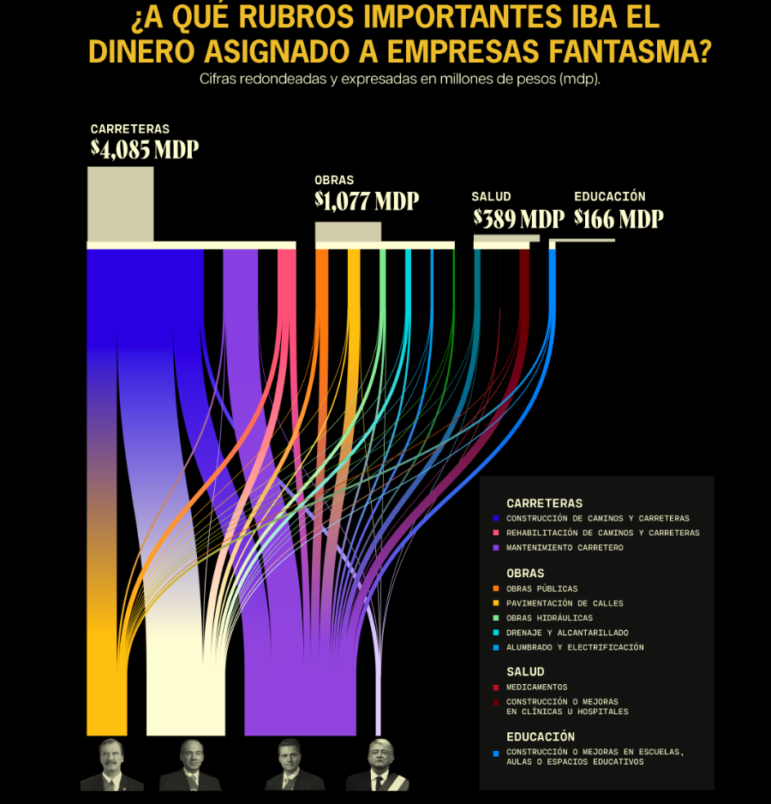
The project explains how four administrations awarded more than 3,000 public contracts to 800 entities designated as shell companies by the government. Image: Screenshot from Quinto Elemento Lab
To strengthen the investigation, the team sought access to all documentation underlying the contracts, including calls for tender, company records, invoices, and evidentiary documents for the services provided.
“For us, it wasn’t enough to simply confirm that a company on this list of shell companies had held a government contract,” Santiago said. “We requested a wealth of documentation — the kind that companies are required to provide during these contracting processes. And that revealed some very telling details, such as the size of these companies or how many employees they have.”
Managing Chaos
Another of the main challenges of Fantasmas del Erario was the capture and organization of information, due in part to the disorganization and gaps of public data, Santiago said.
“The quality of open data and of the data one obtains through transparency mechanisms in Mexico is terrible,” Santiago said. “We are constantly running up against poorly constructed databases, with variables that change over the years.”
For example, the platform from which companies’ articles of incorporation are obtained is decentralized, and the format varies by state, Nicolás-Carlock said. This made it necessary to capture that data manually, he added.
While the list of shell companies contains around 14,000 records, the public contracts database exceeds 800,000, as it encompasses tenders and contract awards spanning a 20-year period. Cross-referencing the two datasets posed a technical challenge, Santiago said.
To this end, the R programming language was of great assistance, said Efraín Tzuc, an investigation assistant and data analyst at Quinto Elemento Lab. R enables the automated connection of databases, using shared data to detect relationships, matches, or patterns.
In the case of Fantasmas del Erario, the data used was the companies’ Federal Taxpayer Registry, Tzuc said.
“That is the difference between being able to cross-reference data sets of hundreds of thousands of records with a smaller one,” Tzuc, who coordinates #CatálisisQEL, Quinto Elemento Lab’s unit for technological applications in investigative journalism, told LJR. “We write code, but we are also journalists. In that sense, we can carry out the kinds of exercises that you can’t do with Excel, for example.”
It was thanks to that cross-referencing that the figure of 3,529 federal government contracts with shell companies during the specified period was found.
Visualizing Corruption
To better understand the role of shell companies in the universe of corruption, it is advisable to analyze them as part of a system, Nicolás-Carlock said. And for this purpose, network analysis proves very useful.
It is a methodology drawn from disciplines such as sociology, biology, and physics for the study of a network and the relationships between its nodes. In a network, nodes can represent people, entities, or objects.
In corruption studies, network analysis makes it possible to identify who is connected to whom, observe money flows and visually identify areas of risk, said Nicolás-Carlock, who trained the Quinto Elemento Lab team.
“I showed them how that information regarding contracts and EFOs [Companies that Invoice Simulated Operations, in English] could be visualized as a network, making it much easier to see the connections that exist,” he said. “For example, which government entities contracted the same EFO.”
Nicolás-Carlock said that the team used Cytoscape — open source software originally developed for research in biology and genetics — which enables the visualization and analysis of complex networks. It allows for interactive navigation to understand patterns and relationships between nodes.
“That helped them a lot, because the data cross-referencing part is the difficult part,” he said. “If you want to know how many companies a shareholder is connected to, and you only analyze the tables, it’s very complicated. But here, it’s visual, you see it automatically.”
Cytoscape also allows for the generation of graphics like those that illustrate some of the reports in the series. Network analysis enabled the team to discover, for example, that many shell companies that received public contracts were linked to one another through shared shareholders, administrators, legal representatives, or notaries.
The Quinto Elemento Lab team decided to grant open access to the Fantasmas del Erario database as an exercise in transparency, but also so that other journalists, activists, investigators, and citizens can explore it.
“We have observed with great pleasure that colleagues have downloaded it, used it or replicated the methodology,” Santiago said. “Ultimately, that is what Quinto Elemento Lab aims to do: foster investigative journalism throughout the country; and in this way, we feel we are achieving that objective.”
Editor’s Note: This story was originally published by the LatAm Journalism Review and is reprinted here with permission.
 César López Linares began his career at the Mexican newspaper REFORMA, and has written for publications such as TODO Austin, Texas Music Magazine, and The Austin Chronicle. He previously wrote about innovation in journalism for the Gabo Foundation in Colombia and currently reports for the Knight Center’s LatAmJournalism Review digital magazine.

GIJN’s Global Guide to Freedom of Information

GIJN Bookshelf: 9 Investigative Titles to Better Understand Latin America

How Quinto Elemento Trains Mexico’s New Generation of Muckrakers
10 Tips for Founding a Successful Investigative Startup
Mexico’s Transparency Institute Helped Reporters Uncover Corruption and Wrongdoing: How Will Investigation Journalism Fare Once It’s Gone?

Investigating Mexico: An Interview with the Reporter, Writer, and Film-Maker Diego Enrique Osorno

How an Investigative Hub Trained a Generation of Reporters in the US-Mexico Border Region

Using Public Information Requests to Investigate Drug Trafficking in Mexico

This work is licensed under a Creative Commons Attribution-NoDerivatives 4.0 International License
Republish our articles for free, online or in print, under a Creative Commons license.
Republish this article
This work is licensed under a Creative Commons Attribution-NoDerivatives 4.0 International License
Read Next
News & Analysis Research
Mexico’s Transparency Institute Helped Reporters Uncover Corruption and Wrongdoing: How Will Investigation Journalism Fare Once It’s Gone?
For decades, the work of INAI helped investigative reporters uncover hidden truths. They fear its abolition will hinder exposés on corruption and human rights abuses.
News & Analysis
Investigating Mexico: An Interview with the Reporter, Writer, and Film-Maker Diego Enrique Osorno
From covering drug cartels to investigating how corruption links to tragedy, the award-winning reporter has made chronicling modern day Mexico his beat.
How They Did It Teaching & Training
How an Investigative Hub Trained a Generation of Reporters in the US-Mexico Border Region
The Mexico Border Investigative Reporting Hub helped new muckrakers shine a light on corruption and human rights issues.
Reporting Tools & Tips
Using Public Information Requests to Investigate Drug Trafficking in Mexico
Here’s how three Mexican investigative journalists have used public information requests to aid their reporting on drug trafficking and the government’s fight against it.