
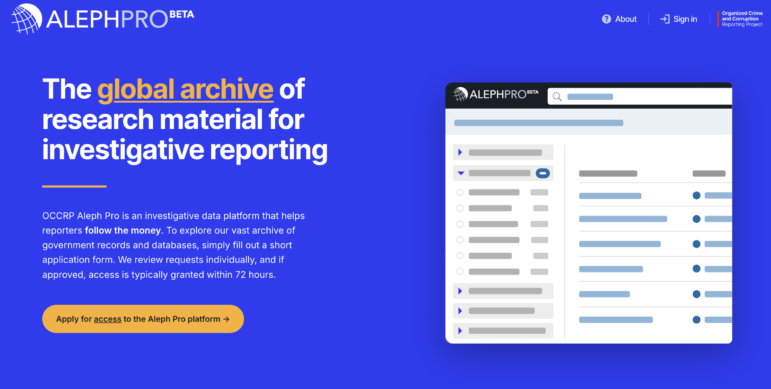
Image: Screenshot, OCCRP
Aleph Pro Tutorial: How to Get the Most from OCCRP’s Updated Investigative Data Platform
Read this article in
Our world is data. Vast amounts of data. And this data holds many stories, often buried behind a confusing collection of documents, spreadsheets, and databases. Finding patterns, trends, and the wider story requires massive swaths of data, the ability to process it, and, most importantly, making it accessible to journalists and investigators who aren’t necessarily data experts.
This is where Aleph Pro comes in. Launched in December 2025, it’s an update of Aleph — a huge data repository hosted by the Organized Crime and Corruption Reporting Project (OCCRP) that includes hundreds of datasets, public records, and leaks from more than 180 countries, with a cross-referencing feature that enables users to search for names and companies of interest and uncover previously unknown connections. Aleph Pro has performance upgrades, a new interface, and new features.
This tipsheet explains how to get started with the Aleph Pro platform and how to make the most of its datasets, cross-referencing capabilities, and new features.
What Is Aleph Pro and What Can It Do?
At its core, Aleph Pro is an entity-based data storage and management system built for easy search and cross-referencing. Do you have a massive dataset of property ownership records? Aleph Pro will take it. A set of leaked bank documents, residency registrations, or a flight manifest? The system can ingest it all.
In practice, this means that it not only stores the original data files, but also automatically extracts a wide range of data points — such as names, addresses, phone numbers, registration numbers, emails, and other key identifiers. This provides a much more intuitive way for researchers to navigate complex datasets, handling the tedious “baseline work” of manually searching for these details.
By cross-referencing this information with existing datasets in the system, Aleph Pro can also unearth connections to other entities that might otherwise go completely unnoticed. Investigative work that once took weeks or months now happens with a single click (and a little bit of waiting).
It can combine those extracted data points to represent full entities such as “person,” “company,” “contract,” or even “court case.” This feature set makes further data processing much easier and quicker.
Crucially, it is a collaborative platform. You can run your own investigations by combining your data with existing datasets. By uploading your own documents, such as FOI records or leaks, you can cross-reference your findings with existing data in Aleph Pro to uncover hidden links. Your uploaded data remains private and will not be shared with other users, but Aleph Pro’s existing database will serve as a powerful baseline for your work.
Furthermore, Aleph Pro can process and search documents in various languages and supports Optical Character Recognition (OCR), making scanned images and PDFs fully searchable. For cross-border investigations, the system can even transliterate search terms across different scripts — for example, returning results for the Cyrillic string “Путин” when you search for “Putin.” To support global teams, the Aleph Pro interface itself is available in six languages: English, German, French, Russian, Arabic, and Spanish.
What Data is Already in Aleph Pro?
Aleph Pro contains approximately 250 datasets from over 180 countries, with a particular focus on Eastern Europe and former Soviet states. But the scope is constantly expanding to other regions. OCCRP also runs automated scrapers to keep datasets up to date. Leaked or hacked datasets are also included, while each case undergoes an ethical review to determine its public interest.
OCCRP’s research and data team collaborates with local partner organizations to gather relevant information, including company registries and government filings.
How Does it Work?
We will walk you through an example investigation to show how you can use Aleph Pro to enrich your investigation and demonstrate some of the functionalities. To get access to Aleph Pro, you need to request it from our official access portal. Your request will be assessed by a member of OCCRP, and if you fit a set of criteria, you should receive access data where you can log in on: https://aleph.occrp.org.
The initial view gives the user an overview of the available datasets already accessible to all users of a certain “security group” for either inspection or using them for their own investigations.
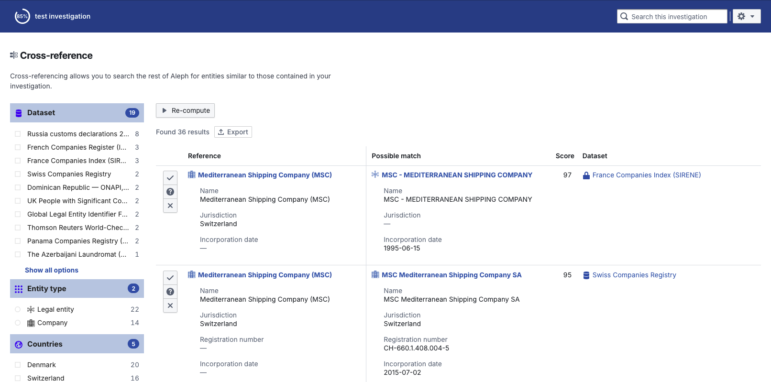
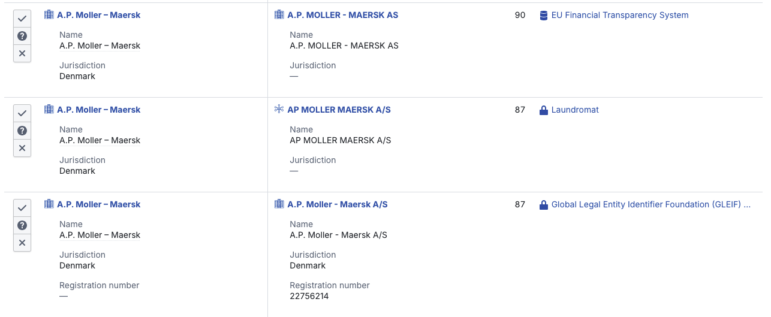
Images: Screenshot, Aleph Pro
Here is a simple example of how an investigation could be conducted. Given a list of corporations, we are trying to find references to those companies in other datasets. This way we will be able to map out the wider involvement of corporate structures, ownership, jurisdiction, involvement of individuals, and possible traces to court cases or other malfeasance. We start with a list of a handful of selected companies, compiled based on certain criteria earlier. Like operators at a certain port, for example.
The more detailed information we can provide for each of the companies, the better Aleph Pro will perform down the road. A list of company names is good, but having specifics like telephone numbers, tax numbers, and addresses provides a much richer set of data.
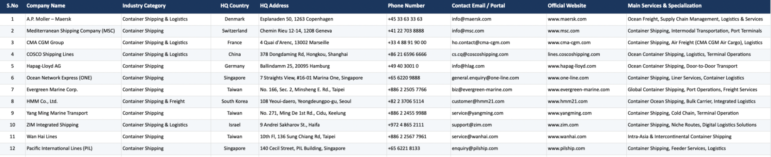
Image: Screenshot, Aleph Pro
After uploading the Excel file and letting the system extract the different company entities, a cross-reference of all the fields indicates in which other datasets these companies can be found. For example, the famous Panama Papers or the Slovakian Public Sector Partner Register. A reminder: Aleph Pro can only use data that is already stored in its own database.
This provides us now with clues for further research. For example, an investigator could now revisit the Laundromat dataset and see which specific records can be found on this match. All this could also be done directly in Aleph Pro.
Image: Screenshot, Aleph Pro
Of course, all these matches can be exported in several data formats for further investigations outside of Aleph Pro, allowing further post-processing via proprietary data analysis systems of other media outlets.
Aleph Pro is not just limited to Excel tables; it can handle a wide range of file formats. The system can extract datasets from unstructured document scans, PDFs, or JPEGs. The ‘cleaner’ the data input, the easier it is for Aleph Pro to do its work.
Additional Features
To expand Aleph Pro’s functionality as an investigative tool, there are a handful of additional features.
Each investigation, for example, also offers a canvas for investigators to build diagrams of the entities in the dataset, allowing them to quickly create a visualization of connections and relationships between individuals, companies, assets, and other entities — making dry, unintuitive data structures more accessible.
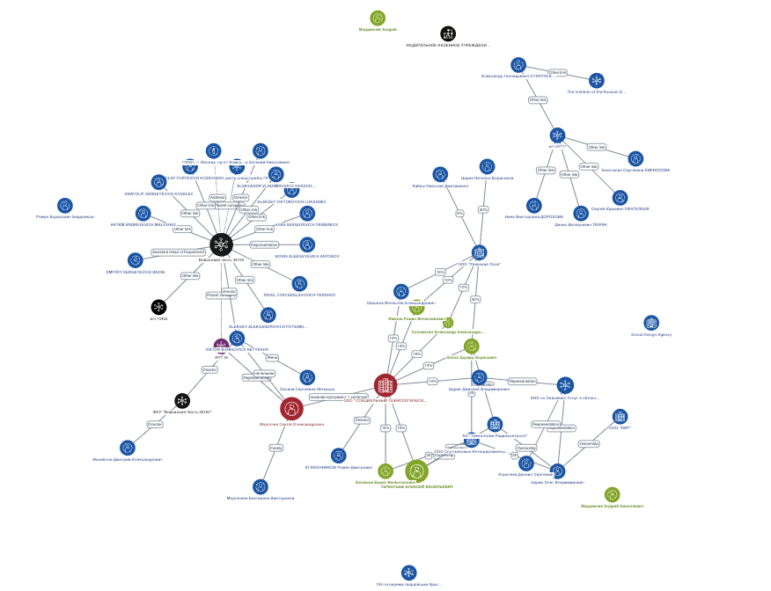
Image: Screenshot, Aleph Pro
Another new feature that helps to structure big datasets is the “List” functionality, which enables investigators to combine different entities into comfortable lists, to keep on top of complex data classifications along topics, shared characteristics, or other meta indicators that are not provided in the base entity structure by Aleph Pro.
Last but not least, the “Timelines” functionality serves as a chronological view on a manually selected set of entities inside an investigation.
Finally, Aleph Pro can also be a security shield. Files uploaded to Aleph Pro that can carry malware get ‘defanged’ and only exist in the Aleph Pro database — protecting your own system from damage.
Conclusion: Making the Most of Aleph Pro
Aleph Pro is a resource that helps journalists uncover connections in vast datasets. By combining Aleph Pro’s existing data with your own materials, you can conduct deeper investigations and track complex networks more effectively. Whether you are starting out or looking to use advanced features, Aleph Pro is a practical tool designed to support investigative reporting across borders. Visit our Aleph Pro Discourse community forum to learn more.
OCCRP regularly offers virtual training sessions on Aleph Pro’s advanced features. Journalists interested in deepening their understanding of the platform can participate in these sessions to learn more.
Due to funding and resource constraints, OCCRP has since sunsetted development of the legacy version of Aleph, an open source platform. In December 2025, they released Aleph Proᴮᴱᵀᴬ, a complete rewrite of the system.
 Marc Hofer is the data editor at the Organized Crime and Corruption Reporting Project.

Researching Corporations and Their Owners

Follow the Money: Investigating Shell Companies
Tipsheet for Reporters: How to Get the Best from OCCRP’s Aleph

Step-By-Step Guide for Journalists on the Basics of Google Sheets
Tipsheet for Reporters: How to Get the Best from OCCRP’s Aleph

Tips for Linking Shell Companies to their Secret Owners

‘True Justice is Years in the Making’: 10 Years on from the Panama Papers

New Tools for Geolocation, Collaboration, Illicit Finance, Deportation Data, and Bad-Actor Tracking

This work is licensed under a Creative Commons Attribution-NoDerivatives 4.0 International License
Republish our articles for free, online or in print, under a Creative Commons license.
Republish this article
This work is licensed under a Creative Commons Attribution-NoDerivatives 4.0 International License
Read Next
Tipsheet Reporting Tools & Tips
Tipsheet for Reporters: How to Get the Best from OCCRP’s Aleph
In investigative journalism, connecting data points is often key to uncovering the truth. Aleph helps reporters search, organize, and analyze data, to better trace hidden connections.
Investigative Techniques Reporting Tools & Tips
Tips for Linking Shell Companies to their Secret Owners
At a recent panel at the 2024 NICAR conference, Karrie Kehoe, deputy head of data and research at ICIJ, offered a series of tips for investigating the true owners of shell companies.
News & Analysis
‘True Justice is Years in the Making’: 10 Years on from the Panama Papers
A look back at a decade of changes after the Pulitzer-Prize winning exposé sent shockwaves through the offshore world, spawning criminal probes and bringing down governments.
GIJN Toolbox
New Tools for Geolocation, Collaboration, Illicit Finance, Deportation Data, and Bad-Actor Tracking
At the NICAR 2026 conference, dozens of leading data journalists shared some of their favorite digital tools and databases for investigating numerous topics.