
Finding Joy in the Public Service of Journalism
‘The Worst Crisis for Press Freedom’: How to Report in Asia’s Challenging Environment
Investigating Inside Conflict Zones and Areas Controlled by Armed Groups: Lessons from South Asia and the Middle East
Pro-China Propaganda, Espionage Tools, Green Illusion: 2023’s Best Investigative Stories from Southeast Asia
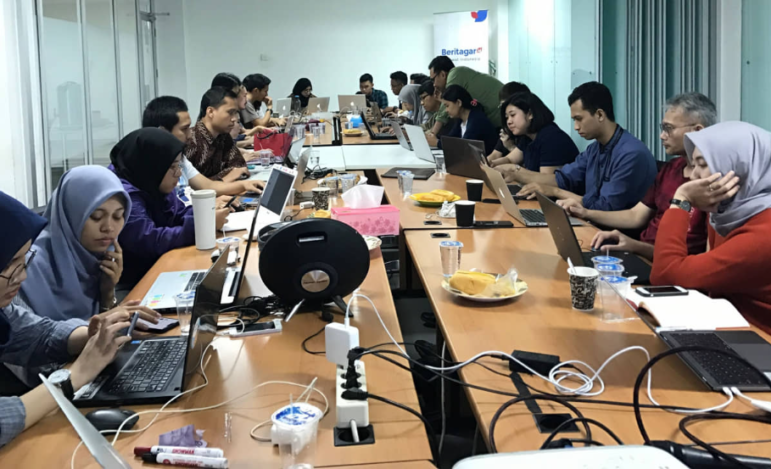
Data Journalism Pioneers at Work Across Southeast Asia
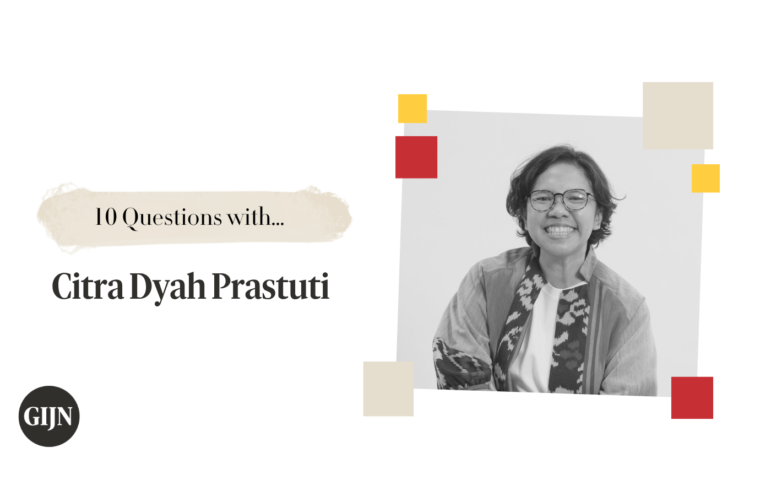
Citra Dyah Prastuti describes herself as “the KBR person,” having worked for Indonesia’s national broadcaster for 24 years — half her adult life.
Prastuti joined KBR — which stands for Radio News Agency — in 2002, starting as a political and national affairs reporter. Martial law was declared in 2003 and in the same year, she covered the military offensive launched against the separatist movement in Aceh as an embedded journalist. The campaign in Aceh was the government’s largest military operation since the occupation of East Timor.
After a sabbatical to pursue postgraduate studies in the UK as a Chevening Scholar, Prastuti was back at KBR covering the political developments in the region and as editor of the award-winning Indonesian radio feature program Saga and Asia Calling, an English-language broadcast to Southeast Asia, South Asia, and Australia.
Prastuti was quickly promoted, and became KBR’s chief editor and director in 2014. One of her key goals in that position was creating new ways to use the intimacy of audio to bring stories closer to the audiences listening across hundreds of KBR’s radio stations across the country.
Under her leadership, KBR went on to win awards such as Best Innovative Digital Product in the 2024 Digital Media Awards Asia by the World Association of News Publishers (WAN-IFRA) and Best Journalistic Work About Children in the radio category by UNICEF and the Alliance of Independent Journalists – Indonesia for the investigative podcast series, “Dipaksa Kawin” (“Forced to Marry”), which examined Indonesia’s child-marriage crisis. In 2018, she received a Courage in Journalism Award from the Pantau Foundation in recognition of her coverage of democracy, religious tolerance, and human rights.
Beyond the journalistic accolades, Prastuti worked to make the newsroom a safe and inclusive space for reporters. As a gender, equality, diversity, and inclusion trainer, Prastuti established safeguards to prevent and respond to gender-based violence, and set up an implementation task force. In 2024, UN Women Indonesia named KBR second runner-up for workplace gender equality.
Eni Mulia, executive director for Indonesia Network for Investigative Journalism (jaring), worked with Citra at KBR for many years starting in 2002 and considers her “my best traveling mate” for their many work-related trips that include attending GIJN conferences. “Citra is someone who consistently keeps a cool head when facing difficult challenges, both in her personal and professional life,” End said. “Throughout our long-standing friendship, I have never seen her give up in any situation.”
Prastuti’s LinkedIn profile lists “a bundle of joy” among her credentials — a title she has chosen to reflect how she has chosen to live her life. “I tend to look for the lighter, happier side of things — even in situations that are supposed to be perceived as sad,” said Prastuti.
There’s been remarkable personal resilience too: 2026 marks the 10th year of living with breast cancer. She has gone through a series of treatments since 2016 and documented her journey in her blog, Virgo meets Cancer, a play on her star sign. She is soon set to receive an injection that signals the completion of the prescribed treatment. “Let’s say goodbye to all the cancer cells — forever!” she said, crossing her fingers.
Currently, Prastuti is establishing Info Lansia — “lansia” means elderly in Indonesian — a public service platform to help others understand aging as a family, community, and public health issue. Alongside this, she is the vice chairperson of the Association for Cyber Media in Indonesia, where she advocates for media literacy to combat fake news, hoaxes, and disinformation.
Info Lansia is deeply personal to Prastuti who counts herself among the “sandwich generation” of people aged 25-45 who are simultaneously caring for older parents, raising kids, and building their career.
“Preparing for your own aging and retirement is one of the greatest acts of love you can offer your future self — and your family,” she says. “That is why I believe every generation needs to start talking about it earlier and prepare for it not only with resilience, but also with dignity, openness, and joy!”
GIJN: Of all the investigations you’ve worked on, which has been your favorite and why?
CDP: My favorite would be Disclose, KBR’s first investigative podcast series on child marriage in Indonesia. Through GIJN, we had the opportunity to work with Susanne Reber, who mentored us from the earliest brainstorming and script development through production, marketing, and promotion. (Editor’s Note: Read more on how GIJN Advisory Services worked with KBR.)
What made Disclose special for me was how much we were able to experiment. We pushed ourselves on storytelling, story arcs, and sound design, while also thinking carefully about how the series could create impact beyond the podcast itself.
The positive audience response was rewarding, but what stayed with me most was the learning process. Disclose showed me how rigorous investigative journalism and strong narrative storytelling can reinforce each other and how, when done well, they can bring renewed public attention to an issue as important as child marriage in Indonesia.

The podcast art for Dipaksa Kawin, or Forced to Marry. Image: Screenshot, Disclose, KBR
GIJN: What are the biggest challenges in terms of investigative reporting in your country?
CDP: Indonesia is currently experiencing a decline in press freedom with rising threats and violence against journalists, as well as recent mass layoffs that have affected thousands of media workers. We at KBR were also part of the story.
With my recent role as a publisher, I can see how the Indonesian media ecosystem presents a big challenge to press freedom. Many media companies rely on government advertising budgets to survive, along with local ads. This does not put the media in a strong position to freely criticize the government. The biggest victim is the public because they have limited access to quality journalism that exposes wrongdoing by public officials.
A recent study shows another challenge to investigative reporting in Indonesia: self-censorship. According to the 2025 Journalist Safety Index, a total of 80% of journalists admitted to having practiced self-censorship, while 72% of respondents stated that they had experienced censorship. This is such a “Big Brother is watching” moment for Indonesia — and it’s frightening.
GIJN: What’s been the greatest challenge that you’ve personally faced in your time as an investigative journalist?
CDP: Leading a small newsroom meant making difficult choices about where to put our limited time, people, and resources. Investigative journalism required us to stretch beyond our capacity, but I saw it as my responsibility to create the conditions for strong journalism to happen — to protect editorial space, back my journalists, and make sure quality was not sacrificed simply because we were small.
IndonesiaLeaks, a collaborative investigative report exposing government corruption, was one of the moments that tested that leadership most clearly. As chief editor, I had to defend not only the story, but also the reporting process, editorial judgment, and ethics behind it. I remember having a serious conversation with my boss about why publishing mattered. Other newsrooms faced pressure over the potential business consequences; KBR moved forward. Senior editorial leadership is ultimately about taking responsibility for difficult decisions and standing behind your journalists when the stakes are high.
GIJN: What is your best tip for interviewing?
CDP: An interview is basically a conversation. You need to know why you need to have the conversation, what to talk about, and you need to know the person you are talking to. The person you interview can be a president, a minister, or someone you see on the streets — behind every label or position, there’s a human being. When you see an interview as a conversation, you will treat the other person equally.
Also important is building trust. It’s something that you need to learn over time. You need to trust the person you interview, and vice versa. One of the ways to build trust is to do your research thoroughly, as the foundation for feeling confident throughout the interview.
GIJN: What is a favorite reporting tool, database, or app that you use in your investigations?
CDP: As a small newsroom, we stuck to the basics of reporting — talking to people, compiling data, etc. If we could include AI in this, AI tools were mostly used to assist us in the pre-production process. If I could turn back time, I would encourage the newsroom to explore data journalism more. Looking back, I see that as a missed opportunity to strengthen our reporting, uncover deeper patterns, and give our journalists more tools to tell complex stories with greater impact.
GIJN: What’s the best advice you’ve gotten in your career and what words of advice would you give an aspiring investigative journalist?
CDP: Be patient. When you are going deep with sources, working through data, and trying to build a strong story, exhaustion can easily set in. That is often when the temptation comes to rush, finish the story, and simply move on. But good journalism needs time. Time to earn the trust of sources, develop the story arc, verify every detail, and make sure the journalistic process remains rigorous and intact. Patience is not simply about waiting; it is part of the discipline of producing journalism that matters.
I would also add another: keep swimming — like Dory in “Finding Nemo.” Journalism is not an easy profession. There will always be difficult stories, skills you have yet to master, leads that go nowhere, and questions you cannot immediately answer. What matters is that you keep moving.
For me, “keep swimming” also means continuing to learn. It means knowing where you want to go while remaining curious enough to fill in the gaps along the way. As journalism continues to change, that mindset will become even more important. The tools, platforms, and challenges may evolve, but the willingness to learn, persist, and keep asking better questions is what will keep journalists — and journalism itself — moving forward.
GIJN: Who is a journalist you admire, and why?
CDP: I have to name Susanne Reber. Not only because she mentored us during the production of the Disclose podcast series, but because working with her gave me something quite rare: the opportunity to understand both the craft behind a story and the impact of the finished work.
It felt like having a 360-degree view of the storytelling process — seeing how a story is conceived, shaped, produced, and ultimately received by audiences. I was not simply admiring someone’s work from a distance; I was able to observe how she thought, how she made editorial choices, and how those decisions translated into the final product.
The more I learned from Susanne, the more I found myself going back to her other podcasts, listening with a different ear and trying to connect what I heard with what I had learned from her during the mentoring process. That experience deepened not only my understanding of podcast storytelling, but also the way I think about editorial craft more broadly.
GIJN: What is the greatest mistake you’ve made and what lessons did you learn?
CDP: Never underestimate preparation. One of my former editors used to tell me that good preparation is already half the work. Over time, however, once you have done something many times, it becomes easy to take preparation for granted.
I have learned that this is when mistakes happen — an interview does not go as deeply as it could, an important detail is missed, the recorder is not switched on, or the final story does not land the way you had hoped. Experience can make you more confident, but it should never make you less prepared. To me, preparation is not a sign of insecurity. It is a sign that you respect the work, the people involved, and the responsibility of getting the story right.
GIJN: How do you avoid burnout in your line of work?
CDP: Over the years, I have learned that you need to give your mind permission to pause and yourself permission to take a break. This may not work for everyone, but I find cleaning surprisingly therapeutic. I can spend hours cleaning the house because it allows me to stop thinking for a while.
Another thing that has kept me going is finding something new in the work and embracing it. From the outside, staying in the same profession for many years may look like being trapped in a comfort zone. I have never experienced journalism that way. There is very little that feels comfortable about it. The questions change, the people change, the challenges change — and there is always something new to learn. That continuing sense of curiosity and discovery is what has kept journalism exciting for me all these years.
GIJN: What about investigative journalism do you find frustrating, or do you hope will change in the future?
CDP: What frustrates me most is not that investigative journalism takes time — good stories should take time. The frustration is how difficult it has become for newsrooms to protect that time.
At KBR, investigative work often happened alongside daily production for radio, web, and social media. We made it work because the journalists were deeply committed, but it showed me how fragile investigative journalism can be when it depends too much on individual sacrifice.
I hope the future brings stronger, more sustainable newsrooms, more collaboration, and greater investment in journalists’ skills, safety, and well-being. Investigative journalism should not survive because journalists are willing to sacrifice everything for a story. It should thrive because institutions are willing to protect the people, time, and independence that make those stories possible.
 Ana P. Santos is a journalist with more than a decade of experience. Her work has been published by Rappler, DW Germany, The Atlantic, and The Los Angeles Times. She specializes in reporting on gender issues related to sexual reproductive health, HIV, and sexual violence, and as the Pulitzer Center 2014 Persephone Miel Fellow, she reported on labor migration in Europe and the Middle East.
‘The Worst Crisis for Press Freedom’: How to Report in Asia’s Challenging Environment
Investigating Inside Conflict Zones and Areas Controlled by Armed Groups: Lessons from South Asia and the Middle East
Pro-China Propaganda, Espionage Tools, Green Illusion: 2023’s Best Investigative Stories from Southeast Asia
Data Journalism Pioneers at Work Across Southeast Asia

A Cross-Border Collaboration Exposes Digital Sex Crimes in Asia

Advice from a Pioneer of Investigative Journalism in the Chinese-Speaking World
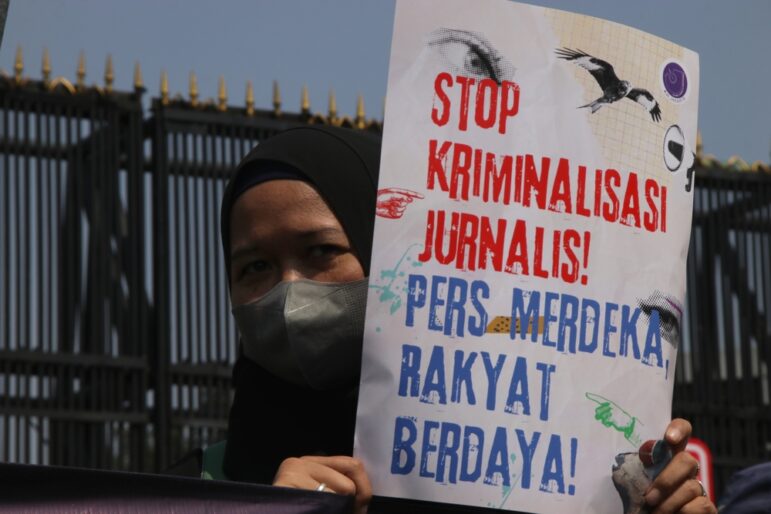
‘Make-or-Break Moment’: Wahyu Dhyatmika on the Growing Threats Confronting Independent Journalism in Indonesia
IndonesiaLeaks: Officials Attack First Investigative Report From Whistleblower Platform

This work is licensed under a Creative Commons Attribution-NoDerivatives 4.0 International License
Republish our articles for free, online or in print, under a Creative Commons license.
Republish this article
This work is licensed under a Creative Commons Attribution-NoDerivatives 4.0 International License
Read Next
News & Analysis
A Cross-Border Collaboration Exposes Digital Sex Crimes in Asia
How did a team of reporters across Asia investigate digital sex crimes, and what did they learn about interviewing victims of image-based abuse during their deep dive into this phenomenon? Sarah Karacs speaks to the team to find out how the collaboration worked, and what they learned about a phenomenon of growing concern worldwide.
10 Questions Asia Focus
Advice from a Pioneer of Investigative Journalism in the Chinese-Speaking World
The award-winning reporter and deputy CEO of Taiwan’s The Reporter says public support is the “vital force” that ensures investigative journalism continues to exist.
News & Analysis
‘Make-or-Break Moment’: Wahyu Dhyatmika on the Growing Threats Confronting Independent Journalism in Indonesia
For veteran journalist Wahyu Dhyatmika, Indonesia’s intensely challenging press climate is a wake-up call for the media to retool its business model and refocus on serving the public.
News & Analysis
IndonesiaLeaks: Officials Attack First Investigative Report From Whistleblower Platform
Top officials in Indonesia are dismissing the first collaborative investigative report from IndonesiaLeaks, which was released earlier this month. The report, which implicated a top police official in a bribery case, has resulted in a massive social media campaign aimed at discrediting the investigation, while one of the group’s media partners was hit by a denial of service attack, knocking it offline for several hours.