
Image: GIJN, YouTube
Confronting the AI Paradox: Potential Source of Abuse and Misinformation vs. Game-Changing Newsroom Reporting Tool
Read this article in

Resource Guide
Tech Focus Project

Resource Guide Chapter
The Investigative Agenda for Tech and AI Journalism
Resource Guide Chapter
Radical Collaboration: Why It’s the Antidote to Big Tech
Resource Guide Chapter
Holding the Power of Big Tech Accountable
Resource Guide Chapter
Gabriel Geiger Shares Tips and Tools on Investigating Government Use of AI

Resource Guide Chapter
Making Tech Surveillance a Reporting Beat
Resource Guide Chapter
John Scott-Railton Shares Tips and Tools to Protect Yourself Digitally

Resource Guide Chapter
Investigating Location-Tracking Surveillance Systems

Resource Guide Chapter
Investigating Disinformation in the Age of AI
Resource Guide Chapter
Karen Hao on AI Narratives Reporters Should Deconstruct

Resource Guide Chapter
Leveraging AI and Technology to Investigate Power
Resource Guide Chapter
Tips for Using AI as a Reporting Tool to Uncover Wrongdoing
Resource Guide Chapter
Gina Chua on 4 Tips for Innovative Journalism in the Age of AI
Global Academy Webinars Resource Guide Chapter
Webinar: Detecting AI-Generated Content – Updated Tools and Techniques
Resource Guide Chapter
Athandiwe Saba Shares Practical Tips on Investigating Big Tech in Africa

Resource Guide Chapter
Investigating the Human Cost of Tech

Resource Guide Chapter
Techniques for Investigating Data Centers
Resource Guide Chapter
Credits and Acknowledgments
In the sci-fi world of Dune, Paul Atreides harnesses the power of the spice to break an empire whose dominance rests on exploiting it and turning it into fuel for political control. Spice expands human perception and grants strategic advantage, which is why the empire relies on it, but that’s also the reason why the story’s hero uses the substance against the system built to profit from it.
A similar paradox now haunts modern newsrooms. Large language models and related technologies, arguably the closest thing in daily life to science fiction, are rapidly becoming key tools for journalism. Newsrooms often deploy AI and LLMs to analyze vast amounts of data and supercharge accountability reporting — and ironically their targets are frequently the very companies producing and profiting off of AI.
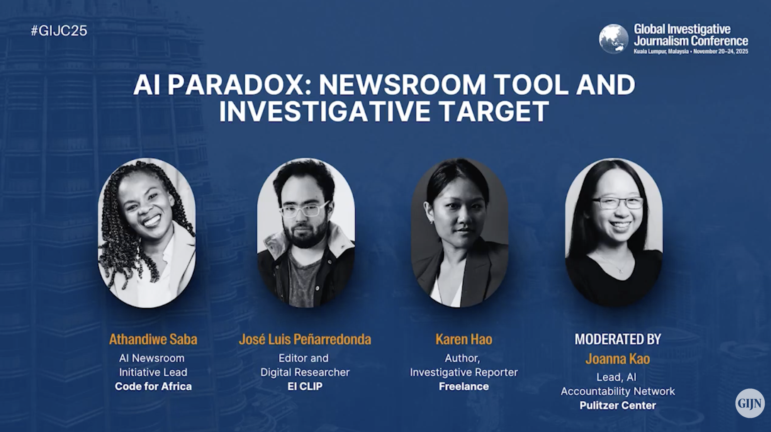
Athandiwe Saba, AI Newsroom Initiative lead at Code for Africa, José Luis Peñarredonda, editor and digital researcher for the Latin American Center for Investigative Journalism (El CLIP), and Karen Hao, investigative reporter and author of “Empire of AI,” came together for a GIJC25 session to discuss this contradiction, moderated by Joanna Kao, lead of the Pulitzer Center’s AI Accountability Networks.
Pinning Down the Meaning of AI
To start, the panelists sought to establish an agreed-upon definition of AI. The term “artificial intelligence” has been around since the late 1950s, referring to machines that seemed to imitate human thought by following rules and recognizing patterns based on data inputs. But the meaning has shifted recently. Generative AI, the technology that burst into public use in the 2020s, produces novel outputs like text, images, and code that mimic human creativity, by learning statistical patterns from vast amounts of training data. This is what AI has come to mean.
But Hao urged reporters to reflect on the power dynamics behind this semantic shift, because it favors the interests of “big tech” companies that have based their business model on aggressive technology scaling, which can devastate the environment and cause deep social harms. AI doesn’t have to be synonymous with “large scale generative AI,” she noted.
“I like to think of the word ‘AI’ as I think of the word ‘transportation.’ I think it’s the most useful analogy. Transportation can refer to anything, from a bicycle to a rocket, they’re all different technologies that bring us from point A to point B, but clearly, they’re designed differently, there are different cost-benefit trade-offs”, Hao explained. “AI is a similar thing. I think of generative AI as the rocket of AI, as it’s the most expensive to develop. We don’t want rockets to be in the hands of everyone and tell them that they can use the rocket for anything.”
Hao said there are smaller, more focused AI tools that could be considered the bicycles of AI. They’re much friendlier or less impactful on the environment, require less data to train, and are less socially risky than the generative AI that big tech hands over to internet users for free. As examples, she cites certain tools for detecting objects in images or the DeepMind AI system for protein folding that won the researchers the Nobel Prize for Chemistry.
But while our society finds ways of scaling back and better adjusting AI to its needs — or decides if it even wants to — newsrooms need to hold the so-called rockets and rocketmakers accountable. So, while big tech accelerates this “rocket approach” to AI, what questions should investigative journalists be asking?
Making AI Accountable
Code for Africa’s Saba emphasized that journalists must start asking basic questions: Where is the information you’re working with while using AI? Where is that information coming from? How has this technology been built? What are the algorithms behind this tool?
These questions are meant to start grappling with a technology that’s easy to take for granted. Saba explained that one of the biggest problems she’s encountered is helping ordinary people, or even journalists, recognize the problems behind AI. People have trouble seeing beyond its capacity to make their lives somewhat easier or more fun, by editing their texts or making memes for them. So the real challenge is to drive home why the questions she poses above are important. And why the answers to some of those questions should make us stop and reflect on the safety of the “rockets,” to come back to Hao’s analogy.
The information AI works with is processed in enormous data centers that demand huge amounts of energy and water. AI’s information comes from aggressive, large-scale training that has often flouted copyright and privacy laws, and has been documented relying on underpaid labor from developing countries. AI has been built by accumulating some of the most powerful and advanced graphics processing units, which is why the graphic processing chip company Nvidia became the cornerstone of AI technology and needs a constant supply of rare earth minerals. The resources to build AI come from large-scale investors, like Microsoft in the case of OpenAI. The capital demands of continually scaling AI pressured OpenAI, once a nonprofit meant to create safe open source technology, into a for-profit behemoth, in part to receive Microsoft as an investor. And the algorithms behind AI can be initially understood by humans, but their final product is a mystery. Programmers specify the architecture and training objective of AI, but optimization over massive amounts of data yields distributed nonlinear representations whose behavior can’t be cleanly mapped back to human-readable rules. Generative AI is in many ways a black box.
This is just one way of framing the answers to Saba’s questions. Journalists will find others, because exploring each of these issues opens avenues for conducting investigations on corporate compliance, investor schemes, environmental degradation, and the ethics of allowing children and teenagers to interact with a tool not even fully understood by the people who designed it.
Saba has also centered her research on how technologies such as AI and social media are spreading misinformation and hate faster than we can make sense of, or counter it. African countries whose governments have been destabilized by misinformation, for example, are precisely those where critical minerals used to build AI are found:
“So you start making these connections between big tech, the social media companies, and now AI artificial intelligence as well, and the critical minerals,” Saba warned. “There’s a big push right now around Ibrahim Traoré, the transitional leader in Burkina Faso. There are images and videos, supposed videos, which are AI-generated, spreading the message of him as an amazing leader, which are not marked, watermarked in any way, and are spreading so much faster than we’ve ever seen before,” she added.
José Luís Peñarredonda has also approached AI from a political angle. Regulatory debates are especially interesting, in his view, because key political decisions regarding technology are settled through them. So, he suggests journalists ask themselves: How are political decisions about technology made? Who is talking (in regulatory debates) and, just as importantly, who is NOT talking (identify voices absent from those debates)?
And in a broader sense, Peñarredonda also suggests tackling many of the big questions about AI’s repercussions: What impact does AI have on employment? How is it affecting power consumption? Why are some people affected by these issues not speaking out? Are they intimidated? Do they not have enough information about how AI is affecting them? What political decisions are being made around AI? Who has the power to make them? Who runs the risks if something goes wrong? Who benefits from the decisions?
Peñarredonda mentioned that, in Colombia, some media outlets are publishing articles with sensationalist approaches to AI: “There’s this style of article claiming things such as ‘AI says who is the best presidential candidate’ or ‘AI says who should be the next coach of the Colombian national soccer team,’” he noted. But Peñarredonda sees an opportunity for rigorous journalists to ask deeper questions: “Asking yourself what it means AI ‘said’ those things and why is very important,” Peñarredonda added. There is a reason why AI is providing these results, and of course, there’s a reason why some media outlets are interested in creating a false sense of truth or value behind the results.
How Should Journalists Responsibly Use AI While Investigating AI?
How to approach the tool? How to engage with the companies that make the “rocket” without causing further damage?
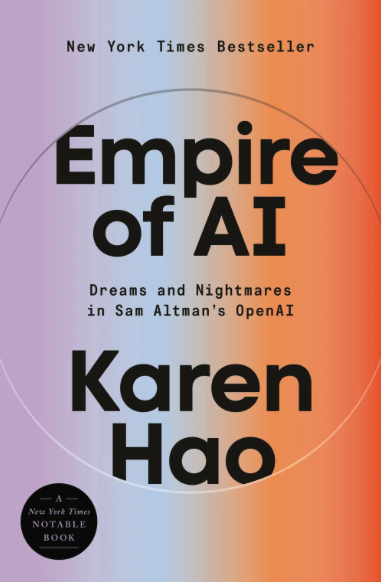
Image: Screenshot, Karen Hao
Karen Hao has a blunt answer: “I don’t use generative AI at all in my work or in my personal life.” The “Empire of AI” author made this decision because using generative AI doesn’t really strengthen her work, she has found, which depends on talking to people and writing. Also, the time she spent investigating these companies led her to take the ethical stance of not using their technology. Finally, she pointed out that it would create a huge privacy concern to take the wealth of data she has amassed during her investigations and then effectively provide the same companies’ data processing tools access to it.
That could be one of the clearest red lines for journalists: don’t use generative AI in your investigative piece if you’re muckraking the company that owns the product.
Saba also advised against using generative AI from the get-go. She suggests journalists ask themselves what exactly AI will help you with and how specifically the tool will save you time. There are AI-based production tools that organizations use for drafting, summarizing, translating, tagging, and accelerating the mechanics of publication. But sometimes generative AI can make your work more inefficient, especially because you are forced to verify all the information it gives you. AI is prone to hallucinating and manufacturing false data.
One of the things Saba helps newsrooms and organizations with is determining how and for what they will use AI. She insists these are crucial questions to confront, and the first one she always asks a team she works with is: What are your AI guidelines?
Peñarredonda suggested journalists exercise the same caution with AI as they would with tools like messaging apps and cloud services. Are they private or not? How do they manage your sensitive data? Is it responsible to share information that could place your sources at risk on these platforms?
So if you’re not ready to take Hao’s AI-free stance, it’s nevertheless critical to be cautious and aware. You’re not only boarding a so-called rocket at your own risk, but you also have an audience and sources you’re accountable to. Report responsibly and with a clear objective.
Karen Hao and Joanna Kao, from the Pulitzer Center, closed the session by sharing the courses and tools offered to help journalists navigate the challenges posed by AI. You can access Hao’s Artificial Intelligence Spotlight Series here.
Watch the full GIJC25 panel video below.
 Santiago Villa is an award-winning journalist who has written for Latin American news outlets for more than a decade. He is currently based in Colombia and writes an opinion column for El Espectador. He has previously worked as a foreign correspondent in South Africa, China, Venezuela, and Ecuador.

Reporter’s Guide to Detecting AI-Generated Content

Guide to Investigating Social Media Algorithms

Investigating Elections: Threat from AI Audio Deepfakes

Guide to Investigating Tech and AI in Modern Warfare

Tips to Investigate AI Labor Abuses in the Global South

‘Every Reporter has an AI Story to Tell’: Tips from an Award-Winning Journalist on the Risks of AI

Using AI and Satellites to Track Illegal Fishing in Marine Protected Areas

Global Collaborations and AI: Navigating the Future of Investigative Journalism

This work is licensed under a Creative Commons Attribution-NoDerivatives 4.0 International License
Republish our articles for free, online or in print, under a Creative Commons license.
Republish this article
This work is licensed under a Creative Commons Attribution-NoDerivatives 4.0 International License
Read Next
GIJC25 News & Analysis
Tips to Investigate AI Labor Abuses in the Global South
Workers in East Africa and South Asia are now paid low wages to perform behind-the-scenes data tasks are used to power AI-driven facial recognition systems around the world.
GIJC25
‘Every Reporter has an AI Story to Tell’: Tips from an Award-Winning Journalist on the Risks of AI
Karen Hao — one of the world’s leading voices on the impacts and potential harms of artificial intelligence — speaks to GIJN ahead of her appearance at GIJC25 in Malaysia.
Using AI and Satellites to Track Illegal Fishing in Marine Protected Areas
Using artificial intelligence and synthetic aperture satellite technology, investigators can better identify and document illicit activity at sea.
GIJC23 Reporting Tools & Tips
Global Collaborations and AI: Navigating the Future of Investigative Journalism
Three veteran journalists shared tips on maximizing the potential and navigating the pitfalls of artificial intelligence and cross-border collaborations.