
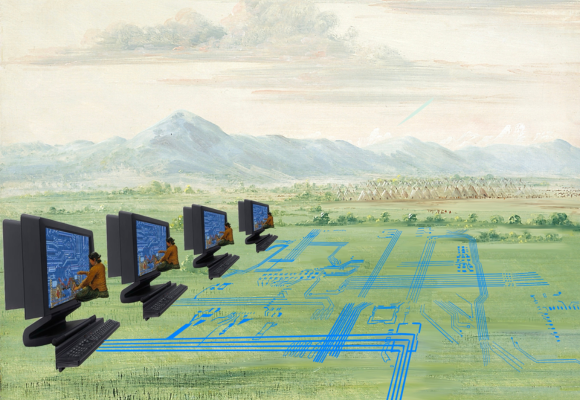
Image: Hanna Barakat & Archival Images of AI + AIxDESIGN (Better Images of AI), Creative Commons BY 4.0 license

Resource Guide
Tech Focus Project

Resource Guide Chapter
The Investigative Agenda for Tech and AI Journalism
Resource Guide Chapter
Radical Collaboration: Why It’s the Antidote to Big Tech

Resource Guide Chapter
Holding the Power of Big Tech Accountable
Resource Guide Chapter
Gabriel Geiger Shares Tips and Tools on Investigating Government Use of AI

Resource Guide Chapter
Making Tech Surveillance a Reporting Beat
Resource Guide Chapter
John Scott-Railton Shares Tips and Tools to Protect Yourself Digitally

Resource Guide Chapter
Investigating Location-Tracking Surveillance Systems

Resource Guide Chapter
Investigating Disinformation in the Age of AI
Resource Guide Chapter
Karen Hao on AI Narratives Reporters Should Deconstruct

Resource Guide Chapter
Leveraging AI and Technology to Investigate Power
Resource Guide Chapter
Tips for Using AI as a Reporting Tool to Uncover Wrongdoing
Resource Guide Chapter
Gina Chua on 4 Tips for Innovative Journalism in the Age of AI
Global Academy Webinars Resource Guide Chapter
Webinar: Detecting AI-Generated Content – Updated Tools and Techniques
Resource Guide Chapter
Athandiwe Saba Shares Practical Tips on Investigating Big Tech in Africa

Resource Guide Chapter
Investigating the Human Cost of Tech

Resource Guide Chapter
Techniques for Investigating Data Centers
Resource Guide Chapter
Credits and Acknowledgments


The production of this report stems from the rich and stimulating exchanges that took place in Kuala Lumpur on November 20, 2025, during the GIJC25 pre-conference event “The Investigative Agenda for Tech.”
This day of discussion and brainstorming was made possible thanks to the outstanding program design by Lam Thuy Vo and the dedicated leadership of GIJN Spanish Editor and Digital Threats Project Director Andrea Azarba, who led the effort within GIJN. The event also benefited from the invaluable support of Francisca Skoknic, under the direction of GIJN Executive Director Emilia Díaz-Struck and GIJN Program Director Sandrine Rigaud. We are also deeply grateful to Pulitzer Center Executive Editor Marina Walker for her generous support.
Within GIJN, special thanks go to Amel Ghani, Maxime Domegni, and Alan Kawamara (GIJN team) for ensuring the smooth organization and coordination of the day and to Andrea Romanos and Eunice Au for generously sharing their experience in organizing GIJC pre-conferences. Additional thanks go to members of the GIJN editorial team, Laura Dixon, Alexa van Sickle, Joanna Demarco, and Reed Richardson, who helped produce and promote this project for the web. The main illustration was by Emil Hasnain.
We warmly thank the speakers and moderators — leading experts on technology and accountability from 22 countries- whose ideas, experience — and presentations significantly shaped and informed this report:
- Ethar Al-Azem, Journalist, ARIJ (Jordan)
- Luis Assardo, Journalist, RSF (Guatemala)
- Helena Bengtsson, Journalist, Gota Media (Sweden)
- Eva Belmonte, Reporter, Civio (Spain)
- Rigoberto Carvajal, Data Architect, CLIP (Costa Rica)
- Jelena Cosic, Training Manager, ICIJ (Serbia)
- Anuška Delić, Senior Reporter, OSTRO (Slovenia)
- Jyoti Dwivedi, Senior Reporter, India Today (India)
- Gabriel Geiger, Reporter, Lighthouse Reports (Greece)
- Manisha Ganguly, Investigative Journalist & Filmmaker (UK)
- Karen Hao, Reporter, Freelance (Hong Kong)
- Malek Khadhraoui, Director, Inkyfada (Tunisia)
- Allison Killing, Senior Reporter, Financial Times (UK)
- Purity Mukami, Data Journalist, Freelance (Kenya)
- Syed Nazakat, Founder, DataLEADS (India)
- Fabrizio Palumbo, Data Science Reporter, OsloMet (Norway)
- Paul Radu, Co-Founder, OCCRP (Romania)
- Nayeli Roldán, Investigative Reporter, Animal Político (Mexico)
- Nataliia Romanyshyn, Reporter, Texty (Ukraine)
- Athandiwe Saba, AI Newsroom Initiative Lead, Code for Africa (South Africa)
- Craig Silverman, Digital Reporter, The Indicator (Canada)
- John Scott Railton, Researcher, Citizen Lab (Canada)
- Natalia Viana, Executive Director, Agência Pública (Brazil)
- Leon Yin, Data Reporter, Bloomberg (USA)
The exchanges during the pre-conference were held under the Chatham House Rule. Names are cited in this report only when the information shared was already public or with the consent of the individuals concerned.
For some of the images used in this project, we have selected illustrations from Better Images of AI, which seeks to address the fact that “the images that are commonly used today often misrepresent the technology, reinforce harmful stereotypes and spread misleading cultural tropes.” In response, this project has pulled together more diverse, human-created images and commissioned original works by artists to “more realistically portray the technology and the people behind it and point towards its strengths, weaknesses, context and applications.”

This work is licensed under a Creative Commons Attribution-NoDerivatives 4.0 International License
Republish our articles for free, online or in print, under a Creative Commons license.
Republish this article
This work is licensed under a Creative Commons Attribution-NoDerivatives 4.0 International License
Read Next

GIJC27
Submissions Now Open for GIJC27 Global Shining Light Awards
This award, sponsored by GIJN, honors investigative journalism in a developing or transitioning country, done under threat, duress, or in the direst of conditions. Deadline to apply is February 28, 2027.

My Favorite Tools
How Gillian Brockell Investigates ICE Removal Flights from US
Since August 2025, this former Washington Post reporter, now working freelance, has written dozens of stories mapping the Trump administration’s massive, third-country deportation apparatus.
10 Questions
Finding Joy in the Public Service of Journalism
Citra Dyah Prastuti reflects on her 24 years with KBR, Indonesia’s public radio broadcaster, and on centering public service, joy, and rigorous journalism in every story.
Tech & AI
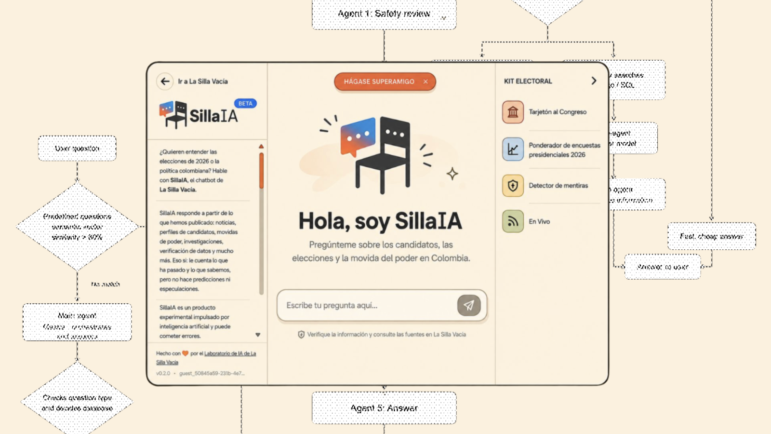
What We Learned Building a Chatbot for La Silla Vacía’s Newsroom Archive
We spent 12 months building an AI tool for our independent news site in Colombia. Here’s what it taught us about running a newsroom in the age of AI.