
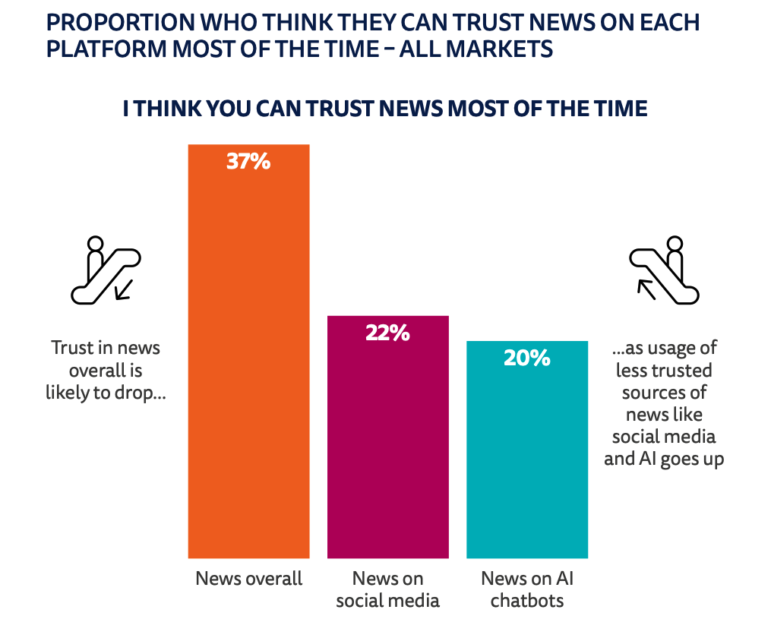
Less than four in 10 surveyed now report trust in the news that they see, a figure that is likely to drop further in the future as the shift toward getting news on less-trustworthy platforms like social media and AI chatbots continues. Image: Screenshot, 2026 Reuters Institute Digital News Report
‘Unsettled Time’: 2026 Reuters Institute Digital News Report Finds Rise of Social Media, Video Creators, and AI Chatbots Amid Falling News Interest and Trust
Read this article in


The 15th edition of the Reuters Institute Digital News Report reveals a turbulent news environment with ongoing shifts in news consumption habits and third-party intermediaries, while the public appears to be drifting away from interest in news and has lost confidence in the media’s integrity and accuracy. However, readers still cite news impartiality and independence as a core value and necessary for society.
“Some of this year’s report makes for unsettling reading, but it is an especially unsettled time both for the news media sector and for the world at large,” the Reuters report notes in its executive summary. “A central theme this year is this growing ‘platformization’ of news consumption “For the first time, social media and video networks are, on average across the markets covered, more popular than both TV and owned news websites and apps as sources of news. Growing numbers are also experimenting with AI chatbots as a new means of access. When online, people increasingly like to watch rather than read the news, often drawing on a wider range of sources and voices. Some of the new contributors are credible, innovative, and making a positive contribution to the range of news choices. This report explores in detail the rise of creators and other emerging news producers, the role they play in this changing environment, and what audiences value about their content.”
In recent years, the Reuters Institute has found four platforms experiencing steady growth in readers’ use for news: WhatsApp, YouTube, TikTok, and Instagram. Facebook, after noticeably dropping for years, has seen a small uptick in news consumption since 2025. Very few users of Twitter/X, Facebook Messenger, and Snapchat, however, use those platforms for news and those platforms have had little to no growth as a news source for more than a decade.
Still, the report points to some positive signs: “Against the backdrop of disruptive political, economic, and social change, core news values nevertheless remain relevant. While opinions may be fragmenting in many countries, support for principles such as impartiality persists, even if audiences express dissatisfaction with aspects of their current news experience. People still care about what news and journalism — in new ways and in some traditional forms — aspire to.”
It likewise found that, in the 26 countries it studied with public service media (PSM), audiences generally agreed that public service-oriented journalism has a “positive social impact” and a plurality said that PSM had a worthwhile impact in their individual countries (37% positive, 22% negative). Still, the survey noted that public attitudes toward PSM news providers varied widely based on political ideology in nations like Germany, Spain, the US, and the UK.
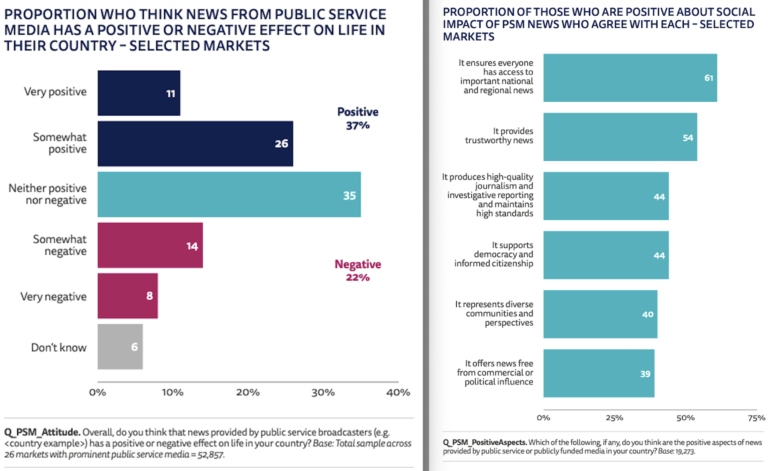
The 2026 Reuters Institute Digital News Report found that news audiences had generally more positive attitudes toward public service media’s impact (left) and that access, trust, support for democracy, and investigative reporting were among the top reasons why consumers felt positive about public service media (right). Image: Screenshot, Reuters Institute
Some of this divergence can be attributed to the ongoing embrace of news consumption on social media and video networks, which are “now more popular as a source of news than owned and operated online news websites and apps in 30 of our 48 markets.” Social media and video feed algorithms increasingly sort users by their perceived interest and online behavior, and then fuel further partisanship by serving more content, including news, that aligns with the user’s worldview. Notably, more than half of all 18-24 year olds (52%) surveyed now say social media, video networks, and AI are their main source of news. Just under half (44%) of the next age cohort, 25-24 year olds, say the same. Both of these figures represent double-digit percentage point increases from just five years ago. Meanwhile, TV and news websites/apps saw fewer news consumers across all age groups say TV and news websites are their main source of news.
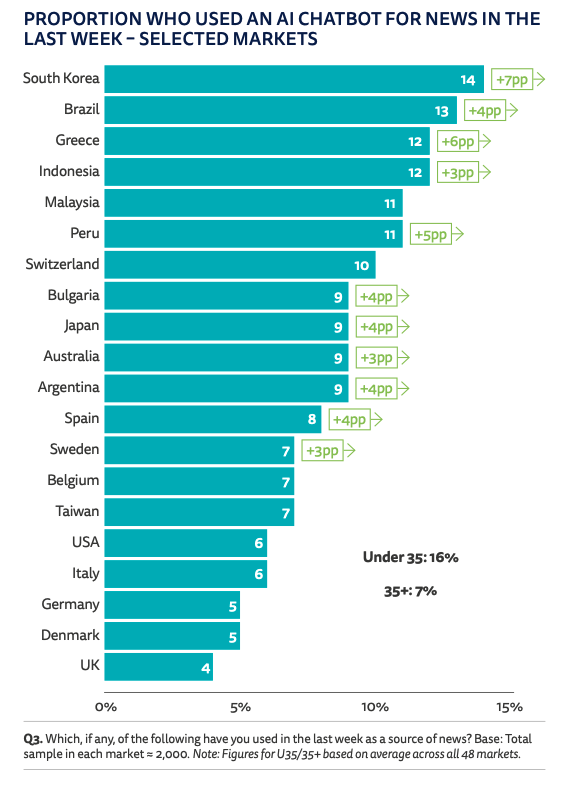
One-sixth of those under 35 years old said they used an AI chatbot for their news in the last week — and its use is growing globally. Image: Screenshot, Reuters Institute
A new, but growing player, in the news environment is the AI chatbot, which has begun to eat into the share of traditional search engines for news consumption. “Our data this year shows fast rather than explosive growth in the use of AI chatbots for news. At the global level, weekly news usage has increased three percentage points from 7% to 10% of all audiences,” the report states. Reasons given for the growing embrace of AI chatbots include its speed, ability to summarize complicated storylines, and features that allow for translation or follow-up inquiries. The impact that the adoption of AI chatbots could have on news sites’ web traffic remains a serious concern, as the report noted that only 42% of chatbot users “always or often click through from chatbot answers to original news sources.”
Along with decrease in direct source news consumption is a growing distrust of the news itself. This phenomenon is partly a knock-on effect of the shift toward people getting their news indirectly, as the report noted that “news consumed via third-party platforms is substantially lower than trust in news overall.” In fact, only 32% reported trusting news from search engines, 22% trusted news on social media, and 20% trusted news found in AI answers.
Those figures are noticeably lower than the 37% of respondents globally that said they trusted the news overall, a three percentage point drop from 2025. Out of the 48 countries surveyed, 38 saw readers lose trust in the news in the past year, with the Philippines (-10% percentage points), Ireland (-9%), Poland (-8%), Thailand (-8%), and Peru (-8%) seeing the biggest drops from a year before. (The US and the UK both had -5% percentage point decreases.) Only Germany (+1%), Singapore (+1%), Japan (+2%), Spain (+2%), and Kenya (3%) saw slight percentage point increases in news integrity.
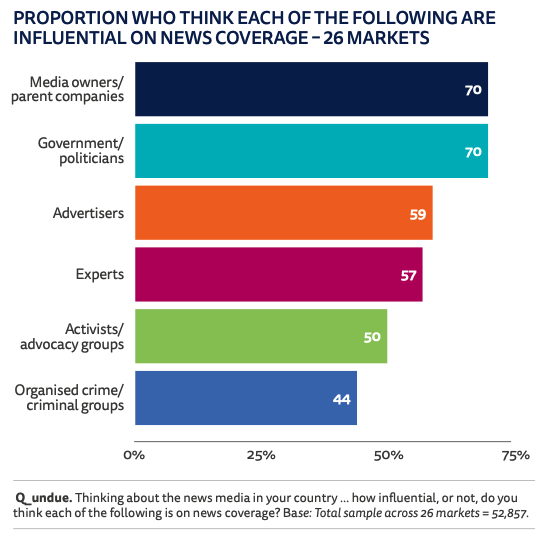
Survey respondents identified numerous entities that they felt exerted undue influence over the news. Image: Screenshot, Reuters Institute
Fears of bias and state capture are also playing a role in this lack of trust. Large majorities in 26 sampled countries said that media owners/corporate parents (70%), government/politicians (70%), advertisers (59%), or experts (57%) have an undue influence on the news being reported and published.
“How to respond to the rapid development and diffusion of generative AI is the biggest 360-degree challenge for today’s news leaders and policymakers,” the report concludes. “The use of AI chatbots is growing fast, but use for news is not growing as quickly as use of AI tools more widely. This perhaps creates a small window of opportunity to work through some of the thorny distribution dilemmas about whether to allow AI platforms access to publisher content and, if so, how to be compensated for the value this brings to the AI chatbot experience.
“Trust and interest in news are falling, concerns about misinformation are rising, but at the same time a number of individual news brands are highly and broadly trusted, standing out against an abundance of content, and connecting with their target audiences,” it adds.
Finally, it suggests that deeper, more impactful reporting, like investigative and accountability-focused journalism, could be a key way to resonate with a broader audience and build back reader trust: “News organizations can play a vital role helping people make sense of seismic change in the world at large and in brokering and facilitating trust in societies and neighborhoods where people may feel there is sometimes more which divides them than they have in common.”

This work is licensed under a Creative Commons Attribution-NoDerivatives 4.0 International License
Republish our articles for free, online or in print, under a Creative Commons license.
Republish this article
This work is licensed under a Creative Commons Attribution-NoDerivatives 4.0 International License
Read Next

Document of the Day
GIJN Joins Paris Charter on AI and Journalism
GIJN joined with 16 other media partners to draft a charter and 10 principles for using AI in newsrooms and investigative reporting.
Tech & AI
What We Learned Building a Chatbot for La Silla Vacía’s Newsroom Archive
We spent 12 months building an AI tool for our independent news site in Colombia. Here’s what it taught us about running a newsroom in the age of AI.

Member Profiles
Fiquem Sabendo: ‘An Engine for Brazilian Journalism in the Search for Information’
Journalist Léo Arcoverde started a blog in 2015 publishing one story a day based on information obtained through Brazil’s new access-to-information law. The initiative eventually became Fiquem Sabendo.
How They Did It
How We Investigated the Hidden Costs of the World’s Farmed Seafood
Over the past five years, an international team of journalists at The Outlaw Ocean Project has examined the largely overlooked $313-billion food-for-feed aquaculture industry.