
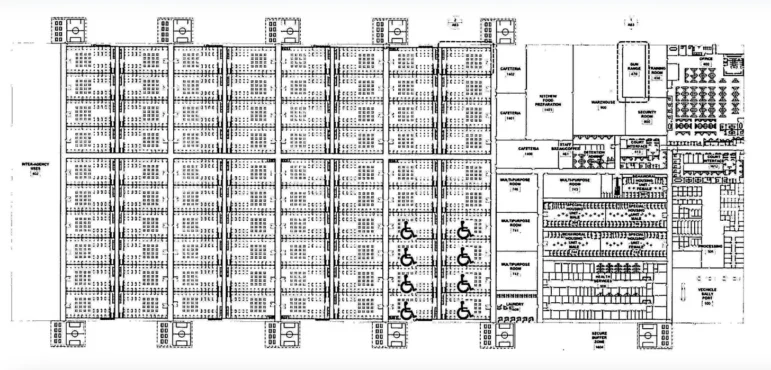
A proposed floor plan for a migrant detention center, taken from the US Department of Homeland Security website, which featured in a recent story. Image: Screenshot, DHS
New Tools for Tracking US Migrant Detention Centers and Illicit Dual-Use Exports for Russian War Effort
In this latest installment of the GIJN Toolbox, we profile two new, free-access databases made for investigative journalists that provide hard-to-find accountability evidence on pressing harms.
One of these provides unique insight into the infrastructure of the new mass migrant detention network in the US: a vast, increasingly militarized campaign targeting dozens of nationalities, and of growing interest to watchdog reporters in numerous countries.
Another offers a new way to hold Western companies accountable for selling equipment with both civilian and military applications to Russia in potential breach of international restrictions; equipment which, in many cases, has helped enable Russia’s war in Ukraine.
Both tools involve easy-to-use interactive maps, where reporters can simply click on targets to find layers of detailed data.
Project Salt Box: Live Research, and the ICE Warehouse Tracker
As part of its unprecedented and deeply invasive effort to detain and deport migrants en masse, the Trump administration in the US is engaged in an opaque, heavily-funded scheme to build, purchase, or retrofit industrial warehouses, and use them as migrant detention centers. These purchases by the Department of Homeland Security (DHS) and its sub-agencies are characterized by fast-tracking contracts, circumvention of normal procurement rules, and opposition from community and human rights groups. Despite the obvious public interest ramifications of this policy, information about the development of migrant detention infrastructure has proved to be elusive for investigative journalists.
Project Salt Box is a new, free-access database that represents a major source of insights into both existing and planned US migrant detention facilities, and generally offers more than two-dozen datapoints on each of 480 current, planned, and cancelled detention-related facilities and supporting network through interactive maps, litigation updates, and data tables.
Created by a small volunteer group of citizen sleuths, the tool’s ICE Warehouse Tracker gathers public documents on everything from sanitation and local security contracts to pre-orders of ready-to-eat meals and real estate deals, and can therefore also serve as a camp plan early-warning system for journalists, as it recently did for a AZPM News report on questions surrounding a proposed detention facility outside Tucson, Arizona.
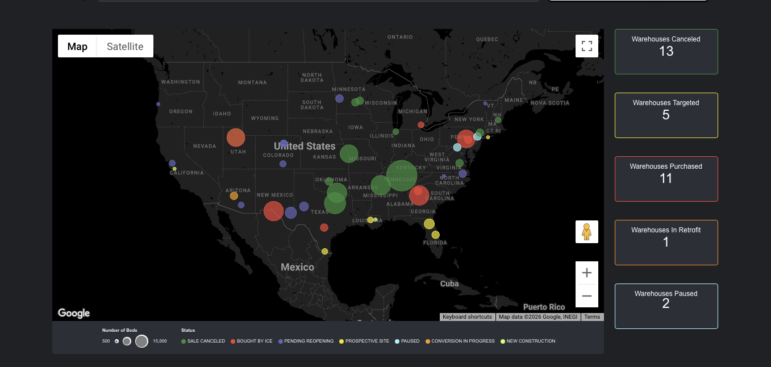
The interactive map of the US warehouse detention center network on the ICE Warehouse Tracker. Image: Screenshot, Project Salt Box
In another example, the Associated Press recently relied partly on Project Salt Box digging into newly-signed deeds for its investigation into hidden warehouse deals, in a story that stated: “More than 20 towns with large warehouses have become stealth targets for Immigration and Customs Enforcement’s $45 billion expansion of detention centers.” Meanwhile, The Washington Post’s investigation into contract awards to untested companies for the private operation of these centers was sparked by an initial report by the project team.
The platform’s sources include SAM.gov, USASpending.gov, county assessor records, FOIA libraries, deeds of sale, public contracts, and local permit records.
“The interactive map that has all the warehouses on it is also tied to a dataset that has background data to each of those facilities, so you click a dot on the map, and the tables underneath populate with environmental risk information, financial background on the seller, all kinds of different datasets,” explains Michael Wriston, co-founder of Project Salt Box.
“There is also a dropdown that shows all the warehouses — both the existing structures and greenfield sites that ICE is looking to purchase to build brand new detention centers around the US,” Wriston adds. “The other part of that tracker is for those states that have filed litigation against the federal government — like Maryland, Arizona, New Jersey, and Michigan — using an up-to-the-minute scrape of CourtListener to show you what the latest is in these cases.”
The team also produces its own research reports, and actively assists reporters.
Wriston — a military veteran with data research experience — says the platform’s three-person team represents a volunteer effort dedicated to transparency.
“We come from different backgrounds,” he notes. “We have someone from the immigrant rights community, we have a team member who is in the government contracting world and is intimately familiar with procurement processes, and I’ve got 20 years in Air Force intelligence analysis. We’re three people very passionate about the data on this issue.”
The Project Salt Box site also features useful guides for independent digging, such as “How to FOIA ICE.”
Notably, Rachel Maddow, journalist and anchor at the MS Now network, recently described Project Salt Box as “the best resource I have found anywhere” on US migrant detention procurement.
Tools of War: Dual-Use Russia Export Database
In November 2025, CORRECTIV, a leading nonprofit investigative newsroom in Germany, revealed that European companies had exported equipment with potential military applications to Russia 28,000 times in the lead-up to Russia’s war on Ukraine. Their startling finding was based on information from a new database and insights resource, Tools of War, which tracks “dual-use technologies” — machine tools and sensitive equipment with both civilian and military applications — and their shipment to Russia. This trade continued apace with little accountability ahead of Russia’s full-scale invasion of Ukraine, despite dual-use export licensing requirements from authorities such as the EU and international sanctions that were supposed to prevent Western military sales there.
The platform — which is free to use by reporters who request access — hosts and analyses more than seven million relevant lines of data donated to the project by the commercial trade site ImportGenius, and integrates it with sanctions databases and its own AI-driven assessment model.
Tools of War features an interactive map populated by precisely geolocated companies, so reporters can simply click on exporters highlighted in their local towns or countries to see detailed customs records. It also scores exported parts on a scale from 0 to 1 for military application, together with a slider filter — so reporters can zero in on parts known to be used in the current Ukrainian war theater. For instance, CORRECTIV noted that one Russian weapons firm that manufactures drones imported a precision welding analysis scanner from a German company. (See this video tutorial.)
Remarkably, the platform includes a separate, no-fee tool that allows journalists to search potential violations in reverse, by searching, for example, major Russian defense-related companies — and then requesting, say, their top 10 Western suppliers, and digging into the raw customs data found there. However, this added feature does require a special API key, or assistance from the platform team.
Overall, the tool represents a source of leads and raw data, rather than investigative evidence, and findings on sanctions violations or actual military deployment still require verification and onward reporting.
The database was created by Brussels-based freelance journalist and open source intelligence consultant Dylan Carter, following an initial grant from Journalismfund Europe, and currently involves three active researchers.
“The precision engineering relied on by every Russian military factory — the precision cutting, grinding, folding, and milling of metal, and the machines to check it — is almost always European equipment,” says Carter. “Despite sanctions and Russia’s aggressions in Crimea and the Donbas in 2014, European companies increased their shipments of specialist equipment.”
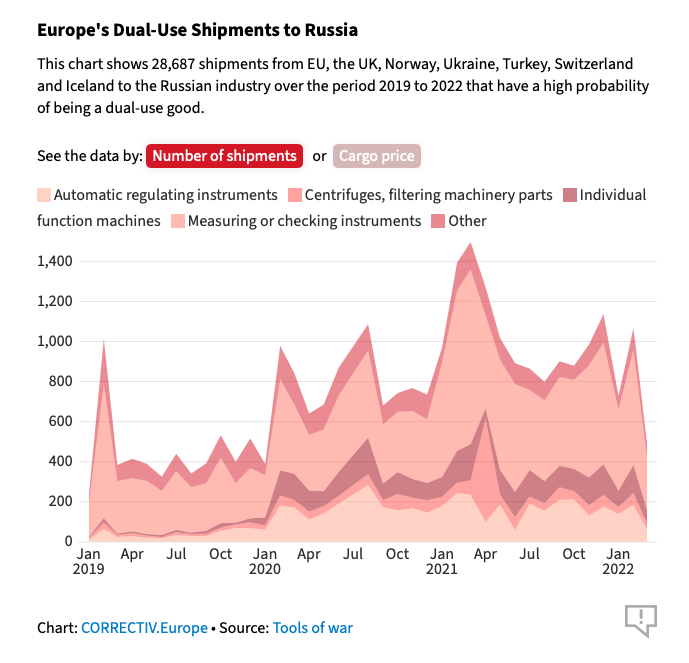
A chart showing the 28,687 machine tool shipments from European companies to Russia with a “high probability” of military applications, in the lead-up to the 2022 invasion of Ukraine. Image: Screenshot, CORRECTIV.Europe
The tool’s public-facing dashboard is currently limited to the sanctions period between 2019 and 2022, but Carter says data going back to 2014 can be made available on request, and notes that the intermediate sanctions interval from 2014 to 2022 represents the key period for accountability investigations now.
“A lot of reporters are understandably obsessed with the post-invasion period, but sanctions evasion and sanctions avoidance networks — especially involving European companies willingly breaking the rules to get goods to Russia — were most acute between 2014 and 2022, and not afterward, when sanctions were further tightened. I think if you want to get accountability for Russia’s current military capacity, that’s where you need to start looking.”
He adds that reporters can also request dual-use exports from other Western regions, including the US and Latin America.
However, Carter concedes that the tool’s machine-learning assessment system for what goods have true military uses is “far from perfect.”
“This tool is not going to do the investigation for you — it will give you leads and potential hints,” he points out. “We also encourage reporters who do find good leads to follow-up by emailing me, because I can find a lot more — for example, data on goods going via third countries.”
Carli Kooijman, an investigative reporter at NRC in the Netherlands, says she has used Tools of War frequently in the past few months.
“It’s a very cool project that launched late last year,” notes Kooijman. “Reporters might use the data directly or think of creating similar projects with customs data.”
Journalists can access the tool with an email via the “Request Access” section on the site.

Rowan Philp is GIJN’s global reporter and impact editor. He was formerly chief reporter for South Africa’s Sunday Times. As a foreign correspondent, he has reported on news, politics, corruption, and conflict from more than two dozen countries around the world.

Introduction to Investigative Journalism

Tech Focus Project

How to Acquire Free Satellite Imagery for Your Investigations

My Favorite Tools with Pulitzer-Winning Reporter Martha Mendoza

GIJN Toolbox: Hunting for Secret Money and Financial Conflicts of Interest

New Tools for Geolocation, Collaboration, Illicit Finance, Deportation Data, and Bad-Actor Tracking

Journalism-First Tools to Search Spreadsheet Text, Track Website Changes, and Mine Investigative Resources Through the Years

Watchdogs Against Hate: A Reporter’s Toolbox for Tracking Political Extremism

This work is licensed under a Creative Commons Attribution-NoDerivatives 4.0 International License
Republish our articles for free, online or in print, under a Creative Commons license.
Republish this article
This work is licensed under a Creative Commons Attribution-NoDerivatives 4.0 International License
Read Next
Reporting Tools & Tips
GIJN Toolbox: Hunting for Secret Money and Financial Conflicts of Interest
In this edition of GIJN Toolbox, we profile three brand new — or newly expanded — tools to dig into financial secrecy and hidden gains from corruption or crime. Our list includes a user-friendly database to search for sanctions and conflict-of-interest red flags, a site that uses an algorithm to detect hidden bank accounts, and a newly expanded database on the true owners of offshore companies.
GIJN Toolbox
New Tools for Geolocation, Collaboration, Illicit Finance, Deportation Data, and Bad-Actor Tracking
At the NICAR 2026 conference, dozens of leading data journalists shared some of their favorite digital tools and databases for investigating numerous topics.
GIJN Toolbox
Journalism-First Tools to Search Spreadsheet Text, Track Website Changes, and Mine Investigative Resources Through the Years
In this latest GIJN Toolbox, we highlight three new powerful but easy-to-use investigative tools that have been specifically developed with the needs of data and investigative journalists in mind.
GIJC23 Reporting Tools & Tips
Watchdogs Against Hate: A Reporter’s Toolbox for Tracking Political Extremism
The influence of extremist groups on mainstream politics is on the rise, and journalists need tools to face this threat to healthy democracies.