

10 Tips for Tracking Russian-Owned Assets
OCCRP senior investigator Tom Stocks shares 10 best practices for tracking the mansions and superyachts of Russian oligarchs and officials deemed closest to President Vladimir Putin.
OCCRP senior investigator Tom Stocks shares 10 best practices for tracking the mansions and superyachts of Russian oligarchs and officials deemed closest to President Vladimir Putin.

In this edition of GIJN Toolbox, we profile three brand new — or newly expanded — tools to dig into financial secrecy and hidden gains from corruption or crime. Our list includes a user-friendly database to search for sanctions and conflict-of-interest red flags, a site that uses an algorithm to detect hidden bank accounts, and a newly expanded database on the true owners of offshore companies.
DOSSIER, an Austrian outlet that is a member center of the Organized Crime and Corruption Reporting Project, has been able to offset the financial challenges experienced by many media outlets in Austria — and combat a series of vexatious lawsuits — thanks to its membership program.
GIJN’s latest membership class includes its first two members from Francophone Africa and three new members in the Middle East/North Africa. They range from investigative newsrooms and media development groups to university-based centers and cross-border networks. GIJN also welcomed members from six previously unrepresented countries: Cameroon, Malta, Paraguay, Palestine, Senegal, and the Slovak Republic.
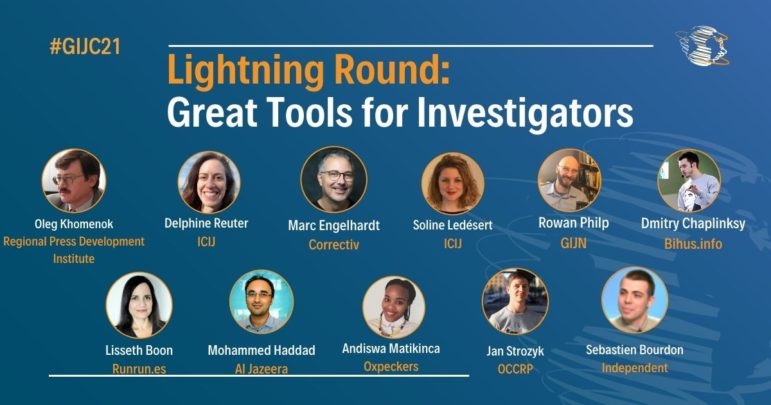
In a lightning round session at #GIJC21, a panel of leading reporters and editors needed just five minutes each to outline new tools and databases that any reporter can use to gather hard-to-find facts.

In a session on high-level corruption at #GIJC21, a panel of reporters from Liberia, Ukraine, Sudan, Russia, and Lebanon suggested a series of strategies that can pry facts from obstinate government agencies, find whistleblowers, and deliver alternate forms of accountability for officials seemingly above the law.
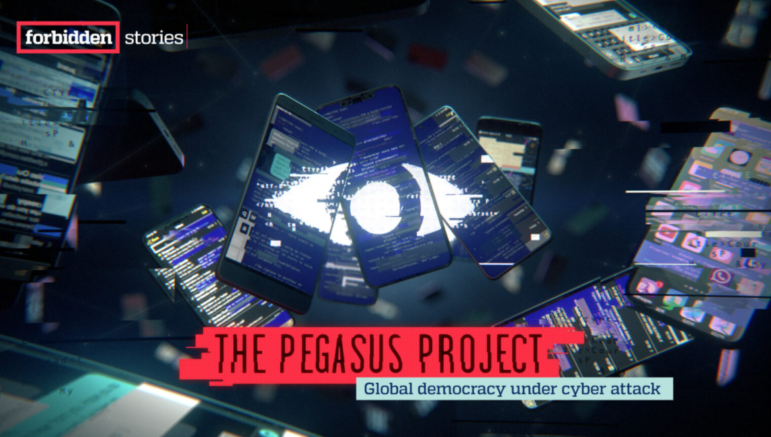
In a collaboration of 16 news organizations, the Pegasus Project revealed that thousands of citizens — including 180 journalists — were selected as targets of commercial spyware by 11 governments. The coordinators of that project told GIJN how the investigation worked, and offered detailed tips on how to investigate while under extreme threat of digital surveillance.

The criminal blueprint and its elements need to be understood to efficiently follow the money and stop criminals from doing business as usual. Criminals, both the ones just starting out as well as those who are already well established, have regional and global infrastructure that is continuously built and maintained by what the Organized Crime and Corruption Reporting Project (OCCRP) team calls the “criminal services industry.” Here’s OCCRP’s Paul Radu on how it works and how to untangle it.

The following stories, selected by GIJN Arabic, are not just a list of impressive investigative reports from 2020. We chose them for their significance, their use of investigative tools and techniques, and their commitment to social accountability.

As part of our annual Editor’s Pick series, read on to discover the best investigations in French published this year and selected by GIJN French Editor Marthe Rubio and GIJN Francophone Africa Editor Maxime Domegni.
In 2001 GIJN was born, as investigative journalists from around the globe met for the very first time to share ideas, tips, and best practices to strengthen their reporting in a world where journalism was increasingly under threat.
Today the threat has multiplied, and at GIJN we find ourselves under the same pressures as our member organizations. Most urgently: available funding for investigative journalism has been impacted as some longtime funders who supported journalism in the past are no longer doing so or have closed. Yet our work continues, more important than ever before.
GIJN serves as the global hub for the world’s investigative reporters. Our core mission is to support and strengthen investigative journalism—with special attention to those from repressive regimes and marginalized communities.
We are embarking on our first-ever campaign initiative to help us expand our revenue by the end of the year through individual donors. If you have ever joined one of our free webinars, used one of our free resources, learned a new skill thanks to a GIJN training, or simply believe that press freedom is essential to civil society, we ask you to show your support for GIJN’s work with a donation of your choosing. Called “Friends of GIJN,” this campaign includes a more personalized experience, starting in 2027, for individuals who answer the call to join with us during this unprecedented time.
Truth and democracy are under attack around the world. You can fight back by helping GIJN support investigative journalists with free access to the latest tools and techniques — so they can foster justice and hold accountable those who abuse the public trust.
With a staff based in 24 countries, GIJN works in a dozen languages each day, linking together the world’s most enterprising journalists, offering state-of-the-art training, webinars, tip sheets, and a Help Desk that responds to 2,000+ requests for assistance each year. More than 84% of GIJN’s operating budget goes directly to our program work.
Please make a gift today to support journalists on the front lines of the fight for accountability and human rights.