
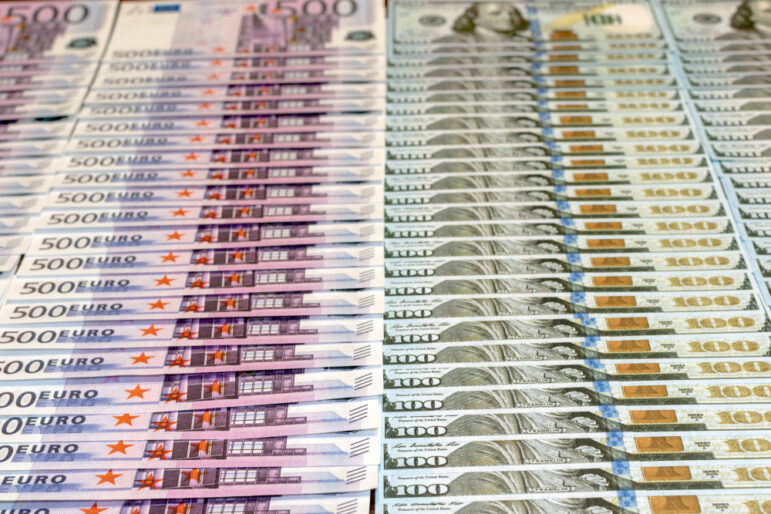
The 500-euro note (discontinued in 2019) and the US 100-dollar bill are routinely used by money launderers to move large amounts of illicit currency. Image: Shutterstock
How Journalists Can Fight Back Against the Rising Tide of Money Laundering
Read this article in

Money laundering is the crime that makes crime pay, says journalist Oliver Bullough in his latest book. Phone theft, fraud, drug trafficking, and terrorism are all enabled by money laundering. And he warns that it’s never been easier to move illicit money around.
Wales-born Bullough has been writing about financial crime since 2014 — and the takeaway of his investigative book on the subject, “Everybody Loves Our Dollars,” is ominous: ‘how money laundering won.’
In a recent book talk hosted by Ian Gary, executive director of the FACT Coalition, Bullough pointed out that the estimated amount of money laundered every year is staggering — around 2-5% of global GDP or between US$2-5 trillion. If that sum represented a country, it would be somewhere between the 3rd and 11th richest in the world. This estimate has remained about the same despite decades of treaties, diplomacy, laws, and task forces.
Bullough explained that for his new book, he set out to find “where the flaw was baked in” to our anti-money-laundering system — and how to fix it. “The story of the book that I found is really about a sort of arms race between lawyers and agencies and regulators on the one hand, and money launderers on the other,” Bullough tells GIJN in a separate interview. “And how any attempt to do something to restrain money launderers is immediately met by innovation, by very entrepreneurial criminals who keep coming up with new ways of moving their money around.”
“All these new innovations get layered on top of each other, and therefore become ever more complicated and hard to understand… Once you add all of it together, it becomes almost impossible,” he adds.
Bullough started his journalism career in Russia just as Putin was amassing power. He worked for Reuters in Moscow and covered the war in Chechnya. His award-winning books have investigated global dirty money (“Moneyland”) and its Western enablers, such as law firms, banks, and PR companies that help launder cash and reputations (“Butler to The World”). He writes the Oligarchy newsletter for Coda Story and has led Kleptocracy tours of luxury London properties.
‘Drugs for Gucci’
“Money laundering is an intensely entrepreneurial activity… and it has become significantly more sophisticated since the 1980s,” Bullough detailed in the webinar.
Bullough’s book zooms in on some fascinating pieces of the global money laundering puzzle. Making crime pay is what enables Russia to deploy drones across Ukraine despite trade restrictions on components, and what makes it profitable for criminal gangs to traffic women from Southeast Asia to various US cities.
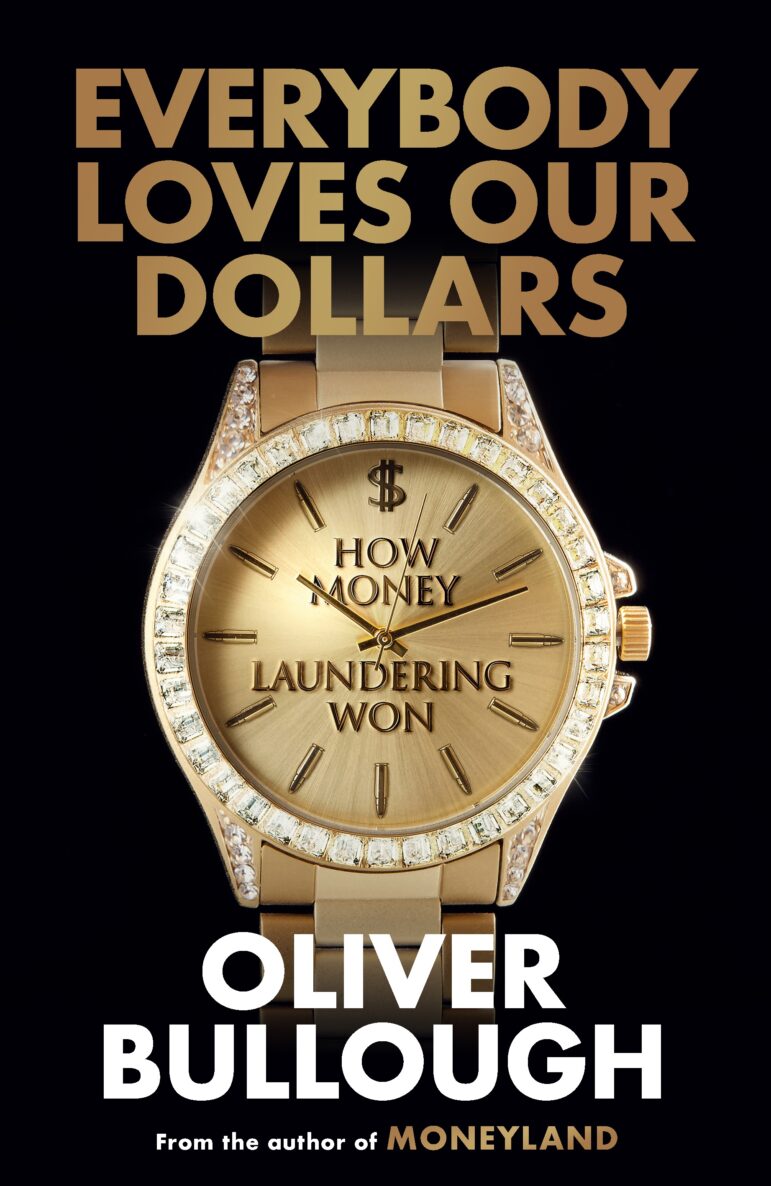
Oliver Bullough’s newest investigative book, “Everyone Loves Our Dollars,” looks into the growing scourge of money laundering around the world. Image: Courtesy of Bullough
Now-derelict casinos on the Pacific islands of Saipan and Tinian, where Bullough found troves of documents related to the laundering of Chinese cash, and an outlet mall in suburban England where international tourists buy high-end handbags are two more pieces of the global puzzle. The book was sparked by a conversation Bullough had with a senior policeman about Bicester Village, a designer outlet shopping center in Oxfordshire in the UK, in which he remarked how popular this mall seemed to be with Chinese shoppers — something that had been frequently noted by the UK press.
The policeman explained that there was more to the frantic purchases of Louis Vuitton handbags than meets the eye: “A lot of them obviously just like shopping,” said the officer. “But the rest of it is money laundering.” Factories in China ship drugs to British gangsters, who then give the payment in cash to Chinese students studying at UK universities, the officer explained. “The students either take the cash to Bicester Village or first pay it into their bank accounts before going; then they buy Gucci handbags or whatever and ship them back to China, where the criminals sell them to fashion victims… It’s all coordinated by WeChat, and we struggle to follow it.”
So, if money laundering has won, what can journalists do? Bullough has some ideas to get started, which he discussed in the book talk and in a separate interview with GIJN.
1: Understand the Anti-Money Laundering Regulatory Framework
Tracing the history of anti-money laundering efforts took Bullough to northeastern Texas and the home district of the “grandfather” of all money laundering legislation, Congressman Wright Patman, who served from 1929 to 1976. Thanks to Patman’s efforts — harnessing an appetite for a fairer financial system in response to the Civil War debts that grew out of the Gilded Age — Congress passed the Banking Secrecy Act of 1970, which requires US banks to help government agencies in detecting and preventing money laundering through monitoring and reporting.
The Banking Secrecy Act is why banks have to report transactions of US$10,000 or over. “This was a completely new idea,” explained Bullough in the webinar. “That financial institutions have a responsibility to society to check the origins of the money they are moving around.”
But international cooperation is essential for fighting money laundering. A milestone in global cooperation was the formation of the Financial Action Task Force (FATF) in 1989 — the international body that combats money laundering and terrorism financing, in part by making recommendations, setting compliance rules, evaluating nations’ anti-money laundering standards, and identifying high-risk jurisdictions.
Bullough uses his Saipan and Tinian adventures — and the documents he found relating to money laundering — to illustrate a larger point about what he calls “conflicts of interest” within FATF. “Colossal quantities” of money have been laundered through casinos in the Commonwealth of the Northern Mariana Islands (CNMI) — a commonwealth of the United States, just northeast of Guam — while other jurisdictions, such as the Marshall Islands, have faced more FATF scrutiny for offshore finance and banking secrecy.
CNMI-based casinos have been slapped with huge fines from FinCEN — the US Financial Crimes Enforcement Network — and local enforcement measures, but in general, “the CNMI has been a massive problem, a real hole in the US defenses, particularly against money laundering originating in China,” Bullough said.
FATF certainly has its work cut out this year. On July 1, 2026, the UK takes on FATF’s rotating presidency, and evaluators will go to Washington this year as the US undergoes the review process of its anti-money laundering standards — at a time when US leadership on illicit financing has backslid. The US has historically played a leading role in fighting illicit financing and jailing those responsible. Still, the Trump administration’s recent neutering of the Corporate Transparency Act is a clear sign of backsliding, explained Bullough. Likewise, President Trump’s recent pardoning of former Honduran president Juan Orlando Hernández, the US government’s enabling of cryptocurrencies, and the receptiveness for questionable companies to list on the New York Stock Exchange are further warning signs of official US policy softening against money laundering.
“If I could have one wish to add to the arsenal of tackling financial crime in the US, it would be for more transparency, if only for law enforcement, on who owns various corporate structures registered in different states,” Bullough said. FATF’s 40 recommendations, conceived at its inception, could also do with an update, he added.
2. Why Big Banknotes Enable Criminality
“Cash dollars — or to a lesser extent, cash euros and pounds — are… the international currency of crime,” writes Bullough. “Banknotes are the most useful tool for any money launderer.”
This is especially true of bigger denominations for the obvious reason that you need fewer of them to move a lot of money, he writes, quoting a London Metropolitan police assistant commissioner David Veness, who once said: “the link between Medellin and Moscow is the 100-dollar-bill.”
“Eighty percent by value of the dollars being printed are in the form of $100-dollar bills, which is incredible, because you don’t see them very often,” noted Bullough.
And around 70-80% of these US$100 bills go overseas — making them more valuable as an export than pharmaceuticals — where they are largely used for criminality.
Crime is also connected to the demand for printed money. In his chapter ‘The Buck Starts Here,’ Bullough is once again in Texas, this time in the Fort Worth area, where the Western Currency Facility prints most of the new dollars for the Federal Reserve — meeting a huge demand despite the declining use of cash for everyday transactions.
So why are countries printing far more banknotes — in the US but also in Europe, New Zealand, and Singapore — than they need? “There is US$7,357 outstanding for every person in the United States,” Bullough writes. In the eurozone, it’s €4,500 for every resident.
Central bankers have surprisingly little to say about this ‘missing’ currency, observes Bullough, and, relatedly, why big bills are the most popular, despite most people using small bills most often. In the 1970s, a McKinsey consultant pointed out that only two transactions in the US depend upon large, untraceable, non-credit transactions: “The first is profit-motivated crime…the second is tax evasion.”
3. Rise of Stablecoins
Cryptocurrencies haven’t replaced the old methods of moving dirty money around the world, noted Bullough, but they are an important part of the money laundering story now: “It’s really useful as a low-cost, high-speed way of moving value around the world.”
Crypto is a godsend for money launderers because cryptocurrencies and stablecoins operate outside the financial system. Stablecoins in particular are a growing but underappreciated threat.
“One of the phenomena that has underpinned not just the battle against money laundering but also the battle against rogue states has been the US dominance of the global financial system via the dollar monopoly,” said Bullough in the webinar. “The fact that transactions have to be cleared via New York has given the US a degree of jurisdiction over the activities of the Russian regime, or whatever, which has been a genuine source of strength and a real source of vulnerability for Putin and other allied actors.”
Stablecoins such as Tether (USDT) and USDC give criminals the ability to transact in US dollars without US jurisdiction, he added.
“What we’re seeing now is the use of stablecoins by, say, Colombian drug cartels and the Iranian Revolutionary Guard, and scam factories in Cambodia run by Chinese organized crime groups that now have hugely diversified money laundering networks,” Bullough said.
4. Find Stories to Tell
The challenge that underlies all the others, writes Bullough in the book’s closing pages, is this: How can we expose money laundering and corruption so that bad actors are held accountable?
“The only way I know is to tell stories,” he writes. “To highlight the harm that inactivity is causing and to stress how much better it would be if governments finally took the actions they need to take.”
Asked by GIJN to expand on this point, Bullough explains: “The difficulties that we face is in trying to persuade politicians of the seriousness of this problem… It goes so far beyond just the financial system. It’s embedded in every aspect of the economy.”
Bullough suggests that journalists and researchers look into trying to understand how criminal wealth moves via trade networks, and investigate where all these “missing” banknotes may have ended up.
“I don’t think the problem is the lack of material for journalists,” he adds. “I think for some reason it’s pretty difficult for these stories to have an impact that they should have had.”
“I think that what we need is to be more imaginative about the way we tell the stories,” he concludes. “To create a public concern, where politicians have no choice but to do the right thing.”
 Alexa van Sickle is a journalist and editor with experience across digital and print journalism, publishing, and international think tanks and nonprofits. Before joining GIJN, she was senior editor and podcast producer for the award-winning foreign correspondence and travel magazine, Roads & Kingdoms.

This work is licensed under a Creative Commons Attribution-NoDerivatives 4.0 International License
Republish our articles for free, online or in print, under a Creative Commons license.
Republish this article
This work is licensed under a Creative Commons Attribution-NoDerivatives 4.0 International License
Read Next

How They Did It
How We Investigated a Global Crypto Laundromat
Investigators explain how they found a sanctioned crypto exchange in Russia resurrected itself under a new name and continued to attract new clients and move money across borders.

Organized Crime Reporting Tools & Tips
Latest Money Laundering Trends Journalists Should Watch For
A recent IRE conference panel focused on new money laundering strategies that make hiding illicit assets increasingly difficult to track.

GIJC23
Following the Money, from Laundromats to Central Banks
How did three reporters investigate complex financial stories featuring Nigerian billionaires, Eurasian oligarchs, and the head of Lebanon’s central bank?
GIJC23 Reporting Tools & Tips
Investigating Cryptocurrency: Key Questions and Tips for Reporters
Criminal activity tends to thrive where state oversight is weakest. So it’s no wonder that cryptocurrencies are the financial tool of choice for criminals around the world, which makes insightful coverage of them increasingly important for investigative journalists.