

Image: Shutterstock
World Cup 2026: Investigations, Data Dives, and Podcasts Covering the Global Football Tournament


“The beautiful game has never looked more beautiful on the pitch, or more ugly off it,” said Simon Skinner in the London Review of Books podcast. As in many previous tournaments, once the whistle blows on the first match, the drama, joy, and camaraderie of one of the world’s few truly globally shared pieces of cultural heritage can drown out the burgeoning off-pitch controversies.
Of course, political interference and financial corruption around the world’s most popular sporting event are not new. And there are always many stories to be found, from investigative deep dives to granular goal-scoring data to analyses on immigration issues, because it touches so many countries, livelihoods, power systems, and people.
For the 2026 tournament, held in Canada, Mexico, and the US, an off-pitch story kicked off with the US Justice Department’s sudden announcement that it was dropping its landmark corruption probe more than a decade after it indicted 14 defendants, including nine high-ranking officials from World Cup governing body FIFA, for their roles in a bribery scheme. Several outlets dug into the massive DOJ case or its abrupt end in their World Cup coverage, including a special Wall Street Journal podcast, “The FIFA Files” — a document-driven investigative podcast — and the Sports and Crime Briefing. Bloomberg Law warned about the “potential unraveling of dozens of other international soccer corruption cases and hundreds of millions of dollars in unrecovered penalties.” This issue is far from closed — and will give investigative journalists around the world a deep well to explore.
Other investigative reporting includes Argentinian newspaper La Nación’s scoop that the FBI is looking at some of the Argentine Football Association’s US-based activities.
The Economist’s data viz blog and the Center for Investigative Reporting / Reveal’s World Cup podcast examined another 2026 issue — the eye-watering ticket costs as FIFA, for the first time, managed ticketing and implemented dynamic pricing. (Tickets for the July 19 final range from US$2,030 to US$ 11.5 million for certain resale luxury packages.)
In addition, reporters, researchers, and digital verification experts sounded the alarm about fake ticketing sites harvesting credentials or installing malware, racist disinformation, and AI-generated “political ragebait” capitalizing on massive World Cup interest on social media.
Data reporters broke news about how recent rule tweaks have changed how the game is played, created dynamic “data portraits” for each game — and the Financial Times mused on the increasing presence of hot pink boots on the pitch.
Investigative Stories, Reporting from Investigative Outlets
Dangerous Game: The Brazil of Online Gambling — Agência Pública
“The World Cup is key to connecting the dots in a groundbreaking investigation into the different facets of a political, economic, and public health problem,” noted the Brazilian investigative newsroom, which during the tournament broke a 10-part series on online sports gambling and what betting companies are hiding, digging into how betting markets exploit millions of indebted and vulnerable Brazilians, who are exposed to a barrage of advertising connected to the contest.
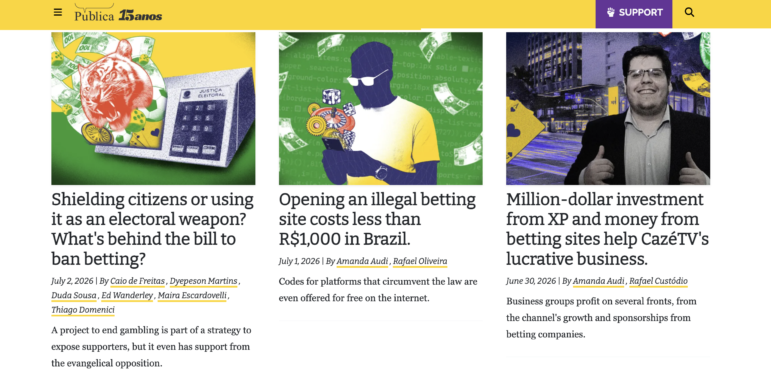
Image: Screenshot, Agência Pública
The Real Story of the Resilient African Migrants Reshaping Global Football — The Sunday Times (South Africa)
The “humanitarian posturing” of the World Cup should not distract us from the existence of a globally precarious class of migrants, wrote the South African weekly newspaper, noting that this group has traveled, sometimes dangerously, from Africa to Europe with dreams of playing football. “As plenty of research has shown, many become stranded as unauthorized migrants, manipulated by deceitful agents, or exploited by football clubs.”
How a Curious FIFA Boardroom Deal Handed Fox an Astounding Bargain — The New York Times
Long-time FIFA reporter Tariq Panja broke this story about the details of a 2014 FIFA boardroom decision designed to stave of a potential dispute with US broadcasting network Fox over its Qatar 2022 broadcasting rights. This dispute arose from moving the tournament from summer to winter when it would compete with Fox’s basketball, hockey, and (American) football coverage — resulted in the network getting a huge discount on the highly lucrative 2026 World Cup rights.
Disinformation about the World Cup Abuses AI to Inflame Political Disputes — Aos Fatos
The Brazilian disinformation-debunking and fact-checking outlet investigated some of the fake or misleading content related to the World Cup, noting that AI is fueling misinformation posts and videos shared on social media.
General Coverage — Sports and Crime Briefing
The Sports and Crime Substack covers the intersection of sports and organized crime around the world, ranging from in-depth investigations to analysis, with a big football section. Extensive World Cup coverage includes an explainer on the legal and political developments behind the dropped FIFAGate probe, the ticketing saga, and the recent calls for investigating FIFA’s boss.
General Coverage — Play the Game
The investigative sports site and funder has extensively covered issues that are coming to a head at the 2026 World Cup — such as illegal sports betting in Asia-facing markets. A series of podcast episodes look at the current FIFA era under Gianni Infantino, how Donald Trump has captured sport, and how World Cup projects are putting pressure on communities and ecosystems in Mexico.
Data-Driven Stories and Visualizations
Alexander Bogachev — Football Data Portraits
“Football is one of the few data-rich subjects that a global audience already reads fluently,” observed data storyteller Alexander Bogachov. By collecting around 1,500 events recorded during each match, including “every touch, pass, shot and card,” this generative data project rebuilds games into “a single moving image — readable at a glance” with dynamic blankets representing each team as the game progresses. (Read more about how he did it here.)
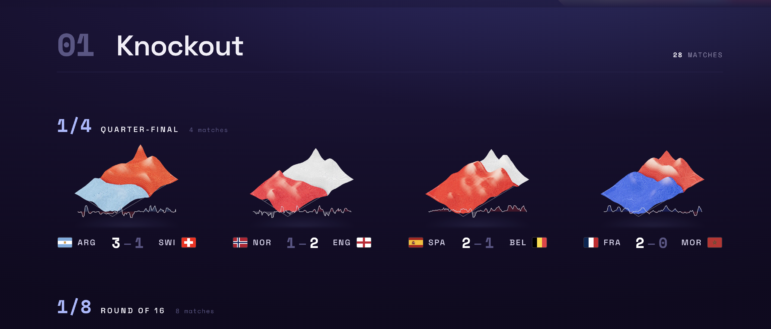
Image: Screenshot, Football Data Portraits
How to Score Goals, Statistically — Datawrapper
In its Weekly Chart, Datawrapper’s Julian Freyberg mined StatsBomb Open Data — a free football event dataset covering 80 competition seasons across 24 competitions — to identify the best spots to shoot from and aim for if one were going to attempt a World Cup goal. From 101,227 shots at goal in the dataset, a little more than 11% — 11,328 — ended up in the net. Freyberg showed the statistical equations and a heat map to break down how he found the most successful shots on goal.
Who Is Your Football Twin? — The Straits Times
Singapore’s Straits Times looked into the physical traits that make soccer players suited to their positions. Drawing on national population stats and data from ESPN and sports transfer sites, they compared the heights of forwards, midfielders, defenders, and goalkeepers. Also: an interactive tool where readers can enter their own height, weight, and age to see which World Cup players they most resemble physically.
FIFA’s Exorbitant Tickets Could Backfire — The Economist / Graphic Detail
The Graphic Detail blog explains why football’s atmosphere is hard to monetize and charts rising ticket prices. “Even after adjusting for inflation, World Cup tickets across the US, Canada and Mexico cost more than twice as much as they did in Qatar in 2022 and roughly four times as much as when the US last hosted the tournament in 1994.” But the new prices are a gamble; even if higher prices offset weaker sales, the product itself could be damaged — hurting FIFA’s more lucrative revenue streams, such as broadcasting, because “full stadiums create the noise and tension that make matches compelling on screen.”
Added Time, Added Drama — Reuters
Reuters reporters found that thanks to increasing stoppage time at the end of each match to make up for delays or injuries — which has stretched from roughly three minutes in 1990 to 14 minutes in 2026 — more and more World Cup goals are being scored past the 90-minute mark. The new “hydration breaks,” more substitutions, and fatigue also raise the likelihood of decisive goals coming in a match’s final minutes.
Underdog Victories at the World Cup: What Were the Biggest and Best Upsets? / David beats Goliath: The Biggest Upsets of the World Cup So Far — The Guardian
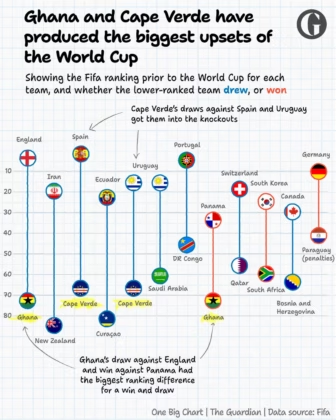
Image: Screenshot, the Guardian
A team at the Guardian looked at data from 1994 onwards to visualize how this World Cup’s “consistent stream of upsets” compares to previous tournaments. By analyzing game results against relative rankings of teams, they devised an “upset score” for each World Cup game. At a later stage, an analysis for the data section, One Big Chart, integrates this year’s game results to convey the biggest upsets of the tournament — notably Ghana (ranked 73rd) and Cape Verde (67th) breaking in to the round of 32.
The Most Stifling World Cup Ever? — La Nación
“One in four [2026 World Cup] matches will exceed safety limits due to heat and humidity,” noted the Argentinian newspaper. According to projections from World Weather Attribution, a scientific network that observes weather and climate models to analyze how climate change affects extreme weather events, the most demanding matches — those that could exceed 28° C Wet Bulb Globe Temperature, which measures heat stress — are in Houston, Dallas, and Miami. Applying WWA data to various scenarios for Argentina’s tournament performance, journalists created an automatically updating chart that predicts how likely it is that the team will play its next game in temperatures above 26° C (79° F).
The AI-Powered World Cup Runs on Thousands of Data Workers — Rest of World
Human data annotators in countries such as Brazil, Cambodia, India, and the Philippines track every movement in the football tournament for teams, broadcasters, and the betting industry, manually logging thousands of match actions. The sport — from VAR technology to AI assistants for each of the 48 teams in the World Cup — increasingly relies on advanced data analytics and AI tools, but the multi-billion-dollar industry is powered by behind-the-scenes workers.
Podcasts
The Beautiful Game is More Unaffordable Than Ever — Center for Investigative Reporting / Reveal
“Following the money, power, and politics of the World Cup,” Reveal’s resident soccer fans dug into some of the biggest questions around this year’s tournament — including the finances that pour into and out of the World Cup, FIFA’s role, the cost of tickets, whether host countries ever make the money back, and Haiti’s prospects.
The FIFA Files — Open Source Network
This 40 (short)-episode podcast, set to culminate after the World Cup final on July 19, explains how FIFA’s organizational structure enabled the bribery scheme that became the target of a sprawling US DOJ case in May 2015, and why the DOJ dropped the remaining legal battles ahead of the 2026 tournament. It drew heavily on documents such as the indictment, court filings, and leaked emails, but also described the dramatic setpieces of the story — such as cash-filled briefcases and the arrest of a soccer official at Trump Tower, where he kept two apartments (one just for his cats.)
The FIFA Files also reminded listeners why soccer fans should care. Decades of corruption as a multi-generational “theft from the game itself” — the cash generated by the sport through games, tickets, jerseys that was earmarked for developing the sport at the grassroots level ended up in sports executives’ checking accounts or sunk into condos in Miami — instead of building pitches in Nigeria or funding youth coaches in Costa Rica.
World Cup Cupidity — The London Review of Books
This podcast, spun from a recent review article, explores the often unsavory intertwining of the World Cup and political power, noting that sportswashing is as old as the tournament itself. A primer on off-pitch World Cup controversies, the hosts draw on a recently published history of the competition and the LRB’s archived reporting on the subject. It also mused on interesting historical ephemera: When Germany invaded Italy in 1943, an Italian sports official, anticipating the Nazis would try to steal the tournament’s trophy, smuggled it to relatives in Foggia — who hid it in a barrel of extra virgin olive oil for two years.
The World Cup Story — The Wall Street Journal
This two-part special covers how the tournament grew from a small event in Uruguay into a global empire, the DOJ’s blockbuster corruption case, and the FIFA era under its current president, Gianni Infantino.
My Cultural Media / iHeartRadio — American Fútbol
A smart look at American soccer culture and the World Cup from a US perspective, but with a critical eye on geopolitical pressure points and the relationship between immigration and the sport in that country. Told in “short, narrative episodes with deep-dive interviews,” the 10 episodes include topics such as the rebirth of US soccer culture when it hosted the tournament in 1994, the Haitian team’s “epic qualification,” and how Iran’s challenges this year “exemplify the political turmoil and contradictions that have come to define this World Cup.”
 Alexa van Sickle is a journalist and editor with experience across digital and print journalism, publishing, and nonprofits. Before joining GIJN, she was senior editor and podcast producer for the foreign correspondence and travel magazine, Roads & Kingdoms.

This work is licensed under a Creative Commons Attribution-NoDerivatives 4.0 International License
Republish our articles for free, online or in print, under a Creative Commons license.
Republish this article
This work is licensed under a Creative Commons Attribution-NoDerivatives 4.0 International License
Read Next

Resource Video
How to Investigate the World Cup
Football (soccer to Americans) is the world’s most popular sport and the World Cup one of its highlights, anticipated by millions, even billions around the globe. The next World Cup takes place in November-December this year in Qatar, based on a decision made in 2010 by football’s governing body, FIFA (the International Federation of Football […]

GIJC23 Reporting Tools & Tips
How — And Why — Journalists Should Investigate Sports
Hands-on tips for scaling your sports investigations from three award-winning journalists who have covered doping, sexual abuse, sportswashing, and more.
Tech & AI
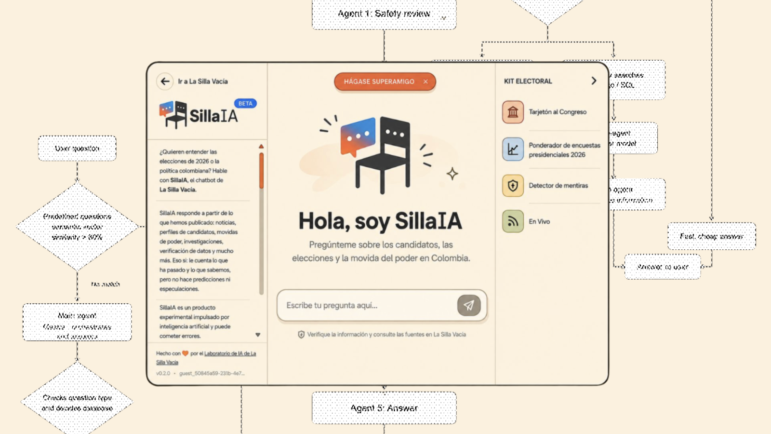
What We Learned Building a Chatbot for La Silla Vacía’s Newsroom Archive
We spent 12 months building an AI tool for our independent news site in Colombia. Here’s what it taught us about running a newsroom in the age of AI.

Member Profiles
Fiquem Sabendo: ‘An Engine for Brazilian Journalism in the Search for Information’
Journalist Léo Arcoverde started a blog in 2015 publishing one story a day based on information obtained through Brazil’s new access-to-information law. The initiative eventually became Fiquem Sabendo.