

Image: Shutterstock
How to Tell the Stories of People Behind Data Points
Read this article in




Investigative reporters encounter a common sourcing challenge after securing the data and the expert input on discrimination and inequity stories. How do they actually identify individual people experiencing the harms represented by the data points to humanize the piece — and how do they get them to talk? It’s a problem partly because the people behind the numbers tend to be new to media interaction, and often new to statistics, and don’t come forward on their own. And partly because the individuals most impacted by unjust policies — whether from a biased social security algorithm in South Africa to climate change impacts in Brazil — often don’t know that they are losing out relative to others.
In a session at the NICAR26 data journalism summit, a panel of veteran data reporters shared tips on how to amplify and contextualize data-driven public interest stories with ordinary people at the short end of policy.
The panel included Stephanie Lamm, data reporter at the Atlanta Journal-Constitution; Mark Nichols, senior manager of data journalism for ABC News; Caresse Jackman, investigative consumer reporter with Gray Media’s InvestigateTV; Elisabeth Gawthrop, data journalist with American Public Media; and Jared Kofsky, investigative producer at ABC News.
“Having the data is great, but if you don’t have somebody who will resonate, or who can bring that data to life, then it gets lost,” said Jackman.
One takeaway from the panel was that interviews with people behind data points don’t just involve questions, but rather conversations that begin with the reporter: to explain the data, your story process, and how you believe the person may be reflected in some of the numbers.
Another was that it’s important to treat people as full human beings with particular circumstances, rather than merely as examples of data point outliers.
Once identified and approached, Nichols noted that reporters often need to carefully brief people on the data, the source of the dataset, and your initial findings — but to do so “without leading the witness.”
“Sometimes the people in these situations we’re reporting on don’t even realize they’re in the worst crime neighborhood in the city, or in an area where pollution is three times greater than everywhere else in the community,” Nichols explained. “Sometimes I have to educate the potential source; get them to understand what we found, and how we think they fit in.”
“Be clear and transparent to the person about what the story is, and how their information will be used – even over-communicate,” Jackman added. “I sometimes chat on the phone and then do a Zoom with them just to get their trust.”
The panel suggested the following routes to finding these sources:
Think about whether there might be a nonprofit organization, union, or advocacy group that represents people in the data. “Nonprofits are often a really good source for finding people affected by issues,” Kofsky advised. “Colleges and universities are also an amazing place to find experts and also people behind the numbers. Professors tend to be very willing to talk.” Panelists noted that reporters can also search transcripts from public meetings — using keyword search with tools such as summarize.tech for recorded meetings — and online complaints forums.
Consider carefully-worded reader call-outs when there is no obvious advocacy group to approach. An investigation by Lamm and her colleagues at the Atlanta Journal-Constitution used emergency agency records to reveal that residents making 911 emergency calls were put on hold 30% longer than the industry standard — and sometimes for so long that callers in grave peril gave up.
Lamm needed to find people left on hold for long periods while facing serious, recent emergencies. “We initially reached out to people on social media,” she recalled. “A lot either didn’t want to speak to me, or were too far removed from the situation or its consequences.” Her next tactic was to publish a short announcement story and a call-out form.
But Lamm also noted that the wording of these forms is crucial. Their approach was both deliberately vague on the topic — “If you had issues calling 911 or with fire, EMS or police responding to an emergency, please tell us about it” — and specific on the core way to contact — a valid email address for follow-up interviews — and included a gentle warning that reader claims would then be subjected to verification.
“We took advice from ProPublica’s surveys — they do a lot of call-outs — so I knew I needed to require contact information, as that’s the biggest hurdle,” she explained. “People want to tell you all about their experience, but when you ask for a name, they clam up. We made sure to say we want to hear your experience — good or bad; we didn’t want it to look like an attack.”
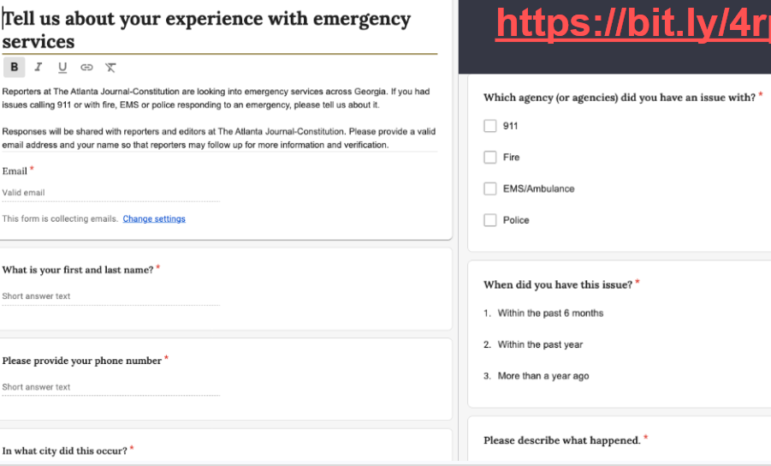
How the Atlanta Journal-Constitution published an outreach to its audience for reporting help on investigating 911 response times. Image: Stephanie Lamm, NICAR presentation
Check complaints at occupational safety agencies — or just from people you know. To investigate the chemical harms of some hair relaxer products, Jackman started with questions for her own hairstylist. But she found her ideal subjects thanks to Facebook group reach-outs — such as “Is there anybody out there who…” test balloons — and public complaints filed to the US Occupational Safety and Health Administration (OSHA).
Check for relevant plaintiffs in lawsuits or via attorneys. Last year, Nichols and his colleagues at ABC News revealed that minority homeowners — who are often “lowballed” on valuations when selling their properties — were also forced to pay disproportionately high property taxes in Baltimore and other US cities, after being “highballed” by property tax appraisals. They found that 92% of homes listed for tax sales in the city were in majority-nonwhite neighborhoods. Seeking to identify individuals who had been negatively impacted, or even lost their homes as a result, Nichols found the name of Bonita Anderson in a group foreclosure lawsuit against the city. Anderson, 70, had lost her home of 16 years in a Baltimore tax sale after juggling cancer treatment costs and high property taxes – and became a compelling character to illustrate the cascading discrimination injustices.
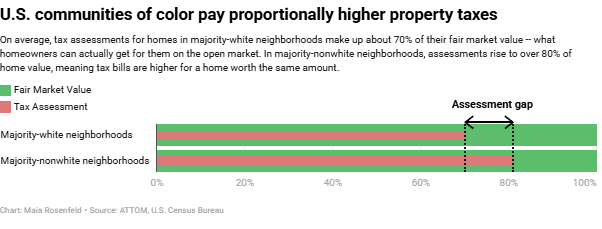
Bar chart showing “assessment gap” between fair market value and tax assessment for communities of color vs. majority-white neighborhoods in the US. Image: Mark Nichols, NICAR presentation
“Minority homeowners are often the highest-taxed people, paying a higher proportion of property taxes because of the way the property assessment system works,” he explained. The ABC story also revealed how data on the experience of a single interviewee can sometimes illustrate the issue better than population data — such as the following graph showing how Anderson’s property taxes were inflated by soaring city appraisals of her home’s value.
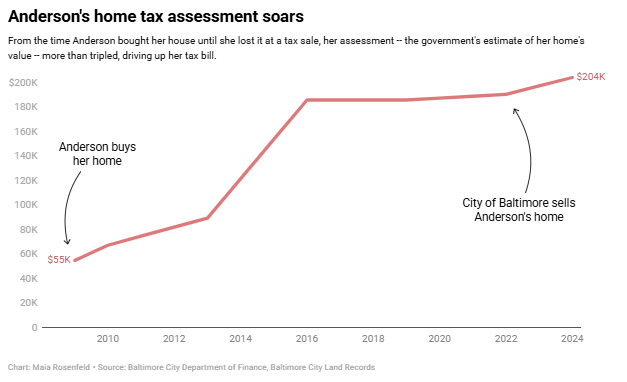
Graph of Baltimore resident Bonita Anderson’s property tax assessments over time. Image: Mark Nichols, NICAR presentation
Try LinkedIn, ThatsThem search, and Facebook groups. “Use the free people-finding tools, like ThatsThem,” Nichols suggested. Lamm added: “LinkedIn is especially useful for finding former employees; there is a LinkedIn for journalists group you can join,” Lamm explained. (Reporters can fill in a simple online form to apply for a free, messaging-enabled LinkedIn for Journalists account to find experts and current and former officials, as well as ordinary people who are unlikely to be among a reporter’s connections. Freelancers can also apply, by including work samples on the form.) Gawthrop added that LexisNexis searches can quickly help verify basic details about people interviewed, and check for past convictions.
Panelists acknowledged the truth of the saying that “statisticians look for averages, and journalists look for extremes.” However, Nichols pointed out that Bonita Anderson was a good example of “an average-extreme”: a typically overtaxed minority homeowner who was made homeless by highballing, and who was then forced to watch her house auctioned off to the city for a fraction of even its original purchase price.
Panelists also offered tips on how to treat these interviews:
- Be open to a changed story focus. The speakers noted that reporters sometimes assume outliers in a new dataset to be victims of one phenomenon, like bias, when testimony from those people reveals the numbers are really about something else, such as a targeted scam, or a sudden demographic change. “It’s also an iterative princess, where you may speak to some people and realize: ‘Oh, we should be looking at this data in a different way, based on what this person’s experience,’” said Lamm.
- Don’t stop your person-search after the first person with a strong quote. ”It can be tempting to go with the first person on record, and you think: ‘I’ve got it; I’m done; next step: writing,’” said Gaethrop. “Try to find the person who fits the story better.”
- Be willing to “lose” interviewees with candid initial contacts. Lamm said it’s better to fully brief potential interviewees with an initial off-record call — explaining, for instance, that you will need to vet the person, and may need to publish a photo and pull records on the incident after the interview.
- Beware of honest memory lapses. “Memory during traumatic events can be really tricky — we had people swear they were on hold [with 911 emergency services] for 15 minutes; when we got the records back, in some cases, they were really on hold for 30 seconds,” Lamm recalled. “Verification is critical.”
 Rowan Philp is GIJN’s global reporter and impact editor. He was formerly chief reporter for South Africa’s Sunday Times. As a foreign correspondent, he has reported on news, politics, corruption, and conflict from more than two dozen countries around the world.

This work is licensed under a Creative Commons Attribution-NoDerivatives 4.0 International License
Republish our articles for free, online or in print, under a Creative Commons license.
Republish this article
This work is licensed under a Creative Commons Attribution-NoDerivatives 4.0 International License
Read Next

Data Journalism
Developing a Data State Of Mind: Key Tips for Editors
Data is woven into how journalists cover everything from local government spending to global climate change patterns, but for editors without a specialist background, it can be daunting.

Data Journalism
From Data to Storytelling: Concept and Design Tips from the Financial Times’ John Burn-Murdoch
The chief data reporter for the Financial Times discusses how he considers the use of text, color, and annotation to aid visual storytelling through charts and graphics.
The Japanese Journalist Fighting for Better Data, Public Records, and Human Stories
Frustrated by journalism that gave voice to those in power rather than the voiceless, Yasuomi Sawa was inspired to become an investigative journalist. He shares with Scilla Alecci about the state of journalism in Japan, including the limitations to its existing freedom of information laws and how preventing institutional or individual embarrassment can hinder a relentless free press and uncomfortable public debates.

Data Journalism
Humanizing Data: Using Numbers AND People
With the growing relevance and popularity of data journalism, it may be easy to prioritize numbers over people, and spend our time emphasizing the data through graphics, maps, charts, and other visual products. But sometimes the faces and names behind the data get lost. Fortunately, we have some guiding lights to keep us on the path of good journalism. Consider these highlights from the panel Humanizing Numbers at IRE16…