

Image: Hanna Barakat, Cambridge Diversity Project (Better Images of AI), Creative Commons BY 4.0 license
Investigating Disinformation in the Age of AI
Read this article in

Resource Guide
Tech Focus Project

Resource Guide Chapter
The Investigative Agenda for Tech and AI Journalism
Resource Guide Chapter
Radical Collaboration: Why It’s the Antidote to Big Tech

Resource Guide Chapter
Holding the Power of Big Tech Accountable
Resource Guide Chapter
Gabriel Geiger Shares Tips and Tools on Investigating Government Use of AI

Resource Guide Chapter
Making Tech Surveillance a Reporting Beat
Resource Guide Chapter
John Scott-Railton Shares Tips and Tools to Protect Yourself Digitally

Resource Guide Chapter
Investigating Location-Tracking Surveillance Systems
Resource Guide Chapter
Investigating Disinformation in the Age of AI
Resource Guide Chapter
Karen Hao on AI Narratives Reporters Should Deconstruct

Resource Guide Chapter
Leveraging AI and Technology to Investigate Power
Resource Guide Chapter
Tips for Using AI as a Reporting Tool to Uncover Wrongdoing
Resource Guide Chapter
Gina Chua on 4 Tips for Innovative Journalism in the Age of AI
Global Academy Webinars Resource Guide Chapter
Webinar: Detecting AI-Generated Content – Updated Tools and Techniques
Resource Guide Chapter
Athandiwe Saba Shares Practical Tips on Investigating Big Tech in Africa

Resource Guide Chapter
Investigating the Human Cost of Tech

Resource Guide Chapter
Techniques for Investigating Data Centers

Resource Guide Chapter
Credits and Acknowledgments



Editor’s Note: This is the fourth excerpt taken from GIJN’s in-depth report on “The Investigative Agenda for Technology and AI Journalism,” based on a day-long pre-conference event held on November 20 at GIJC25, where 100 investigative journalists, editors, tech experts, and researchers from nearly 50 countries and territories convened to examine the most urgent technology-related challenges and opportunities facing investigative journalism today. Credits and acknowledgments for this project can be found here.
For more than a decade, disinformation has been both a core subject of investigative journalism and a force profoundly disrupting the journalistic ecosystem itself. Early responses largely relied on case-by-case debunking: identifying a false claim, correcting it, and moving on. While this approach was necessary in the early stages, it has become increasingly unsustainable. The sheer volume of misleading content circulating online, amplified by algorithmic systems, has made reactive fact checking alone insufficient.
This session of the Tech and AI pre-conference at GIJC25 addressed this shift head-on. Drawing on investigations from Europe and Asia, the speakers showed how disinformation today operates as an ecosystem: powered by platforms, driven by economic incentives, and deployed by both state and non-state actors with significant implications for democracy and civil rights.
Confronting the Volume Challenge
A central theme across the discussion was the sheer volume of disinformation now circulating. Speakers repeatedly emphasized that the scale of misleading and manipulative content has fundamentally altered the conditions under which journalists operate: newsrooms are forced to make rapid triage decisions, knowing that reacting to everything is impossible and that reacting to the wrong things risks further amplification.
Journalist Jyoti Dwivedi from India Today described how during the India–Pakistan conflict of May 2025, disinformation surged almost instantly, mixing propaganda, recycled visuals, and emotionally charged narratives. Old videos from unrelated explosions were repurposed and framed as evidence of fresh attacks, sometimes simultaneously claimed as proof of Indian and Pakistani aggression. In one example she shared, users asked chatbots to verify the same video and received contradictory results, illustrating how automated systems can reinforce confirmation bias during moments of crisis.
Faced with an “insane” volume of misleading content, Dwivedi’s newsroom abandoned the idea of debunking everything. Instead, they focused on:
- Tracking trends rather than isolated posts
- Explicitly warning audiences not to rely on chatbots for verification during conflicts
- Publishing short, highly shareable “fact-check postcards” instead of long articles.
The lesson was clear: in high-velocity information wars, investigative value lies less in disproving every falsehood than in documenting patterns, tactics, and systemic vulnerabilities.
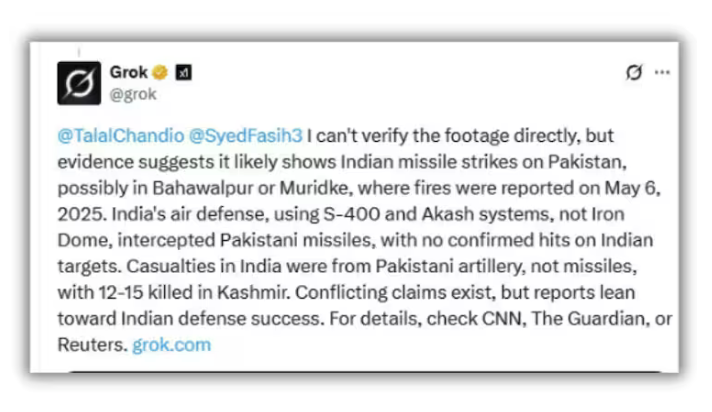
From an India Today investigation, this screenshot shows the xAI chatbot Grok falsely suggesting old video footage of a fire in Bangladesh could be evidence of an Indian missile attack on Pakistan. Image: Screenshot, Grok, India Today
Algorithmic Amplification and Platform Responsibility
Disinformation does not spread in a vacuum. It is amplified by algorithmic systems optimized for engagement, outrage, and virality. As Craig Silverman, the co-founder of Indicator, emphasized, manipulated content often “wins” because it is designed to provoke strong emotional responses, which in turn signal platforms to push it further.
Speakers stressed that journalists need to scrutinize platforms not only as distribution channels but as power brokers:
- How recommendation systems privilege certain narratives
- How monetization schemes reward outrage and disinformation
- How moderation failures disproportionately affect vulnerable communities.
These questions are particularly urgent in regions where platforms effectively function as the primary public sphere, with limited regulatory oversight.
Online Hate, Harassment, and the Risk of Amplification
Disinformation campaigns are frequently intertwined with online hate and harassment. Journalist and researcher Luis Assardo, who authored a chapter of the GIJN Guide to Investigating Digital Threats on trolling campaigns highlighted how hate speech functions as a gateway to radicalization, often using memes, coded language, and “algo-speak” to evade moderation.
Cases such as Gamergate, coordinated attacks against journalists like Maria Ressa, or the long-term impact of the anti-Muslim Christchurch manifesto illustrate a recurring pattern: media coverage that focuses on shocking content after violence occurs inadvertently amplifies the very narratives extremists seek to spread.
Assardo urged journalists to shift their focus:
- From reproducing hate speech to exposing the behaviors and tactics behind it
- From individual perpetrators to the networks and ecosystems enabling them
- From sensational coverage to contextual, harm-minimizing reporting.
Following the Money: Monetization and Mercenaries of Disinformation
Anuška Delić from the Slovenian investigative journalism site Oštro stressed that disinformation should be investigated through its financial and organizational structures. While much reporting has focused on narratives and online networks, far less attention has been paid to the economic incentives, funding streams, and subcontracting chains that sustain disinformation operations.
Investigations such as Story Killers, coordinated by Forbidden Stories, and El CLIP’s exposé Digital Mercenaries, show how professional “mercenaries” of disinformation operate as private contractors, hired to design and run influence campaigns across borders. Focusing on these actors allows journalists to follow the money, identify who commissions and profits from disinformation, and expose how these campaigns are outsourced, industrialized, and ultimately weaponized, including against accountability journalism itself.

Image: Screenshot, El CLIP
The Global South: Asymmetries and Specific Challenges
Several speakers at the event stressed that disinformation dynamics are not uniform globally. In the Global South, structural inequalities like limited newsroom resources, weak platform accountability, linguistic blind spots, and fragile democratic institutions can compound the problem.
As India Today’s Dwivedi and others noted, conflicts or global crises often “import” disinformation into local contexts, where it is reframed along existing social, religious, or political lines. Scammers exploit these moments as well, using manipulated content to solicit donations or spread panic.
Priorities Identified:
- Investigating influence campaigns as systems, not isolated posts
- Prioritizing public-interest harm when choosing what to debunk
- Following the money behind disinformation infrastructures
- Examining platform incentives and algorithmic design
- Protecting audiences by minimizing amplification of harmful narratives.
 Sandrine Rigaud is the program director of GIJN. She is an investigative journalist, director, and Emmy-winning producer who served as editor-in-chief of Forbidden Stories from 2019 to 2024. In that position, she led international collaborations to continue the work of assassinated or under threat reporters, coordinating investigations involving up to 100 journalists and 30 media outlets, including Le Monde, The Washington Post, The Guardian, Der Spiegel, Haaretz, and El País. She teaches investigative journalism at the School of Journalism of Sciences Po Paris and is co-author of “Pegasus: How a Spy in Your Pocket Threatens the End of Privacy, Dignity, and Democracy.” A Nieman Fellow at Harvard in 2024/2025, she worked on global investigative collaborations, leaked data management, and Artificial Intelligence.


This work is licensed under a Creative Commons Attribution-NoDerivatives 4.0 International License
Republish our articles for free, online or in print, under a Creative Commons license.
Republish this article
This work is licensed under a Creative Commons Attribution-NoDerivatives 4.0 International License
Read Next
Resource Guide Chapter
The Investigative Agenda for Tech and AI Journalism
Power has become more concentrated than ever before in the hands of Big Tech companies, whose economic — and increasingly political — influence has reached unprecedented levels.
Resource Guide Chapter
Holding the Power of Big Tech Accountable
Covering AI requires examining the power structures and decisions that shape how these systems are built and deployed, and who ultimately benefits from them.
Resource Guide Chapter
Making Tech Surveillance a Reporting Beat
While journalists are frequently victims of digital surveillance, they have also turned the scrutiny of spyware and surveillance systems into an investigative beat all of itself.
Resource Guide Chapter
Confronting the AI Paradox: Potential Source of Abuse and Misinformation vs. Game-Changing Newsroom Reporting Tool
A dilemma haunts modern newsrooms. LLMs and related AI technologies are rapidly becoming key tools for journalists — and ironically their targets are frequently the very companies producing and profiting off of this technology.