

News & Analysis Reporting Tools & Tips
Questions and Tips to Guide Website Investigations
At a panel at NICAR 2023, two digital experts discussed tips and techniques for conducting investigations into suspicious websites and their owners.
At a panel at NICAR 2023, two digital experts discussed tips and techniques for conducting investigations into suspicious websites and their owners.
Based on an interview with Wayback Machine’s director, Mark Graham, ProPublica’s Craig Silverman shares more essential tips on using it, including how to bulk archive pages, compare changes, and see when elements of a page were archived.
The Internet Archive is a nonprofit library that is best known for the Wayback Machine, a staple for investigative journalists around the world. Launched 20 years ago, the Wayback Machine now archives much of the public web at the rate of more than 1 billion archived URLs per day.
This year, in our My Favorite Tools series, we asked 12 of the world’s top journalists what their go-to tools are. From VeraCrypt and OnionShare to Aleph and the Wayback Machine, here are GIJN’s favorites.

For this week’s Friday 5, where GIJN rounds up key reads from around the world, we found a ready-for-prime-time study on financial crimes in the US art market, how misinformation actors are weaponizing the Wayback Machine, and Google’s not-so-altruistic $1 billion for publishers.

CNN reporter Donie O’Sullivan describes how he and a colleague were able to discover, and then prove, that the largest Black Lives Matter Facebook page in 2018 was an Australia-based scam. O’Sullivan also provides insights into the value of good archive sites and domain registration tools in investigating suspicious social media pages, in conjunction with traditional reporting methods.
For our series about journalists’ favorite tools, we spoke with Barbara Maseda, the founder and editor of Proyecto Inventario, an open data platform for journalists reporting on her native Cuba. She told GIJN about the investigative tools she uses to overcome the difficulties of data reporting in and about Cuba.
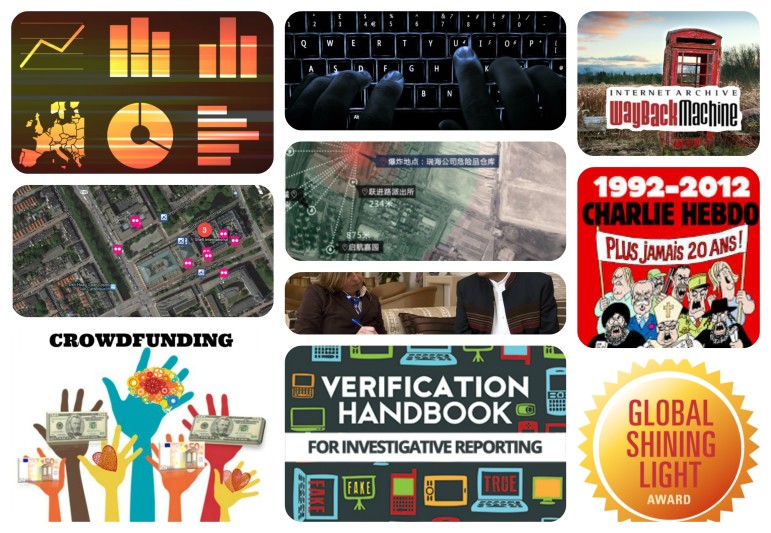
As 2015 nears an end, we’d like to share our top 12 stories of the year — the stories that you, our dear readers, found most compelling. The list ranges from free data tools and crowdfunding to the secrets of the Wayback Machine. Please join us in taking a look at The Best of GIJN.org this year.

A growing number of reports of self-censorship, hacked websites, and intimidation and arrest of writers in Serbia has prompted public warnings by the U.S. government, EU and OSCE. One of the country’s top journalists, Branko Čečen, is firing back with a hard-hitting critique on the sorry state of the nation’s media. He asks: Who’s really interested in accountability and real reporting in Serbia today?
In 2001 GIJN was born, as investigative journalists from around the globe met for the very first time to share ideas, tips, and best practices to strengthen their reporting in a world where journalism was increasingly under threat.
Today the threat has multiplied, and at GIJN we find ourselves under the same pressures as our member organizations. Most urgently: available funding for investigative journalism has been impacted as some longtime funders who supported journalism in the past are no longer doing so or have closed. Yet our work continues, more important than ever before.
GIJN serves as the global hub for the world’s investigative reporters. Our core mission is to support and strengthen investigative journalism—with special attention to those from repressive regimes and marginalized communities.
We are embarking on our first-ever campaign initiative to help us expand our revenue by the end of the year through individual donors. If you have ever joined one of our free webinars, used one of our free resources, learned a new skill thanks to a GIJN training, or simply believe that press freedom is essential to civil society, we ask you to show your support for GIJN’s work with a donation of your choosing. Called “Friends of GIJN,” this campaign includes a more personalized experience, starting in 2027, for individuals who answer the call to join with us during this unprecedented time.
Truth and democracy are under attack around the world. You can fight back by helping GIJN support investigative journalists with free access to the latest tools and techniques — so they can foster justice and hold accountable those who abuse the public trust.
With a staff based in 24 countries, GIJN works in a dozen languages each day, linking together the world’s most enterprising journalists, offering state-of-the-art training, webinars, tip sheets, and a Help Desk that responds to 2,000+ requests for assistance each year. More than 84% of GIJN’s operating budget goes directly to our program work.
Please make a gift today to support journalists on the front lines of the fight for accountability and human rights.