
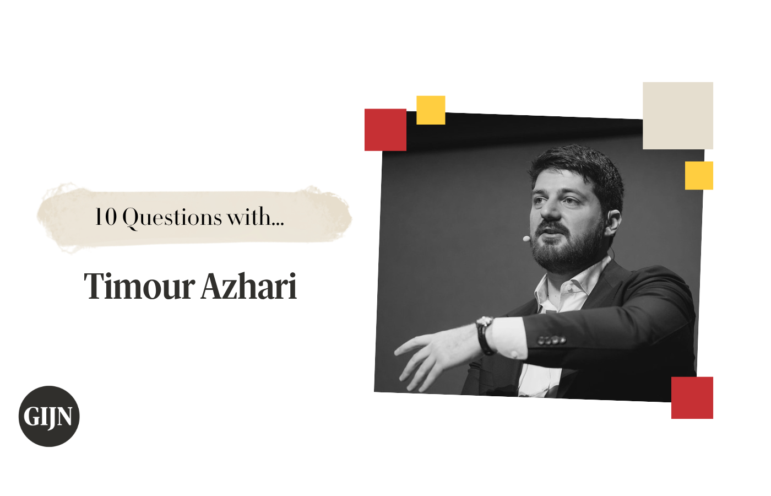
Photograph: Courtesy of Truth Tellers, the Sir Harry Evans Investigative Journalism Summit, London 2026.
‘As They Say, If Your Mother Tells You She Loves You, Get a Second Source’: Navigating the World of MENA Investigative Journalism

‘Never Stop Learning’: Reporting on Yemen Beyond the Headlines
Gathering Evidence and Documents in Conflict and War Zones — A MENA Case Study

GIJC23 – Criminal States & Kleptocracies
How Many Journalists Does It Take to Fill an Olympic Swimming Pool? GIJN’s Guide to Size and Number Comparisons
When Bashar al-Assad’s regime fell in 2024, no one had any idea how the new Syrian authorities would run the country. Closed-doors appointments, unexpected deals, and an economy in dire need of recovery after more than a decade of civil war left many wondering how the new government would operate. This is where investigative journalists like Timour Azhari come in.
While currently working as Reuters’ chief correspondent in Saudi Arabia, Azhari has led groundbreaking reporting across the Middle East in recent years, including a stint in Syria. It was there that he helped unveil how Assad’s confidants were allegedly plotting uprisings from abroad, and where he worked on investigations to unravel the secrets of Syria’s new economic system — tracing the power all the way to the new president’s brother.
Azhari’s first role was with The Daily Star, although now defunct it was once the leading English-language newspaper in Lebanon. During Lebanon’s 2019 protest movement, he was one of the most important voices on the ground for English-speaking audiences.
His work for The Daily Star, Al Jazeera, and eventually Reuters took him to Lebanon, Syria, Iraq, and across the Gulf, covering important stories that shed light on little-known issues in the region.
Last year, Azhari was part of the Reuters team that won the Sigma Delta Chi Award for Public Service in Journalism for the investigative series Syria After Assad. The series meticulously exposed mass graves, sectarian violence, and the covert economic networks built by the Assad regime to enable its elite members to survive in exile. The team also won the Scripps Howard Award for Excellence in National/International Investigative Reporting for the same series.
Speaking to GIJN, Azhari spoke about his work in Syria, the new challenges he faces as a journalist in the Gulf, and where he thinks investigative journalism is going in the future. The interview has been lightly edited for length and style.
GIJN: Of all the investigations you’ve worked on, which has been your favorite and why?
Timour Azhari: I have to say it’s the story about how the new authorities in Syria are reshaping the economy. I think that, firstly, it was this very nice mix between me and my colleague Feras [Delatay, a GIJN associate editor], on-the-ground reporting and old-school sort of sleuthing and building contacts and all of that, plus data journalism bringing in a cache of documents, and sifting through it and piecing things together.
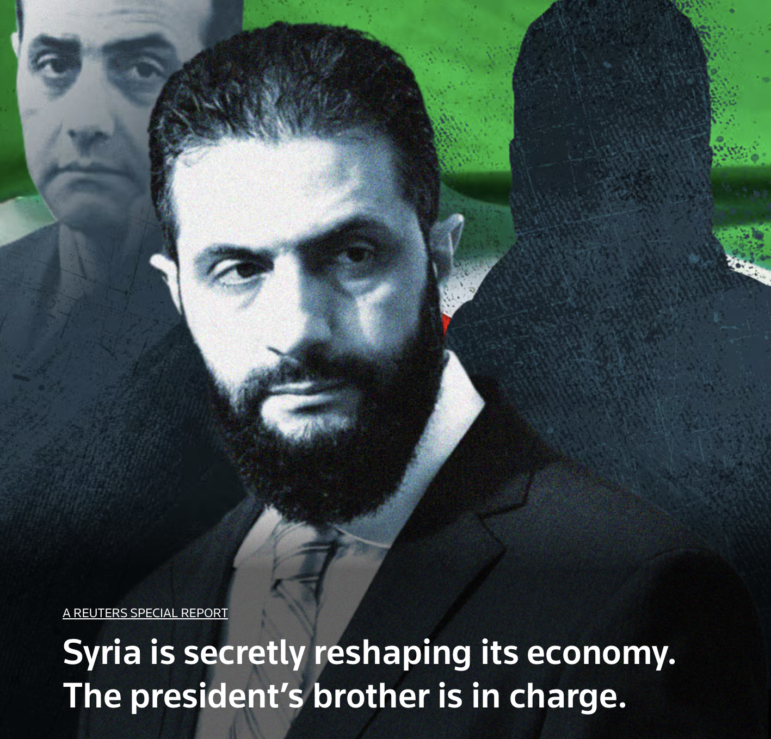
Timour Azhari dug into how the Syria economy was being remade after the fall of the Assad regime. Image: Screenshot, Reuters
And it’s something that we started reporting basically as soon as the regime fell, because the idea was to try and understand what Syria had in terms of resources and what was being done with these resources, because that ultimately is at the core of the recovery of the country. And so pretty much when we hit the ground in Damascus, we started reporting.
I think it was an important story because it revealed how this was being done: It revealed the characters, the people behind it, and also the scale of what we’re talking about, which is really that most of the Syrian economy was under the control of the Assad regime through various methods.
Additionally, the characters were just incredible, particularly trying to unravel the identities of people who were known by their nom de guerre, like Abu Mariam al-Australi [a man sanctioned by his native Australia for alleged terrorism financing, currently heading Syria’s committee for economic restructuring], so you start off with just a figure, like a face, and then you try to build as much information as you can.
I think it was the first big piece on Syria’s economy and showed what was happening. It was also a piece of critical reporting at the time where there hadn’t been that much. And I think still to this day, that piece sort of lives on, and we see the reverberations continuing in the way that the political economy of Syria is being set up. It’s still controlled by a small group of people who are very politically connected. There’s very little accountability.
GIJN: What are the biggest challenges in terms of investigative reporting in your country or region?
TA: In Syria, you’re in a country where you just had the fall of a decades-old regime and everything is being remade, and you are trying to chart that and say something serious and lasting and definitive about something that continues to move and develop as you report it. Honestly, sometimes as we were reporting, investigating, you felt that you were traveling at the same speed as the information itself, you see it next to you, and that poses its own sort of challenge. You have to be very careful.
The way we approached it is really just getting as many sources as we could. We worked on the economy story for more than half a year. We were living this, we were dreaming this, so that was definitely a challenge. Then the challenge was also getting input from a government that didn’t really have the infrastructure set up to give you an answer easily and hadn’t really dealt with the media.
So we really went out of our way to get comments… to give the opportunity to the subject to respond. It took weeks, and in the end, it also posed some relationship challenges for us.
And then of course, there’s the security aspect of it. Feras and I did face sort of an online hate campaign, and were, to some extent, worried about our personal security. Nothing happened, but that was also definitely a consideration. There was a lot of cortisol and a lot of adrenaline in that.
Saudi Arabia, where I now work, poses a different set of challenges.
I think one of the things we noticed in Syria is that people really wanted to talk after the fall of this brutal, oppressive regime. People wanted to tell their stories and they wanted to prevent anything like what happened from happening again, so people were very engaged.
Saudi Arabia is a monarchy, and it’s a monarchy where over the past decade or so, it’s become even more difficult to speak to people who don’t follow the general line from the top, so, criticism has been stamped out more and more. So, moving to the Gulf, it’s a bit more difficult to find sources on the ground, but we find our ways.
GIJN: What’s been the greatest challenge that you’ve personally faced in your time as an IJ?
TA: I would say making the time to do investigative journalism, first of all, because in addition to doing investigations, I also report on breaking news, and I try to do everything at the same time.
It’s not always easy to think about the medium and long term, although I found that that’s kind of what keeps you sane, so you don’t feel like Sisyphus, sort of rolling that stone up the hill and then seeing it roll down the next day. It’s really these sort of longer pieces that give you that lasting impact.
In the past five, six years, I feel like generally in the world, we’ve moved towards a place of system collapse and the failure of international norms and law and journalism. Investigative journalism particularly exists in a place where you’re trying to have an impact, and that also depends on having things like a judiciary that functions or politicians that care about not being corrupt, you know, and aren’t just bare faced about it.
Journalism is the fourth estate, but the other three estates are essential to the functioning of it and I think that the breakdown that we’re seeing in the world — and that reflects on the region we work in — is really harmful to that. It makes it precarious and also makes you feel sometimes like, “OK, now what?”
GIJN: What is your best tip for interviewing?
TA: I think the best piece of advice I can give is be a human, be a person. Don’t be a journalist sort of interrogating this person. The way I do my job is I sit and have a conversation, it’s important to build those relationships and be human because I think that some journalists actually get a bad name for seeming like they’re trying to extract something from someone.
A lot of the time in my initial meetings with people, I don’t get out a notebook and a pen, because I feel like that changes the situation. I am then recording what they’re saying, and that will change how they talk.
So I would say that another good piece of advice is if you’re interviewing someone and you can is to just sit there and have a conversation and mentally log the important bits.
Obviously, if it’s a formal interview with a politician or on record, then you record it. But when you’re sitting down and having a coffee, be a person, be a human.
GIJN: What is a favorite reporting tool, database, or app that you use in your investigations?
TA: I really don’t know what to answer because honestly, I am so old school, I am not a data guy. So WhatsApp is my favorite app, and Signal probably even more. I cannot honestly say that there is an app that I use regularly for my work: I meet people, I talk to people, I build relationships, that’s the way I have done my job.
GIJN: What’s the best advice you’ve gotten in your career and what words of advice would you give an aspiring investigative journalist?
TA: In ever-shrinking newsrooms, the advice I got is to ruthlessly prioritize what I work on. And the advice I would give to an aspiring investigative journalist or any journalist is: never underestimate a meeting with someone you might not think is important.
I remember when I moved to Iraq a few years ago, I met with someone and, while on my way to the meeting I was a bit tired, wondering why I was doing this. Within a couple of months, this person helped me break an incredibly important story. So I would say, never say no to a meeting because you never know when that person’s building might burn down, and then it’s a story.
GIJN: Who is a journalist you admire, and why?
TA: I grew up watching Amy Goodman and Democracy Now! on YouTube, and I love the fact that she would bring you stories that a lot of large media organizations would not bring you from the ground, from protests.
She always has the human perspective, the people’s perspective. She really inspired me, and she’s just dedicated to what she does.
GIJN: What is the greatest mistake you’ve made and what lessons did you learn?
TA: I have reported things that turned out to be incorrect, and I think it happens to probably all of us at some point. This was not an investigative piece, more a news piece where you think you have the sourcing and then for whatever reason, it turns out that you were wrong.
You just have to always remain sort of critical and double-check yourself. Sometimes that’ll happen when you’re used to speaking with someone and they’ve been reliable before, and you let down your guard a bit.
But as they say, if your mother tells you she loves you, get a second source, and I think it’s probably good to get a third or a fourth as well.
GIJN: How do you avoid burnout in your line of work?
TA: Well, last year, I didn’t. The year of reporting in Syria left me really, I don’t know if it’s burnout, but I know that I felt extremely tired and just unable to focus.
I think it’s difficult and that there is no magic answer to this. It’s trying to have balance and trying to find the time for things. Whether that’s working out or doing whatever makes you happy. I try now to at least schedule a workout once a day at a certain hour and basically make no exceptions for that.
GIJN: What about investigative journalism do you find frustrating, or do you hope will change in the future?
TA: I think I would probably go back to my first answer, which is that I feel like doing investigative journalism in an increasingly unaccountable world is frustrating. I would hope that we are able to go back to a place where we see the impact of this work.
I do think that investigative journalism remains as important as ever, and it can still have an impact. I just feel like there’s so much going on, and so much collapse and degradation of norms, that we need more of it.
But as we know the media is under pressure, financial pressure. It’s been trimmed and cut by social media before and now by AI, so I hope that we can weather that.
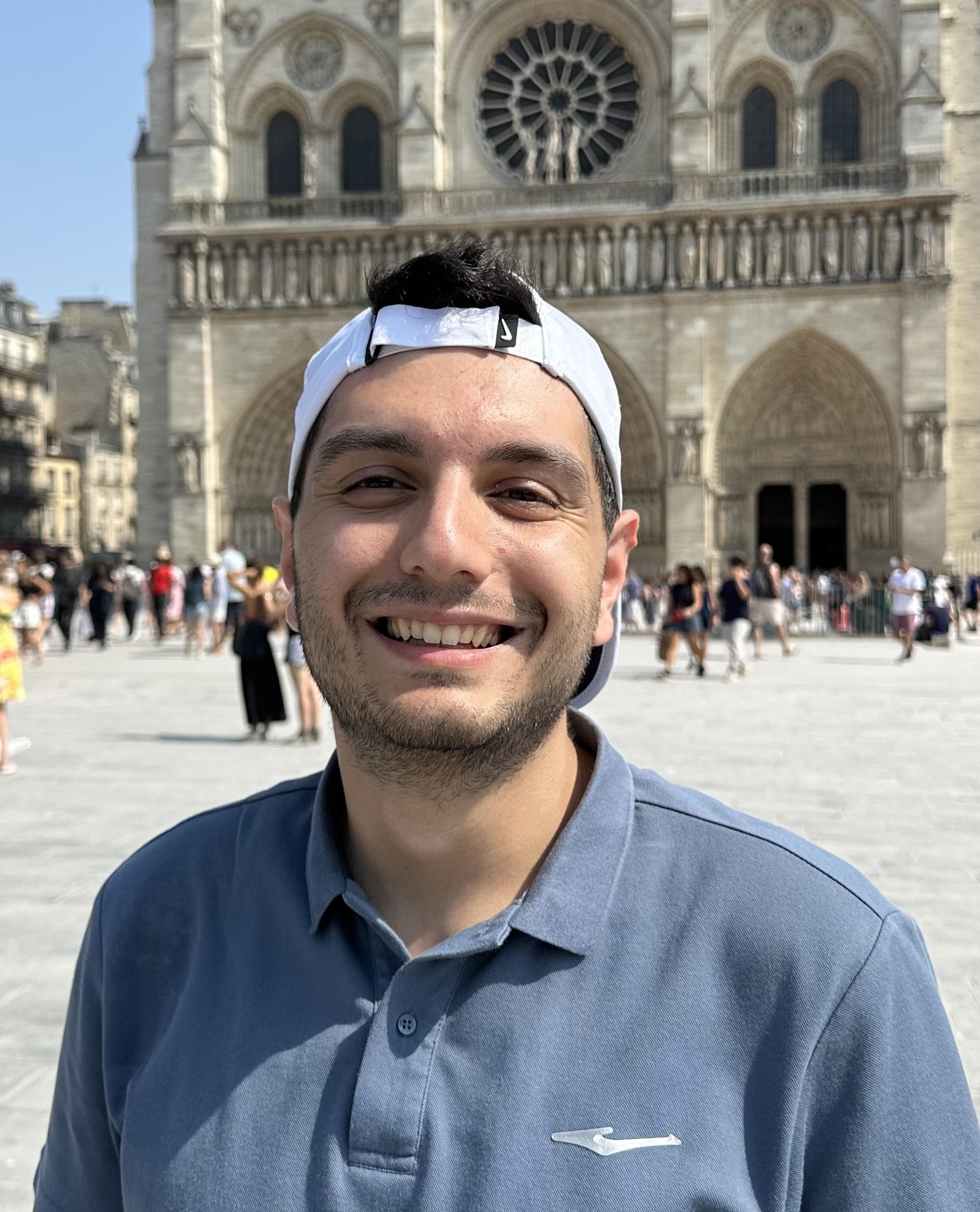 Nader Durgham is a journalist and researcher currently working with the Committee to Protect Journalists. He previously worked with AFP, Middle East Eye, Sky News, and the Washington Post in Beirut, covering Lebanon, Syria, Palestine and the wider region. He is a graduate of the American University of Beirut and has a master’s degree in Democracy and Comparative Politics from University College London.
‘Never Stop Learning’: Reporting on Yemen Beyond the Headlines
Gathering Evidence and Documents in Conflict and War Zones — A MENA Case Study
GIJC23 – Criminal States & Kleptocracies
How Many Journalists Does It Take to Fill an Olympic Swimming Pool? GIJN’s Guide to Size and Number Comparisons
Uncovering Syria’s Stolen Children

Investigating Syria after Assad: A Black Box, Opened
Deadly Gaza Aid Sites, Damascus Dossier, Exploiting Sudanese Refugees: 2025’s Best Investigative Stories from the Middle East and North Africa

Fighting a ‘Scourge of Secrecy’ and Uncovering Corruption in Malawi

This work is licensed under a Creative Commons Attribution-NoDerivatives 4.0 International License
Republish our articles for free, online or in print, under a Creative Commons license.
Republish this article
This work is licensed under a Creative Commons Attribution-NoDerivatives 4.0 International License
Read Next
How They Did It
Uncovering Syria’s Stolen Children
This collaborative investigation brought together international and local journalists to reveal how the Assad regime used a global childcare charity to aid the disappearance of children.
Getting the Story Out MENA Focus Week
Investigating Syria after Assad: A Black Box, Opened
Feras Dalatey describes the surreal experience of reporting in his home country days after the fall of the Assad regime — and the challenges ahead for Syria’s investigative journalists.
Editor's Picks News & Analysis
Deadly Gaza Aid Sites, Damascus Dossier, Exploiting Sudanese Refugees: 2025’s Best Investigative Stories from the Middle East and North Africa
Also featuring exposés on sex-trafficking of workers in Dubai, secret mass deportations of Tunisians from the EU, and unlicensed addiction treatment centers in Egypt.
10 Questions Africa Focus
Fighting a ‘Scourge of Secrecy’ and Uncovering Corruption in Malawi
GIJN’s Benon Herbert Oluka talks to Golden Matonga, investigations director at the Platform for Investigative Journalism – Malawi, about his career uncovering corruption.