

Image: Screenshot, BBC, YouTube
‘Mr Nobody Against Putin’: An Oscar-Winning Documentary’s Lesson on Undercover Reporting in Plain Sight
Read this article in
(Editor’s Note: This story has been updated to reflect that the film won the Best Documentary Feature Oscar at the 2026 Academy Awards.)
“This is me. Pasha Talankin. In this moment I have no idea the amount of trouble I am about to cause for myself.”
And so begins this extraordinary story by Pavel “Pasha” Talankin, an ordinary member of the teaching staff at a Russian primary school — “a nobody” — who turns into a whistleblower, taking extraordinary risks to film and then smuggle out material that documents militarization in Russian schools.
As the event co-ordinator and school videographer at Karabash Primary School No. 1, deep in the heart of Russia’s industrial heartland, Talankin films everything — the friendships, the graduations, the lessons, the local landscape. But in February 2022 when Russia’s full-scale invasion of Ukraine began, his role changes drastically. A new federal patriotic education policy comes into force — he is told to film all the events as proof that the school is complying with government orders.
“We need to get the kids to recite some patriotic songs and speeches — you need to film it,” a colleague tells him. “We also need to record the kids reciting poems about our victory.”
His response — “Are we completely fucked up?” — hints at the origins of the film. But while he mulls over resigning from his position to avoid becoming “a pawn of the regime,” he instead decides to do what he is told, document the marches, military visits, and propaganda lessons — and then send the material to filmmakers outside the country.
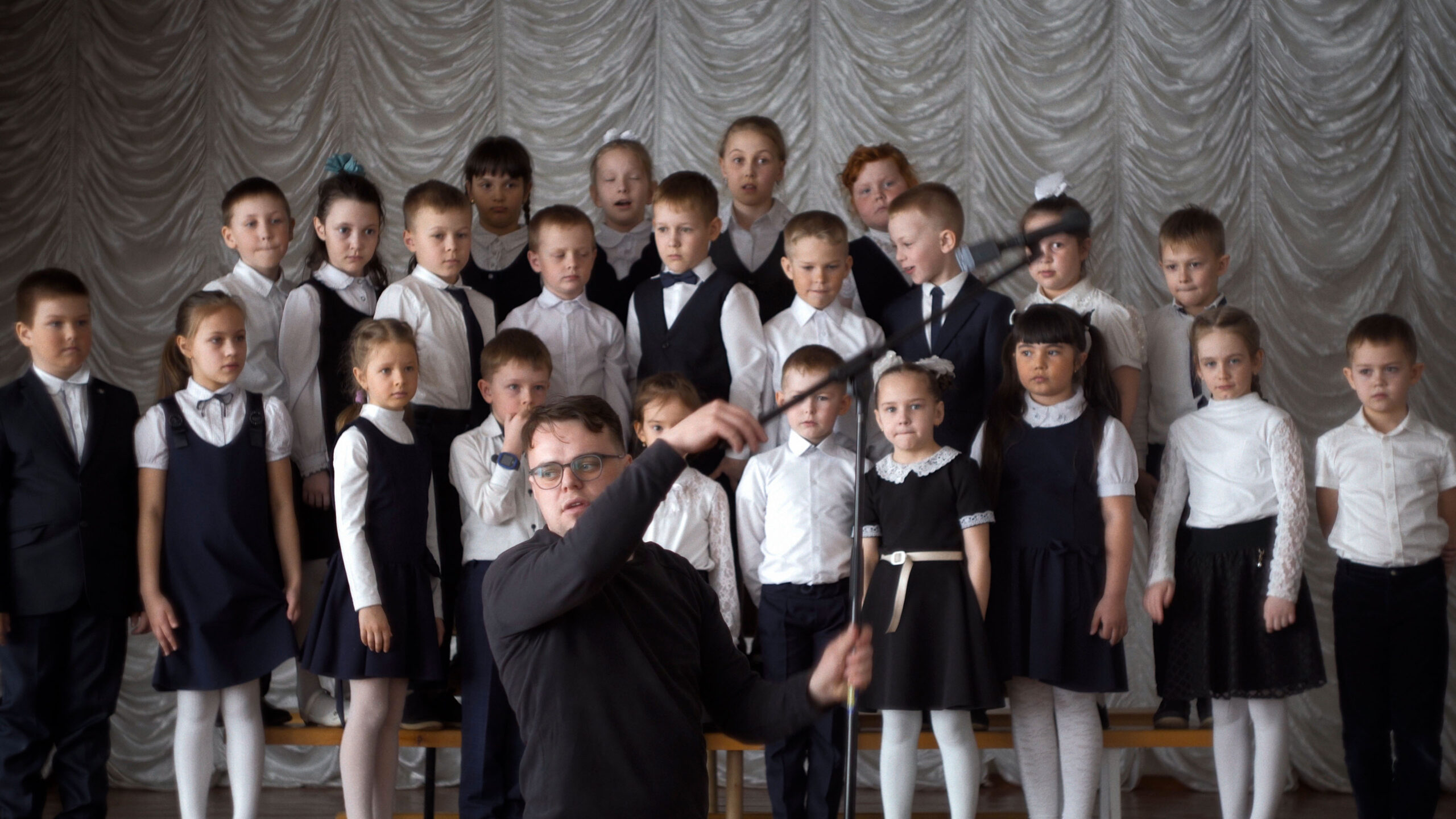
Image: Pavel Talankin in front of the school choir. Image: BBC, Pavel Talankin, made in copenhagen
This footage shows how Russian schools have become a kind of ideological frontline in the war: children read from pre-prepared scripts about the military operation, teachers cite long, state-authored texts about Ukraine and conflict. A classroom of eight-year-olds look at them, bored, while being taught about foreign agents. Some teachers adhere to the rules with a patriotic zeal, while others note that their students’ grades are dropping as classroom lessons are swapped out for visits from soldiers from the Wagner mercenary groups offering surreal advice tips about throwing grenades.
“It felt like us teachers were being forced to fight this war too,” Talankin says at one point. “I am a teacher forced to do the exact opposite of what a teacher should do.”
His opposition ranges from the cheeky — playing Lady Gaga instead of the national anthem one day, teasing the children by telling them their teachers have been forced to say everything they are about to say — to the risky: Covering up a “Z” symbol, which has become the patriotic marker for the war on the school roof. Hiding copies of his material so it is not found if he is searched.
“It’s like walking a tightrope,” Talankin explains, of his undercover work. “At first it felt like a game. It became harder as the political atmosphere was heating up. People start taking notice if the camera is present. They get pretty worried. Start whispering. It seems like… in a second, trust was lost.”
A clip of Russian President Vladimir Putin incorporated into the film is a reminder of why this matters so much: “We’ve never had a demand for teachers as we have now,” he says on a newscast. “Teachers play critical roles when countries are at turning points. Commanders don’t win wars. Teachers win wars.”
As the environment hardens, and Talankin starts to feel more at risk, he films recent graduates freshly conscripted into the war shaving each other’s heads in tearful farewell parties. He speaks to students who have brothers who have been sent to fight, and records the audio from a funeral of a deceased soldier as a mother cries: “Artyom! My sweet boy. No no no, my little Artyom.”
The day before fleeing Russia, Talankin organizes a party at the school for the graduating class and delivers them a coded message. “Sometimes to express your love, you must sacrifice everything,” he tells them. The next day, he was gone.
Talankin became the co-director on the documentary — “Mr Nobody Against Putin” — together with filmmaker David Borenstein. The film won a BAFTA award earlier this year, and is in the running for best documentary feature film at the 2026 Academy Awards. (Editor’s Note: The film won the Oscar.)
Ahead of the ceremony, GIJN spoke to Lucie Kon, the commissioning editor for Storyville, the BBC’s international documentary strand, and the executive producer of the film. The interview has been edited for length and style.
GIJN: How did this story first come to your desk — we hear a little bit about it from Pasha in the documentary, that he sent off this email about what he’d been filming to someone outside the country — how did that lead to this collaboration?
Lucie Kon: I was in a meeting with someone… He mentioned this project with a Russian teacher who was filming covertly and openly, in fact, in a school. I thought: ‘Oh my god that sounds extraordinary.’
My background is as an investigative journalist. I worked on Panorama before Storyville as an executive producer, and before that on Dispatches on Channel 4, so I had one of those mic drop moments. But my first question was about the security, and the logistics, which feels a bit boring but you can’t do it unless you do that right.
GIJN: So Pasha was doing that — sending material — as he went along?
LK: He would do some of that as he went along, he would also leave Russia from time to time and meet the team elsewhere with some rushes. There was a combination of things because they needed a steady flow. It took a while to get to the stage where they could look at what they had and start looking at the film in an edit and start thinking about how you would make the film.
Because obviously when you start this you are like: ‘Oh my goodness this story is extraordinary,” but we don’t really know what it’s going to look like.
We did know if this was going to land properly then he would not be able to stay there [in Russia]. There were lots of different elements to look at. For me, it was really interesting that his mother was a supporter of the regime. The question was: Is his mother in the film? Can he interview his mother?… And then there’s consent, because of course no one consented.
GIJN: Let’s talk about consent, and going undercover, which is particularly sensitive in this case as it relates to children in the school. How did you manage that issue?
LK: Obviously with children there are two issues, probably more. The key is the students’ parents hadn’t given consent and the children were not old enough to give their consent. So there was no informed consent, no consent in any way, shape, or form.
I work very closely with BBC editorial policy, and they thought that when we had the film as a rough cut that they could then make a judgement. They were completely astounded by the material that he got, and felt very strongly there was a very strong public interest in making the film in the way it was shot.
We couldn’t have anyone in the film who was even vaguely critical of Putin — other than Pasha.
That wasn’t manufactured — it is a genuine reflection of what people are like in Karabash. There is no distortion of the facts in the film. But there were times when people might make a joke or a teacher might say to the children something sarcastic. But we wouldn’t allow those comments in because… if you talk to a foreign broadcaster that’s treason and you are going to prison. If you make a comment — as a joke — they will take it seriously and you will go to prison. We didn’t want to expose anybody. So we didn’t allow anything even vaguely critical.
GIJN: What has happened since the film was broadcast — have there been any repercussions?
LK: Pasha said to me recently that state television in Russia has spent a lot of time in Karabash trying to undermine the film. And they went and knocked on the doors of a lot of parents and said you need to go to the police and report the film because you did not give your consent. Not one single parent in Karabash would do that. That feels like a very powerful thing. They absolutely could have — they were absolutely in their rights to do that — but they didn’t because they recognize the film is really important. The message it’s telling the world is really important. Pasha’s mum is still there, she still works in the school as a librarian, and she’s fine.
GIJN: How does he speak about the decision he has made now? I guess the bigger the film becomes, the bigger the personal impact for him. He says in the film he probably can’t go back, but I imagine now he knows that until things change he can never return?
LK: I think he is sad — his whole life was around that school. He went to that school, and then he worked at that school. He was obviously incredibly popular in that school. He hasn’t been replaced so the kids don’t have another version of him, a young teacher who is relatable. They don’t have a space to go — like his classroom, which was a bit of a haven. I think he’s really sad but he felt within himself he had to do this. He’s done it, and his life won’t ever be the same again.
There will always be a risk. We always thought he would have to get out at the end of that school term. While he would leave on the same terms that he was leaving previously, when he was taking rushes in and out of Russia, which was going away for a week and coming back, [there was a feeling] this time he was never going to go back. It was a really big deal for him, but I think he felt it was really important.
GIJN: Can you tell us — without putting him in any danger — if he is safe, if he has been able to claim asylum somewhere?
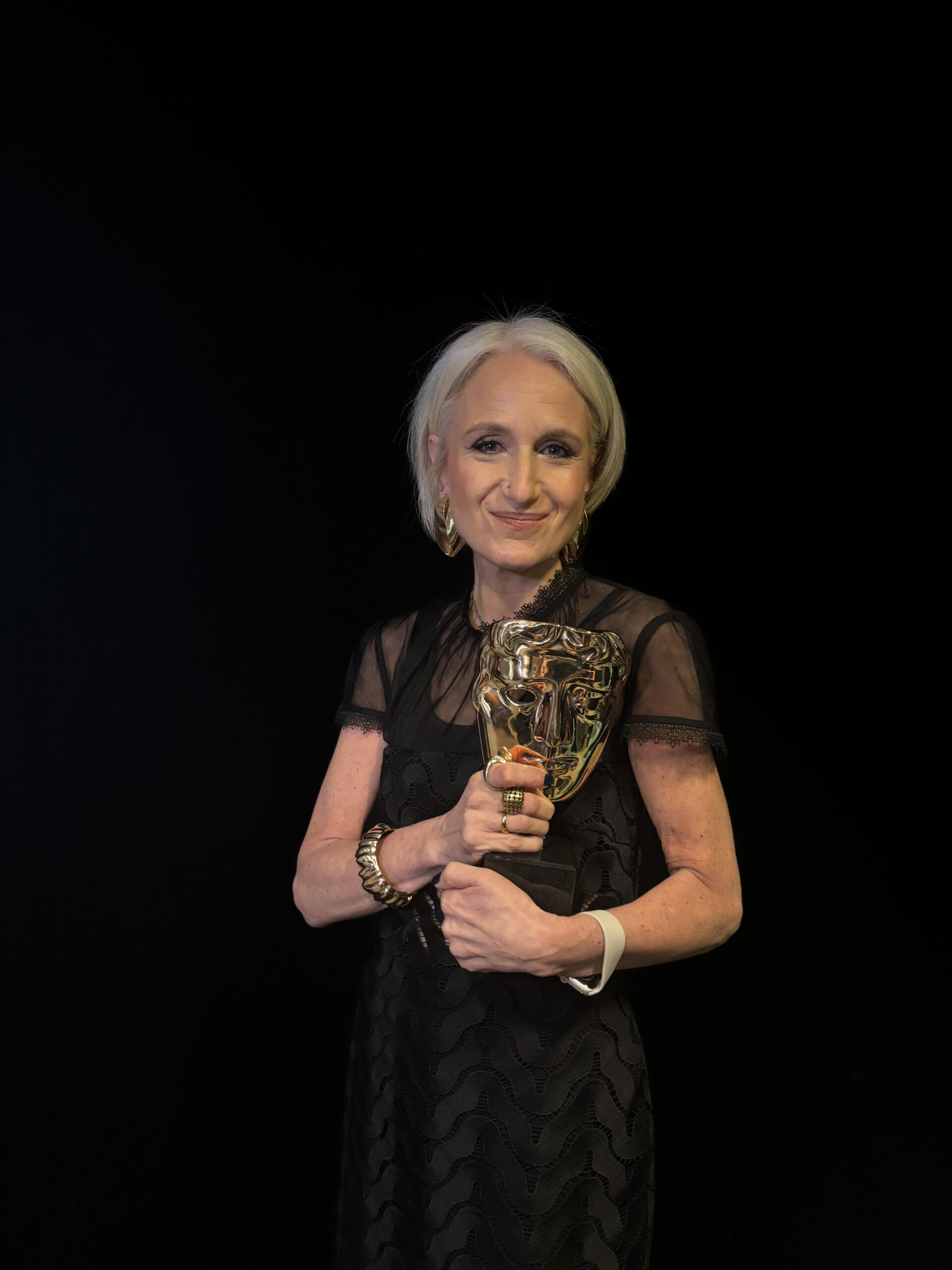
BBC Storyville editor Lucie Kon. Image: Courtesy of Kon
LK: Yes, he has asylum in Europe. There was a lot of help to get him asylum. He is settled, he is learning the language in the country where he lives. He is also learning a bit of English. He is really sweet and lovely, I have huge admiration for him, but there’s no denying, and he recognizes, how difficult it is. He had a year and a bit where he couldn’t travel. There was a screening — the premiere at Sundance last year — he spoke to the audience [remotely]. There was a big standing ovation, but he had all those months when he was very isolated, and I think that was hard. Now he’s in the exciting stage because he is able to travel, and is traveling with the film… But he knows he has to go back to that life where everything will be quiet again, and it will be a different daily reality to the one that he’s been seeing up to now. Now he has some really important decisions to make about his future, but after all these awards are over.
GIJN: Whistleblowers — particularly whistleblowers on this scale — sacrifice so much.
LK: The [Russian government] knows where he lives, of course. I’m not going to say where he lives because I have that duty of care to him, but they know everything, don’t they? Pasha is very aware since [Alexander] Litvenenko was murdered, before him others were murdered. He’s quite blasé about it [the risks], but I suppose that’s a coping mechanism. It’s also really important he understands — and when we were making the film that he understood — what kind of a risk he was taking. I know when I saw the finished rough cut, the one that looks a lot like the film today — I thought this is going to make a really big noise. You just have a feeling. He didn’t know when he was filming it, none of us did, how big it was going to be. Obviously, we are delighted that it is… because it matters that people understand what’s happening in lots of countries around the world where children are the ones who are used.
GIJN: There is that quote in the film where President Putin says on TV, “Commanders aren’t the ones that are going to win this war, teachers are.” The film explores the role of teachers and propaganda — delving into the question of who writes the curriculum and what children learn. Why is it so successful — is it because of Pasha’s role as a trusted student confidant, or is it because he is there in the classroom literally showing these edicts?
LK: He isn’t there teaching that stuff. He’s there to record [others] teaching that stuff. To prove that it’s happening. And I think the film works because it has so many different tones to it. When it starts, it’s funny. It has this incredible energy.
So many films and documentaries don’t have energy. You need to grab the audience from the beginning, and this really does that. That’s because of the way David [Borenstein], the director, has cut it together, and because Pasha has this personality that lends itself to the way they’ve cut it together.
Pasha being in the room and being able to make those sarcastic comments — which everyone thinks are jokes — including when a young person asks who he is making the film for and he says “the BBC” and they are like “Ha, ha yeah…” His personality and ability to make these jokes means you get this window. It’s not just a sad story, it’s a defiant story. And that’s the power.
GIJN: And to speak about the other teachers at the school — who face a direct intervention in what they are able to do and what they are able to say or teach the children.
LK: The teachers recognize that by changing the curriculum and spending all this time teaching them to use guns and throw grenades, to sing patriotic songs and wave flags, they are not learning math, the basics that they need to succeed in life.
Suddenly, they are not doing their jobs — they are reading from scripts. And even the children are reading from scripts, just to provide some tape for the Russian Ministry of Education. You get that that is ridiculous. Neither the teachers nor the students are stupid enough to believe that anything is real when a child has been given a script to read from and has to hold the script underneath their desk so the camera can’t catch it.
GIJN: And he manages it because of who he is.
We had lots of different names for this film. We had to give it code names so it wasn’t registered on the BBC system as what it was. It was called “Teacher P” at one point, then “Putin’s Classroom.” And then “Mr Nobody Against Putin.” At first I thought it was a bit rude, you don’t call Pasha Mr Nobody. But I really love it now, it really works. As Mr Nobody, he can get away with so much that he wouldn’t be able to get away with if he was Mr Somebody. Or if he did a different job. If he was the headteacher of the school, say…
GIJN: Pasha was able to make the documentary in part because he wasn’t a journalist. So many reporters in Russia have had to go into exile, or stop their work. What is he able to show us about Russia that we have not been able to learn about because of that vacuum and the reporting restrictions that have been put in place?
LK: I think it’s the degree to which the government is prepared to go to make their people believe that what they are doing in Ukraine is right… [At the start of the invasion] we were seeing pictures here of Russians protesting against Putin and hearing how the laws were being changed to clamp down on them. What we never heard about was how that was going into the classroom in the most remote parts of Russia.
You see how it seeps into every element of society, every single one. Every conversation that people have, it comes into it. And if you don’t say the right thing you could be in really serious trouble. I think it just shows you the level of fear that has spread across the country and how children are manipulated. And not just in Russia, but in lots of different places across the world, children are being used to keep conflicts hideous, bloody, conflicts going. That puts the world in a really dangerous place.
GIJN: Pasha was never arrested, but I guess you had to prepare him for it?
LK: He was never arrested, and never had conversations with law enforcement. But when he got to the point where he had spotted them outside his house, he alerted us, and that’s when we decided: “Right, we have to get you out, now.”
In the UK, you can watch the full documentary on BBC Storyville.
In the US and select other countries, the film is available for rent on Amazon Prime.
 Laura Dixon is a senior editor at GIJN and a freelance journalist. She has reported from Colombia, the US, and Mexico. A former staff reporter at The Times, her work has been published by The Irish Times, the Guardian, The Washington Post, and The Atlantic. She has received fellowships from the IWMF and the Pulitzer Center and is a member of the Transparency International J4T network. She is currently based in the UK.
GIJN’s Guide to Undercover Reporting

Reporting on War Crimes in Ukraine’s Occupied Territories

Fighting a War with Data Journalism: Ukraine’s Texty and the Battle for Truth
Report and Survive: Ukraine’s Young Journalists Investigate Through the War’s Most Brutal Winter

How This Oscar-Nominated Director Turned the Lens on Herself to Investigate the Man Who Sexually Assaulted Her
2025 Double Exposure Festival: Interrogating New Fault Lines on Lethal Inequity, Human Resilience, and the Limits of Journalism
‘Some Stories Just Work Better Through Film’: On the Strategy Behind Making an Investigative Documentary
Oscars 2024: Celebrating Documentary Film

This work is licensed under a Creative Commons Attribution-NoDerivatives 4.0 International License
Republish our articles for free, online or in print, under a Creative Commons license.
Republish this article
This work is licensed under a Creative Commons Attribution-NoDerivatives 4.0 International License
Read Next
How They Did It News & Analysis
How This Oscar-Nominated Director Turned the Lens on Herself to Investigate the Man Who Sexually Assaulted Her
Journalist Shiori Ito directed the Oscar-nominated documentary ‘Black Box Diaries,’ spending years reporting on her attacker and helping to spark the #MeToo movement in Japan.
News & Analysis
2025 Double Exposure Festival: Interrogating New Fault Lines on Lethal Inequity, Human Resilience, and the Limits of Journalism
The four-day event will showcase 25 feature-length and short-form documentaries that shine new narrative light on urgent topics in North America and far beyond.
Getting the Story Out
‘Some Stories Just Work Better Through Film’: On the Strategy Behind Making an Investigative Documentary
Direkt36 co-founder Andras Petho speaks about how an investigative documentary became a rare viral success, what it revealed about Viktor Orban’s Hungary, and what other small newsrooms can learn from its impact.
News & Analysis
Oscars 2024: Celebrating Documentary Film
While the Oscars are known for glitz and glamor, recognition here bestows a higher level of prestige and, in many cases, can bring urgent or in-depth reporting to a global audience.