
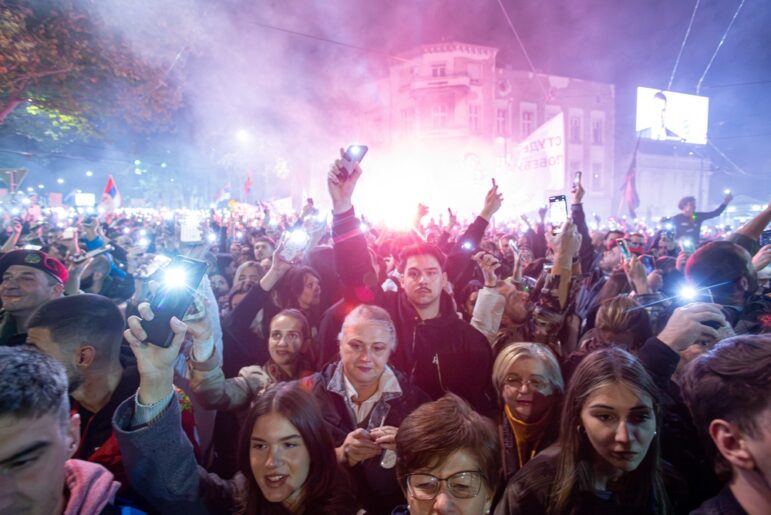
Just days before the Serbian elections in October 2026, more than 150,000 demonstrators gather in Slavija Square in Belgrade to support the Student List movement and protest widespread corruption by the ruling government. Image: Shutterstock
‘Is This Real?’: A Serbian Investigative Journalist Reflects on the Country’s Stunning Election
[The Oct. 25] election marked a turning point in Serbia, with the ruling SNS party of Aleksandar Vučić handed a resounding defeat by a student movement that capitalized on mounting public anger over years of corruption and criminality.
Many of those abuses had been exposed by KRIK, an award-winning Serbian investigative outlet (and GIJN member) and OCCRP partner that has spent years covering the country’s criminals, its corrupt officials, and the connections between them. In return, its young journalists have withstood pressure most people can scarcely imagine: personal attacks by pro-government tabloids, an endless stream of lawsuits, and even death threats.
Now, a new era is dawning. The seemingly unbreakable control exercised by Vučić — who served as information minister under dictator Slobodan Milošević — has been broken.
In this interview, KRIK editor-in-chief Stevan Dojčinović reflects on what the last few days have meant for him, how the students did it, and what challenges lie ahead. As he spoke with OCCRP late at night, the sounds of celebration filtered in from the street.
This interview has been edited for length and clarity.
OCCRP: Stevan, what was it like on election day?
Stevan Dojčinović: First of all, I didn’t expect this. I’ve never experienced such energy on the street. It was so high energy, like everybody was happy. And you couldn’t find any Vučić supporters.
Clearly, people were [openly] supporting the students, which was not the case before. Because, you know, Vučić was putting pressure on the media, and even on what people tweeted. So people were not really free to talk. But now, I went to my hometown, and there was all this energy in the street, and everything was bright.
When I went to the voting site with my mother, I talked with the guys who were controlling the voting on the student side, and they showed me the numbers, and they were huge. I was there around noon, and an insane number of people had already turned out.
In the end, almost 70 percent voted. There was never a case like this. Basically, Vučić can’t reach any new voters, so he was always fighting not to have a big turnout. So when it went up to 50 percent, you know, and then up to 70, it was done. It was completely clear.
But I thought, and everybody was expecting, that he wouldn’t give up so easily. My idea was that he would do his best to rig the elections. Even with these big numbers, I thought he would just rig more and declare victory.
And I thought, if this happened, it would be a nightmare. People would be on the street, and there would be violence, and somebody could die.
When the electoral places were shut down, it was going in this direction. Because suddenly, Vučić started bringing a lot of armored riot police to the center of Belgrade. And, in parallel, which was a really bad signal, he started bringing these thugs, these criminals who protect him. They were coming in big numbers to meet in this park in front of the presidential building.
And then it turned out that he lost by so much — like, half a million votes. And nobody can rig half a million. So, I believe what happened is that he figured out that nothing would work.
OCCRP: How’s the newsroom? Are your colleagues at KRIK relieved, now that the pressure on you guys will ease?
SD: All of us are happy. But we also feel like we’re in a parallel timeline. It’s like, is this real?
We’re sitting in our office and talking freely. For 10 years, our rule was never to discuss any important stories in the office, because we understood that the secret service was spying on us all the time. We didn’t trust our office, it could have bugs. Usually we would go out to some place where we felt safe to discuss things.
I never trusted my apartment in Belgrade. I was censoring what I could say in there. Because I knew my apartment was definitely bugged. So you never really had a safe space where you could even talk.
But, today, we can just sit, and we can really communicate in our office. It’s a completely different life than yesterday. And that was our first journalistic day of working in freedom.
KRIK was founded in 2015. We were founded in Vučić’s time. And, every day we worked, it was in Vučić’s time. So now we’ll see what it’s like to work in freedom, which is something we never really had. So, it’s strange now, for everyone, this is new, new, new.
OCCRP: If you had to boil down the reason for people’s dissatisfaction with Vučić, would you say corruption was the main thing?
SD: Yeah. He was connected to organized crime, but corruption was the first thing. You could feel the corruption, that’s the thing.
Because people couldn’t get any jobs. Only members of his party could get jobs. People couldn’t start their own businesses. The financial inspectors would come and shut them down. But the party people can open businesses. So, people could really feel the corruption.
Unfortunately, too, a lot of people died. When this rail station [in the city of Novi Sad] collapsed, people died.
People didn’t just feel that they were losing money, that they weren’t living a good life. They saw people die, and that everybody who lives in Serbia could have been standing in that spot. In the end, they thought, we’re going to die because these people are stealing money.
OCCRP: You mentioned that the established opposition would stay in Belgrade and not go to the villages. Did the students make an effort to go to smaller places? I remember that was also a big deal in Hungary, with Péter Magyar’s campaign.
SD: Yeah… the students, they had a campaign called “a student in every village.”
And Vučić, of course, put a lot of lies about the students, saying that they work for the Secret Service and this and that. But when you see them going to the villages and talking with the grannies, with peasants, with farmers, when you have this real life experience, that really changed people and helped them to earn huge support.
I think that was one of the main focuses of their campaign. More than doing stuff in Belgrade. Belgrade is easy. You have the most progressive people, and it’s easier to win. You don’t need to really be there.
OCCRP: So that’s one way of defeating a situation where the media is controlled by the government — you have to reach people in person, because otherwise the only thing they hear is the pro-government media.
SD: Yeah, exactly. But usually, nobody will do that.
The typical opposition in Europe is complaining about social media. They complain that they cannot reach people because of these troll campaigns, but they will not actually go [in person]. But you really need to go to every village.
And that’s nothing new. That’s like old-school politics, right? We just have to literally get back to the ways of how politics was done, and not allow social media to make you lazy.
The social media algorithms will always boost content that helps populists, right? All the hate speech, the anti-immigrant things, will always be pushed. So you have to literally meet people and talk. We in KRIK have a bit of experience, because we do a lot of crowdfunding, we have connections with our audience. So we understood how important it is to do that stuff.
So I hope, at least in Europe and the US, politics will return to this old-school way a little bit.
OCCRP: Turning to the future, what do you expect will happen now?
SD: Now we have a lot of work to do. Now comes the really tough period. I think it’s important to learn from history.
There’s a chance to change things, but Vučić left a really strong system. All the big businesses, the whole economy is in the hands of his oligarchs. Organized crime is powerful. So this will not be easy.
And we need to learn from what happened in the past. After Milošević was gone, [reformist Prime Minister Zoran] Đinđić was killed two years later, basically by a joint venture of the Secret Service and organized crime, because they didn’t want to allow the country to reform.
So we can celebrate tonight, but tomorrow it’s the beginning of a really big job. Now it’s really important that everyone really does their part of the work. We as journalists should continue to investigate.
I believe it will happen like in Milošević’s time — as we speak now, they’ll start destroying evidence and documents, bribing witnesses. In the next three months, we’re in a defining period where we need to discover as much as we can. And when the students constitute the assembly and the government, I hope that they’ll start prosecuting these people.
But it won’t be easy. Now the very difficult part is coming.
OCCRP: What about the criminal groups? They were heavily embedded in the Vučić regime. You’ve done a lot of reporting on that. Are they scared now? Are they running? Are they going to fight?
SD: They will do what they always do. They will not run. I believe the criminals are now thinking of finding a way to approach the students. I believe they will not succeed, but that’s how criminals work. They don’t care, in the end, for Vučić.
But I need to say, this is really funny to see. So like I said, last night Vučić brought these strong police forces to the center of Belgrade, and all of these hooligans and criminals, a really big number of them, to this park next to the presidential building.
And in the moment when he declared defeat on TV, and people started gathering in the center of town to celebrate, there is a video, the criminals who in the moment start running, you know, and you have like tens of them just running, literally running from this park. They’re only strong when they have protection, and when the police are working with them.
OCCRP: You sound pretty optimistic, because it seems like you really trust the students, is that fair to say?
SD: I trust the students because I completely trust their intentions; in those terms I’m optimistic. But I’m realistic about what’s going to happen now; it will be really hard.
And the second thing, I’m really afraid of what would happen — this also happened in the time after Milošević, when the democratic [forces] won — I think that we will feel in the following years a lot of the damage that Vučić did to the economy. I think it will be a hard period.
And I’m afraid of how people usually react — everywhere, not just in Serbia — if the economy isn’t perfect in two years, which is completely logical because we just now see how much devastation he left, if people aren’t happy in a year or two, they will not be able to make the connection to Vučić, they’ll most likely then blame the new power in Serbia.
OCCRP: And that was how Vučić came to power the first time, right? Taking advantage of disappointment with the democratic generation before him.
SD: Exactly. They needed to deal with the country left by Milošević, which was under sanctions and embargos and completely devastated. But people will say, the ones now in power are the ones to blame. So I think this is a big danger.
The problem is also that journalists need to change how they operate. I don’t think we can do old-school journalism anymore. So I think journalists can help, but we also need to find other ways to communicate these things and inform the audience. There’s a lot of fighting to be done.
But literally everything changed — the atmosphere on the streets. Before the protests, there was this kind of this dark atmosphere, cynical and dark, like there was no hope. Now it’s like living in a completely different country. It is insane and very refreshing.
Editor’s Note: This is an excerpt of a longer interview that was originally published by OCCRP and is reposted here with permission. Watch the full interview on YouTube below.
 Ilya Lozovsky is a is a staff writer and senior editor at OCCRP. Based in Amsterdam, he writes about the intersection of corruption and democracy; covers Russia, Ukraine, Central Asia, and the Caucasus; edits investigations; and is working on new products in other formats. In a previous stint as OCCRP’s managing editor, Ilya helped develop the organization’s editorial workflow, coordinated cross-border investigations, and trained up-and-coming journalists on investigative editing and storytelling. Prior to joining OCCRP, Ilya edited and wrote for Foreign Policy magazine’s Democracy Lab channel in Washington. Ilya’s work has appeared in Foreign Policy, the Washington Post, The Atlantic, Haaretz, and other outlets.

GIJC23 – FOIA/RTI Investigations

GIJC23 – Plenary: Watchdog Journalism in the Age of Digital Subversion (Panel)

GIJC23 – 40 Years of Cross-Border Muckraking: Where It All Began

GIJC23 – Fighting Back Against SLAPPs & Other Legal Threats
‘I Didn’t Really Sleep’: Inside the Investigation That Helped End Viktor Orbán’s Rule
Five Questions on How Independent Hungarian Media Beat Orban’s ‘Propaganda Machine’
Investigating Threats to Democracy and the Rise in Authoritarianism: IJ WEEK Sessions Focus

Following the Money, Routes, and Violence: Inside Cross-Border Criminal Enterprises

This work is licensed under a Creative Commons Attribution-NoDerivatives 4.0 International License
Republish our articles for free, online or in print, under a Creative Commons license.
Republish this article
This work is licensed under a Creative Commons Attribution-NoDerivatives 4.0 International License
Read Next
How They Did It News & Analysis
‘I Didn’t Really Sleep’: Inside the Investigation That Helped End Viktor Orbán’s Rule
Investigative outlet Direkt36’s high-risk exposé of the Fidesz party’s secret operation to bring down the opposition party helped unseat Orbán after 16 years of illiberal rule and media capture.
News & Analysis
Five Questions on How Independent Hungarian Media Beat Orban’s ‘Propaganda Machine’
As Hungary heads into a new political era, OCCRP spoke to András Pethö, co-founder of Direkt36, an independent outlet that has published numerous exposés of alleged government corruption.
Investigating Threats to Democracy and the Rise in Authoritarianism: IJ WEEK Sessions Focus
For International Day of Democracy, GIJN looks at several panels of its upcoming IJ WEEK online event that address how our community can address threats to democracy and the rise of authoritarianism.
GIJC25
Following the Money, Routes, and Violence: Inside Cross-Border Criminal Enterprises
Expert follow-the-money journalists have documented how criminal networks now operate, via fluid, decentralized systems that are often indistinguishable from legitimate global commerce.