
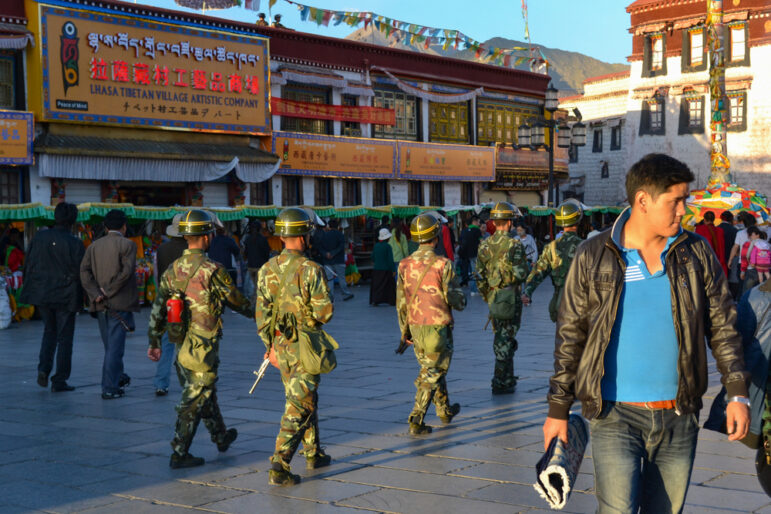
Chinese soldiers on patrol in Lhasa, Tibet. Image: Shutterstock, Mo Wu
Exiled Journalists’ Tips for Source Protection and Avoiding ‘Propaganda Creep’
Read this article in
In 2024, reporters at Radio Free Asia revealed a rare public protest in Tibet: a mass demonstration against the construction of a hydroelectric dam that would force the relocation of several communities.
The newsroom, based outside China, knew a subsequent surveillance crackdown by Chinese authorities in the area would make it too risky to publish follow-up stories on the Dege dam protests. Instead, the team made sure their initial exposé was worthy of the courage of sources, included allied project concerns such as the destruction of farmland, and verified the evidence with external research and protest video clips.
This investigation highlighted many of the key takeaways of a IRE26 panel titled “Reporting from Exile: How to Cover Authoritarian Regimes, Protect Sources, and Build Trust,” among which included: picking your topic battles in autocratic countries; assessing and re-assessing the risk for your sources and even their diaspora families; revealing all that you safely can in a single story; and avoiding undue source exposure on post-story surveillance crackdowns. Session speakers included Tenzin Pema, a Knight-Wallace fellow and former award-winning Radio Free Asia Journalist; Tibisay Zea, Latin America correspondent for The World radio program; Clavel Rangel, an independent journalist and Knight Wallace fellow; and Iranian freelance journalist Fatemeh Jamalpour.
Notably, the panelists highlighted the fact that the bulk of the first row of seats at the session was filled with courageous fellows from the Exile Training Program at Alfred Friendly Press Partners, to a clattering of applause from attendees.
And their reporting advice extended to Western journalists, who, they said, sometimes accidentally amplify disinformation narratives from authoritarian regimes by restating claims and names produced by state media and AI systems.
Jamalpour — who survived multiple detentions and interrogations in Iran — reported one of the most notable eyewitness accounts of Iranian state violence against protesters, and spoke about the moment when exile becomes essential for journalists.
In her report, she recounted the harrowing experience of being caught in the crossfire, which eventually convinced her that she had to flee Iran. “The protests tailed off after the executions. The last day that I went was terrible. I thought I was going to die,” she wrote. “The security forces closed off all the streets with their cars and poured streams of tear gas and rubber bullets into the trapped crowd. I saw a bullet pass right by my face.”
“Exile is not a real choice,” said Jamalpour in the panel session. “When I had to leave the country, I had to choose between going to prison because of my reporting, or leaving the country. I wanted to stay, honestly, but my lawyer told me that ‘we need you to be out, to be our voice out there.’ I lost the details and the texture of life there. But I keep reporting.”
Pema agreed, adding: “Exiled media don’t just report news; they preserve historical memory, they monitor developments inside, and provide information that world that would otherwise never reach the outside world.”
Useful principles shared by panelists for reporting on deeply repressed societies from afar included the following pieces of advice.
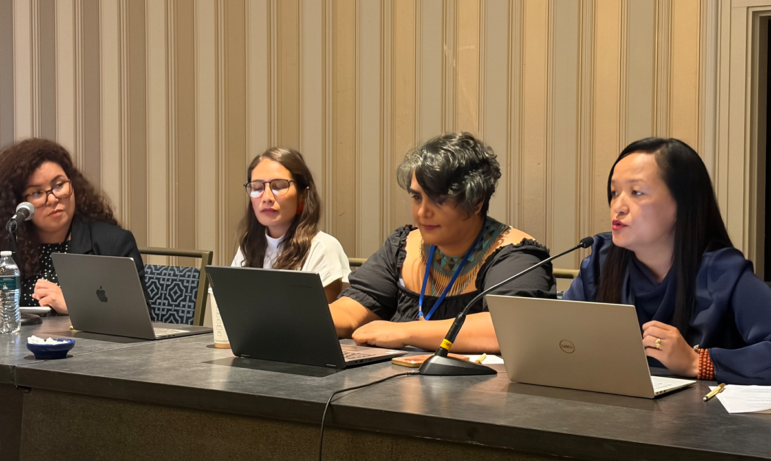
Exiled journalists speaking at an IRE26 panel on reporting on their country from afar:(from left) Clavel Rangel, Tibisay Zea, Fatemeh Jamalpour, and Tenzin Pema. Image: Rowan Philp for GIJN
Answer the courage of sources with deep care, and stories that count. “Exile media can only report because of brave and courageous sources who are willing to take extraordinary risks to share information,” said Pema. “These sources are not just sources; they are people with families, history, trauma, and risk profiles; so source protection is central to our reporting.”
She added: “In Tibet, these sources are ordinary citizens who have become accidental journalists, or activists, and they are punished for contacting other Tibetans in exile, for sending a photo or video clip or voice note or official document that can serve as a verification tool.”
As a result, Pema said source protection must be built into every stage of the reporting process: everything from encrypted communications channels to careful risk assessments prior to source contact. “Understanding these risks has become essential for how we journalists approach every source, every lead, every interview on every story,” she explained. “Outside Tibet, those risks don’t disappear; they simply change form. Many Tibetans in exile still have relatives and friends inside, and that means even a source in India or the US may hesitate to speak because they fear consequences for their family. This is transnational repression; the extension of authoritarian control beyond national borders, and it creates self-censorship and distrust thousands of miles away.”
Communicate with sources when you don’t need them — and don’t rush to publish when you do. “Call your sources when you don’t need them, so they know you care,” Pema advised. “Build source networks before you pursue a project. It’s only when you have established relationships with sources that they respond to you in the middle of a crackdown or blackout or election crisis.”
Jamalpour added: “Part of building trust is never rushing to publish. With trust, sources start to connect me with other families of protesters. And really care for them: they are not just sources for one or two quotes, and many are traumatized. I’m still in touch with sources from 20 years ago.”
Cast a wide net of alternative sources, to include NGOs, academic research, and satellite imagery tools. “Get creative about sourcing and verification with civil society and research — not because they are necessarily the best or most up-to-date, but because they aren’t at the same risk” as human sources,” Rangel advised.
Said Zea: “Sometimes you need to build your data yourself; rely on academic papers and NGOs. Verify everything. There’s a lot coming from social media, but it’s very hard to trust.”
Pema added that she often uses satellite imagery and remote sensing tools. “But it’s getting difficult, because a lot of map labels have been changed, and there is a nomenclature warfare happening” she noted, referring to the government practice of changing place names on official maps and documents.
Collaborate when censorship turns to silence. For exiled journalists reporting on the most repressive countries, Pema said the question changes from “Can I find someone inside who is willing to speak?” to “Do I dare even reach out?”
“The very act of contacting someone can itself create a risk, both for the source and the reporter,” she explained. Tibet, for example, is saturated with cameras, digital monitoring, checkpoints, facial recognition systems, and communication controls by Chinese authorities.
“People in Tibet know their phones and online activity may be monitored; their movement tracked; and their families interrogated and detained, so many choose not to speak at all,” Pema pointed out. “This silence in Tibet is not accidental; it’s the product of an information ecosystem built around systematic surveillance, fear, and control. Even food delivery employees have been roped in to serve as ancillary police for more effective surveillance.”
She said most of the important stories about Tibet now are the result of collaborative efforts involving multiple layers of verification.
“The obvious question becomes: ‘Who is still able to tell these stories?’” she explained. “The reality is that almost all the reporting on Tibet happens [from] outside. Stories are being pieced together by exiled journalists, human rights researchers, academics, open source investigators, and satellite imagery analysts, and, of course, the diaspora networks spread across the world.”
Pema said exile media organizations represent a “lifeline” for journalists, residents, and diaspora communities.
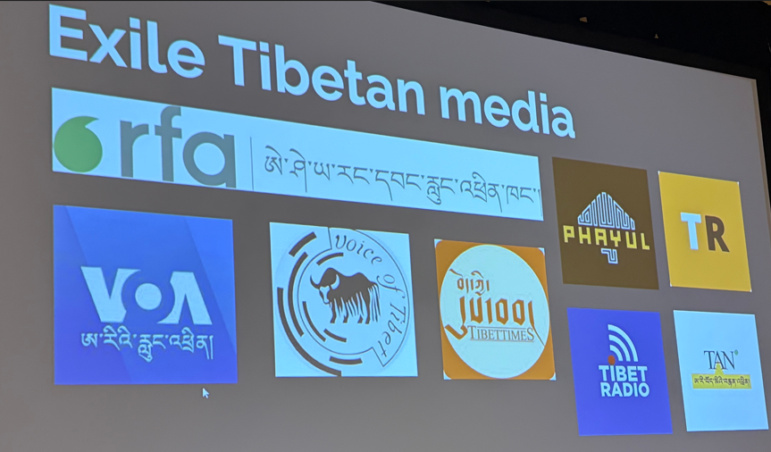
At IRE26, former Radio Free Asia journalist Tenzin Pema said that exiled media represent a “lifeline” for reporters and repressed citizens in places like Tibet. Image: IRE presentation screenshot
Work to your sources’ time zones. Jamalpour noted that working in the time zone of the autocratic country is not only important for your source’s convenience, but also because residents often cannot risk leaving messages, and need to communicate live across the encrypted channels they’re comfortable with.
“The time zone challenge is hard from exile; often I need to be working at 4:00 am; at 7:00 am, because messages from sources can disappear,” she says. “There are many checkpoints where they search people’s phones, so when someone reaches out to me, they need to know they can do so safely.”
It requires discipline, added Pema. “It is difficult to manage time zones, both for sources in the region and for diaspora contacts in other time zones.”
Spend time in immigrant neighborhoods near you. “A great way to connect with sources through diaspora communities is to go to local businesses in immigrant neighborhoods; spend time with friends there; go to a barbershop there,” said Zea.
Recognize new propaganda threats. “Propaganda today does not look like propaganda,” Pema warned. “It may look like a chatbot answer; a search result; a tourism video from a social media influencer; a map label. Today, Chinese authorities have moved on from simply restricting information about Tibet to actively shaping it.”
She added: “We see this through state-driven narratives; through efforts to normalize terms such as ‘Xizang’ — which is an effort to replace the name of Tibet altogether, and how it is remembered. Increasingly, propaganda is spread through AI-powered information systems created to present these curated versions of Tibetan history.”
Remember that exile reporting is also about preserving history. “Language matters: names, labels, maps, terminology can shape how entire histories are remembered,” Pema noted. “Authoritarian regimes know this very well. Exiled journalism is not just about gathering information, it is about bearing witness, and creating a historical record that is grounded in truth. In many authoritarian contexts, it is the only journalism possible, but it requires humility, patience, verification, and deep community trust.”
Don’t accidentally amplify state narratives in Western media. Notably, all four panelists warned that – partly because of the isolated nature of these societies — subtle forms of disinformation, including altered place names and cultural features, are increasingly creeping into Western media coverage.
“We all need to be careful not to repeat propaganda,” Zea warned. “Ask: ‘Who is benefiting from this explanation?’ ‘What evidence is there for this narrative?’”
Pema suggested that Western media pay deeper attention to exile media coverage, “because of the real threat of a mainstream media that unknowingly adopts state-defined terminology.”
She added: “In 2025, there was a massive earthquake in Tibet, and the only information getting through was through Chinese state media. So what started happening was ‘Xizang’ — a word the Chinese government is using to try to rename Tibet — increasingly crept into ordinary reporting by mainstream media, without so much as a mention of the context. Many people call Tibetans ‘ethnic minorities,’ which is not how Tibetans or Uyghurs would like to be called; it is the national identity.”
Archive everything. “We tend to think the internet is forever, and you can find your clips whenever, but it’s not true,” Rangel cautioned. “We lost much of our archives in Venezuela, after outlets closed and many sites were attacked.”
Examine the true effects of sanctions. Panelists noted that international economic sanctions on autocratic states have differing effects that reporters need to uncover. “The Venezuela government blamed the economic collapse almost entirely on US sanctions,” said Zea. “They did have a huge impact, but they were not the main cause of the crisis.”
Jamapour warned that sanctions, in effect, often penalize and dehumanize the ordinary people suffering under autocratic regimes. “The Iranian Revolutionary Guard was the greatest beneficiary from the oil sanctions, yet people in the diaspora struggle to send money to family due to sanctions.”
Relentlessly add and repeat historical context in stories — if only for Western understanding. “It’s important to present the story in a way that global media will also understand it — that’s very important,” said Pema. She explained that common misunderstandings in Western media have sometimes clouded the judgment of exiled media.
“Even we exiled journalists sometimes look at Western media and start questioning what we actually know, because we’re used to Western media being authoritative,” she acknowledged. “The greatest risk facing us now is that these state narratives are increasingly becoming the default record.”
Don’t trade truth for access. “Foreign journalists wanting to cover Iran tend to sacrifice truth for access,” said Jamalpour. “They need governments to issue a visa, and they can only interview officials without challenging them. We never see the full picture of Iran in Western media.”
On the flip side, Rangel asked the panel about operating in a situation “where Western editors worry you have perhaps lost contacts and context on the ground, being in exile.” Panelists indicated that persistence — together with collaboration and remote sensing tools, such as satellite imagery — helps to maintain editorial confidence.
Randy Smith, president of Alfred Friendly Press Partners, which runs an Exile Training Program, told GIJN that exiled reporters can also benefit from finding a supportive community of other exiled journalists. Smith says the benefits of community support can include employment opportunities, childcare tips, journalism training, career advice, and resources for mental health and safety resources. He also advises exiled reporters to make use of global safety resources from the ACOS Alliance and the Committee to Protect Journalists, and to lean on programs dedicated to supporting the mental health of exiled reporters like the JX Fund for media in exile.
 Rowan Philp is GIJN’s global reporter and impact editor. He was formerly chief reporter for South Africa’s Sunday Times. As a foreign correspondent, he has reported on news, politics, corruption, and conflict from more than two dozen countries around the world.

GIJC23 – Exiled Media: Survival Strategies

GIJN Webinar: How to Acquire Free Satellite Imagery for Your Investigations
Working with Whistleblowers

Reporter’s Tipsheet for Acquiring Free Satellite Images
Journalism In Exile: Reporting, Sourcing, and Managing Everyday Life Away From Home

Investigating State Attacks on Exiles: Lessons from The Washington Post’s ‘Repression’s Long Arm’ Series
‘Journalism in Exile Has Been Somewhat Romanticized’: The Challenges of Being Forced to Investigate from Afar
Expert Advice to Keep Your Sources and Whistleblowers Safe

This work is licensed under a Creative Commons Attribution-NoDerivatives 4.0 International License
Republish our articles for free, online or in print, under a Creative Commons license.
Republish this article
This work is licensed under a Creative Commons Attribution-NoDerivatives 4.0 International License
Read Next
GIJC25
Journalism In Exile: Reporting, Sourcing, and Managing Everyday Life Away From Home
Forced to leave their homes and homelands, exiled journalists spoke about finding ways to continue their journalism in the countries where they have sought refuge.
How They Did It Reporting Tools & Tips
Investigating State Attacks on Exiles: Lessons from The Washington Post’s ‘Repression’s Long Arm’ Series
The international investigations team at The Washington Post is tackling the issue of transnational repression in an ongoing series called Repression’s Long Arm.
GIJC25
‘Journalism in Exile Has Been Somewhat Romanticized’: The Challenges of Being Forced to Investigate from Afar
Joseph Poliszuk — co-founder of Venezuela’s Armando.info — has spent years investigating illegal mining and drug trafficking. He speaks to GIJN ahead of his appearance at GIJC25 in Malaysia.
GIJC25
Expert Advice to Keep Your Sources and Whistleblowers Safe
Keeping your sources, your data, and yourself safe during investigations is a complex undertaking. Four veteran journalists offer their tips on how to do so.