
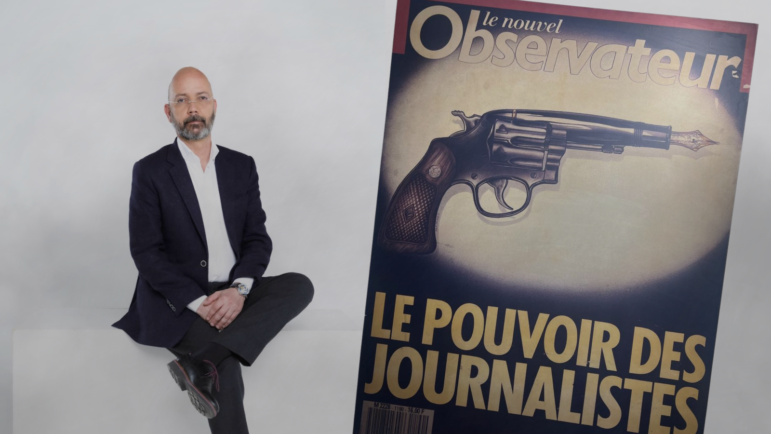
Image: Ricardo Calderón loved this Le Nouvel Observateur poster so much a copy of it hung for many years in his office. It reads "The Power of Journalists" in French. Image: Courtesy
‘Once Someone Opens the Door, I Have a Shot’: Colombia’s Ricardo Calderón on His Career Conducting High-Risk Investigations
Read this article in
The poster depicting a fountain pen emerging from the barrel of a revolver hung for many years behind Ricardo Calderón’s desk. It was an old cover from Le Nouvel Observateur, and the text above the image read: “Le pouvoir des journalistes,” the power of journalists. A colleague had bought it from a Paris flea market and brought it to the newsroom of Semana magazine in Bogotá, where Calderón worked for more than two decades as an investigative reporter. He loved the poster so much that he made a copy of it so he could see it every morning when he walked into his office.
I was an inexperienced political reporter at the same magazine, eager to learn about investigative journalism, when I first met Ricardo, or Richi, as I would get to call him later. By then, he was already a seasoned muckraker who had exposed all kinds of abuses and wrongdoing by those in power or contesting it: generals in the army and the police, spies from the national intelligence agency, politicians from all parties and elected officials, as well as drug lords, guerrilla group fighters, and vigilante commanders. He never talked much about his investigations, not even with his closest colleagues over drinks on a Friday night, so we never really knew what he was up to. But we did know it was important and dangerous work: I still remember the funeral flower wreaths delivered to the newsroom as a warning and one of the assassination attempts on his life.
Despite winning major journalism awards, including the Maria Moors Cabot, the Javier Valdez Latin American Awards for Investigative Journalism, and the King of Spain Prize (some of them more than once), Calderón tended to stay out of the spotlight. But in 2020, after Semana magazine changed ownership and enacted a new editorial policy that he felt would compromise his independence, he left. Although he didn’t like cameras, he ended up joining the investigative unit of the country’s major TV news channel, Noticias Caracol, where he and his team continued to reveal major stories, such as the Colombian mercenaries’ role in the assassination of Haiti’s president, Jovenel Moïse, or how former Venezuelan president Nicolás Maduro’s regime hunted dissidents who had sought refuge in other Latin American countries.
While he famously doesn’t like talking about himself, he agreed to be interviewed about some of his investigations, experiences, and key lessons learned over the years. We met for coffee in Bogotá on a chilly afternoon. He reassured me that the poster I could never forget now hangs at home, serving as a constant reminder of how much good — or harm — he can achieve through his work. This is an edited version of our conversation.
GIJN: You started on the sports desk. How does a sports reporter end up becoming an investigative journalist specializing in armed conflict and digging into the security agencies?
Ricardo Calderón: It was the only way to get started in journalism. I knew that in soccer it was 11 players against 11 players and there was a ball to be kicked, but I didn’t know much else about sports. I could have gone to the World Cup and things like that, but I didn’t want that, so I traded it in for [covering] the massacres.
GIJN: The massacres?
RC: The editorial staff at Semana magazine was relatively small, and the country was going through a difficult period in the mid-to-late 1990s. Two major events were unfolding at the same time: the political scandal involving the Cali Cartel’s financing of then-President Ernesto Samper’s campaign, and the expansion of paramilitary or vigilante groups that perpetrated massacres. Since the political scandal sometimes left no room to cover the massacres and there weren’t enough people on staff, even though I was the sports reporter, I volunteered to go cover them.
GIJN: Did you always want to cover armed conflict, abuses, and corruption?
RC: Yes. Because I saw the way “the bad guys” — guerrillas, paramilitaries, drug traffickers — were covered by other journalists. Covering them often meant actually covering them up. I felt the need to do a different kind of reporting, to tell what was really happening with these non-state armed groups. I thought that by writing about their abuse of power I would help people; exposing a drug trafficker could help a community.
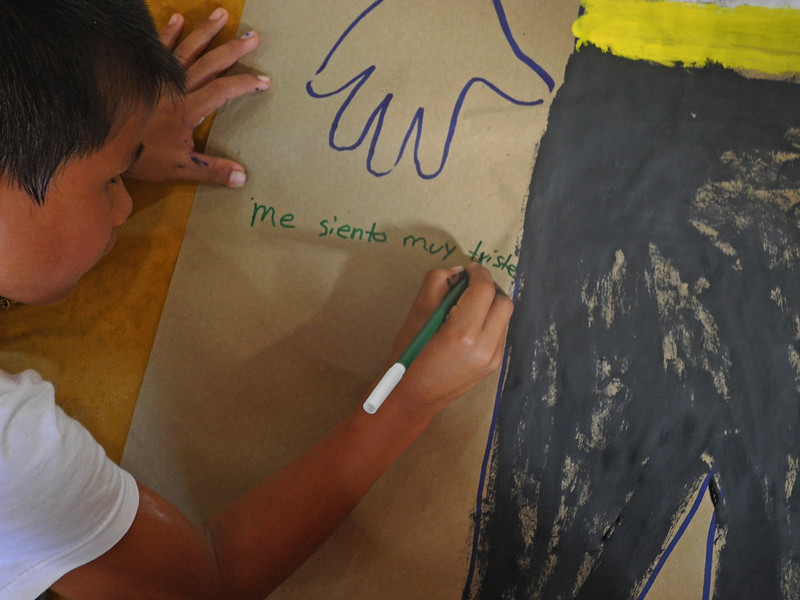
Ricardo Calderón has spent decades investigating all sides involved in Colombia’s armed conflict. In this photo, a child attending a meet-up for families whose loved ones disappeared in San José del Guaviare writes “I feel very sad.” The photo was taken during a ICRC meeting for families. Image: Edgar Alfonso, ICRC Colombia / Creative Commons BY-NC-ND 2.0
GIJN: Did you receive any guidance from your editors or special training on how to cover armed groups?
RC: I worked on a few stories with Gerardo Reyes, who had come from the first investigative unit at the newspaper El Tiempo. One of them was a profile of Negro Acacio, a former guerrilla leader of the Revolutionary Armed Forces of Colombia’s (FARC’s) 10th Front, whom almost no one knew. Through that story, I learned that public security issues could be covered differently: by going deeper, not just relying on what an intelligence report said, but by investigating on my own. Beyond those assignments, it was mostly a trial-and-error process in which I made many mistakes. For example, at first, I treated everyone the same — drug traffickers, police, and military personnel. Over time, I realized that each group is different, and you have to understand where they’re trying to outmaneuver you.
GIJN: After writing that profile or those first investigative stories, did you decide that was the kind of journalism you wanted to do moving on forward?
RC: I never made a conscious decision to become an investigative journalist; fate just led me in that direction. Along the way, I also realized there was an under-explored niche: security and intelligence issues, which are extremely complicated and dangerous to report on both in Colombia and in other countries. I began specializing in that field just because no one else was doing it.
GIJN: What unique challenges are there in investigating security forces and spies?
RC: That’s the most interesting part. Some areas of journalism can be monotonous after a while; this field isn’t. We’re dealing with people who work in intelligence and are used to manipulating sources and information. It’s more complicated, but never boring. It can be dangerous, yes — I’m not saying I’m not afraid when doing this kind of reporting — but I do it because it’s necessary, so that society knows [when] its intelligence agency is corrupt, or that it’s been at the service of drug traffickers, paramilitaries, and the politicians in power. The same goes for the military. Colombia is a very pro-military country, fanatical about its security forces despite the “false positives” scandal [in which the army was involved in more than 6,000 extrajudicial killings of civilians between 2002 and 2008]. The country forgave the army for something extremely serious, an aberration, and yet they remain untouchable. It was important to investigate them as well, to debunk that myth of the national hero, because a patriotic soldier can also be a villain.
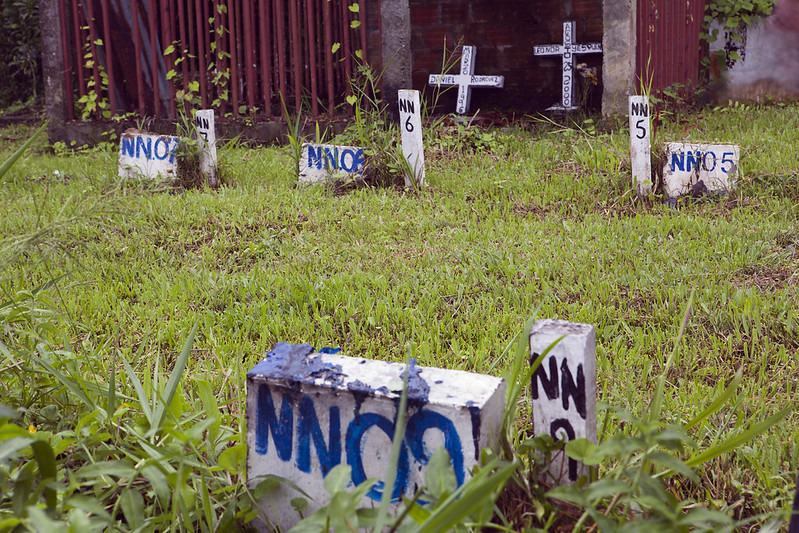
“Since the political scandal sometimes left no room to cover the massacres and there weren’t enough people on staff, even though I was the sports reporter, I volunteered to go cover them,” says Calderon, of how he started investigating the armed conflict in Colombia. In this 2011 photo from Bocas de Satinga, in Nariño in the south of Colombia, the tombs of unidentified victims are marked “NN,” for “no name.” Image: ICRC Colombia / Creative Commons BY-NC-ND 2.0
GIJN: How do you get spies, especially if they’re from another country, to trust you? Why would they talk to you?
RC: Have you seen “Pay It Forward”? It’s a cheesy movie, but the premise of the story works really well for this kind of source: someone introduces someone else to another person who owes them a favor, and that person introduces them to someone else who can pay it forward, and so on… That’s how I’ve built a network of people who trust me and recommend me to others so they’ll open the door for me. That takes months, even years, and I often fail, simply because I’m a journalist. But once someone opens the door and I manage to sit down with them, I have a shot. I’ve learned two very important things in this process. Number one: you have to speak their language. You don’t talk to an FBI agent the same way you talk to someone from the DEA, or to a Spaniard from the CNI. And number two, prepare well. If they notice you don’t know the subject, you won’t get a second meeting.
GIJN: How do you protect yourself from surveillance or possible wiretaps?
RC: By assuming that everyone is recording me, that everything I say to them could be published on the front page. It’s hard at first; it’s still hard for me. It means thinking through and weighing every word I say at meetings. And not just with security agents, but with drug traffickers, guerrillas — everyone.
GIJN: How did you come to realize that you needed to take extra safety precautions in this job?
RC: I realized when my sources were killed. In the DAS case [the DAS — or Administrative Department of Security — was Colombia’s primary state intelligence and security agency from 1960 until it was dismantled in 2011 after Calderón’s exposé] I lost two, and in the army corruption case, I lost one. You know that possibility exists, and you have to talk about it with your sources, because these are very dangerous investigations. But the first time one of your sources is killed, it’s a wake-up call that forces you to reevaluate everything when it comes to security.
GIJN: What did you change?
RC: I used to look for secluded places and what I thought were safe hotels for meetings, but despite that, a couple of my sources were killed. So I started conducting interviews in the early morning, between 1:00 and 4:00 a.m. — it’s easy to tell if you’re being followed at those hours. I also started driving to other cities for meetings, and I invested heavily in communications: at one point I ended up with 10 disposable phones at the same time, one per source. This was before Signal, back in the days of the Nokia 1101.
I also learned that if the source is an ordinary citizen, you have to plant the seed of “healthy paranoia” in their mind: let’s not use this, let’s not go to that place — it’s for your own good, look what happened in this other case to this other source… Also, people provide information without realizing the danger they’re putting themselves in, and sometimes I have to say: I’m not going to publish this information because it puts you at risk. Some get mad at me, they may even think I’m a really bad journalist, but I need to protect them first.
Another thing that helped me learn certain tricks was covering police stories. I’d study the case files on how an operation had been carried out, and investigators would tell me off the record how they’d thrown a drug trafficker off their trail, for example. That ended up being applicable to my own safety — changing routines, driving at 20 km/h on a highway, or making four U-turns if you suspect you’re being followed, because nobody else does that.
All of this was trial and error; the safety manuals for journalists that exist today didn’t exist back then.
GIJN: Which story has been the most challenging or dangerous, not only for your sources, but for you as well?
RC: The DAS case, because it spanned seven years, divided into two phases. Like any intelligence agency, everything was compartmentalized. That was challenging, it took me a while to understand that at first, but later it turned out to be an advantage. It allowed me to cross-check what one source told me against what another said, without giving them away to each other. Because of that investigation, they bugged my office, and the threats started coming in: between funeral wreaths and condolence messages, there were almost 10. I also had a tombstone delivered, but that one came when I was already working on another investigation, involving the military.
GIJN: When you received these threats, what options did you consider: stop the investigation, report it to the authorities, publish the story?
RC: I didn’t have to think about it for long. My investigation into the DAS was well underway, with sources really involved in helping me with the story. Stopping it would have meant leaving them in the lurch, and you have a responsibility to the people who risk their lives to give you information. The commitment is to see it through to the end, and often publishing ends up protecting those sources more than silence does. That doesn’t mean I didn’t take precautions: a couple of times I had bodyguards, and once I went to London for 10 days, but I came back and continued because, as a lone wolf — that’s one of the disadvantages of not working with a team — I had no one to replace me if something happened, and I couldn’t continue investigating in exile.
GIJN: How do you respond when the government tries to impose a narrative that seeks to refute or distort the investigation and under your credibility as a journalist?
RC: I learned this the hard way — through blood, sweat, and tears — during the administration of Álvaro Uribe, who, for 80% of Colombians, was God on earth at one point. Uribe tried to impose a false narrative saying everything I had published was fake. What I learned from that experience is that the best defense is having enough ammunition — perhaps I shouldn’t use military metaphors — but you should not use all you’ve got in the first publication. That means holding onto reporting that you often don’t need, just in case, and “drip-feeding” the information. In addition, I try to conduct simultaneous investigations, opening up different fronts so I can respond from angles they don’t expect. Also, before publishing, I always think about the worst-case scenario: how are they going to attack me?
The same thing happened recently with then-president Gustavo Petro: he claimed that the information published in an investigation came from the CIA. That made no sense at all, but it forced us to put out a story in response. The problem isn’t what people say on social media, but that this narrative reaches the ears of sources who might end up believing it. It’s an extremely exhausting task having to go back to all the sources and explain, and since I’m not on social media to defend myself, it’s often my colleagues who end up taking on that defense.
GIJN: About that recent investigation criticized by the Petro administration, the general public also questioned why it was published after the presidential election rather than before. When should an investigation be published?
RC: When it’s 100% ready. In that investigation into the “Total Peace” negotiations between Petro’s government and the Clan del Golfo [Colombia’s largest organized crime group], we had some audio recordings that would have been easy to publish in their raw form. But a leak is never an investigation in itself, it can be the start of one, however. So we went through those recordings, line by line, verified and contrasted the information through freedom of information requests, and cross-checked it with more than 15 human sources and documents — that investigation took six months for just two audio recordings. Many of those sources aren’t even featured, because they aren’t used to tell the story but rather to corroborate it.
GIJN: You worked in print for over 20 years; now you’re in television. What challenges have you faced adapting?
RC: It’s much more complicated. In print, you can protect your sources better with words; on television, even if you distort the image or the voice, the risk remains. If you don’t have an image, you have nothing, and many stories simply never see the light of day because of that. I also lost my anonymity — until five years ago, there were no photos of me — and that has affected my ability to go unnoticed when I meet with sources at a restaurant, for example. But I also gained something: the impact of television is immense.
GIJN: Speaking of audiences and impact, do you think the public still values investigative journalism?
RC: The media is facing a serious credibility crisis, but there is a niche audience that does value it. People are interested in reading or watching a long piece if it’s well done, and I think serious journalism will continue to be important — perhaps not on a massive scale, but certainly for those who want to be well-informed. I also don’t think AI is going to replace us: it can’t read someone’s face to tell if they’re lying, nor can it ask a follow-up question.
GIJN: This profession can take a heavy toll — personally, on your family, and on your health. Have you ever thought about doing something else, or retiring?
RC: My only limitation is my age. There are things I no longer want to do, like covering breaking news. That’s for young people. As the years go by, you get tired more easily. Experience, however, also has its advantages. You end up being like a wise old lion in Africa who knows how many gazelles there are, but no longer hunts them all: he targets the best one he can catch.
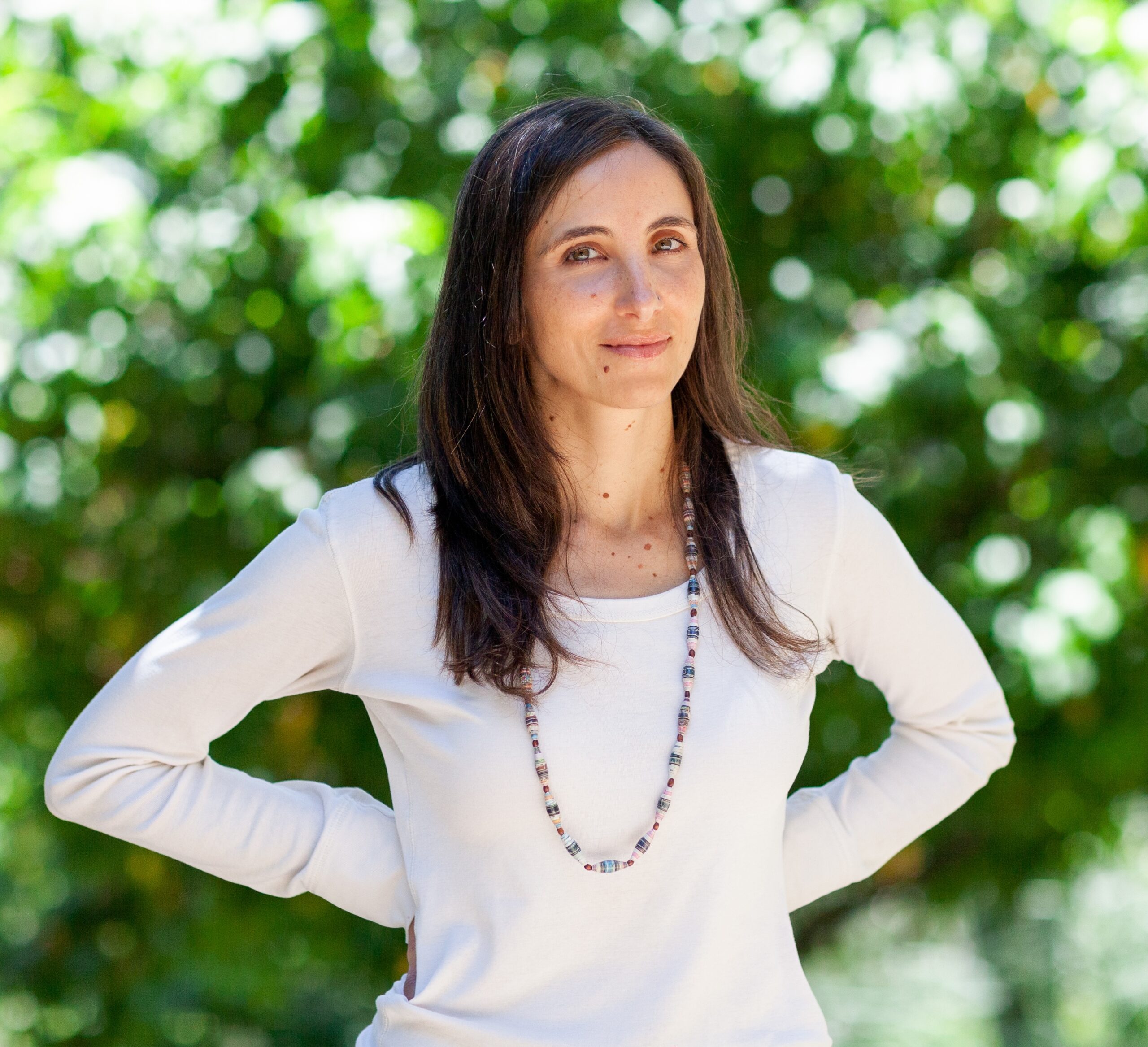 Catalina Lobo-Guerrero is a freelance journalist and editor based in Colombia and a frequent contributor to La Silla Vacía, Ojo Público, CLIP, El Pais and Armando.info. She’s the author of “Los restos de la revolución” (“The Remnants of the Revolution”), a nonfiction narrative book about Venezuela’s unraveling while she was a foreign correspondent in Caracas between 2012-2015. She was previously GIJN’s Spanish editor, and an investigative-political reporter for Semana.

Introduction to Investigative Journalism
Clandestine Airstrips, a Mexican Mega Leak, and a Crisis of Unidentified Missing People: 2025’s Best Investigative Stories in Spanish

Investigating War Crimes
GIJN’s Guide to Undercover Reporting

How One Reporter Unravelled the Mystery Behind a Field of Starving Horses in Argentina

Investigating in Audio: Nine Standout Podcasts from Latin America
Under Pressure, but Undeterred: How the Investigative Press Corps Perseveres in Argentina

The Power of Collaboration: El CLIP and the Plan to Transform Latin America’s Investigative Ecosystem

This work is licensed under a Creative Commons Attribution-NoDerivatives 4.0 International License
Republish our articles for free, online or in print, under a Creative Commons license.
Republish this article
This work is licensed under a Creative Commons Attribution-NoDerivatives 4.0 International License
Read Next
How They Did It News & Analysis
How One Reporter Unravelled the Mystery Behind a Field of Starving Horses in Argentina
GIJN spoke to the author of a 2024 Gabo Award-winning investigation into the case of 700 horses found abandoned in a field outside Buenos Aires.
Getting the Story Out LATAM Focus News & Analysis
Investigating in Audio: Nine Standout Podcasts from Latin America
Investigative podcasts from the region have successfully managed to mix traditional reporting with one of the continent’s oldest genres: narrative journalism.
News & Analysis
Under Pressure, but Undeterred: How the Investigative Press Corps Perseveres in Argentina
In Argentina, investigative reporters are grappling with personal attacks, deteriorating press freedom, and roadblocks when trying to access information, but they refuse to bend or stop their coverage.
LATAM Focus Member Profiles News & Analysis
The Power of Collaboration: El CLIP and the Plan to Transform Latin America’s Investigative Ecosystem
CLIP was founded by three leading journalists who shared the conviction that to mirror the transnational challenges journalists face in Latin America, the stories had to be cross-border too.