

Bruno Morassutti and Taís Seibt from Fiquem Sabendo lead a workshop at the Abraji Congress in 2026. Credit: Maressa Andrioli / Ateliê Selva
Fiquem Sabendo: ‘An Engine for Brazilian Journalism in the Search for Information’
Read this article in

Investigating in Audio: Nine Standout Podcasts from Latin America

‘We Are Just Warming up Our Engines’: What’s Next for Investigative Journalism in Latin America

5 Tips for Slashing FOIA Costs (Including How One Reporter Lowered a Records Request Fee from $2,800 to Just $29)

The Secret Sauce of NINA, El CLIP’s Data Community Tool for Latin America
Pensions paid to relatives of deceased public servants — including lifetime benefits for adult children — have long stirred interest and controversy in Brazil. While individual cases occasionally made the news, there was little data to reveal the full scope of the system: who received these benefits, how many people collected them, and how much they cost taxpayers.
The problem persisted even after Brazil’s Access to Information Law (LAI, for its acronym in Portuguese) came into effect in 2012. Although the law granted citizens the right to request information from public authorities, data on federal government pension payments remained unavailable in an accessible database.
That began to change between 2020 and 2021, when the federal government made hundreds of thousands of pension records public. The data fueled a series of investigative stories. One published by piauí magazine found that R$36.5 billion (US$7.1 billion) was being spent annually on pensions for 529,000 relatives of public servants who had died, a colossal sum that exceeded the amount allocated to the government’s flagship anti-poverty program, Bolsa Família.
Behind the release of those records was Fiquem Sabendo (FS), an independent organization whose name translates to “You Should Know,” and which is dedicated to advancing government transparency.
The data release followed years of advocacy by the members who would go on to form FS, who took the government to court to reveal undisclosed payments — particularly the most sensitive data, related to military pension beneficiaries and those linked to Brazil’s Central Bank.
They won that case, but soon learned that making all the records public was only part of the job. They also had to be understandable and accessible. The team at FS recovered and compiled historical databases, developed tools to navigate the data, and created a collaborative network of journalists to investigate them.
The data would be used by several media outlets to draw attention to the scale and nature of pensions paid to military dependents in Brazil. El País Brasil reported that the Ministry of Defense spends millions of dollars a year on multiple pensions paid to relatives of military personnel — including the case of one woman who receives the pension of her father and of two deceased husbands. An investigation by Metrópoles identified around 400 daughters of military personnel who receive pensions — since there were special provisions for “daughters” in Brazilian law — while also being listed as partners or shareholders in companies worth millions of reais. Agência Pública, meanwhile, found that the daughters of military officers accused of crimes during Brazil’s dictatorship collectively receive R$1.2 million (US$234,000) in pensions each month. “Today, pension data is available on Brazil’s Transparency Portal thanks to that first request and that first favorable [court] ruling Fiquem Sabendo obtained back in early 2020,” notes Taís Seibt, the organization’s strategy director.
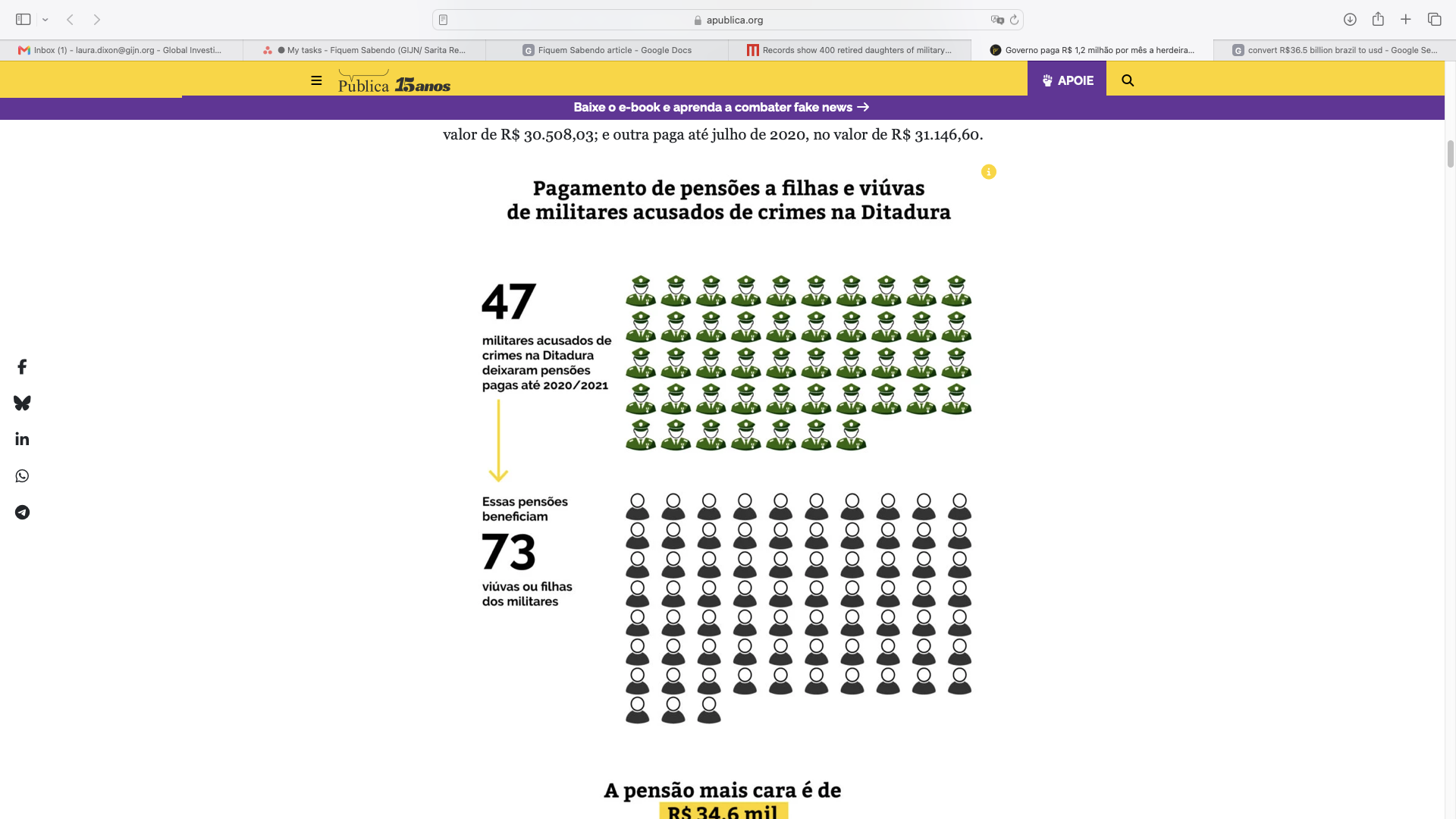
Fiquem Sabendo’s successful fight to obtain government pension data meant reporters could identify how many people related to military personnel, accused of committing crimes during Brazil’s military dictatorship, were still receiving their pensions. Image: Screenshot, Agência Pública
The project was Fiquem Sabendo’s first high-profile initiative and earned the organization a nomination for the 2020 Sigma Awards, an international data journalism prize now hosted by GIJN. That data transparency project also helped consolidate a model that combines journalism, advocacy, civic technology, and education to expand access to public information.
Ana Carolina Moreno, president of the Brazilian Association of Investigative Journalism (Abraji), calls Fiquem Sabendo “one of the organizations that has played the most important role in advancing transparency over the past decade.” Its work, she says, gives journalists more resources “to produce investigative reporting, uncover facts, and ensure society’s right to know what is happening in government.”
Katia Brasil, co-founder and executive editor of Amazônia Real, an independent investigative journalism group that focuses on stories from the Amazon, highlights the organization’s role in supporting other news outlets. “I have always seen Fiquem Sabendo as an engine for Brazilian journalism in the search for information, whether through the Access to Information Law or public data – information that other outlets, many of them independent, cannot access as quickly because of the expertise FS has developed over the years.”
From Blog to Organization
When Brazil’s Access to Information Law took effect in 2012, regulating a right established in the country’s 1988 Constitution, anyone could begin requesting information directly from public agencies and government entities through an online platform created by the federal government.
Journalist Léo Arcoverde began exploring the possibilities of the new law in his reporting. He regularly filed information requests, but not everything he uncovered became a story at the newspaper where he worked. To give that material an outlet, he started a blog in 2015 and set himself a goal: publish one story a day based on information obtained through the new law. The initiative would eventually become Fiquem Sabendo.
Arcoverde later met journalist Maria Vitória Ramos, FS’s co-founder and executive director, who encouraged him to turn the individual project into an organization, which was formally established in 2019.
Around the same time, lawyer Bruno Morassutti joined the project to lead its advocacy work. “We realized that journalists, in general, still knew very little about the Access to Information Law, used it very little, and were largely unaware of the possibilities it offered to anyone interested in obtaining public information,” he says.
Seibt joined the group in 2020, completing its current leadership team. A year later, in 2021, GIJN welcomed Fiquem Sabendo as a member. Since then, FS has grown, and today has a staff of 10, including administrative professionals and software engineers, besides occasional contributors.
Information for Those Who ‘Do Journalism’
Fiquem Sabendo’s main journalism product is its bi-weekly newsletter, Don’t LAI to Me — a play on the English pronunciation that sounds like “lie” — and which shares databases obtained through the Access to Information Law. “Journalists are free to use and cite the information,” explains Seibt, explaining how part of their model is to do the digging and share the nuggets of information they find. Today, the newsletter has around 20,000 subscribers, most of them journalists.
FS also conducts investigations in partnership with news organizations. One such collaboration, with the investigative food and health site O Joio e o Trigo, resulted in the series Lobby da Carne (the Meat Lobby), which examined how meatpacking companies and industry associations lobbied the federal government behind the scenes to secure a tax exemption for meat in Brazil’s 2023 tax reforms.
In 2025 alone, the organization filed around 3,000 information requests with federal, state, and municipal agencies under the Access to Information Law, according to Seibt. The information obtained through that work generated 2,000 mentions in local and national media.
Deciding what to investigate involves a combination of long-term monitoring and attention to the news cycle. “Some issues are part of our recurring coverage, such as public safety, health services, and environmental fines. We file these requests again periodically to keep the historical datasets shared through Don’t LAI to Me up to date,” Seibt says. “We are also always following the news and high-profile cases, looking for information that can shed light on these issues and contribute to journalists’ work.”
Beyond Information Requests
“What sets Fiquem Sabendo apart is its multidisciplinary approach. That is what has sustained our impact over the years,” Seibt explains.
On the advocacy front, the organization acts when it identifies failures to comply with the Access to Information Law, either by filing complaints with oversight bodies — as it did in the case involving federal pension beneficiaries — or by taking legal action.
The FS team also drafts legislative proposals aimed at expanding the disclosure of information in the public interest. Two of them became federal laws in 2024: one established minimum public transparency requirements in education, while another set rules for the disclosure of data from Brazil’s basic and higher education censuses and their respective exams and assessment systems.
Training is another area of focus, and over the years, Fiquem Sabendo has taught more than 5,000 people to use the Access to Information Law and published free tutorials to make the tool easier to use.
“More than simply providing access to data and documents, the Access to Information Law makes government decision-making processes more traceable. It allows us to identify the actors, interests, and relationships that influence public policy and to produce evidence for research, advocacy, and public oversight,” says Vitor Baptista, the organization’s technology director. “But filing successful requests requires expertise.”
On the technology front, FS’s strategy is to turn that accumulated expertise into tools that anyone can use.
“Civic technology allows us to turn a methodology developed over eight years into solutions that can be used by far more people than we could ever reach directly,” Baptista notes. “Instead of expanding our impact solely by increasing our own operations, we give others the tools to access public information, hold the government accountable, and exercise their rights more independently.”
Projects developed in recent years include:
- Agenda Transparente (Transparent Agenda): A tool that collects and organizes information about meetings between executive branch officials and other actors, making it easier to track their schedules and activities. “We collect information on public officials across Brazil and publish it in an organized and structured way in one place. That makes monitoring much easier,” notes Morassutti, FS’s advocacy director.
- WikiLAI: A practical guide to the Access to Information Law, featuring guidance, templates, and ideas for information requests. “It was created based on the knowledge Fiquem Sabendo has accumulated throughout its history, as an open repository where people can find inspiration in templates and ideas for requests,” Seibt explains.
- Queremos Saber (We Want to Know): A tool that allows users to submit access-to-information requests anonymously, protecting the requester’s identity.
- Sem Sigilo (No Secrecy): A task force created to identify and disclose public documents that have been improperly kept secret. According to Morassutti, the initiative also seeks to encourage “a renewed discussion about how confidential government information is managed.”
For Gustavo Faleiros, director of environmental investigations for the Pulitzer Center, it is the combination of these different areas that makes the organization unique. “Fiquem Sabendo is a one-of-a-kind project in Brazil because it combines the ability to aggregate and organize data with support for high-impact investigative journalism,” he says. “Over the years, it has become a reference in discussions about transparency and accountability, reminding us of the importance of access to information as a pillar of democracy.”
New Tools, Same Mission
Amid shifts in how people consume information and how content is produced, securing the resources needed to sustain existing work while investing in new projects has become an even greater challenge for nonprofit organizations like FS. “The challenge is maintaining a reasonably steady stream of funding so that we can really think about new services and new activities,” Morassutti says.
Today, 46% of the organization’s revenue comes from funding earmarked for specific projects. These include the Google News Initiative Innovation Challenge, which supported Agenda Transparente, and the Canada Fund, which financed LAI para Comunicadores (LAI for Communicators), a training program on the Access to Information Law for journalists and communicators working in hyperlocal initiatives. Individual donations account for another 34% of revenue, while foundations provide just under nine per cent. The rest of the budget comes from crowdfunding and service provision. “Financial sustainability really is a challenge given how many funding opportunities have disappeared in recent years,” Seibt says, although the reputation the organization has built helps.
FS has earned national recognition for its work promoting transparency and access to public information. Its honors include two Cláudio Weber Abramo Data Journalism Awards, in 2019 and 2023, and four consecutive Journalism-Mosca awards, from 2020 to 2023. The organization also received the Brazilian Chamber of Deputies’ Transparency and Public Oversight Award in 2022 and won the public-engagement category of Folha de S.Paulo’s Social Entrepreneur Award in 2024.
Refusing to stand still, Fiquem Sabendo is also exploring new ways to expand its impact. One involves using artificial intelligence in civic technology tools.
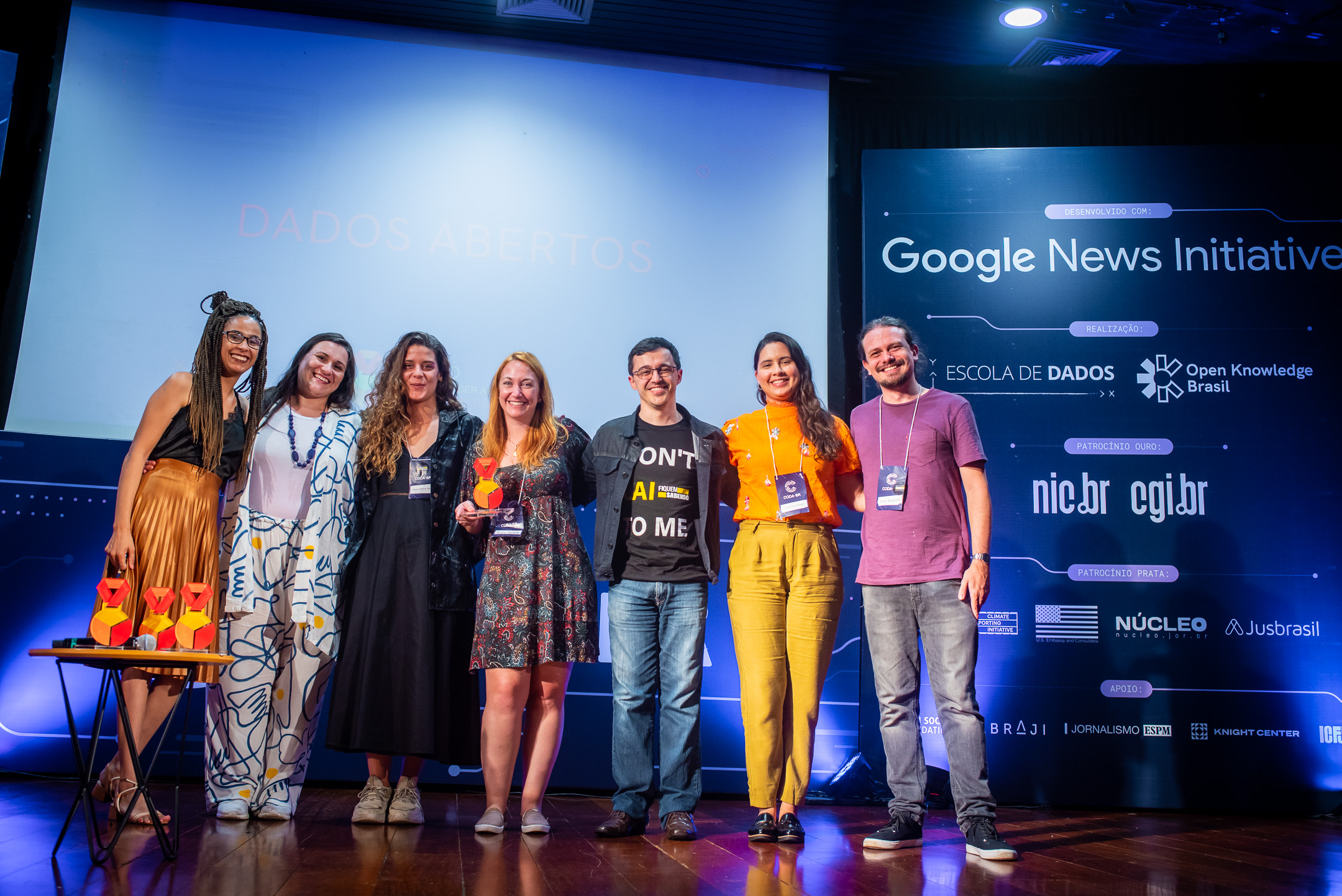
The Fiquem Sabendo team receives the Cláudio Weber Abramo Data Journalism Award in 2023. Image: David Ferreira Hapu
One example is LAIA, a project still under development that aims to help users appeal denials of access-to-information requests. Baptista explains that what distinguishes it from general-purpose AI systems such as ChatGPT or Gemini is that its instructions are designed by Access to Information Law experts and its responses are objectively evaluated against real cases and the elements an “ideal appeal” should contain.
“The long-term ambition is for LAIA to function as an Access to Information Law mentor, also helping users draft requests, track responses, and assess the quality of government agencies’ handling of them,” Baptista adds.
The investment in technology extends beyond artificial intelligence. FS is building a dedicated team focused both on improving its internal data-opening processes and on developing tools that make it easier for the public to access government information.
The tools may change, but according to Seibt, the mission remains the same. “We will remain committed to the public interest, government transparency, and supporting journalism.”
 Sarita Reed is a freelance multimedia journalist from Brazil who covers primarily environmental issues, human rights, and culture. She holds degrees in journalism and law, as well as an MA in media studies. Her work has appeared in National Geographic Brasil, BBC Brasil, Dialogue Earth, among others.
Investigating in Audio: Nine Standout Podcasts from Latin America
‘We Are Just Warming up Our Engines’: What’s Next for Investigative Journalism in Latin America
5 Tips for Slashing FOIA Costs (Including How One Reporter Lowered a Records Request Fee from $2,800 to Just $29)
The Secret Sauce of NINA, El CLIP’s Data Community Tool for Latin America

When the Investigative Journalist Becomes a Target: Lessons From Brazil

How Tai Nalon Creates New Tools to Investigate and Fact-Check Brazilian Politics
How Data Journalists Exposed the Real COVID-19 Death Toll in Brazil

Dictatorship’s Legacy, Rise of Portugal’s Far Right, and Devastating Flooding: 2024’s Best Investigative Stories in Portuguese

This work is licensed under a Creative Commons Attribution-NoDerivatives 4.0 International License
Republish our articles for free, online or in print, under a Creative Commons license.
Republish this article
This work is licensed under a Creative Commons Attribution-NoDerivatives 4.0 International License
Read Next
10 Questions LATAM Focus News & Analysis
When the Investigative Journalist Becomes a Target: Lessons From Brazil
When the award-winning Folha de São Paulo journalist did an investigation into election disinformation, she became a target herself.
Case Studies Reporting Tools & Tips
How Tai Nalon Creates New Tools to Investigate and Fact-Check Brazilian Politics
For GIJN’s My Favorite Tools series we spoke with Brazilian journalist Tai Nalon, executive director and co-founder of the fact-checking website Aos Fatos, who now leads an award-winning reporting team of nearly 20 people.
News & Analysis
How Data Journalists Exposed the Real COVID-19 Death Toll in Brazil
With the help of two former students, Brazilian data journalist Marcelo Soares collected data showing that deaths from COVID-19 in Brazil’s cities were far higher than authorities claimed. Check out how he did it.
Editor's Picks News & Analysis
Dictatorship’s Legacy, Rise of Portugal’s Far Right, and Devastating Flooding: 2024’s Best Investigative Stories in Portuguese
Also featuring stories on dubious pension payments, sinking cities, and deforestation, here are our favorite stories from the Lusophone world this year.