

Image: Courtesy of RSF
Reporters Without Borders: Amid Widespread Erosion of Democracy, 2026 World Press Freedom Index Drops to 25-Year Low
Read this article in
As the international community looks to celebrate World Press Freedom Day this coming Sunday, May 3, Reporters Without Borders (RSF) reports that its World Press Freedom Index has hit a “25-year low,” with more than half of the world’s countries currently falling into the “difficult” or “very serious” categories.
Although RSF has been documenting the rise and fall in press freedom globally for 25 years, this year’s findings are “dramatic,” observed RSF Executive Director Christian Mihr, who explained that only one in 100 people worldwide now has access to information from a robust, diverse, and healthy media landscape.
In addition, RSF Editorial Director Anne Bocandé urged governments around the world to do more than pay lip service to supporting the fourth estate and accountability journalism. “It’s no longer enough just to state principles — effective measures to protect journalists are essential and must be seen as a catalyst for change,” she said in the report. “This starts with ending the criminalization of journalism: the misuse of national security laws, SLAPPs, and the systematic obstruction of those who investigate, expose and name names. Current protection mechanisms are not strong enough; international law is being undermined and impunity is rife. We need firm guarantees and meaningful sanctions. The ball is in the court of democracies and their citizens. It is up to them to stand in the way of those who seek to silence the press. The spread of authoritarianism isn’t inevitable.”
Also notable this year was the effect that wars and accompanying restrictions to access have had across the globe, especially in places like Russia, Yemen, Palestine, Iraq, and Sudan. The report’s key findings note that out of the five indicators used to assess press freedom worldwide: political context, economic context, socio-cultural framework, legal framework, and safety, the legal indicator had the sharpest decline this year, dropping in more than 60% of nations worldwide, including in the European Union, where laws are not evenly applied.
RSF also spotlights a “deepening crisis” across multiple indicators for the United States — which has dropped to 64th in the Index, between Botswana and Panama. Press freedom has been declining in the US over the last decade, but “President Trump is throwing gasoline on the fire,” notes the report. However, it adds that: “The Index shows that this decline [in the US] is measurable and ongoing, but preventable.”
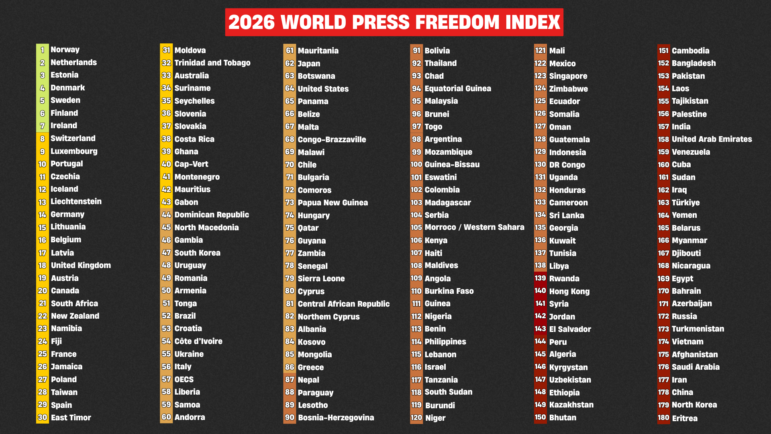
Image: Courtesy of RSF
Elsewhere in the Americas, countries led by other Trump allies are raising red flags as well. President Javier Millei has presided over a continued erosion in Argentina’s ranking (98th), which dropped 11 spots in the past year and has precipitously fallen 69 spots since 2022. Likewise under President Nayib Bukele — who has implemented a “foreign agents” law that effectively criminalizes most journalism — El Salvador’s press freedom ranking (143rd) has plummeted 74 places since he took power in 2019. Ecuador, where official crackdowns and organized crime routinely threaten the press, saw the biggest one-year drop in the Americas region, falling 31 spots from 94th in 2025 to 125th this year.
Some regional trends that emerged in previous years also recurred in the 2026 Index. There was little change in its top tier, comprising Scandinavian, Baltic, and northern European countries. Norway leads again worldwide for the 10th consecutive year, followed by the Netherlands and Estonia. The European Union and Balkans zone overall has held onto first place despite a drop in journalism conditions. The Middle East and North Africa (MENA) region now sits at the bottom worldwide for press freedom. However, RSF noted that while Syria remains in a “very serious” tier, the dramatic political changes there have prompted the country to jump 36 places — into 141st place — since just last year, and all five of its indicators have improved. Political instability and conflict continue to erode press freedom in Africa, where the sub-Saharan region has seen a marked decline.
There were also a few, surprisingly positive moves. Brazil (52nd) has jumped 58 spots since 2022 and Kosovo’s climb up 15 places to 84th since 2025 is a bright spot in the Western Balkans, where press freedom has also been deteriorating steadily.
International Research Guide: How to Find Experts and Hidden Documents on Any Topic
Guide to Investigating Tech and AI in Modern Warfare
Turning Copernicus Satellite Data Into Public-Interest Climate Stories
10 Practical Tips for Verifying Scientific Claims
Abzas Media: From Exile, Fighting for Press Freedom and Civil Space in Azerbaijan

Chaos and Credibility: A Snapshot of How AI Is Impacting Press Freedom and Investigative Journalism
Fighting for Accountability and Press Freedom in West Africa

‘The Most Important Thing Journalism Can Do in a Dictatorship Is to Tell the Truth’: Q&A with El Faro’s Carlos Dada

This work is licensed under a Creative Commons Attribution-NoDerivatives 4.0 International License
Republish our articles for free, online or in print, under a Creative Commons license.
Republish this article
This work is licensed under a Creative Commons Attribution-NoDerivatives 4.0 International License
Read Next
Member Profiles News & Analysis
Abzas Media: From Exile, Fighting for Press Freedom and Civil Space in Azerbaijan
Founded in 2016, this news site was created to report on issues often ignored or suppressed in state-controlled media, including corruption, misuse of public resources, and human rights violations.
News & Analysis Press Freedom
Chaos and Credibility: A Snapshot of How AI Is Impacting Press Freedom and Investigative Journalism
GIJN offers a snapshot of how watchdog reporters are confronting algorithmic abuses and misinformation while also employing AI as a key newsroom tool.
Member Profiles
Fighting for Accountability and Press Freedom in West Africa
For almost 30 years, the Media Foundation for West Africa has supported watchdog journalism and press freedom in both democratic and authoritarian states across the region.
News & Analysis
‘The Most Important Thing Journalism Can Do in a Dictatorship Is to Tell the Truth’: Q&A with El Faro’s Carlos Dada
Carlos Dada delivered the 2026 Reuters Memorial Lecture. As the leader of El Faro, he has edited and published dozens of investigations exposing corruption of governments of all colors.