
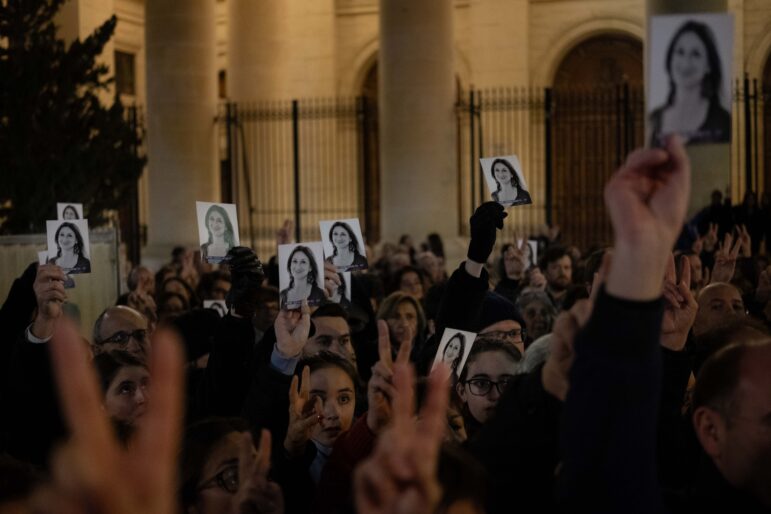
Members of the public attend a demonstration organized in 2018 by Malta's anti-corruption movement, holding aloft portraits of Daphne Caruana Galizia. Photo: Joanna Demarco
‘Denies Her the Justice She Deserves’: A Shocking Verdict in the Murder Trial of Daphne Caruana Galizia

Reporters Without Borders: Amid Widespread Erosion of Democracy, 2026 World Press Freedom Index Drops to 25-Year Low
Why Journalists in Autocracies Should Report as If They’re in a Democracy
Turning Copernicus Satellite Data Into Public-Interest Climate Stories

10 Practical Tips for Verifying Scientific Claims
Malta’s Courts of Justice are located at the heart of its capital, Valletta. Facing the neoclassical building stands a national monument turned makeshift memorial for journalist Daphne Caruana Galizia.
Photographs are placed on the stone of the memorial and in the soil around it, among placards and bouquets of flowers — some fresh, some a bit older. This protest memorial has been persistently maintained by activists for almost nine years, since Daphne’s assassination in October 2017. The memorial, frequently revived, acts as a manifestation of the consistent call for justice. Over the past two months, new candles were placed on the memorial and lit — some lighting up the word justice as dusk set in.
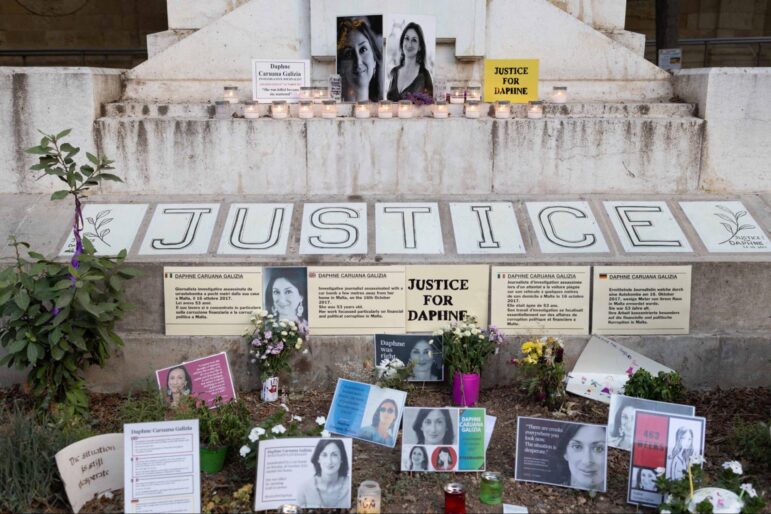
The protest memorial for Daphne Caruana Galizia at Malta’s Court of Justice, as seen during the trial. Image: Joanna Demarco for GIJN
The memorial could be seen through the window of Hall 22, Malta’s biggest courtroom.
Adjacent to the windows, and across from my seat on a bench in the press area of this courtroom hung a crucifix and a large Maltese coat of arms, its scroll slightly tilted.
Judge Edwina Grima sat directly below, elevated on a dais. In the center of Malta’s largest courtroom, the prosecution’s table was covered in thick files dressed in mint-green covers. That the documents covered the entire surface — about the size of a billiard table — spoke to the weight of the case.
This was the long-awaited trial of Yorgen Fenech, who stood accused of conspiring in the assassination of prominent journalist Daphne Caruana Galizia. She was killed by a car bomb outside her home while driving to the bank, on October 16, 2017. The two principal charges against Fenech, a Maltese business tycoon, were complicity in the wilful homicide and criminal association to commit the murder. He denied the charges and pleaded not guilty.
Previously, five men were convicted and jailed for direct roles in the assassination: the three hitmen who planted and detonated the car bomb — brothers Alfred and George Degiorgio and their associate Vince Muscat — and the two men who supplied the military-grade explosive — Robert Agius and Jamie Vella.
According to the family’s testimony, prior to the assassination, Caruana Galizia had received a large dossier from a source. She was investigating Electrogas — the company behind Malta’s main power station. The power station was the star of the Labour Party’s 2013 electoral campaign, in which it had pledged to slash electricity bills. According to the prosecution, the Electrogas project was Fenech’s “baby.”
The prosecution and members of Caruana Galizia’s family, under oath, made clear their contention that she was killed in connection with that investigation and what it might reveal.
The prosecution argued that Fenech commissioned and financed the murder, and paid self-confessed middleman turned state-witness Melvin Theuma to commission the hitmen.
Fenech’s WhatsApp conversations, displayed by the prosecution, showed his strong ties to persons in positions of power in Malta — including former Prime Minister Joseph Muscat, industry regulators, and even a deputy police commissioner who had headed the murder investigation.
The defense argued that Fenech did not order or finance the murder, that the state’s case rested on unreliable evidence from a pardoned accomplice, and that investigators had not convicted other suspects — most notably former Prime Minister Joseph Muscat’s chief of staff, Keith Schembri.
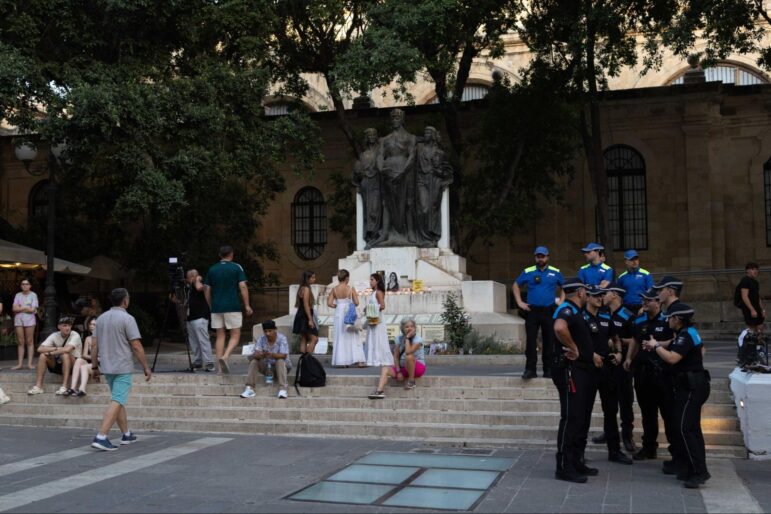
Police stood close to the memorial in Valletta as the jury deliberated. Image: Joanna Demarco for GIJN
A “Shock” Acquittal
The trial’s “shock verdict,” as the Times of Malta called it, was handed down just eight hours after jury deliberations began and stunned the public across Malta and around the world. Fenech was acquitted on both charges, with a vote of 8-1 against conviction from the nine-person jury on both counts.
For the first time in seven years, Fenech left the Court through the front door, surrounded by his legal team, to shouts of “murderer” and “mafia.”
In a statement immediately following the verdict, the Daphne Caruana Galizia Foundation, a GIJN member, said that the acquittal “denies her the justice she deserves,” and that “the institutional failures that enabled her murder remain unaddressed and unreformed. Lasting justice means no person should ever face the same risks again. Our country failed to protect Daphne’s life. It owes it to her to prevent other lives being lost.”
In a comment to GIJN prior to the verdict, Corinne Vella, Caruana Galizia’s sister, pointed out that, across many other murders of journalists worldwide, only low-level operatives have ever been held accountable or sent to prison. Those suspected of planning or orchestrating the killing of a reporter have never been found guilty in a court or held officially accountable. A conviction in this trial would have been a milestone against impunity for the killing of journalists, globally.
Tom Gibson, deputy advocacy director, EU, for the Committee to Protect Journalists (CPJ), likewise called the decision “heartbreaking for [Daphne’s] family” in a statement. He added that his organization remains steadfast in continuing to seek justice for the crime. “We will continue to stand by them and to seek accountability for all those involved in her murder,” he said. “We must continue to press the Maltese authorities for full justice. Nothing more, nothing less.”
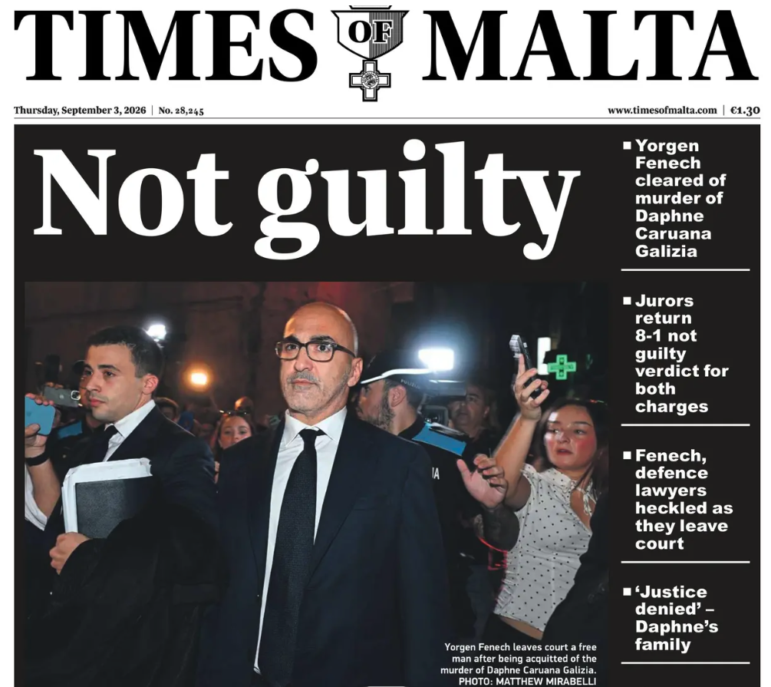
The front cover of the Times of Malta on the morning following the verdict. Image: Screenshot, Times of Malta
Louiselle Vassallo, a senior associate academic and doctoral researcher at the University of Malta’s Faculty of Media and Knowledge Sciences, spoke out on Facebook about the stunning nature of the trial’s end. “You might feel winded right now, suspended in disbelief, but do not look away,” she wrote. “Above all, honour and support Daphne’s loved ones. They never had a moment to properly grieve, yet they have fought insurmountable odds, simply for asking that justice be served. They refused to let her name fade into the shadows, to let the darkness that stole her life erase her memory. Tomorrow is uncertain, but today we stand shoulder to shoulder with them in unwavering solidarity.”
The morning after the jury’s decision, as Malta awoke to this surreal moment, Matthew Caruana Galizia, Daphne’s son, pulled no punches. He condemned the verdict as “obscene” and unacceptable. “What happened in that room is not justice but pure evil,” he said.
Not long after, the prosecution announced that it would be appealing the outcome.
The Last Time I Met Daphne
I had met Caruana Galizia a few times. In Malta, an island where on a good traffic day it takes 40 minutes to drive from one side to the other, it’s difficult not to run into people once in a while. I had once met her at a launch of a new furniture brand, another time queuing for the bathroom at a social gathering. The last time I had seen her was in the same building at the Courts of Justice in Valletta, Malta’s capital.
It was April 2017, and I had recently begun my journalism career as a reporter for a local newspaper. A week earlier, she had reported that Egrant, a secret company exposed in the Panama Papers, belonged to Michelle Muscat, the wife of then-Prime Minister Joseph Muscat.
Speculation about Egrant’s ownership had been high since two companies incorporated alongside it were proven to belong to senior government officials close to Muscat. In response to Caruana Galizia’s reporting, Muscat requested a magisterial inquiry seeking to vindicate himself — the terms of which he set through his lawyer. The request was approved, and that day she was called to testify before the magistrate. Eventually, the inquiry found no evidence linking the Muscats to Egrant, however, questions about the company’s true ownership remain.
When I approached her in court that day, I asked whether she intended to hand her evidence to the police. She said that doing so would be illegal: “Journalists are not required to give information to the police… The tax authorities and police all over the world would love to have access to the Panama Papers, but they can’t,” she had told me.
Two months into my journalism career, that insight was new to me. Despite completing a media degree at the University of Malta and specializing in journalism, I had never even been taught that journalism was fundamentally about holding power to account, let alone the legal frameworks of the profession.
Running Commentary, Fearless Independence
At that time, almost a decade ago, Malta’s media landscape was stifling. As elsewhere, private and political interests often intersected with mainstream journalism, and limited resources and an unrelenting news cycle meant that daily reporting took priority over in-depth investigation.
Meanwhile, as a veteran columnist, reporter, and editor with Malta’s leading newspapers, on her blog Running Commentary, which she started in 2008, Caruana Galizia had amassed an impressive network of both readers and sources.
In the 1990s, Caruana Galizia became Malta’s first woman columnist, and the first to publish under her own name. Her writing was sharp, witty, and eloquent, and she did not hold back from making her stance clear. In this signature style, she wrote relentlessly, her work ranging from pithy opinion pieces to meticulously sourced investigations.
Her sources, whom she called her “international network of spies,” would send her information, trusting that their anonymity would be guaranteed, which she would then post on her platform about any suspected inappropriate behavior they encountered, be it a hasty mobile phone image of what a public official was wearing or dining with, or leaked confidential documents. Her blog frequently attracted more readers than all of Malta’s main newspapers combined.
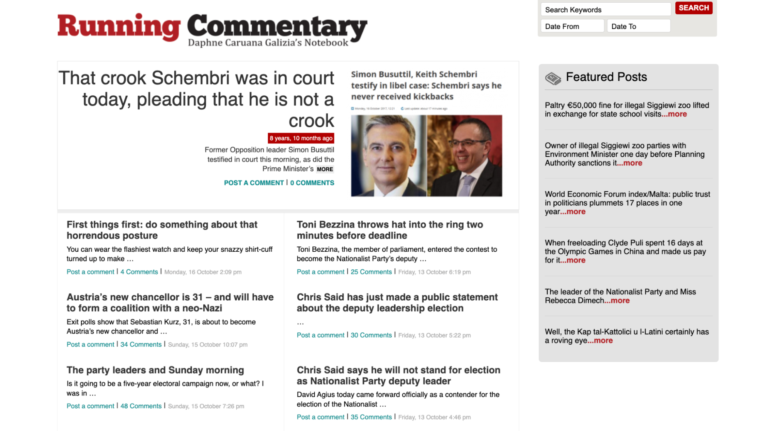
Daphne Caruana Galizia’s blog. Image: Screenshot, Running Commentary
However, in the years leading up to the murder, as Malta’s new Labour government under Joseph Muscat presided over several eyebrow-raising schemes, such as the sale of “golden passports” and an opaque energy deal with Azerbaijan, Caruana Galizia’s reporting had begun to expose deeper and more dangerous levels of corruption.
As her revelations grew, so did the campaign to dehumanize her. Malta’s Labour Party ran a television program that depicted her as a whiskey-drinking witch, and some party members belonged to secret Facebook groups where her death was celebrated. At the time of her murder, she was facing 47 libel suits. Her bank accounts had been frozen by then-Economy Minister Chris Cardona after she reported that he had visited a brothel while abroad on ministerial duties.
It is no surprise that a public inquiry into the murder, for which Caruana Galizia’s family pushed and that the state reluctantly launched, found that the Maltese state had to “bear responsibility” for creating a climate that enabled her assassination.
Bolder Journalism, Stronger Ties
Caruana Galizia was, at the time, largely alone in conducting investigative reporting on that scale, explained Louiselle Vassallo, a senior associate academic and doctoral researcher at the University of Malta’s Faculty of Media and Knowledge Sciences, who has extensively researched media pluralism in Malta.
However, since the assassination, perhaps out of necessity and fueled by a shift in the collaborative nature of investigative journalism worldwide, she said reporting in Malta has grown more courageous and collaborative.
“I have seen bolder journalists emerge,” explained Vassallo, adding she has felt more hopeful due to the emergence of new media platforms inside the country, including The Shift News and Amphora Media, the investigative arm of the Daphne Caruana Galizia Foundation.
In fact, it was collaborative and cross-border journalism that continued and later revealed the reporting Caruana Galizia never got to publish.
During Fenech’s trial, Matthew Caruana Galizia, a Pulitzer Prize-winning journalist, testified that: “[After the assassination] I didn’t know who to trust, and we formed a consortium of journalists and I passed the information on to this consortium.” He was referring to Forbidden Stories, who were committed to continuing his mother’s work.
For The Daphne Project, 45 reporters from 18 new organizations in 15 countries joined forces, working secretly for five months. They continued Caruana Galizia’s investigation and published the revelations she couldn’t. The Daphne Project became their first of an ongoing series of projects to continue the work of journalists who were killed or silenced.
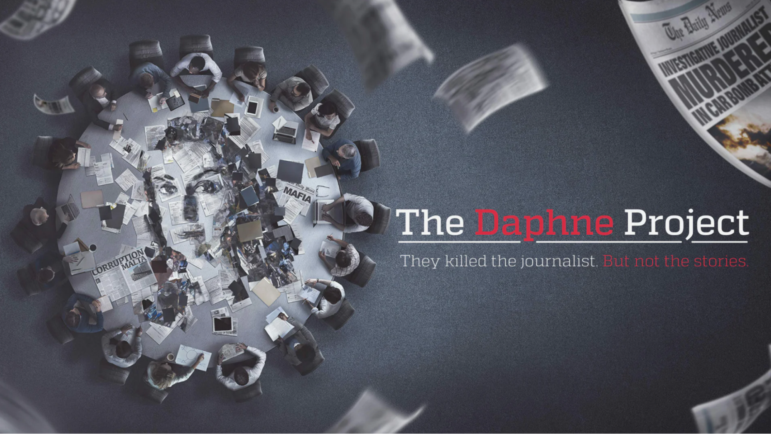
Image: Screenshot, The Daphne Project
Laurent Richard, the co-founder of Forbidden Stories, explained that the work’s intention was to send a “very simple” message: that killing a journalist will not kill the story. “In the end, those who wanted to silence Daphne produced the opposite result.”
Richard cited a comment that Matthew Caruana Galizia made in an interview with Christiane Amanpour following the publication of The Daphne Project — that seeing journalists taking up his mother’s investigations “feels like a taste of justice.”
“For me, this says a lot about what the project achieved,” said Richard, who added that the impact of The Daphne Project was “huge.” He estimated that over 100 million people have been exposed to the project and its stories.
Responses outside of Malta followed. Less than a week after the first publication, the Council of Europe appointed a rapporteur to monitor the rule of law in Malta.
The Daphne Project was also a milestone in the use and purpose of collaborative journalism, explains Richard.
“At the time, cross-border collaboration was mostly associated with big leaks. With Forbidden Stories, the idea was different: could we use the same power of collaboration when one of us is threatened or killed? The Daphne Project showed that we could.”
“First, collaboration provides protection,” he added. “There is no point in killing a journalist if 40 or 50 other journalists already have the information and are ready to continue the work. It also means more resources. And of course more impact… The Daphne Project showed the world that collaboration could be a very concrete response to threats against journalists.”
Following the verdict, Richard said that the ruling “despite the evidence… sends a chilling message to Maltese society that impunity prevails.”
Protecting Daphne’s Legacy
Meanwhile, almost 10 years on, Caruana Galizia’s family have not slowed down on their mission to seek justice in all forms — a constant struggle.
“Daphne’s murder remains horrific, and what has happened since is unforgivable,” said Corinne Vella, Caruana Galizia’s sister, in a comment to GIJN before the verdict. “Malta’s justice system is generally very slow and the defense have delayed the trial for years on one pretext or another.”
“Considering how bad the situation was [with the institutions], my family had to play a role,” Matthew Caruana Galizia told the jury when he took the witness stand in August.
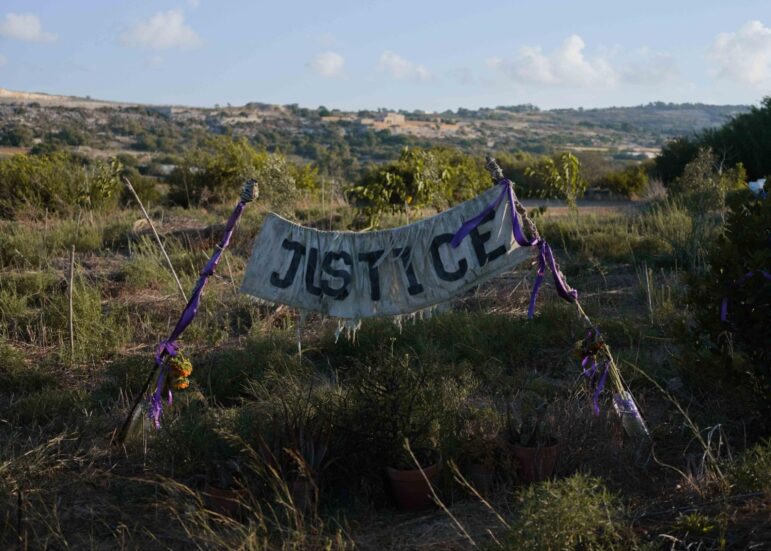
Image: A banner calling for justice at the spot where Daphne Caruana Galizia was killed in Bidnija, Malta. Image: Joanna Demarco for GIJN
The CPJ’s Gibson, who has been following the case closely since 2017, added that Daphne’s assassination also “shook up the narrative of journalist safety in Brussels, igniting political will to address journalist safety… and leading to a number of EU legislations, including the Anti-SLAPP Directive, the Journalism Safety Recommendations, which both led to the European Media Freedom Act.”
How the Maltese authorities choose to respond to and protect press freedom has always been about more than the trial of any one person, Gibson also told GIJN. And despite this acquittal, he urges them “to use the fact that Daphne Caruana Galizia was murdered as an engine for change.”
That remains a challenge, however, as the country’s authorities have been dragging their heels and have resisted introducing any concrete reforms, he pointed out. But he emphasized the importance of making sure Daphne’s work and her story remain in the public eye. “Her work and her life and legacy matter far more.”
That’s the driving force behind the Daphne Caruana Galizia Foundation — which was founded by her husband and children following the assassination and continues today. Vella explained that while ensuring criminal justice for both Daphne’s murder and for her stories remains a core mission of the organization, it is also working on reforms for a safe and enabling environment for investigative journalism, anti-corruption work, and public accountability.
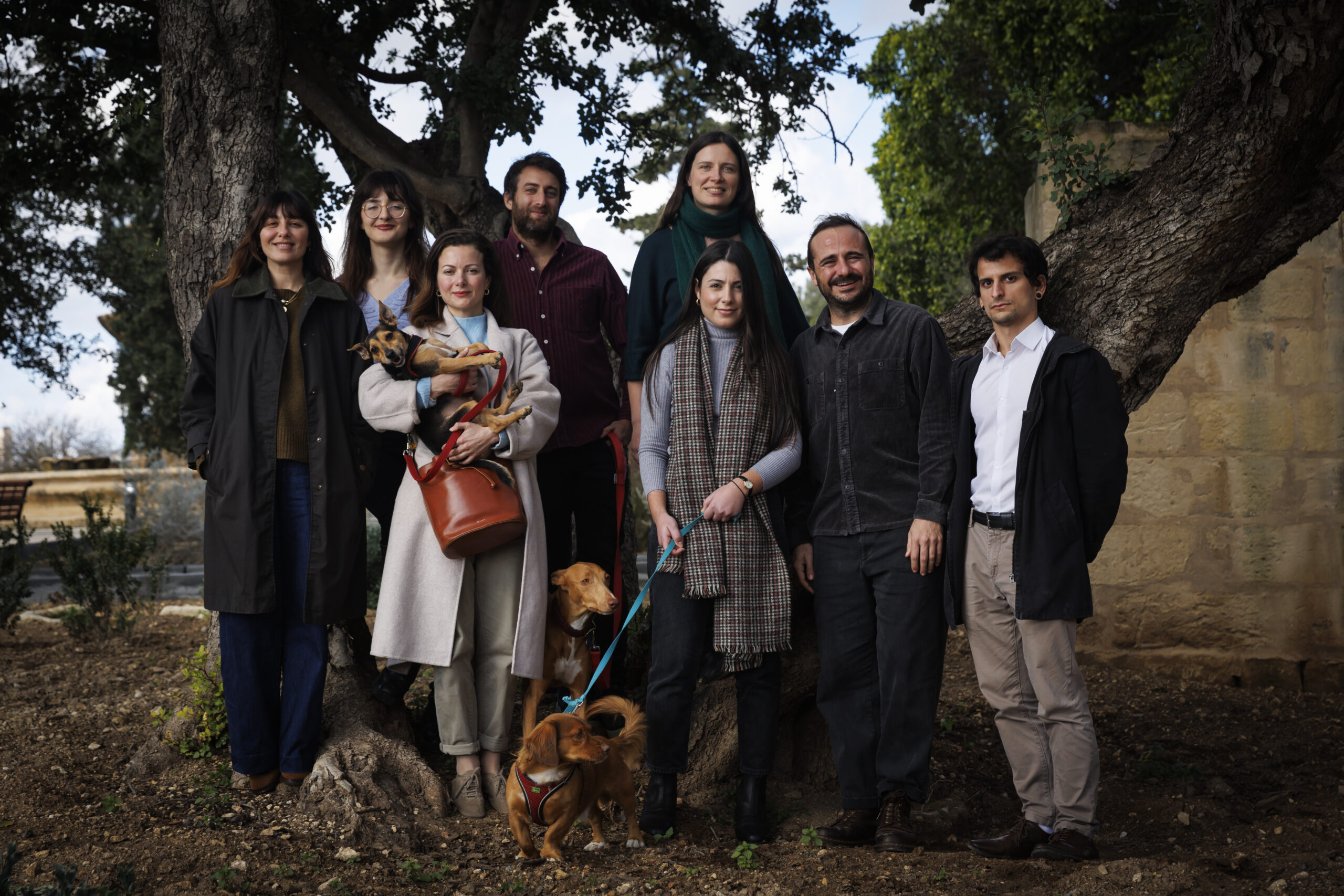
The Daphne Foundation staff Image: Darrin Zammit Lupi
Following the public inquiry report into Caruana Galizia’s murder, “Malta had a chance to act swiftly and become a positive example for the rest of Europe, yet the government still resists reforms that properly protect journalists,” said Vella.
She described the reluctance to address corruption and organized crime in particular as “unjustifiable.”
“Her assassination in 2017 was the first murder of a journalist in Malta,” she added, “and Malta should ensure that it is the last.”

Joanna DeMarco
Joanna Demarco has been working in the field of journalism in Malta for the past decade, both as a journalist and a photographer. Her more recent investigative work has been published with OCCRP, Amphora Media and Politico Europe, among others, and has been recognized by awards including the Voices Awards 2025. She forms part of GIJN’s Comms team as the Visuals and Newsletter Editor.
Reporters Without Borders: Amid Widespread Erosion of Democracy, 2026 World Press Freedom Index Drops to 25-Year Low
Why Journalists in Autocracies Should Report as If They’re in a Democracy
Turning Copernicus Satellite Data Into Public-Interest Climate Stories
10 Practical Tips for Verifying Scientific Claims
How Journalists Can Protect Against Slapp Cases and Other Legal Threats
After a Government Suspension, What’s Next for Uganda’s Premier Journalism Training Organization?

Nordic Countries Are a Press Freedom Haven. What Do They Get Right (And Wrong)?
‘Foreign Agent’ Law in Bosnia Threatens Independent Media

This work is licensed under a Creative Commons Attribution-NoDerivatives 4.0 International License
Republish our articles for free, online or in print, under a Creative Commons license.
Republish this article
This work is licensed under a Creative Commons Attribution-NoDerivatives 4.0 International License
Read Next
GIJC23 Legal Defense & Emergency Aid Press Freedom
How Journalists Can Protect Against Slapp Cases and Other Legal Threats
How journalists can identify whether they’ve been hit with a SLAPP suit — and resources for helping journalists fight back.
Member Profiles Press Freedom
After a Government Suspension, What’s Next for Uganda’s Premier Journalism Training Organization?
The African Centre for Media Excellence fills a critical gap between journalism schools and newsrooms, but earlier this year Ugandan authorities ordered it to shut down and it’s now fighting for its survival.
Press Freedom
Nordic Countries Are a Press Freedom Haven. What Do They Get Right (And Wrong)?
Norway, Denmark, Sweden, and Finland frequently feature in the top ten of the world press freedom rankings. We spoke to investigative reporters in each country to find out why.
News & Analysis Press Freedom
‘Foreign Agent’ Law in Bosnia Threatens Independent Media
Journalists and editors from this Balkan nation warn that if the recently passed law survives a legal challenge, it would stifle independent reporting.