
Image: Shutterstock
How to Make Investigations Matter More: A Q&A with the Authors of ‘The Guide to Impact Journalism’
Read this article in
In recent years, the term “impact” has been used a lot in journalism, the NGO sector, and beyond. In investigative journalism, many newsrooms have begun implementing an “impact strategy.” But how can they do better, what is the goal, and on what practices should they rely?
It was while seeking answers to these questions for their own needs that the investigative media outlet Disclose, a member of GIJN, and the independent media outlet Rembobine published “The Guide to Impact Journalism” last fall. Available online for free, it offers a selection of best practices in impact journalism, both in France and internationally.
While waiting for the English translation of the guide, GIJN reached out to two of the co-authors to learn more: Pierre Leibovici, deputy editor-in-chief for climate and pollution at Disclose and co-coordinator of impact strategy, and Timothée Vinchon, editor and co-founder of Rembobine.
Disclose and Rembobine’s “Guide to Impact Journalism.” Image: Screenshot
GIJN: In what way is impact an issue for investigative journalism?
Pierre Leibovici: The question of impact addresses an existential issue: “What is the purpose of my profession? What is the purpose of investigative journalism?” When we see the prominence of disinformation, entertainment, and so on, I think it’s healthy to ask ourselves this question. And the very idea of evaluating journalism is interesting — not as a barometer, but as a means of self-reflection and, above all, as a way to reconnect with one’s audience.
At a time of democratic crisis and a crisis of trust in the media — which we’re experiencing in both the democracies of the Global North and the Global South — it’s urgent that we equip ourselves with the means to ensure that investigations lead to real-world action: beyond the article that exposes wrongdoing, we must truly adopt an approach that ensures these wrongdoings are brought to the attention of those best positioned to effect change — to take action on the ground, within institutions, and in public discourse… This is the best gift we can offer a skeptical public that doubts the media: a form of total trust agreement.
Timothée Vinchon: In a media landscape completely saturated with news, an investigative report — no matter how high-quality — can disappear very quickly. Hence the need to try to maximize the impact of these investigations.
Another benefit: we’ve found that this kind of impact tracking — as Rembobine does with independent media — allows journalists to see ramifications they hadn’t considered, and this sometimes leads to further investigations.
GIJN: Your guide emphasizes the importance of developing an impact strategy well before an investigation is published. Why?
PL: In the traditional view of journalism, investigative journalists prepare their story, publish it on D-Day, and hope that society will take notice. And then they move on to something else. When you’re pursuing impact journalism and want to maximize the chances of creating levers for change once the investigation is published, that takes preparation. This means, in particular, sometimes confiding in civil society actors so that on the day of publication, not only do these activists share the investigation on social media, but they also send it to their contacts in political circles or even prepare a legal response. At Disclose, we once sent the key elements of an investigation to an NGO two weeks before its release; this gave the NGO’s legal team time to prepare a complaint, which was filed a few days after our investigation was published. I understand this approach can sound like activism for a traditional newsroom. But for us, this is just an extension of our investigative work.
GIJN: In September 2025 in Paris, you organized the first Impact Journalism Festival. What came out of it?
PL: We brought in lots of investigative journalists who explained the impact of their investigations, and then we held workshops to develop an impact strategy based on a fictional topic. This sparked ethical debates. It’s important to note that there is resistance to the idea that focusing on impact should be journalists’ mission.
The outcome of this festival was that everyone agreed we need more bridges between investigative journalism and the rest of society to ensure we don’t remain in a bubble.
GIJN: At what stage of the investigation should a newsroom start preparing for impact?
PL: At Disclose, we consider the potential impact as soon as we start working on a topic. We follow the “hypothesis-driven investigation” model described by Mark Lee Hunter in his “Handbook of the Investigative Journalist.” By listing the hypotheses, we’ll try to prove through the investigation, we also list a whole range of potential impacts our investigation could have. So, as soon as the story is commissioned and launched, the editors reach out to civil society actors to start testing the waters. No later than one month before the investigation’s publication, we also hold a major impact meeting with the person in charge of social media and the person responsible for development to discuss how we can broaden our target audience and see if we can bring other people on board. We then hold another impact meeting seven days before publication. One or two days before the big day, we also usually send the investigation to journalists and AFP [Agence France-Presse] to ensure media coverage. We also contact specialized or professional media outlets that will reach an audience of particular interest to us for certain topics.
GIJN: Your guide suggests establishing impact criteria. Which ones?
PL: It’s really up to each media outlet and each organization involved in journalism — I’m thinking of foundations, for example, or even GIJN — to establish their own impact criteria. When I joined Disclose in late 2022, we hadn’t yet formalized what those impacts might be. One of my first tasks was to establish impact criteria that were consistent with our editorial stance. Drawing inspiration from other media outlets and NGOs, which are sometimes quite advanced in this area, I compiled a list of about a dozen criteria at the time. Today, we have 20 criteria that are unique to us. These criteria cover four broad categories: media impact, institutional impact, legal impact, and societal impact. This set of criteria is found in nearly all media outlets actively working on an impact strategy. But what matters most isn’t so much the number of criteria as their relevance to your positioning.
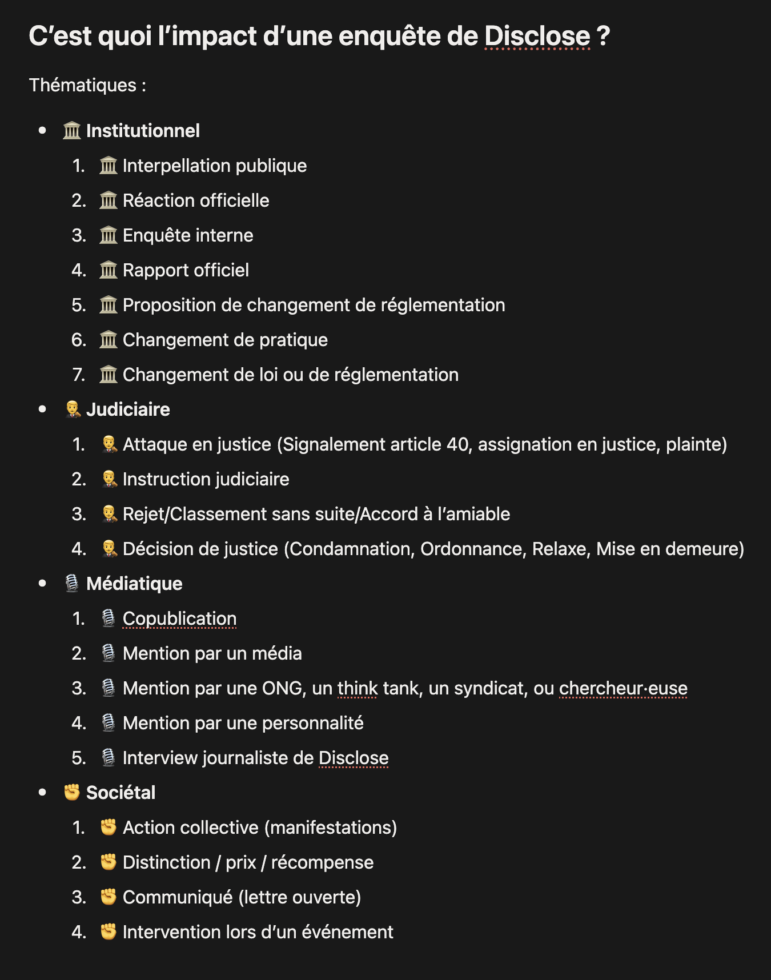
The 20 criteria across four categories that Disclose uses to assess their impact. Image: Courtesy of Disclose
GIJN: What tools can a newsroom adopt for effective impact tracking?
PL: The tool itself isn’t important. The key is to have a database with a designated point person on the editorial team, and that person must ensure that the impact metrics are filled out. At Disclose, we track impacts comprehensively. We can afford to do this because we publish very few investigations — between 20 and 25 per year. We use Notion, a tool that allows us to create highly visual databases that are easy to filter, which is very convenient, especially when we’re putting together our annual impact report, since we can see all this information at a glance. In fact, the link to this impact database is made publicly available in every impact report.
GIJN: Tell us about other ways to amplify the impact of an investigation…
TV: In newsrooms that are increasingly focused on the issue of impact, the question of co-publishing with other media outlets comes up fairly regularly. You have to ask yourself: “Is this project meant to reach beyond national borders?” Or, conversely, should you co-publish with much smaller, local media outlets because it makes perfect sense in terms of local relevance, since it will reach a readership that’s directly affected?
PL: With every investigation, we ask ourselves whether there could be an audiovisual adaptation to try to bring the story to life beyond the written word. We’re also forming more and more partnerships with content producers. In France, Mediapart has also experimented with this, with very interesting results. For an investigation we conducted last February on PFAS, for example, we partnered with a French content creator who made a two-minute video that has been viewed almost two million times. This helped spread our revelations on a very technical subject much more widely.
TV: I’d also like to add how important it is to reach audiences through the formats that matter to them. Take the example of the Bondy Blog, which, on the issue of sports betting in working-class neighborhoods, brought together both the relevant authorities and the young people affected. Disclose also did this recently for an investigation into PFAS in the Ardennes. It’s a format that allows us to get as close as possible to the audiences concerned.
GIJN: Are there cases where it’s difficult to make an impact?
TV: At Rembobine, we document the repercussions of investigations by independent French-language media outlets, and what we’ve realized is that, unfortunately, cases of local corruption sometimes don’t have the expected impact.
This is also sometimes the case with investigations into the misdeeds of major French industrial groups in countries of the Global South. If a significant effort isn’t made to develop an impact strategy, these are issues that, very unfortunately, fall by the wayside — even though they involve major problems.
PL: Sometimes we have an approach — including at Disclose, which we’re trying to correct — that can be very France- or Europe-centric. In April, we published an investigation into a steel giant that sources coal from Mozambique. This time, we really reached out to civil society in the country and asked the local community living near a coal mine that supplies this giant to conduct air pollution surveys for us. A nonprofit organization translated the investigation into Portuguese free of charge to make it available to the audience most directly affected. Lighthouse Reports and The Examination are excellent examples of media outlets that have successfully channeled their impact to serve the communities most affected — and often victimized by abuses committed by multinational corporations.
GIJN: The guide recommends dedicating a clearly identified space for impact reporting. Why?
PL: This is especially important for investigative media outlets that produce a lot of articles, or for traditional media outlets that produce both investigative reporting and other types of content. It’s terrible when impact follow-up articles get lost among all the others. This makes it harder to understand what the newsroom is fighting for. The guide recommends using visual cues and dedicated editorial spaces for impact coverage.
And why not go a step further and produce impact reports once a year — or even more often — which can be very brief? The guide cites the example of The Marshall Project in the United States, an investigative media outlet covering the justice system and the prison system that produces quarterly impact reports, but in an ultra-short, two-page format that reads like an old-fashioned gazette. They’re very well done and detail the impacts that have occurred over the past three months. They are sent to the public and to their funders.
There’s a creative space that can open up to try to show the impact from every angle. Social media is also a great playground for that. At Disclose, half of our social media content focuses on the impacts of our investigations, and the other half is the investigations themselves. I think it’s essential to emphasize that this is what interests us in investigative journalism: what the effects are — not just a scoop that’s forgotten the next day.
Alcyone Wemaëre  is GIJN’s French editor and a freelance journalist based in Paris. She is a former staff reporter for Europe1 and France24 in Paris, and her work has appeared in Le Monde, Slate, Infomigrants, La Chronique, L’Obs, and Le Temps. She is also an associate professor at Sciences Po Lyon, where she is co-responsible for the Data and Investigation specialty for the Master’s degree in journalism. Wemaëre graduated from Celsa and received the François Chalais Prize.
The Investigative Journalist’s Guide to Impact

GIJC23 – Measuring Impact

Guide to Investigating Tech and AI in Modern Warfare
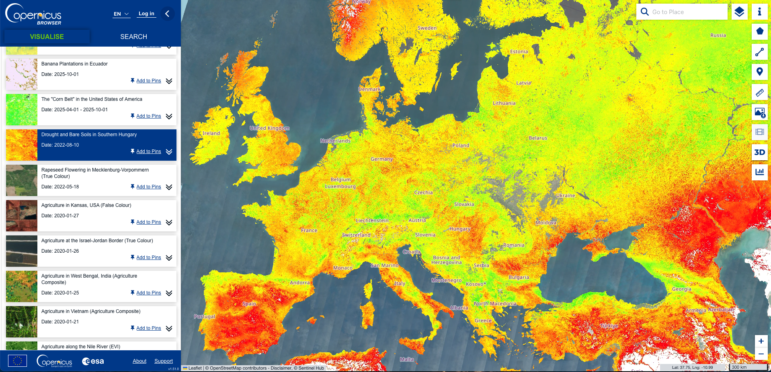
Turning Copernicus Satellite Data Into Public-Interest Climate Stories

Two Years Ago, Meta Killed CrowdTangle. Can a New AI Tool Fill the Void?
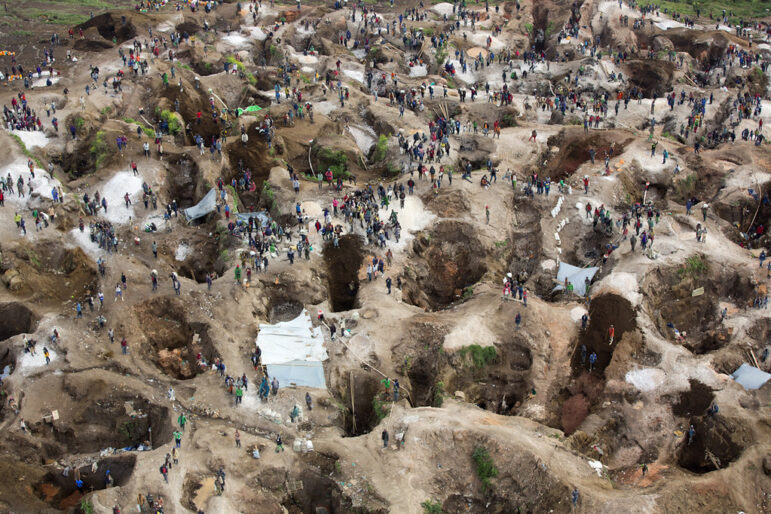
Journalists in Africa and South America Are Mapping the Mines Devouring the World’s Rainforests
Russian War Recruitment in Africa, Hidden West Bank Settlement Funding, Scams in Southeast Asia, and More: 2026 DIG Awards Shortlist
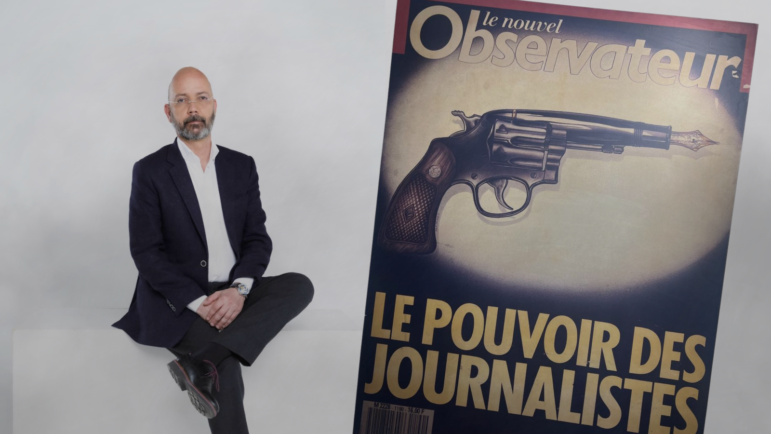
‘Once Someone Opens the Door and I Manage to Sit Down with them, I Have a Shot’: Colombia’s Ricardo Calderón on His Career Conducting High-Risk Investigations

This work is licensed under a Creative Commons Attribution-NoDerivatives 4.0 International License
Republish our articles for free, online or in print, under a Creative Commons license.
Republish this article
This work is licensed under a Creative Commons Attribution-NoDerivatives 4.0 International License
Read Next
Two Years Ago, Meta Killed CrowdTangle. Can a New AI Tool Fill the Void?
A new crop of AI-powered tools is trying to fill the void left by CrowdTangle, which let journalists tack how content spread across Facebook and Instagram. Arbiter is one of the projects leading the way.
Data Journalism
Journalists in Africa and South America Are Mapping the Mines Devouring the World’s Rainforests
Two journalism and technology projects are sharing tools and methods across continents to map where mining is devastating the Amazon and Congo basins.
Russian War Recruitment in Africa, Hidden West Bank Settlement Funding, Scams in Southeast Asia, and More: 2026 DIG Awards Shortlist
The screening of 25 new investigative films — chosen from 300 entries — will be evaluated by an international jury across five video categories for the annual DIG Awards.
News & Analysis
‘Once Someone Opens the Door and I Manage to Sit Down with them, I Have a Shot’: Colombia’s Ricardo Calderón on His Career Conducting High-Risk Investigations
The reporter spent more than 20 years investigating armed conflict, corruption, and spy scandals in print, always trying to avoid the limelight. He had to forgo privacy to take on a new role on national television.