
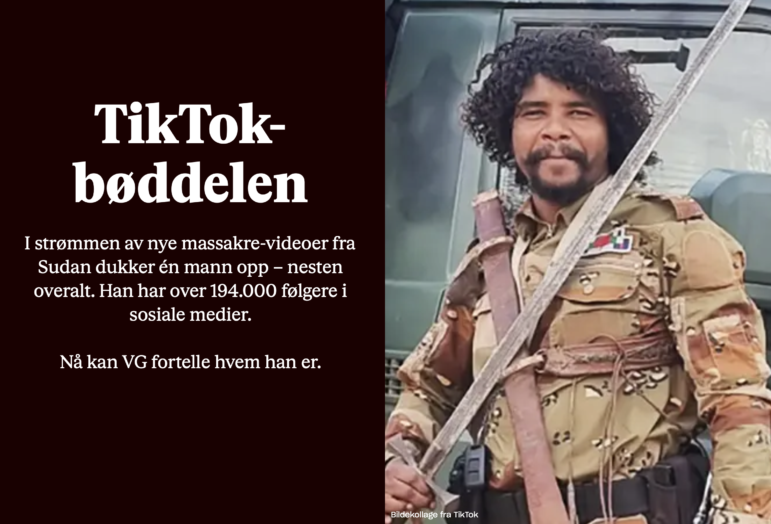
The Norwegian news site VG's investigation into Sudanese militia violence looked into TikTok videos posted by the group and used the same platform to expand the reach of the story. Image: Screenshot, VG
Translating Investigative Journalism into Platform-Native Storytelling
Read this article in
Investigative journalism takes time. Months of documents, interviews, and verification before anything is ready to publish. But the way people find and read journalism has changed much faster than most newsrooms expected. News is now consumed mostly inside social media feeds, on phones, in fragments, between other things.
This creates a real problem for investigative teams: how do you take a complex, months-long investigation and make it work in a format built for fast-scrolling readers? And how do you do that without losing what makes the reporting credible?
More newsrooms are now treating this as an editorial question, not just a distribution task. The format is becoming part of the story itself. Recent examples from 2025 and 2026 show this shift is no longer just experimentation.
Rethinking How Investigations Travel
Norway’s VG — Verdens Gang, a prominent tabloid founded in 1945 — provides one of the clearest examples of this in practice. The newsroom has been adapting investigative reporting into short-form vertical video for TikTok and Instagram, mainly to reach younger audiences who don’t follow news through traditional channels.
One strong recent example is VG’s 2025 TikTok-bøddelen investigation into Sudanese militia violence, where TikTok videos were not just a way to share the story but were actually part of the evidence. The project showed something important: platform-native journalism is not only about adapting existing stories for new formats. Sometimes the platform becomes part of what you are investigating.
According to the International News Media Association (INMA), VG’s short-form news videos generated millions of views in 2024, and for many of the clips, 18-24-year-olds accounted for 60-70% of viewers. But the numbers are not the most interesting part. At VG, audience comments are treated as editorial input; questions and reactions from viewers shape follow-up content and help extend the life of an investigation beyond its original publication. A story does not end when it is published.
There is something else worth noting here, though. What makes this strategy work for VG is not only good content. According to the Reuters Institute’s 2025 Digital News Report, Norway has relatively high public trust in established news brands, and that trust carries over to platforms like TikTok. Norwegian audiences on TikTok still pay the most attention to traditional news outlets like VG, which is quite different from markets where creators, influencers, or politicians dominate the same space. At the Nordic AI in Media Summit in Copenhagen, VG editor-in-chief and CEO Gard Steiro described the need to rethink old formats while preserving the value of storytelling. For VG, that means finding new ways to package and distribute journalism across platforms. The format travels. The trust that makes it land does not always travel with it.
The OCCRP projects Scam Empire and Bad Practice show what this looks like at a much larger scale. Both investigations were produced with partners across multiple countries and distributed not as a single publication moment, but through many different formats simultaneously: long-form reporting, visual explainers, social teasers, and locally adapted versions. The 2025 Scam Empire investigation, built from nearly two terabytes of leaked data, reached audiences through short explainer videos and infographics on social media alongside the full investigation. People who would never read the original report still encountered its findings. The platforms created extra entry points into the journalism; they did not replace it.
Each Platform Has Its Own Logic
Each platform pulls newsrooms toward different storytelling instincts, and the differences are not just technical.
Instagram works well for structured, visual storytelling. Carousel posts and reels let journalists break a complex investigation into smaller pieces, each one building on the last. It rewards clarity over atmosphere. For reporting that involves financial networks, timelines, or layered data, this format can actually make the story easier to follow.
TikTok is less forgiving. You need to hook people in the first few seconds, and the rhythm of the platform does not leave much room for context or nuance. Adapting to TikTok means changing not just the length but the tone and pace of how you tell a story. Some newsrooms have decided that the trade-off isn’t worth it. That reticence is not just a technical limitation; it reflects a real tension between platform culture and editorial identity.
YouTube is still the platform best suited to in-depth, long-form interviews, documentaries, and explainer videos, giving reporters space to build context properly. For many independent outlets, it has become their main editorial environment, not just a place to post extra content.
Telegram plays a different role. In politically restrictive environments, it works more as a continuity tool than a growth channel. When platform controls tightened in Russia in 2026, Telegram remained functional for independent media when other options had gone dark. It does not amplify the way Instagram or TikTok can, but it stays on when other platforms do not.
Turkey: When Platform Strategy Becomes Survival Strategy
Instagram was blocked for nine days in August 2024. During the 2025 protests following the arrest of Istanbul mayor Ekrem Imamoglu, access to platforms including X, YouTube, TikTok, Instagram, and Telegram was throttled for extended periods. Independent outlets that depended too heavily on one platform lost their audience access overnight. Platform diversification, in that context, is not a growth strategy. It is a contingency plan.
Medyascope, an independent digital-first news platform based in Istanbul, was one of the first outlets to figure this out, though not by design. Founded in 2015 by journalist Rusen Cakir after he left mainstream media, the outlet built its model around YouTube and live broadcasting from the beginning. This was not really a creative choice. Turkey’s broadcast ecosystem had become structurally closed to independent voices. Licensing from RTUK, the country’s media regulator, was expensive and politically restrictive. Advertising revenue went mostly to pro-government outlets. The system was not designed to make room for journalism that was not politically aligned. YouTube offered a broadcast model that did not require a license and was harder for regulators to control directly than traditional broadcasting.
The result is an outlet that still looks more like a television newsroom than a social media operation. Long discussions, live political analysis, extended interviews. Medyascope adapted its infrastructure, not its storytelling format. That distinction matters when thinking about what platform-native journalism actually means.
T24 followed a different path, but ended up in a similar place. The outlet started as a web-first news site, and its YouTube presence grew gradually rather than strategically. Today, T24’s YouTube channel has over 252,000 subscribers and more than 14,000 videos, built largely through a steady output of interview-based and analytical programs. What is interesting is that this growth was not the result of a deliberate platform pivot. It happened because audiences were already looking for longer-format political discussion on YouTube, and T24 was there to provide it. The platform matched the editorial identity, not the other way around.
Online news site Diken operates across multiple social platforms while remaining fundamentally article-based. Social media functions mainly as amplification, bringing readers back to the website. The precarity of that model was made clear when X blocked Diken’s content following a court order related to earthquake coverage. Reach built on any single platform can disappear quickly and without much warning.
Bianet has been moving slowly toward more visual content on Instagram, but its approach is still cautious. A lot of Turkish independent media was built around long-form, analytical journalism, and that editorial identity does not translate easily to platforms that reward speed and emotional reaction. Teyit is a different case entirely. The Ankara-based fact-checking organization has done more with TikTok than almost any other independent outlet in Turkey, and it makes sense when you consider what fact-checking involves. In 2023, Teyit published 157 TikTok videos that generated around 12 million views and 160,000 interactions. That output included some of the most demanding news periods in recent Turkish history: the February 6 earthquakes, the 2023 presidential elections, and ongoing regional conflicts. During the earthquake response in particular, Teyit’s short verification clips were circulating in real time, directly addressing viral misinformation while there was still widespread confusion. The format’s speed and modularity matched what the moment required.
@teyitorg Murat Karayılan’ın yer aldığı Millet İttifakı kampanya filmi gerçek değil. Montajlanarak oluşturulmuş. ❌ #teyit #teyitçiyim #teyitlibilgi #teyitorg #seçim2023 #2023genelseçimler #2023seçim #seçim #cumhurittifakı #milletittifakı #erdoğan #kılıçdaroğlu #chp #akparti #haydi #cumhurbaşkanı ♬ orijinal ses – Teyit
Fact-checker Oyküm Hüma Keskin wrote about Teyit’s approach in a 2024 explainer published by Poynter, titled Yes You Can Fact-Check on TikTok. “We danced when the time was right, played with humorous filters, and sometimes distilled our extensive analyses into a few seconds of trending snippets.”
Fact-checking content has a structure that fits short video naturally: here is the claim, here is what we found, here is the answer. That is much easier to adapt for TikTok than a six-month corruption investigation. Teyit’s success on the platform is not just about being creative with format — it reflects a genuine compatibility between what fact-checking is and what TikTok rewards. Newer outlets such as the news channel +90, established under Deutsche Welle leadership, suggest yet another approach. Their content feels less like traditional journalism adapted for Instagram and more like journalism that was built for that format from the beginning. That is not the same thing, and the difference will probably matter more as the media landscape continues to shift.
Different Pressures, A Shared Problem
The reasons newsrooms in Norway and Turkey are investing in platform-native storytelling are not the same.
At VG, the motivation is straightforward: younger audiences are not finding investigative journalism on their own anymore, and if the reporting does not reach them where they are, it doesn’t reach them at all. In Turkey’s case, the NewsLab Turkey report from January 2026 put it more directly: independent journalism in the country has become less about building a sustainable business and more about finding ways to keep operating under ongoing political and economic pressure. Platform diversification is about staying reachable, not just staying relevant.
But both pressures lead to the same editorial outcome: journalism that needs to exist in multiple forms, across multiple entry points, for audiences encountering it in very different contexts. The work of translating an investigation for a TikTok audience or a Telegram subscriber is real editorial work. It requires judgment, not just design skills.
The question most newsrooms are still working through is not whether to adapt — it is how much of the journalism survives the translation.
 Merve Arisoy has a background in digital communications for NGOs such as Greenpeace Mediterranean and Oxfam KEDV, where she has focused on translating complex issues into accessible and engaging formats for wider audiences.

Maximizing Social Media in Your Newsroom: A Tipsheet on Distribution and Engaging Audiences

Guide to Investigating Tech and AI in Modern Warfare
Turning Copernicus Satellite Data Into Public-Interest Climate Stories

10 Practical Tips for Verifying Scientific Claims

Mastering the Rollout: Increasing the Impact of Your Investigative Story

How Serbia’s CINS Pushes Investigative Journalism Outside the State Media ‘Bubble’

From Audience to Community: An Alternative Future for Watchdog Journalism

Young and Inexperienced, Talented and Empathetic: How to Train New Reporters for Collaborative Investigations

This work is licensed under a Creative Commons Attribution-NoDerivatives 4.0 International License
Republish our articles for free, online or in print, under a Creative Commons license.
Republish this article
This work is licensed under a Creative Commons Attribution-NoDerivatives 4.0 International License
Read Next
News & Analysis Sustainability
Mastering the Rollout: Increasing the Impact of Your Investigative Story
GIJN social media editor Holly Pate looked into best practices for increasing impact and audience engagement of investigative stories, gathering real-life examples from journalism sites around the world.
Member Profiles Sustainability
How Serbia’s CINS Pushes Investigative Journalism Outside the State Media ‘Bubble’
Facing attacks and threats from politicians and partisan media, the outlet has turned to innovative reporting formats to increase audience engagement and public interest in watchdog journalism.
News & Analysis
From Audience to Community: An Alternative Future for Watchdog Journalism
Media organizations should focus on serving specific communities with shared interests and values rather than trying to reach “everyone.”
News & Analysis Teaching & Training
Young and Inexperienced, Talented and Empathetic: How to Train New Reporters for Collaborative Investigations
GIJN spoke to Jordy Meléndez of the Latam Network for Young Journalists about how his organization trains reporters to work on collaborative investigative projects.