

Image: GIJN
‘As Long as There Is Journalism, There Is Hope, There Is Life’
Read this article in
Investigative reporting in situations where violence and drug trafficking are rife, where those in power control information, and where colleagues are killed for doing their work, may seem nigh on impossible. But the Mexican reporter and editor Rocío Gallegos refuses to be cowed.
Chihuahua, a border region with the United States, is an area where organized crime has long had a strong hold. Drug trafficking and territorial disputes among criminal groups have made the area particularly dangerous, but alongside the cartels, Chihuahua has also suffered from femicides and the disappearances of women, including the murders in Juárez, a dark period of gender violence and impunity in the 1990s.
Gallegos has spent decades reporting on migration, corruption, and the social impact of violence and drug trafficking. She worked for 22 years at El Diario de Juárez, where she worked her way up the ranks to editorial director, the only woman to hold that position to date. Arguing that “journalists should be close to society and not to power,” she left to found the independent media outlet La Verdad Juárez together with Gabriela Minjáres in 2018, and also the Juárez Journalists Network, an association dedicated to the professionalization of journalists and media safety.
Her courageous coverage of drug trafficking has earned her recognition such as the 2011 Knight International Journalism Award from the International Center for Journalists (ICFJ), the 2011 Maria Moors Cabot Prize — in collaboration with the editorial staff of El Diario de Juárez, and the 2012 Zenger Award for Press Freedom from the University of Arizona School of Journalism. She was recently recognized with the Don Bolles Medal 2025 from Investigative Reporters and Editors (IRE). One recent project she collaborated on, about a devastating fire in a migrant center in Ciudad Juárez, received a number of awards and nominations: at IRE, the Eppy Awards, and the Editor and Publisher Awards.
“She represents the courage, sometimes invisible, of local journalists covering immigration, border violence, and institutional failures,” said Pelin Ünker, member of the awards committee and ICIJ member. “Unlike organizations with greater resources or high-profile journalists, she operates in relative isolation and under constant threat.”
In a recent awards acceptance speech, Gallegos said: “As long as there is journalism, there is hope, there is life.”
For Gallegos, this professional recognition is helpful — it can offer protection, and serve as an encouragement to keep going — but the true rewards lies with your readers. “When I practice journalism, I don’t do it thinking about an award. The greatest recognition you can get as a journalist comes from the audience, from those who see in the stories the solutions to their problems and find that space to learn about what is happening around them, even to make their own decisions,” she says.
GIJN spoke with Gallegos about lessons learned in the course of her 30-year career trajectory, the challenges she has faced, the decisions that have defined her career, and the experiences that have marked her professional life. The interview has been lightly edited for reasons of language and style.
GIJN: Of all the investigations you’ve worked on, which has been your favorite and why?
Rocio Gallegos: One investigation that has a very special meaning for me came about after we covered the story of the 40 people who died in a Ciudad Juárez migrant detention center. After writing about what we saw that night, we knew we wanted to reconstruct what had happened. We felt there were unanswered questions; we weren’t clear on what had happened. The question that sparked our interest was: Why was this fire so deadly? What happened to the keys? There were a number of inconsistencies, and we said, “These have to be answered; we have to go further.” From that moment on, we set out to investigate what had happened that night.
We were very clear about what we wanted to do, but we also knew that as an independent, regional media outlet, we’re a small team and needed funding to carry out the investigation. We began searching for partners and were able to complete the investigation after eight months of work.
We reviewed a file of more than 20,000 pages, examined over 240 hours of video footage, and began trying to establish when the fire started. We reviewed reports, expert opinions, investigations, and testimonies given to judicial authorities and emergency services. The most complicated part was organizing all that information and giving it structure.
There were many challenges in the research stage, firstly, getting access to the information because some requests were denied. Once we gained access to the court file, we sought testimonies from survivors. Within the same file, we also obtained the CCTV footage, and then searched for information from immigration detention centers. That was the biggest challenge: processing all this data.
The resulting report not only contributed to preserving the memory of an event of this magnitude, it also helped the demand for justice for the victims. This was the greatest tragedy to have occurred involving migrants in the custody of the Mexican authorities. All these elements made this the most challenging investigation I have undertaken, and the one that has most successfully brought visibility to the work we do as journalists.
GIJN: What has been the biggest challenge you have personally faced in your career as an investigative journalist?
RG: The biggest challenge I have faced is mobilizing a newsroom amidst the pain of losing a fellow journalist. Armando Rodríguez was a reporter at the Diario de Juárez when he was murdered in 2008. The next day, I had to publish his story, recount what had happened, speak with his family, and we did it in the midst of our grief. We had to go out the following day to report what was happening to us as a profession in the midst of the war against organized crime.
Apart from this challenge, there’s the issue of information control. Local governments are increasingly exerting control through the allocation of advertising contracts. This results in less space for independent news and more space for information that the government wants disseminated for electoral purposes or to damage political opponents.
GIJN: Journalism in Mexico is high risk. How can journalists do investigative reporting in situations of violence and stay safe?
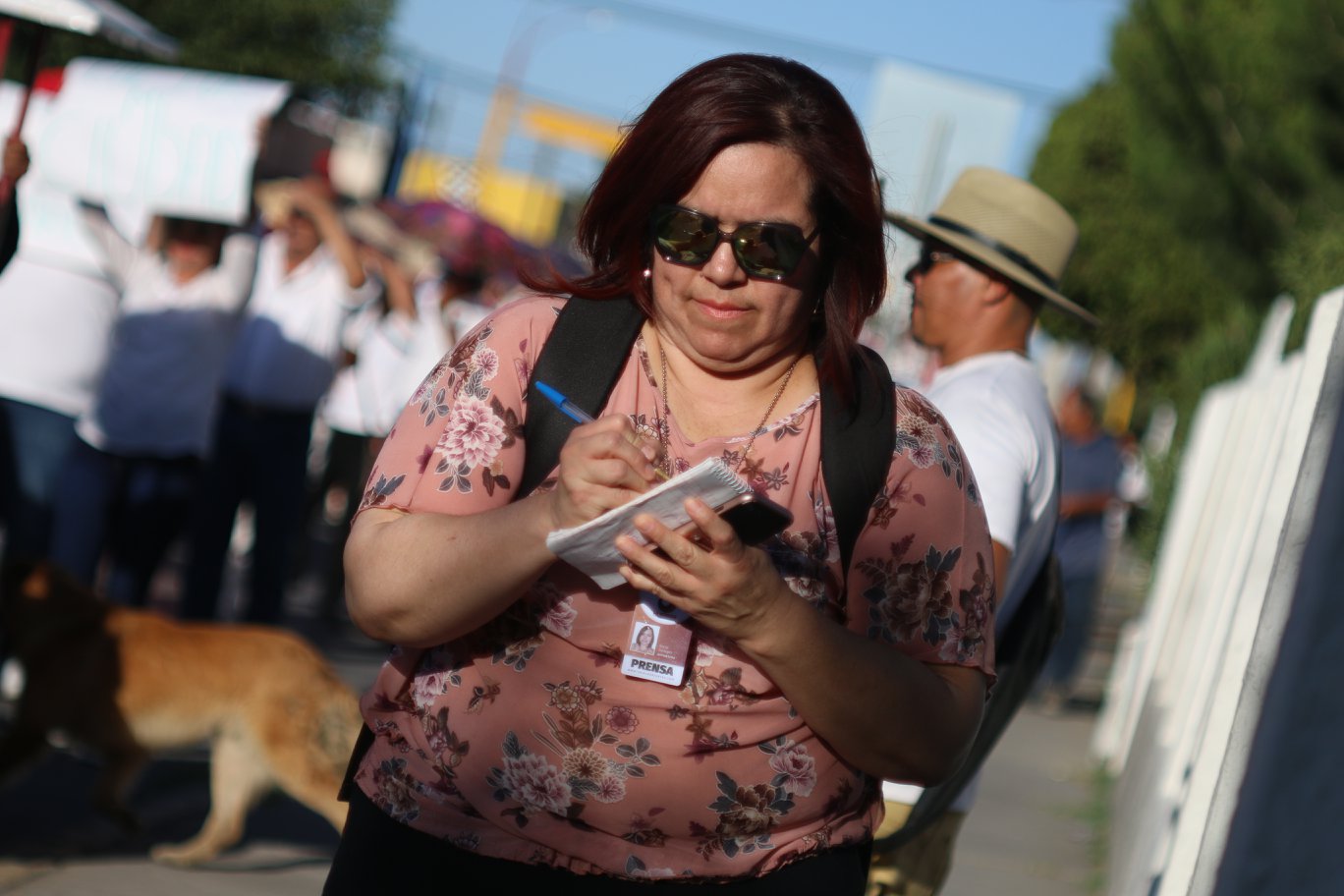
Gallegos reporting — she says reporters in the region face multiple challenges, from security and safety issues related to the organized crime gangs in the area, to poverty and issues related to migration. Image: Courtesy of the reporter
RG: On this side of the border, in Chihuahua, all forms of violence converge: drugs, weapons, human trafficking… It is a territory being fought over by multiple organized crime groups. Added to this are very complex social phenomena ranging from the social impact of poverty to migration. These elements make it more difficult to practice local and independent journalism in Mexico, and journalistic work on the border is very arduous because we are under constant risk and threat.
This is also a precarious time for the media industry; we see how major media outlets are cutting jobs. This creates information deserts that have serious consequences for the social and democratic life of a country, because journalism is increasingly at risk.
GIJN: What’s your best advice for an interview?
RG: You need to prepare — especially when it’s a planned interview — observe, and understand the person you’re going to interview or the topic you’re going to discuss. Something very important is that during the interview, journalists should listen closely, and observe. Often, we focus on the list of questions and forget to look and listen. We mustn’t lose the ability to listen and, above all, to observe, because many times the answers are found more in the movements and behavior of the interviewee than in what they say.
GIJN: What is your favorite reporting tool, database, or application that you use in your research?
Currently my favorite tool is Google Pinpoint, which I know as an audio and video transcription tool. It turns out that during the investigation into the fire at the immigration detention center, we faced the challenge of finding and reviewing all the material we had obtained, in order to identify files and reconstruct the story. But how to review more than 20,000 pages and over 240 hours of footage? This tool uses artificial intelligence to analyze collections of documents and extract structured data from the files, enabling searches and data verification.
GIJN: What is the best advice you have received in your career and what advice would you give to an aspiring investigative journalist?
RG: Someone once told me that a journalist’s loyalty isn’t to the source or the victim, but to their audience, the public. That resonated with me, it put things into perspective. It doesn’t mean you don’t respect your source or your victim, but while there are commitments or agreements when negotiating access to certain information, loyalty to the audience must be even greater.
For journalists starting out, my advice is to honor your commitments and know your own limitations: in terms of resources, time, and available tools. In investigative journalism, especially collaborative journalism, if there’s no trust, there’s nothing. This is even more true now, in times when trust is so easily lost.
GIJN: Which journalist do you admire and why?
RG: Marcela Turati. She is a Mexican journalist who has dedicated herself to investigating human rights violations, covering the social impact of the war on drugs in Mexico, and the disappearance of people. She has also dedicated herself to training and supporting journalists through a network, and I have been part of those training sessions and that network of journalists.
I also admire my colleagues with whom I co-founded the Juárez Journalists Network: Gabriela Minjáres, Luz del Carmen Sosa, Araly Castañon, and Sandra Rodríguez, because they are journalists who, in the midst of the war on drugs, began to promote the professionalization of journalists through collaboration, strengthened the profession through solidarity, and encouraged other colleagues through their journalistic work. I truly admire them.
GIJN: How did the decision to found the Juárez Journalists Network come about?
RG: In 2011, we were in the midst of the so-called “war on drugs.” The city was facing unprecedented violence, and we didn’t want to stop reporting. It was difficult to go out, so what we did was create a safe space to train, protect ourselves, strengthen ourselves, and continue doing journalism. We gave training sessions — journalists training journalists. We sought out colleagues from other regions to help us learn how to deal with this situation, how to interview a victim, how to track public funds in the midst of this war, how to narrate those crime scenes, how to capture the social impact and not just focus on the graphic details of what was happening in the streets. The objective was achieved because we journalists never stopped reporting.
GIJN: What is the biggest mistake you have made and what lessons did you learn?
RG: I accidentally shared a story proposal in a chat room with over 200 people, many of them government officials, lawyers, and people working with profiles relevant to the investigation I was about to work on. I didn’t realize it until someone told me that a certain person wanted to talk to me… “about this information you’re researching.” I was so stressed! My first thought was: “They’ve tapped my phone.” I started to distrust my colleagues at a training workshop. I called one of them and said, “Hey, this happened. Are they monitoring me?” I already felt very insecure. What I did was breathe and ask the person who contacted me: “How did you find out about this investigation?” They told me: “You just shared it in that group.” So it was something very embarrassing because I wasn’t focused, because I didn’t follow the digital security recommendations, and the lessons are very clear.
One of the lessons I learned is that you always have to follow protocols and safety measures that are there for our protection.
GIJN: What aspects of investigative journalism do you find frustrating or hope will change in the future?
RG: One of the most frustrating things about investigative journalism is that you don’t get the immediate impact you expect. Often you conduct an investigation that exposes acts of corruption with solid evidence, and nothing happens… but we mustn’t forget that we don’t administer justice, and the work we do is crucial because we document key moments that can be used in the future, perhaps not as soon as we’d like.
One of the great things journalism does, or should do, is that as journalists, in one way or another, we drive change through our work. There may not be an immediate impact when we publish, but there are consequences.
In the investigation of the immigration detention center, we succeeded in getting rid of the padlocks on doors; migrants will no longer be locked up, and a series of civil protection measures will be implemented in the detention centers. Perhaps there is still no justice for these victims, because the case has not yet gone to trial, but these are changes that are being achieved, steps that will be taken.
 Lucero Hernández García is a freelance journalist and digital consultant from Mexico, and a GIJN collaborator. She has a master’s degree in communication and digital media, with a specialty in multimedia production. She runs workshops and teaches data, visualization, digital tools, and online journalism to university students. Her work has been published by IJNet, and she has received scholarships from Cosecha Roja, Sembramedia, and the Thomson Reuters Foundation.
10 Tips for Founding a Successful Investigative Startup

Investigating in Audio: Nine Standout Podcasts from Latin America
Under Attack: El Faro’s Gutsy Reporting in Latin America
Building Memory, Documenting the Truth: The Case of Nicaragua’s Confidencial

How an Investigative Hub Trained a Generation of Reporters in the US-Mexico Border Region
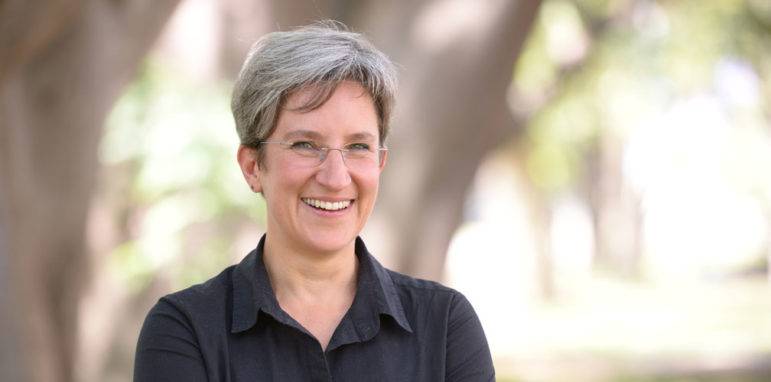
How Quinto Elemento Trains Mexico’s New Generation of Muckrakers
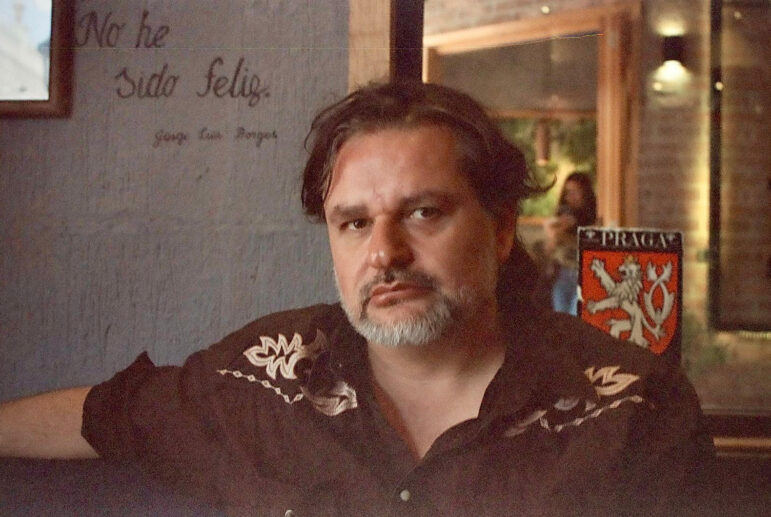
Investigating Mexico: An Interview with the Reporter, Writer, and Film-Maker Diego Enrique Osorno
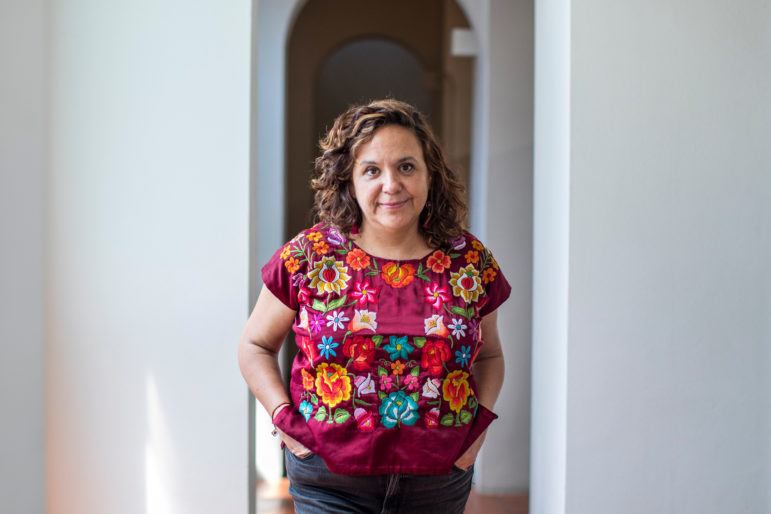
Marcela Turati on a Career Spent Investigating Mexico’s Crisis of Missing People

This work is licensed under a Creative Commons Attribution-NoDerivatives 4.0 International License
Republish our articles for free, online or in print, under a Creative Commons license.
Republish this article
This work is licensed under a Creative Commons Attribution-NoDerivatives 4.0 International License
Read Next
How They Did It Teaching & Training
How an Investigative Hub Trained a Generation of Reporters in the US-Mexico Border Region
The Mexico Border Investigative Reporting Hub helped new muckrakers shine a light on corruption and human rights issues.
Member Profiles
How Quinto Elemento Trains Mexico’s New Generation of Muckrakers
Alejandra Xanic, general editor of Quinto Elemento Lab and Pulitzer Prize-winning investigative journalist, tells how they created the nonprofit journalistic laboratory that is changing the way investigative journalism is produced in Mexico.
News & Analysis
Investigating Mexico: An Interview with the Reporter, Writer, and Film-Maker Diego Enrique Osorno
From covering drug cartels to investigating how corruption links to tragedy, the award-winning reporter has made chronicling modern day Mexico his beat.
News & Analysis
Marcela Turati on a Career Spent Investigating Mexico’s Crisis of Missing People
Journalist Marcela Turati has spent years investigating who is responsible for the thousands of people who have gone missing in Mexico. She spoke to Revista 5W magazine about her work, the dangers of investigating corruption in the country, and why it is so difficult to try and track down who is behind violent crimes against journalists and migrants.