
Image: GIJN
Elections Under Attack, Shadow Aircraft Fleet, National Park Land Grabs: 2025’s Best Investigative Stories from Sub-Saharan Africa
In many African countries, perpetrators of crime or illegal activities bank on being able to act with impunity, emboldened by the perception that the communities affected, advocacy groups, or even governments lack the capacity to hold them accountable once an allegation or scandal has faded from media headlines and public attention.
However, in 2025, investigative journalists across Africa have been able to consistently keep reporting on illegal activities — and their impact — long after the fact, and despite attempts to bury any information.
To show the geographic breadth of investigative work across sub-Saharan Africa, no country is represented by more than one story for our Editor’s Picks; the list also represents a range of topics, methods, and tools.
This means that many excellent investigations — for example, into water contamination in Nigeria, a timber trafficking heist in Liberia, deaths, corruption, and cover-ups at a Zimbabwean mine, UK-based immigration scammers exploiting migrants from African countries, and asbestos waste in Eswatini — featured in our monthly GIJN Africa newsletter don’t appear on this list. This also applies to standout stories produced by foreign journalists or published in foreign outlets — such as investigations into useless snake bite anti-venoms, a president’s wife’s real estate purchases, Ghana’s toxic gold rush, the role of Western mercenaries in the Democratic Republic of Congo (DRC), and post-election killings in Tanzania.
Below are our picks for the best investigative reports from journalists based in or covering sub-Saharan Africa in 2025.
Ghana — Inside a National Service Corruption Scandal
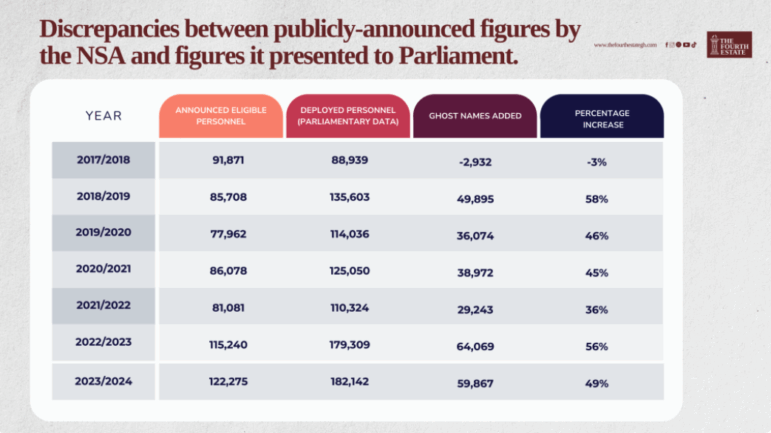
Image: Screenshot, The Fourth Estate
The Fourth Estate reporters Seth Bokpe and Kwaku Krobea Asante did a months-long investigation into systemic payroll fraud involving Ghana’s National Service Scheme, which places skilled young workers in tertiary education into development work in the public and private sectors.
In 2022, the National Service Authority (NSA), the agency that runs the service scheme, claimed it had saved the country 112 million Ghanaian cedi (US$10.5 million) by setting up a digitalization process involving an app for checking ID and identifying fraudulent applications. The reporting exposed that this digital system had instead been co-opted to “facilitate one of the country’s most brazen financial scams” — in which fake identities, such as nonexistent individuals and 90-year-olds purporting to be recent graduates, received regular national service stipends pocketed by NSA officials.
The investigation had a wide-reaching impact. It triggered a reform process at the NSA, according to the Media Foundation for West Africa, The Fourth Estate’s parent organization. In addition, Ghana’s attorney general and minister of justice praised the investigation, and disclosed that 12 NSA officials were set to be formally charged. The government also suspended the national service digital system. In October, two former NSA leaders were charged in a 653 million cedi (US$61 million) corruption case — both pleaded “not guilty” in court.
Kenya — Battling the Teacher and the System
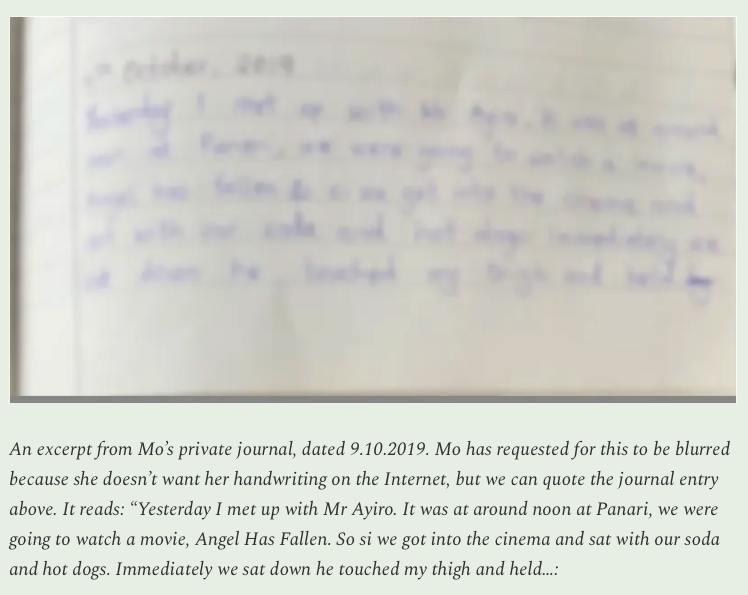
Image: Screenshot, Africa Uncensored
For Africa Uncensored, journalist Christine Mungai spent years revisiting and documenting incidents and patterns of sexual misconduct against female students — including Mungai — by a long-serving male teacher at Alliance High School just outside Nairobi, one of Kenya’s most prestigious schools.
In part one of her investigation, Mungai presented more than 60,000 words of testimony from staff, teachers, and victims to show how the teacher, who also became head patron of the school’s Christian Union, charmed students and wielded his influence in the school. Part two included text messages, correspondence, diary logs, and witness accounts that revealed how he groomed, manipulated, and coerced his targets.
The teacher, who denies all allegations, unsuccessfully attempted to obtain a court injunction to prevent the story from being published. Once the story broke, some of the school’s former students came forward and called for a thorough investigation into the teacher’s 26 years at the school. Kenya’s principal education secretary called for the teacher’s dismissal and arrest. Subsequently, the Teachers’ Service Commission (TSC), an independent body, suspended the teacher and initiated a formal investigation. However, he resigned before the investigation was completed, stating in his resignation letter that the accusations leveled against him were false.
Nigeria — Democracy Deferred
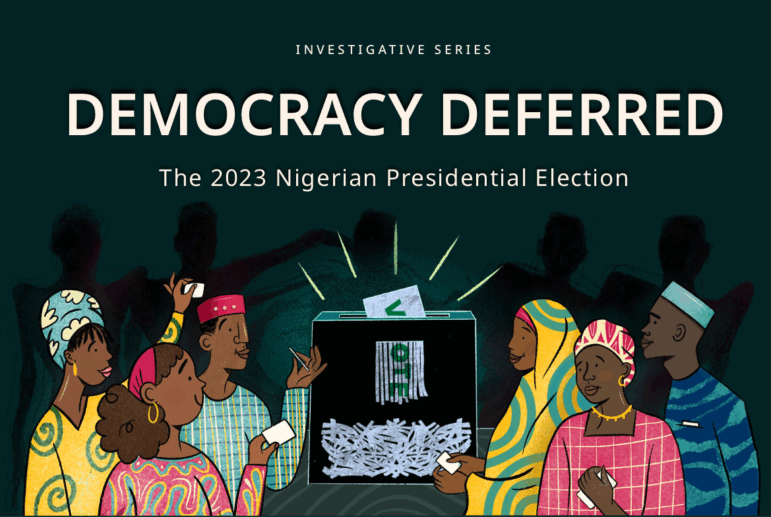
Image: Screenshot, Veza News
This investigative series by the Center for Collaborative Investigative Journalism (CCIJ) — with freelancers and journalists from Nigerian partner newsrooms, including Daily Trust, Wikitimes, and The Cable — raised questions that cast doubt on the legitimacy of Nigeria’s presidential election in February 2023.
Stories included scrutiny of the assault on facts during campaigns, removing the veil on an election dubbed “peaceful” to reveal patterns of violence, exposing toothless electoral laws, analyses of the promises broken by the Independent National Electoral Commission, and a deep dive into Nigeria’s 2023 election data, among others.
From its investigations into Nigeria’s election, CCIJ developed election reporting resources and tools such as the ElectionWatch AI tool, a reporter’s guide for investigating elections, a Fortnite-based multiplayer narrative game called Data Vault, and Shield Your Vote, an augmented reality game designed to promote election integrity and combat misinformation. The series earned CCIJ the Best Investigative Journalism Award (small division) at the 2025 Institute of Nonprofit News Awards.
Uganda — Death in Dubai
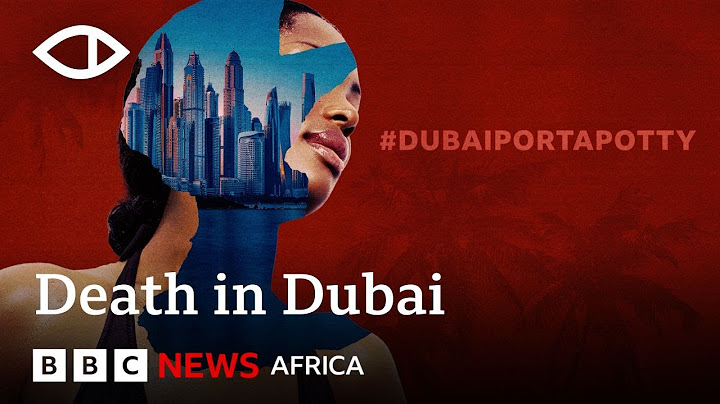
Image: Screenshot, BBC Africa Eye, YouTube
This remarkable BBC Africa Eye investigation by Runako Celina brought to public attention evidence that confirmed rumors circulating for years on social media platforms about sex trade rings in Dubai that exploit vulnerable young women from Africa and pay them to perform “degrading” acts.
Acting on a tip about two young Ugandan women that died falling from high-rise apartments in Dubai, who were allegedly linked to Charles “Abbey” Mwesigwa — identified by the BBC as the alleged boss behind a Dubai prostitution ring — Runako embarked on a transcontinental investigation, using open source intelligence, undercover research, and information from sources. She reported from the victims’ home in Uganda; the team also tracked down Mwesigwa’s base in a Dubai suburb — where a reporter posed as an event organizer trying to procure women for high-end parties. Mwesigwa told the reporter he could provide women at a starting price of US$1,000. Mwesigwa added that many of the women can do “pretty much everything” clients want them to.
When the BBC asked Mwesigwa to respond to the allegations, he denied running a prostitution ring, claiming that he helps women find accommodation through landlords. The story sparked a parliamentary inquiry and a Ugandan police investigation, aided by Interpol. On September 26, 2025, the BBC reported that UAE authorities had arrested Mwesigwa.
Lesotho — Wounded in Combat, Shortchanged at Home
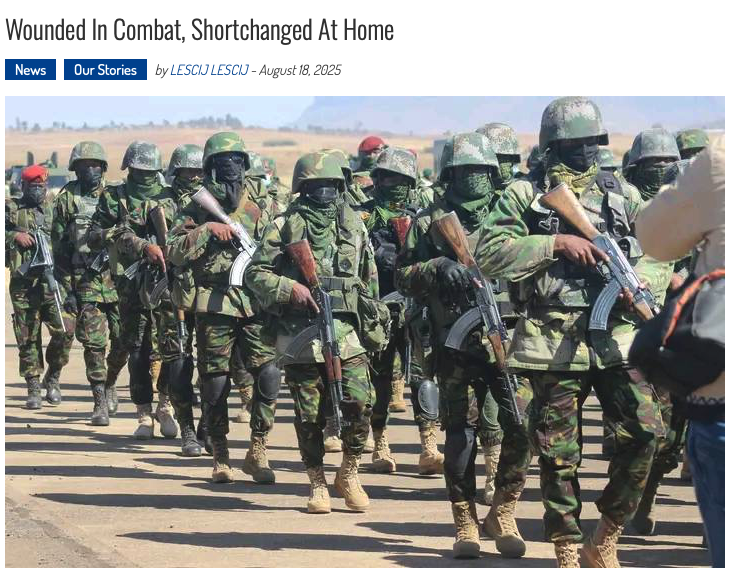
Image: Screenshot, LESCIJ
An investigation by Billy Ntaote, founder of the MNN Centre for Investigative Journalism, revealed that soldiers of the Lesotho Defense Force have yet to receive due injury compensation after being wounded during a 2021 deployment in Mozambique, where they were sent on a South African Development (SADC) mission to quash an Islamic insurgency in Cabo Delgado province.
During the two-year mission, Lesotho deployed 300 troops in three contingents. Twenty soldiers were wounded and claimed they were not offered their full compensation as set out in bilateral agreements signed ahead of the mission and standard operating procedures. Soldiers who spoke on condition of anonymity said that they received contradictory information from the military on how injuries were assessed and also on what threshold was used to calculate the payments made. The soldiers received some compensation, but claim they were “short changed.” The Lesotho government confirms that they paid all the soldiers US$6,100 as compensation for mission completion, but the soldiers claim this number was less than they were owed according to the status of forces agreement.
Documents obtained by the reporter set out how payment should have been calculated for specific injuries, and they confirm that the soldiers should have been paid more. When Ntaote secured an interview with military leadership and asked them about the threshold used to calculate payment, they said that all 20 soldiers had been sent — the day before the scheduled interview — for more medical assessments.
Burundi — The Price of Trading a National Park for a Cash Crop
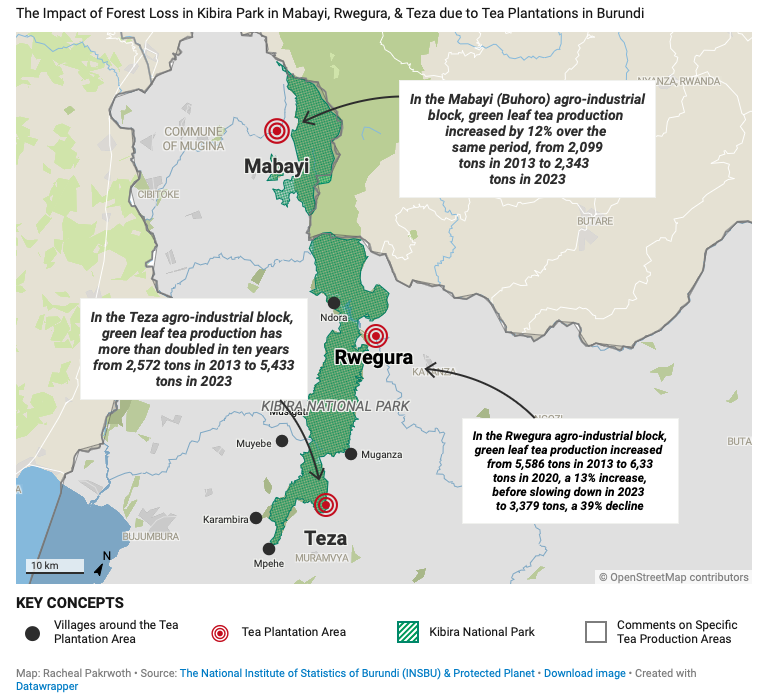
Image: Screenshot, InfoNile
For this four-part investigative series published by InfoNile, Burundian journalist Arthur Bizimana used field reports, interviews, statistical data, satellite images, and scientific studies to show how the expansion of tea plantations have encroached into large expanses of Burundi’s Kibira National Park.
Part one revealed how the national park has lost more than half of its 90,000 hectares (223,000 acres) to three agro-industrial tea blocks, while the boundaries of the park and the tea plantations remain unclear, meaning the park could lose even more land to tea growing. Part two identified the government institutions and local communities behind the illegal grab of Kibira National Park land and the increasing threats to the park — including mineral extraction and plans to build a hydroelectric dam. Part three looked into the impact of human activity on the park, including the decline in numbers and migration of wild animals such as chimpanzees, gorillas, and warthogs. Part four showed how the accelerated drying of water resources in Kibira from deforestation has robbed the population in the park of two watersheds and, by extension, neighboring countries, because Kibira is considered the “water tower” for the Congo and Nile River basins.
Zimbabwe/Mozambique — How to Rig Your Neighbor’s Election
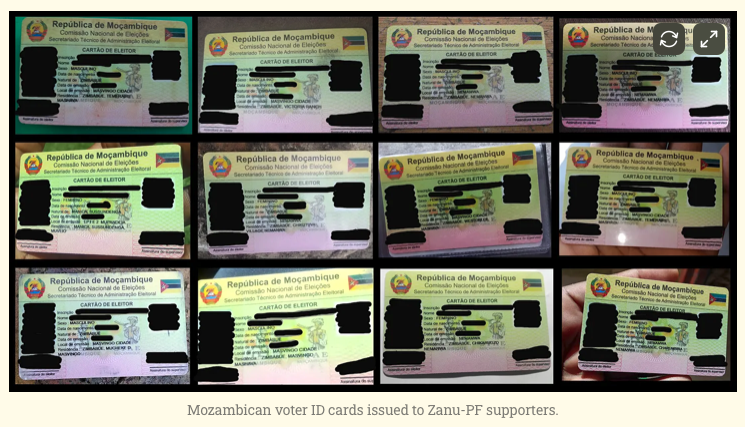
Image: Screenshot, The Continent
What started as a few rumors about Zimbabwe’s ruling party recruiting voters to cast ballots in neighboring Mozambique’s general election in October 2024 spun into a front-page scoop for the pan-African digital newspaper The Continent, which is designed to be read and shared on WhatsApp — a way to get around censorship.
In this investigation produced by the Southern Africa Accountability Journalism Project (SA | AJP) of the Henry Nxumalo Foundation, reporters Walter Marwizi and Garikai Mafirakureva of the Masvingo Mirror, which covers Zimbabwe’s southeastern province of Masvingo, followed a tip-off from a trusted source. This person had told them to visit a voter registration office in nearby Nemanwa, so they went undercover to investigate claims that the ruling Zimbabwe African National Union- Patriotic Front (ZANU–PF) party was providing fake IDs and registering Zimbabwean citizens to vote for its close political ally, the incumbent Mozambique Liberation Front (FRELIMO). The two journalists reported that they were able to vote on election day; they also interviewed more than 20 locals, many of whom also confirmed that they participated in Mozambique’s election. In response, ZANU-PF’s director of information publicly denied the allegations.
FRELIMO won the election, but the result was heavily contested. According to Human Rights Watch and other international advocacy groups, in the resulting unrest, the military killed at least 300 people, more than 3,000 others were injured, and more than 4,200 protesters were arrested.
Malawi — The Shadow Fleet Using a Borrowed Aircraft Registry
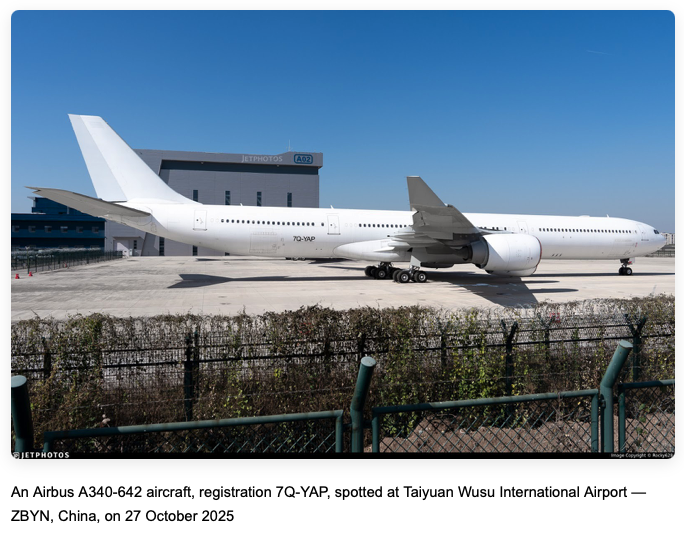
Image: Screenshot, PIJ Malawi
“Malawi is quietly becoming a peculiar kind of global aviation outpost, a nation whose skies are empty, but whose aircraft registry is booming with planes no one in the country has ever seen,” wrote Jack McBrams for the Platform for Investigative Journalism in Malawi. McBrams revealed how Malawi’s “7Q” aircraft tailcode prefix has become a “flag of convenience” — a maritime term for ships that are registered to a country other than their own — for foreign operators around the world to circumvent aviation regulations, and how Malawian tail numbers, including some operating in war zones and others facing sanctions, have never set foot in Malawi. Using open source methods and other techniques, McBrams makes the following findings:
- Four ex-Thai Airways Airbus A340-600s, now bearing Malawi registration, are linked to a suspected sanctions-evasion network tied to Iran’s Mahan Air.
- A Malawian-registered de Havilland Buffalo crashed in South Sudan in 2024, killing civilians — the aircraft was never inspected in Malawi.
- Malawi’s weak oversight — including long periods without a functioning Civil Aviation Authority Board — has created loopholes that foreign companies exploit.
- In Germany, skydiving aircraft carry Malawian registration to bypass stricter EU regulations. (Representatives of the German aviation firm defended their operations in Malawi and denied that the planes were part of a shadow network.)
The investigation exposed grave aviation governance failures in Malawi, revealed oversight shortcomings that threaten international aviation safety, and showed that opaque operators using Malawi’s tail numbers were opening doors to illicit activities, including potential sanctions-busting.
 Benon Herbert Oluka, GIJN’s Africa editor, is a Ugandan multimedia journalist. Benon was a mentor for the 2023/2024 African Union Media Fellowship cohort. His work has been recognized three times on the African continent as the winner of the 2008 Akintola Fatoyinbo Africa Education Journalism Award (First Prize, English category), the 2011 CNN-MultiChoice African Journalist of the Year Award (Tourism category) and the Thomson Reuters’ 2011 Niall FitzGerald Prize for Young African Journalists.
CENOZO, the Organization Shoring Up Watchdog Reporting in West Africa
Guide to Investigating Organized Crime in Africa: Chapter 8 — Kleptocracies

Introduction to Investigative Journalism

Investigating War Crimes: Collecting and Archiving Evidence and Information

Rewriting the Rules of Digital Verification: How African Investigative Journalists Are Building New Data Models
After 21 Years, AIJC Signs Off from South Africa in Style. Next Stop: Kenya

Exposing Extremism Networks in Sub-Saharan Africa Using Open Source Tools
From the Pitch Stage to the Write Up, the Line Edit to Publication: How Editors Can Help Investigative Stories

This work is licensed under a Creative Commons Attribution-NoDerivatives 4.0 International License
Republish our articles for free, online or in print, under a Creative Commons license.
Republish this article
This work is licensed under a Creative Commons Attribution-NoDerivatives 4.0 International License
Read Next
Data Journalism
Rewriting the Rules of Digital Verification: How African Investigative Journalists Are Building New Data Models
The global nonprofit WITNESS seeks to address one of the biggest data gaps in the digital verification landscape: the dependence on tools-based methods that lack local knowledge.
News & Analysis
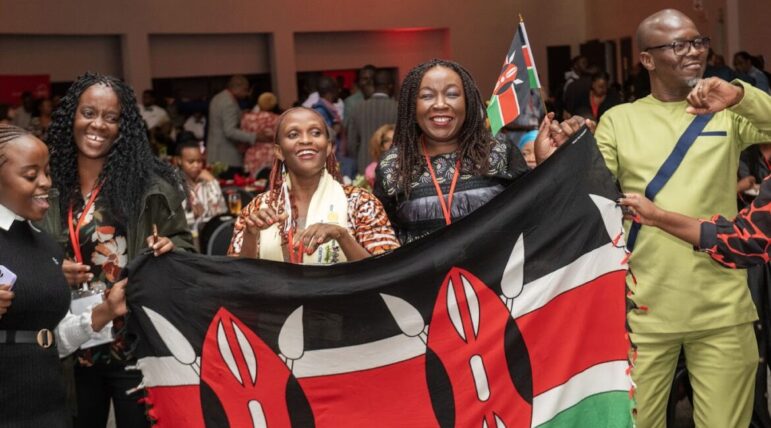
After 21 Years, AIJC Signs Off from South Africa in Style. Next Stop: Kenya
More than 455 attendees representing 45 countries, 37 of them in Africa, attended Africa’s premier investigative journalism conference at Wits University.
How They Did It
Exposing Extremism Networks in Sub-Saharan Africa Using Open Source Tools
As extremism spreads across sub-Saharan Africa, journalists are turning to open source tools to track the networks and physical movement of these often violent groups.
From the Pitch Stage to the Write Up, the Line Edit to Publication: How Editors Can Help Investigative Stories
An editor can play a pivotal role in making or breaking a story’s impact. From narrowing complex stories to ensuring accuracy, great editing turns strong reporting into powerful journalism.