
Tag
AI
95 posts
Global Academy Trainings
Uncovering AI’s Human Cost: A Non-Technical Toolkit for Investigative Reporters
Holding AI systems accountable can seem overwhelming due to the complexity of the technology. But not all investigations into AI require a high level of technical ability.

Global Academy Fee-Based Courses
AI Without the Guesswork: Smarter Journalism Without Prompting and Hallucinations
Back by popular demand, this full-day session with investigative trainer Henk van Ess teaches how to use AI for source discovery and data analysis, stop hallucinations, and prompt more effectively.
Global Academy Trainings
Del caos a la claridad: Automatización de prompts para grandes conjuntos de datos
Este taller ofrece una introducción práctica y dinámica al uso de la inteligencia artificial aplicada al periodismo de investigación, con un enfoque en potenciar el trabajo con información a gran escala.
Global Academy Trainings
Introduction to AI for Data-Driven Investigations
This digital training workshop offers a practical introduction to using AI for investigative journalism, focusing on real-world applications like extracting structure from text, cleaning data, and verifying findings.
Global Academy Trainings
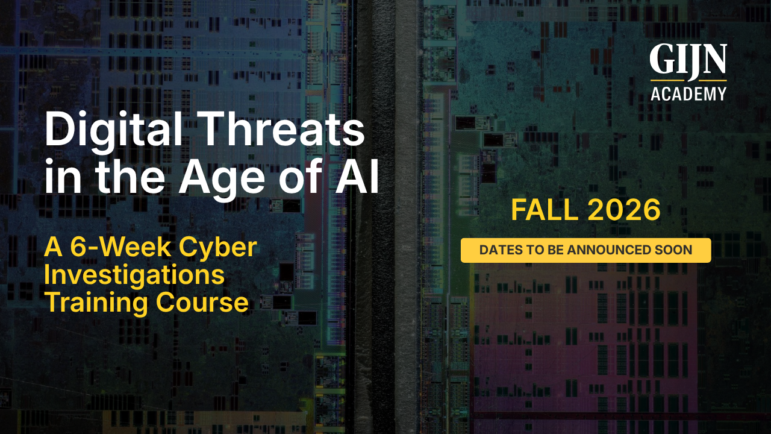
Digital Threats in the Age of AI: Free Cyber Investigations Training Course in Fall 2026
For the fifth time, GIJN is partnering with renowned journalist Craig Silverman and other cutting-edge experts to offer a free, cyber investigations training program tailored for investigative reporters.

Global Academy Fee-Based Courses
SOLD OUT: AI Without the Guesswork: Smarter Journalism Without Prompting and Hallucinations
In this full-day session, investigative trainer Henk van Ess will teach journalists how to use AI for source discovery and data analysis, stop hallucinations, and prompt effectively without memorizing a single template.

Investigating AI-Generated and Manipulated Images
Craig Silverman

Data Journalism
How the Hindu Is Embedding AI Into Its Data Journalism
LLMs are quietly reshaping data journalism workflows at The Hindu, helping reporters process vast document sets, write scripts and build interactive tools.

Resource Guide
Tech Focus Project
There is a central tension facing investigative journalists: the “AI and tech paradox.” Explore our report on the most urgent technology-related challenges facing investigative journalism today.