
Image: GIJN
‘Investigative Journalism Goes Beyond Numbers:’ Reporting on Health and the Environment in Côte d’Ivoire
Read this article in
Marthe Akissi Kra is a familiar voice on Côte d’Ivoire’s public broadcaster Radiodiffusion Télévision Ivoirienne (RTI), where she reports on environmental conservation, sustainable development, health, and community affairs in the West African country.
She spends much of her time in the field reporting on the effects of climate change in Côte d’Ivoire and for Ivorians, such as the pressures facing protected areas — gold mining, population growth, the loss of its rainforests, poaching — and the environmental and health implications for local communities on the frontlines.
Kra has won several regional and international awards for her work, including the Media for Science and Development Award’s Super Prize for science journalism (Cote d’Ivoire), the second Norbert Zongo African Investigative Journalism Prize (PAJI-NZ) in the radio category, and the 2022 Prix Eco-Reportages du club de la presse Drôme-Ardèche (France). She was also recently selected Country Coordinator for the Network of Science Journalists for Francophone Africa (RSAF-Côte d’Ivoire).
She notes that a crucial element in her reporting is translating complex scientific and ecological data into accessible stories that connect global environmental issues to her local listeners: “Investigative journalism goes beyond numbers; it connects public policies with the realities experienced by communities,” she tells GIJN.
In addition, Kra also talked about the challenges of investigative reporting in her country, how she stays “curious, patient, and rigorous,” and the importance of dancing.
GIJN: Of all the investigations you have conducted, which is your favorite and why?
Marthe Akissi Kra: My investigation, “Or trouble: les dessous de l’extraction en Côte d’Ivoire” (Troubled Gold: The Hidden Side of Gold Mining in Côte d’Ivoire) is the one that has had the greatest impact on me. For two years, I analyzed data, examined official documents, and gathered testimonies to understand how gold mining revenues were managed. This investigation taught me that investigative journalism goes beyond numbers; it connects public policies with the realities experienced by communities. It reflects the way I work: patience, rigor, verification, and commitment to the public interest.
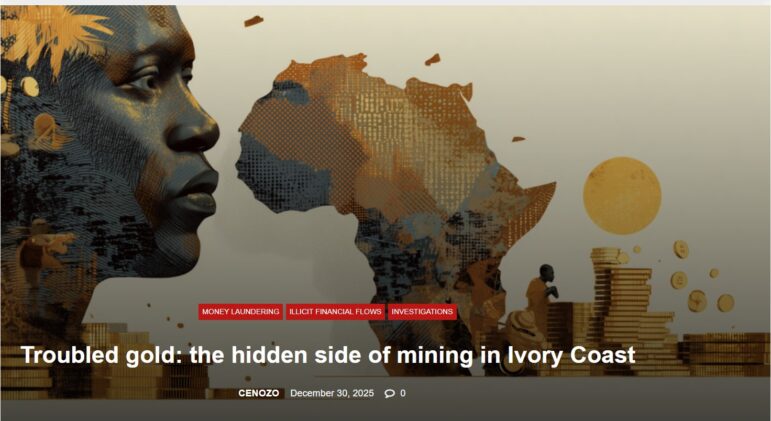
Marthe Akissi Kra’s investigation: Troubled Gold: The Hidden Side of Gold Mining in Côte d’Ivoire. Image: Screenshot, CENOZO
GIJN: What are the biggest challenges facing investigative journalism in your country or region?
MAK: The biggest challenge is access to public information. Although Côte d’Ivoire has an institution responsible for guaranteeing the right to access information of public interest, journalists still face major difficulties obtaining complete documents within a reasonable timeframe. Requests often remain unanswered, information is incomplete and newsrooms have limited resources. Another challenge is being a female investigative journalist. Investigating corruption, extractive industries, and governance are still viewed as “male work.” Rather than discouraging me, these experiences have strengthened my determination to prove that rigor, courage and perseverance are not defined by gender.
GIJN: What has been your greatest personal challenge as an investigative journalist?
MAK: My greatest challenge has been continuing investigations despite numerous obstacles. During my investigation into the mining sector, official data were altered while I was analyzing them. I had to redo part of my analysis and verify all the information again. After publication, the investigation was removed from my public broadcaster’s website following approaches made to management. This experience reinforced my conviction that a journalist’s best protection is the strength of the evidence.
GIJN: What is your best advice for conducting interviews?
MAK: Prepare thoroughly, but above all, know how to listen. The most important answers often come after the prepared questions. When a source feels heard and respected, they sometimes reveal information they had not initially intended to share.
GIJN: What is your favorite reporting tool, database or app?
MAK: I rely heavily on Microsoft Excel to organize and analyze data. I also use reports from the Extractive Industries Transparency Initiative (EITI), corporate reports, official documents and public databases. However, no tool can replace the systematic cross-checking of sources.
GIJN: What is the best advice you have received, and what advice would you give to a young journalist?
MAK: The best advice I have received is to always let the facts guide the investigation, never personal beliefs. I would tell any aspiring investigative journalist to be curious, patient, and rigorous. Accept that some investigations take months or even years. Above all, never publish information that you cannot prove. A journalist’s credibility is built on the quality of their verification.
GIJN: Which journalist do you admire, and why?
MAK: I admire Mark Hunter, whom I have had the privilege of meeting twice: first at the Global Investigative Journalism Conference (GIJC) in Gothenburg, and later at the Centre for Investigative Journalism (CIJ) in London. I admire his vision of investigative journalism, grounded in methodology, rigor, and evidence. Those exchanges strengthened my conviction that a strong investigation is built above all on an impeccable methodology.
GIJN: What is the biggest mistake you have made, and what did you learn from it?
MAK: Early in my career, some colleagues advised me not to pursue investigative journalism, arguing that it was too dangerous for a young woman. Their comments led me to give up a journalism training fellowship that I had been awarded. Looking back, however, that experience became a source of motivation. The investigations I later carried out, and the awards they received, strengthened my conviction that investigative journalism is defined by integrity, courage and rigorous reporting; not by gender.
GIJN: How do you avoid burnout in such a demanding profession?
MAK: I take time to reconnect with my family, dancing, and the people who remind me why I do this work. After a demanding investigation, I make time to rest. It allows me to return to the field with renewed clarity and energy.
GIJN: What frustrates you about investigative journalism, and what do you hope will change?
MAK: What frustrates me most is seeing excellent investigations by African journalists have little real impact after publication. Too often, they lead neither to reforms nor to official investigations or meaningful public debate. I hope that the media, institutions, and citizens will pay greater attention to these revelations so that they contribute to greater transparency, accountability and lasting change.
 Aïssatou Fofana is an Ivorian journalist and media entrepreneur based in Côte d’Ivoire. Communication specialist, and blogger for over a decade with a background in environmental journalism, she co-founded L’écologiste, an online media set to amplify environmental information. She is also an alumni of the African Union Media Fellowship.
International Research Guide: How to Find Experts and Hidden Documents on Any Topic

Guide to Investigating Tech and AI in Modern Warfare
Turning Copernicus Satellite Data Into Public-Interest Climate Stories
10 Practical Tips for Verifying Scientific Claims

Confront Them With the Numbers: This Former Physicist’s Path to Investigative Data Journalism

Exposing Industrial Pollution and Creating the ‘Forever Chemicals’ Beat
What We Learned Building a Chatbot for La Silla Vacía’s Newsroom Archive
Fiquem Sabendo: ‘An Engine for Brazilian Journalism in the Search for Information’

This work is licensed under a Creative Commons Attribution-NoDerivatives 4.0 International License
Republish our articles for free, online or in print, under a Creative Commons license.
Republish this article
This work is licensed under a Creative Commons Attribution-NoDerivatives 4.0 International License
Read Next
10 Questions
Confront Them With the Numbers: This Former Physicist’s Path to Investigative Data Journalism
Anna Behrend is a self-taught data journalist who has found in data-driven reporting and visualization a way to combine her academic background in science with her creative interests.
10 Questions
Exposing Industrial Pollution and Creating the ‘Forever Chemicals’ Beat
In a career spanning more than 20 years, Le Monde reporter Stéphane Horel has brought a creative and, at times, humorous approach to groundbreaking environmental investigations.
Tech & AI
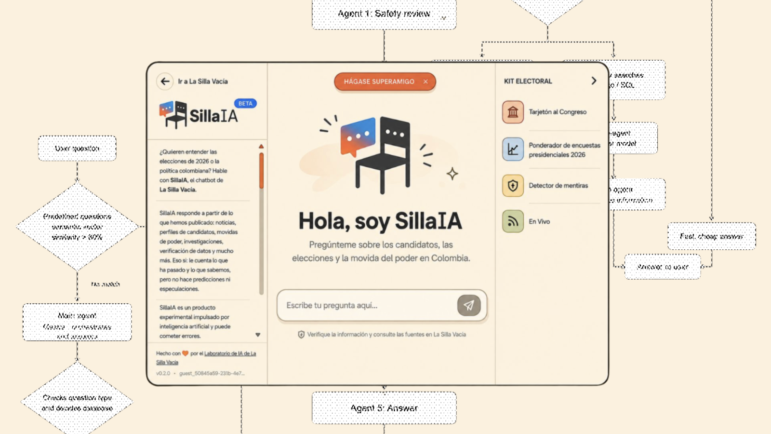
What We Learned Building a Chatbot for La Silla Vacía’s Newsroom Archive
We spent 12 months building an AI tool for our independent news site in Colombia. Here’s what it taught us about running a newsroom in the age of AI.
Member Profiles
Fiquem Sabendo: ‘An Engine for Brazilian Journalism in the Search for Information’
Journalist Léo Arcoverde started a blog in 2015 publishing one story a day based on information obtained through Brazil’s new access-to-information law. The initiative eventually became Fiquem Sabendo.