Accessibility Settings

color options

monochrome muted color dark

reading tools

isolation ruler

Stories

3107 posts

News & Analysis

Reporters Without Borders Releases Press Freedom Index

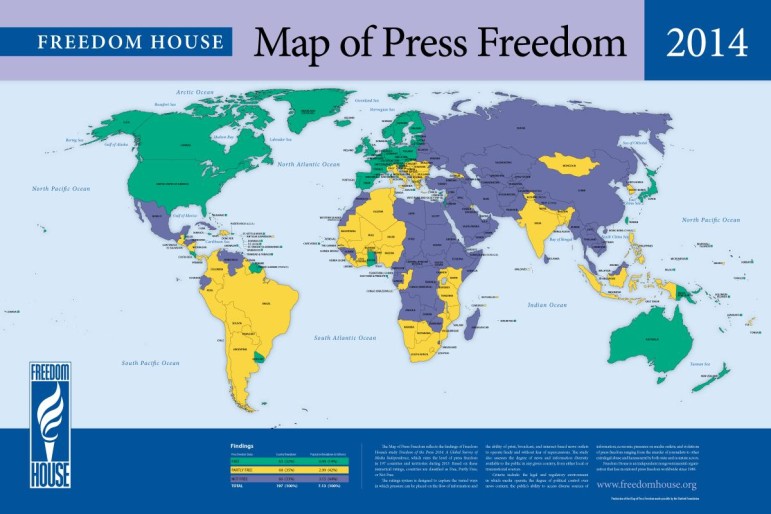
Reporters Without Borders today released its 2014 World Press Freedom Index, spotlighting major declines in media freedom in such varied countries as the United States, Central African Republic, and Guatemala while noting marked improvements in Ecuador, Bolivia, and South Africa. The same trio of Finland, Netherlands, and Norway heads the index again, while Turkmenistan, North Korea and Eritrea continue to be the biggest information black holes, again occupying the last three positions. You can find RSF’s full index and a 3-dimensional map here. The report is also available in several languages other than English.

A Resource Guide to the Millennium Development Goals

IPI has compiled a set of useful resources and contacts for journalists covering topics related to the Millennium Development Goals (MDGs). While certainly not exhaustive, the links below may help point the intrepid reporter in the right direction.

Stories of the Week: A Global Selection of Investigative Reports

Here are some of the best investigative stories of the week, compiled by the Global Investigative Journalism Network (GIJN). Today’s links include stories from Expressen.se, Tehelka, The Sochi Project, the New York Times, CBC, and Foreign Policy.

Reporting Tools & Tips

Holding Big Fish Accountable: How to Uncover Corruption

In a 2011 Transparency International survey, more than 3,000 business executives from around the world were asked to assess the effectiveness of various approaches to weeding out corruption. The result: nearly half (49%) indicated that investigative journalism played a critical role. Respondents from Pakistan (73%) and Brazil (79%), countries where the press reports fiercely on suspected acts of corruption, placed particular faith in the media’s ability to uncover wrongdoing. Why did the participants feel so strongly that journalists can help?

Reporting Tools & Tips

The Art of the Interview

The interview is one of the—if not the—most important tools we as journalists have to obtain information, to expand on information we may have from other sources, and to clarify facts and see things from different perspectives. We use the interview to expand upon the basic “who, what, where, how, when and why” of newsgathering. This is true whatever beat we may be covering: health, economics, politics, or issues having to do with the Millennium Development Goals (MDGs).

Data Journalism

Top Ten #ddj: The Week’s Most Popular Data Journalism Links

What’s the data driven journalism (#ddj) crowd tweeting about? Here are the week’s Top Data Journalism Links on Twitter (for January 30-February 5). This week our links include items from HybLab, the Verification Handbook, and GIJN, among others. Thanks to Marc Smith of Connected Action for gathering the links and graphing them.

News & Analysis

On the Trail: How To Request Information from Authorities

Power sets barriers and the reporter pushes back against them—it’s an unwritten rule on which Colombian writer Gabriel García Márquez believed all journalistic work is based. Some governments, however, have begun to voluntarily lower these barriers by approving legislation designed to make information more accessible to their citizens. To date, approximately 90 countries globally have freedom of information laws, which establish rules and deadlines for facilitating the collection of data.

News & Analysis

Resources: A Guide to Investigative Books and Films

In June 2013, we invited our colleagues in the Global Investigative Journalism Network to name the book-length works of journalism, scholarship, and even fiction that had influenced their practice as investigators. The resultant list isn’t comprehensive – though we invite you to help complete it by sending us your favorites, including full title, authors, publication or broadcast date, a one-line bio to identify yourself so we can give you credit, and two or three lines that explain why you find a given work special. (Let someone else recommend your own stuff, please.)

Methodology Research

Covering the Money behind the Millennium Development Goals

There are the two essential questions a reporter covering business, the economy, or just about any topic should always ask: ‘How much does it cost?’ and ‘Where will you get the money from?’. These simple questions are not only key to gaining information about your current story’s topic, but they offer greater insight into reasons for decisions that have a direct impact on a country and its citizens.

News & Analysis

A Dose of Advice: Tips on Covering Healthcare

In his 1999 book Development as Freedom, renowned economist and Noble laureate Amartya Sen stated that investment in healthcare can lead to success in meeting a wide range of development targets, such as those identified by the Millennium Development Goals (MDGs). Indeed, good healthcare improves quality of life, reduces morbidity and mortality, and raises economic productivity. As such, the World Health Organization (WHO) has recognised the importance of universal health coverage (UHC) and urged its member states to adopt programmes providing essential health packages.

News & Analysis

“Don’t Talk of Hanging” – A Week of Investigative Reporting in Pakistan

How do you cover corruption in Pakistan’s national security agencies? With caution and plenty of guts. Such reporting got investigative journalist Umar Cheema kidnapped, tortured, and nearly killed in 2010, but the founder of the Center for Investigative Reporting in Pakistan hasn’t backed down. Check out the latest from the Islamabad-based Cheema, who this week revealed that elite counter-terrorism officials used a secret agency fund to buy wedding gifts, luxury carpets, and gold jewelry for relatives of ministers and visiting dignitaries.

Methodology Research

Global Is Local, Local Is Global: Tips on Covering the Environment

The environment is the overarching issue of the 21st century for two reasons:
1. The environment includes and touches everything: air, water, food, health, climate, energy, development, poverty, economics—the list could go on without end.
2. Nearly every major environmental indicator is in decline.
We are pushing up against the limits of the Earth’s ability to support us. Climate change, biodiversity loss, and nitrogen pollution are moving toward crisis levels, according to recent studies. There is little public awareness of this reality, which means journalists covering the environment have a plethora of important stories to cover.

Data Journalism

Top 10 #ddj: The Week’s Most Popular Data Journalism Links

What’s the data driven journalism (#ddj) crowd tweeting about? Here are the week’s Top Data Journalism Links on Twitter (for January 23-29). If you click on an image, you’ll be redirected to GIJN’s new Pinterest board, where you can find links to the stories.

This week our links include items from the Global Editors Network, Journalism.co.uk, Askmedia.fr (and GIJN’s own data resource page in Spanish. Thanks to Marc Smith of Connected Action for gathering the links and graphing them.

For Whom Does the Flag Wave? Tips on Covering Gender Equality

Although egalitarian societies with a pattern of matriarchy still exist in Asia, Africa, the Americas, and Oceania, the decline of matriarchal societies in the world has made way for patriarchal domination. Gender discrimination has become rampant. World history is, indeed, “his-story” and not “her-story”. The way we live today is influenced by, and based on, male-derived principles, which bring about male dominance and universal patriarchy. No matter where women live, they do not share equal rights with men. Sensitive and justice-seeking journalists should expose this social malady at every opportunity, so that the lives of women can improve.

Data Journalism

Data Journalism Project Maps Drilling Profits and Aid in Kenya

In Kenya’s poor, dry Turkana region, recent discoveries of water and oil could change the lives of residents who depend on food aid for survival. In March 2012, the country’s President Mwai Kibaki announced that oil had been discovered in Turkana after exploratory drilling by an Anglo-Irish oil firm. And last year, UNESCO announced that large reserves of groundwater had been discovered in the drought-ridden area. How much will the new resources help Kenyans, and how much of the new wealth will flow back to European investors? The answer is complex, but a team of data journalists is working to make it more clear. Land Quest, a cross-border investigative journalism experiment which launched last week in beta, is using data to illuminate the competing financial interests in Kenya. It maps the flow of aid money from Europe to Kenya, and the flow of profits from Kenya back to Europe.

Food for Thought: Tips on Covering Hunger

When stories of a food crisis emerge, it is tempting to ask if the problem stems from the lack of grain. I followed this lead during my early years as a reporter until I read about an event that took place in 1970. That year, the Nobel Peace Prize was awarded to Norman Borlaug. The American agronomist was recognised for his work that combined science and new agriculture techniques to help save millions from hunger. His research—heralding the Green Revolution—paved the way for agriculture built on high-yield outputs.

Investigative Journalism: It’s All About Cross-Border Cooperation

Investigative journalists and other citizens interested in uncovering the organised crime and corruption that affect the lives of billions of people worldwide gain, with each passing day, unprecedented access to information. Huge volumes of information are being made available online by governments and other organisations, and it seems that the much-needed information is in everyone’s grasp. However, corrupt officials in governments and organised crime groups are doing their best to conceal information and to hide their wrongdoings.

Data Journalism

Mapping Data Journalism on Twitter

This intriguing graph depicts a network of 989 Twitter users whose tweets from January 13 to 24 contained the hashtag “#ddj” (data-driven journalism). We’re pleased to see that our site gijn.org was among the top domains and our data journalism resource page among the top URLs that appeared. This work is the brainchild of Marc Smith (@marc_smith), a sociologist of “computer-mediated collective action” who, among his varied activities, maps social media networks that reveal “the key people, groups, and topics discussed in a public conversation.”

“All Readers Now Are Global” — Busting Myths on Int’l Reporting

With two and a half years to go until 2015, the deadline to achieve the Millennium Development Goals (MDGs), progress has been mixed. The spread of some diseases, such as HIV/AIDS, is being brought under control. In China, the proportion of people living on under a dollar a day has been halved. At the same time, though, the number of those living on under a dollar a day in sub-Saharan Africa has dropped by a measly one percent. Why such uneven progress?

News & Analysis

“In Order To Fight a Network, You Need To Create a Network”

Paul Radu of the Organized Crime and Corruption Reporting Project gave an engaging talk at the recent TEDxBucharest gathering, looking at the globalization of crime and how investigation reporters and public-interest hackers can push back. Among the topics he covers: Russian money laundering, European horse meat, and Azerbaijan corruption. Says Radu: “In order to fight a network, you need to create a network.”

News & Analysis

Shining Light Winners Donate Prize Money to Jailed Journalist

Winners of the Global Shining Light Award have donated their US$1000 in prize money to the family of imprisoned Azerbaijani journalist Avaz Zeynalli. The Shining Light Award honors investigative journalism in a developing or transitioning country, done under threat or duress. Zeynalli was editor in chief of the daily newspaper Khural, one of a handful of independent media voices in the repressive, oil-rich nation of Azerbaijan, which lies at the borders of Russia, Iran, and Turkey

Reporting Tools & Tips

People Problems in a Small Media Organization (Part 2)

In People Problems Part 1, we talked about two common kinds of complaints that you as a manager might hear. “I don’t think Karl is showing enough commitment to his work.” “The technical staff is being rude to our salespeople.” Here is a method for developing your colleague’s problem-solving skills, followed by how to apply it in these two cases. If you focus on developing your people, your organization will develop far more rapidly than if you focus on just the num.

Reporting Tools & Tips

People Problems in a Small Media Organization (Part 1)

If you are leading a team in a small media organization, you need to get the best out of your people. Everyone has to be a contributor. This is not just a selfish thing. You get the best out of people by helping them develop their own talents, overcome obstacles and reach their own professional goals.

News & Analysis

Violence, Impunity Take No Holiday for Ukraine Journalists

While most of the Christian West woke up on Christmas morning to messages of peace on earth and goodwill to mankind, events in Ukraine continued down a bloody and almost heathen, medieval path. The physical assaults in the last month on journalists, activists, and demonstrators are too numerous to keep track of without a scorecard and a timeline. But the trend is so clear that even the most witless criminal investigator can see the pattern.