

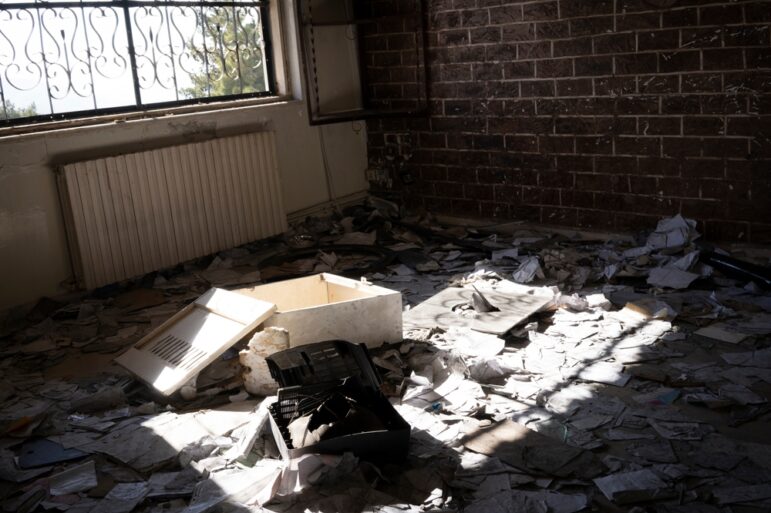
Image: Anas-Mohammed, Shutterstock
Broken After the Story: The Hidden Mental Health Crisis Facing Independent Conflict Reporters Worldwide
Read this article in

During the early days of the Rohingya refugee crisis in Bangladesh in 2017, freelance journalist Redwan Ahmed attended the funeral of a group of refugees who had drowned while trying to cross the Bay of Bengal to safety. Most of the deceased were women and children. At the burial, he spoke to a man who had already lost a son during the violence in Myanmar, and then lost the rest of his family at sea.
He recalls that the man was not crying: ”He simply sat there, nearly expressionless, rehearsing the same details over and over again without knowing whether they would make him seem more like him, or less like him.”
Ahmed had gone to the community to report on the crisis. But the experience remained with him even after his departure. ”There is a kind of accumulation,” he explains. ”Each story, not merely because it remains in the notebook, but because it haunts you. Sometimes it comes back later in your sleep, in your reactions, in how fast you become numb to things that should still shock you.”
Across the world, independent journalists covering conflict and humanitarian crises are often the first to document the human cost of violence, displacement, and political instability. From insurgency-affected communities in Africa to war zones in the Middle East, cartel violence in parts of Latin America, and forced displacement across parts of Asia, freelance reporters are routinely working on the frontlines with little institutional protection.
Although the physical risks confronting independent journalists working in war and conflict settings are well documented, much less has been said about the psychological toll of this kind of reporting. Most independent reporters on this beat lack the support of major newsrooms, and are routinely exposed to potentially traumatic experiences without the support of counseling, insurance, or continued editorial support.
“For freelancers, almost everything is missing: structured support, mental health resources, even basic safety coverage,” Ahmed notes. “And very often, we are too afraid to ask.”
Research has indicated that a high percentage of journalists who report on conflict exhibit the symptoms of post-traumatic stress, depression, and anxiety. Meanwhile, the profession is still physically hazardous, and more than 2,500 journalists and media employees have been killed since 1992, according to the Committee to Protect Journalists. Despite this, mental health is still rarely treated as part of journalist safety, especially for freelancers. In many news environments, there is an expectation that reporters, particularly local ones, will absorb both the physical and emotional risks of the work.
Bruce Shapiro, executive director at the Global Center for Journalism and Trauma, a leading journalism organization whose mission is to address this problem, said that while conversations around mental health in journalism have grown, support systems remain inconsistent and often come too late.
“The culture of journalism is changing to include more conversation about mental health,” he says, referencing efforts by some larger newsrooms to provide training and therapy pathways. But those measures, he added, are still insufficient. “Most newsrooms aren’t offering nearly enough — too often help only comes when a conflict journalist has a full breakdown or goes into a psychological crisis.” For freelancers and journalists working in under-resourced settings, access to meaningful support is even more limited, despite the existence of emergency funds and safety initiatives that many are unaware of.
That resource gap leaves many journalists navigating the emotional impact of their work on their own. Over time, repeated exposure to trauma can shape how they see their subjects, their work, and themselves, sometimes in ways that are difficult to recognize while still in the field.
War, Captivity, and the Long Shadow of Reporting in Iraq
In Baghdad in 2004, Asaad Zalzali joined the ranks of the journalism field, when reporting on Iraq was tantamount to moving about a terrain where violence was never very far away. By 2013, when he had transitioned to investigative reporting, the risks were no longer extraordinary but routine.
Among the moments that still follow him, one came while out on assignment for an investigation when he came across a car bombing in Al-Mansour, Baghdad. He arrived shortly after the blast and bodies were still scattered across the street. He began reporting live while trying to hold himself together.
In a later incident, he was kidnapped by a group of armed individuals while reporting. For hours he thought that he would not leave alive. At some point he even dreamed of writing the news about his death. He was later released, but the experience changed the way he perceived risk in his career.
”Nothing goes by without a trace,” Zalzali recalls. ”Every story, every event I have reported has left a terrible psychological effect upon me. I don’t think any freelance journalist can stay unchanged by this work no matter how strong they may seem.”
For Zalzali, that weight became even more personal during a recent investigation into women victims of so-called “honor” killings. Some of them had sent him their photographs before their deaths. He said the stories stayed with him long after the reporting ended, affecting his sleep and mental state for days.
“I don’t have a structured way of processing these experiences,” Zalzali said. “I usually cope by moving on to the next story and staying busy.”
The strain has also extended beyond the newsroom. Zalzali recalls the toll his work took on his family, particularly his mother, who lived with constant fear during periods when he was kidnapped or injured while reporting. He said those experiences forced him to question whether he should continue in journalism at all.
Other factors can make dealing with trauma difficult as well. In many parts of the world it can be frowned upon to openly discuss struggles with mental health. And especially among men, cultural norms in some regions discourage the expression of mental distress.
Living and Working Inside Palestine
In Gaza, that sense of carrying everything alone becomes part of the daily routine of reporting. Soliman Hijjy begins his workdays not in an office or newsroom, but inside hospital morgues, where families gather around the dead while news of strikes, casualties, and destruction continues to arrive in real time.
From there, his work takes him out into the field. He visits strike locations when he can get fuel and the roads have not been blocked by shelling. He investigates across rubble-strewn landscapes, covering wounded civilians and houses turned to ruins. There is also the challenge of constantly searching for electricity, cell signal, or internet connectivity long enough to send out what he has documented.
”It starts in the morgue, and ends with an attempt to send what we filmed,” he explains. “All that lies in between is mere motion by means of danger.”
Not only is Hijjy covering the war; he is a part of the war. Such proximity redefines his working pattern. Each assignment has its share of professional responsibility and personal fear because the individuals he meets are usually his neighbors, friends, or families he knows. At other times, he said he was documenting events, and envisioning the victims as members of his own family.
His most painful memories are not tied to a single story, but to loss within his own profession.
“The hardest thing was losing my fellow journalists and friends during the war,” he says. “We lost people we worked with daily, people who shared the same mission, shared food, patience, and even blankets, often sleeping in the streets.”
For Ayman Abu Ramouz, a conflict journalist based in the West Bank, the terms of the work will be determined by the outlet where the story will be published. He says that some agencies provide meaningful support even to freelancers and local reporters.
Still, Abu Ramouz says that he has refused some assignments because of the personal dangers involved, even when he felt obliged to cover them. He recalls the time when he was arrested and held at a checkpoint in Hebron.
“I need a break sometimes,” he confesses. “After what I’ve seen, I don’t want to go back there again. But after some time, I do.”
Fieldwork Under Fire and the Weight of Witnessing
Two years ago, Claude Sengenya traveled across the territory of Djugu in Ituri, in the Democratic Republic of Congo, visiting deserted local areas and positions of armed rebels, documenting displacement and insecurity as part of an international assignment.
Just days after he left the area, about 50 displaced people were killed in an attack on a camp he had visited. “All I can think about is what would have happened to me if the attack had occurred while I was there,” he says.
That he might be reporting at a location that could suddenly turn into a massacre site is something he now considers before every assignment. Over time, the repeated exposure to violence has also changed how he experiences the work itself.
“By constantly witnessing horrific testimonies, we neglect minor incidents, even though they all affect human lives,” he points out. “These aren’t just numbers. These are lives affected, open wounds.”
“There are times I feel like I’m crying after a report,” he adds. “And what’s troubling is that the same stories keep recurring, crisis after crisis.”
He said the emotional weight is not only about witnessing violence, but about what happens when those experiences begin to accumulate and blur together.
Recognizing, Coping, Healing
The GCJT’s Shapiro emphasizes that it is important to begin from a place often overlooked in discussions about conflict reporting.
“First of all, it is important to know that, in general, journalists are resilient and adaptable professionals,” he says, noting that the craft itself, along with ethics and peer support, offers a degree of protection. But that resilience is not absolute. “There are trauma reactions including PTSD — basically the body and brain reliving horrific or threatening events over and over.” Alongside that, he pointed to the risks of burnout, describing it as “too much stress at too high a level for too long a time,” as well as depression among reporters working in environments of chronic violence.
In addition to the access to care, Shapiro identifies structural gaps in the way journalists are trained about the realities of covering violence. ”Although safety training is now being offered to the reporters flown into conflict zones by many responsible news organizations, the truth is that too often local stringers and freelancers are overlooked,” he says. Some organizations offering professional safety training specifically for journalists in hostile environments include the ACOS Alliance, International Women’s Media Foundation, and The Rory Peck Trust, the last of which is geared toward freelancers.
He also points out that there’s little mental health preparation or risk mitigation for editors and newsroom staff who, though physically removed from the violence, still risk being exposed to handling of traumatic editorial material including graphic photos and images.
Addressing these shortcomings, he says, involves a change in the priorities in the newsroom. He says that the message that no journalist will be refused an assignment to seek help must be sent out by the editors and news executives, and must become the norm. Simultaneously, he points out that personal strategies are important. Journalists must consider self-care measures as fundamental to their professional tool kit, along with other essentials such as checking facts and obtaining good quotes.
Additional Mental Health Resources
- Global Center for Journalism and Trauma (GCJT) — resources, training, trauma-informed reporting guides, and mental health support for journalists
- Journalist Trauma Support Network (JTSN) — therapy support network specifically designed for journalists dealing with trauma and occupational stress
- ACOS Alliance — safety and trauma resources for freelance and conflict journalists
- International Women’s Media Foundation (IWMF) — emergency funds, safety resources, and mental health support for journalists
- Committee to Protect Journalists (CPJ) — journalist safety advisories and emergency assistance
- Rory Peck Trust — support, safety training, and assistance for freelance journalists working in crisis environments
- Dart Center archive — reporting guides and trauma resources for journalists covering violence and tragedy
 Abdulwaheed Sofiullahi is a journalist and researcher who covers climate change and environmental reporting.

This work is licensed under a Creative Commons Attribution-NoDerivatives 4.0 International License
Republish our articles for free, online or in print, under a Creative Commons license.
Republish this article
This work is licensed under a Creative Commons Attribution-NoDerivatives 4.0 International License
Read Next
News & Analysis Teaching & Training
How to Maintain Mental Hygiene as an Open Source Investigator
Practicing good mental hygiene is a continuous process for investigators that requires active input at all times. Bellingcat offers these small steps to minimize and mitigate your exposure to distressing content, to possibly save you from burnout or worse.
News & Analysis
The Damascus Dossier: Getting Information from 100,000 Photos Without Looking at Them
The pipeline we built turned what would have been months of traumatic manual labor into a searchable, analyzable database that allowed investigators to trace patterns, identify victims, and build cases for accountability.

News & Analysis
Tips for Handling the Mental Load of International Watchdog Reporting
Most reporters still rely on individual coping strategies, leaving them to face systemic challenges alone, says writer and researcher Belle de Jong.