

Image: David Shortle/ Flickr / Republished under a CC BY-NC 2.0 license
Listen Up: Podcasts for Investigative Journalists
What does it take to make the kind of investigation that forces powerful people to resign, or for the police to take action on a long-forgotten case? How do reporters work together when they are in newsrooms in different continents, and speak different languages?
For those interested in the how-to of investigative journalism, there are a number of podcasts in which reporters answer these kinds of questions: podcasts that go behind the scenes, deep into investigative newsrooms. Full of tips, tools, and how-tos from investigative journalists around the world, they also feature fireside chats designed for an audience interested in the mechanics of major scoops.
The list below — which features podcasts from Russia to Israel, France to the United States — is made up of recommendations from our global team. From going undercover to detailing how major investigations worked, to accounts exploring who the journalists are behind the headline stories, there is something for both would-be and established investigative reporters.
1. Mécaniques du journalisme (Mechanics of Journalism)
Language: French
Mécaniques du journalisme explores the behind-the-scenes of major investigative stories and the working methods of reporters. Despite a very stripped-down production style and a sadly too-sporadic release schedule, the series has become a reference point for journalists in France. Rarely has the craft of journalism — and all its ethical, editorial, and practical dilemmas — been examined with such depth.
The series has been running for years: One memorable chapter revisited the “Paris-Descartes scandal” when L’Express journalist Anne Jouan broke the story of France’s largest body donation center, located on the fifth floor of a prestigious Paris medical school, where hundreds of cadavers entrusted to science each year had been stored in appalling conditions, sometimes dismembered or sold. Another episode featured Damien Ressiot, a sports journalist who joined L’Équipe to cover football before becoming one of France’s leading experts on doping, a trajectory that eventually brought him face to face with Lance Armstrong — the athlete’s seemingly impossible performances and a years-long doping investigation soon followed.
A recent highlight included Le Monde journalist Lorraine de Foucher, whose name has become closely associated with investigations into violence against women, looking back on the horrific Mazan (Pélicot) rape case and the so-called “French Bukake” case, which exposed abuses suffered by victims within the pornography industry. The episode addressed the journalist’s personal relationship to violence and trauma, but also the way she engaged with victims and her techniques to persuade her editors to pursue those investigations. — Sandrine Rigaud, GIJN program director
2. Type Investigations — The Backstory
Language: English
GIJN member Type Investigations has been producing its behind-the-scenes investigative reporting podcast The Backstory since 2021. Hosted by Paco Alvarez, Type’s associate research and engagement editor, the program talks with journalists from Type or other collaborating news outlets about their recently published exposés and digs into the methodology behind their work. Episodes are released intermittently — sometimes several months apart — and usually range from 15 to 30 minutes in duration, delving into a wide range of US-focused investigations from very local to national stories. Recent programs have covered how reporters documented the cronyism inherent in New York City’s judicial appointments, understanding the role hospitals play in “medical deportations” in the second Trump administration, and finding out the failures of a law enforcement task force charged with investigating police killings in metropolitan Milwaukee. Through simple but thorough questioning, Alvarez helps listeners grasp how and why the profiled reporters originated their investigations, the key challenges they encountered along the way, and the solutions the journalists arrive upon to get their stories out. — Reed Richardson, GIJN managing editor
3. The Tip Off
Language: English
The Tip Off, hosted by the investigative journalist Maeve McClenaghan, ran between 2017 and 2023. In that time, she spoke to dozens of reporters and editors about how they investigated their stories, in a series that featured everything from “car chases, slammed doors, terrorist cells, meetings in dimly lit bars and cafés, and wrangling with despotic regimes.” The series is currently on hiatus, but many of the stories she featured have a long tail: one, in which she interviewed The Sunday Times’ Hannah Al-Othman about her investigation into an alleged murder in Kenya, has been mentioned in a recent court extradition hearing. Another episode with global appeal featured the BBC Arabic team talking about their investigations into gas flaring in oil fields in Iraq, and the toxic legacy of the emissions on the people they worked with.
In another episode that is just as interesting today as when it was aired, the producer who managed to get “a scoop of epic proportions” with then-Prince Andrew, in which he talked about his controversial relationship with the convicted sex offender Jeffrey Epstein, revealed how she nabbed the interview. “It was in the bag and that was an astonishing feeling,” she told McClenaghan, about the moment the tape stopped rolling. “I didn’t sleep for about two weeks…” McClenaghan told GIJN that the series had reached everyone from journalism students to people who just loved a good detective story. “I still find myself listening back to episodes when I’m facing a tricky moment in my own investigations and need a bit of inspiration for ways to proceed,” she said. — Laura Dixon, GIJN senior editor
4. Wiretap with Andrei Zakharov, The Insider
Language: Russian
War, corruption, sanctions evasion, human rights violations, money laundering, scams, and social problems in the hinterlands: the topics being covered by Russian-language media outlets are consistently powerful, even when many reporters have been forced to flee the country. In Wiretap, which is broadcast on The Insider’s YouTube channel, Russian investigative journalist-in-exile Andrei Zakharov brings together the authors of these reports, asking them how they managed to uncover hidden information and why their stories matter. They discuss the challenges and obstacles journalists face working on their investigations, and in particular, the problem of working with human sources in the current climate. Amid mounting repression in Russia, fewer and fewer people are willing to speak with journalists at all, and especially outlets that have been dubbed “undesirable” by the Russian state, or as “foreign agents.”
Zakharov, who used to work as an investigative journalist at BBC Russia, is the author of the books “Crypto” about the theft of US$400 million from a cryptocurrency exchange, and “The Russian Cyberpunk.” Zakharov draws listeners’ attention to the new methods Russian journalists use to obtain data, as the government restricts access to official information, and discusses with his guests how to work ethically with leaks and hackers, using the black and gray data market and so-called “probiv,” when for a modest fee — sometimes as little as the equivalent of US$10 — a newsroom can buy passport numbers, home addresses, travel and calls histories, car registrations, and internal police records. — Olga Simanovych, GIJN regional editor for Eastern Europe, Central Asia and the Caucasus
5. IJ4EU Confidential
Language: English
In investigative journalism, the process is often just as important as the final story. How did an investigation begin? How was the topic selected? How do journalists build teams across borders, and how do reporters from different countries collaborate effectively? And perhaps most importantly, what kind of impact does all of this work ultimately create?
Since its first episode aired in 2021, this podcast series produced by Investigative Journalism for Europe (IJ4EU) has taken listeners behind the scenes of some of Europe’s most ambitious cross-border investigative journalism projects to help answer these questions. In each episode, journalists do more than discuss their published investigations, they also share how the stories were produced, the obstacles they encountered, the choices they made, and the lessons they learned along the way.
One of the podcast’s greatest strengths is that it does not romanticize investigative journalism. Instead it reveals the complexity of the work in all its dimensions. Listeners learn how international teams are formed, how responsibilities are divided, and how journalists navigate different legal systems, cultures, and reporting environments. Speakers often discuss security strategies, source management, ethical dilemmas, and the emotional burden that often accompanies difficult investigations.
One of the most compelling episodes from 2025 focused on a major investigation into algorithms used within Europe’s criminal justice system, as journalist Pablo Jiménez Arandia discusses a year-long investigation spanning the Netherlands, Italy, and Spain, that examined the algorithms designed to assess the likelihood that prisoners will commit future crimes when considered for parole. The episode demonstrates how journalists can investigate complex algorithmic systems without being data scientists themselves. The key, he said, is not technical expertise alone but journalistic instinct: asking the right questions, challenging opaque systems, and making the invisible visible. Another powerful episode was dedicated to the award-winning Border Graves Investigation, which documented more than 1,000 unmarked graves belonging to migrants who died while attempting to reach Europe.
There is a popular saying in Türkiye: “If you want to eat apples, sit beneath the apple tree.” And this podcast serves precisely that purpose: For journalists seeking to improve their craft, it offers a place to learn from the experiences of others. — Pınar Dağ, GIJN Turkish editor
6. En Primera Persona (First Person)
Language: Spanish
I have enjoyed listening to this podcast with a cup of coffee in hand, or when walking around my neighborhood. The testimonials are so engaging that, with each episode, listeners feel they are a part of the conversation. En primera persona analyzes journalism through the voices of iconic women reporters from the Spanish-speaking world. Even though the podcast was recorded in 2021, the conversations are still relevant and timely, the women featured widely recognized and admired in Latin America and Spain. The podcast gives behind-the-scenes looks at the newsrooms these women have worked in, and the life-changing career decisions they had to make in order to succeed. It is inspiring stuff, and recommended for reporters who want to hear stories that can inspire them to overcome the career obstacles they face.
The second episode with María Teresa Ronderos, the Colombian co-founder and director of the Latin American Center for Investigative Journalism (El CLIP), and the award-winning Chilean reporter Mónica González, is of particular note, as the reporters share their personal experiences with investigative journalism in the region. Also worth a listen from the five-episode series is the Argentine writer Leila Guerriero speaking about the Latin American “crónica,” or long-form narrative reporting. The series was hosted by the Spanish journalist Pepa Bueno, who is now the editor-in-chief of the Spanish broadsheet newspaper El País. — Andrea Arzaba, GIJN Spanish editor
7. Backlight by Lighthouse Reports
Language: English
If you’re the listening type (and you must be, since you’re reading a story on podcasts), this is a go-to podcast for tips and tools for investigative journalists. From journalism awards to undercover reporting, and even live from our own Global Investigative Journalism Conference, Beatriz Ramalho da Silva and Tessa Pang produce the Lighthouse Reports’ monthly podcast series.
Most episodes focus on an investigation Lighthouse Reports has produced and features interviews with colleagues and collaborators; guests explain their methodology, the obstacles they faced, the tools they used, and the impact a particular story had. One recent episode covered how to report on the world’s worst humanitarian crisis in Sudan, with Lighthouse editor Aziz Alnour and digital reporter Sabrina Slipchenko detailing how they found willing sources and how they verified the open source material they collected. Slipchenko’s verification method follows this seemingly simple three-step process: chronolocation (identifying when a video/photo was taken), geolocation (where was the video/photo taken), and source verification (who is posting a particular item and establishing their motivation). Alnour also talks about how he used his network of local journalists and sources to help with verification, and explains the steps he took to ensure the safety of eyewitnesses to a massacre alleged to have been carried out by the Sudanese army.
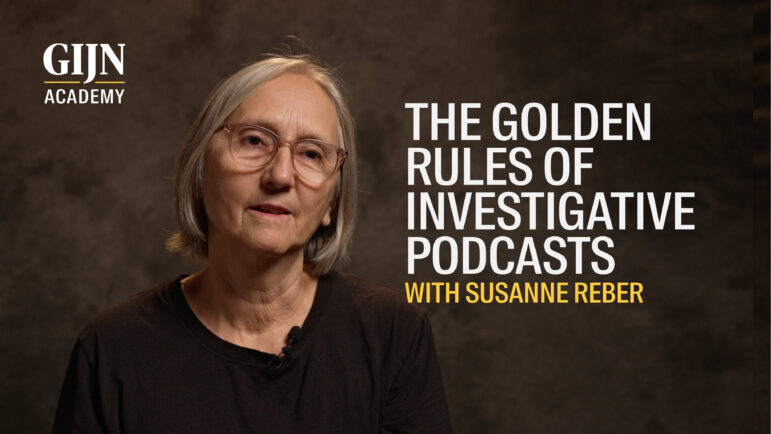
Other episodes have touched on how to make an investigative podcast, with guests Susanne Reber, the founder and executive producer of Piz Gloria Productions, The Economist’s Asia Correspondent Sue-Lin Wong, and PumaPodcast founder Roby Alampay, going undercover to uncover surveillance secrets or to infiltrate far-right group meetings. — Nikolia Apostolou, GIJN Resource Center director
8. The +972 Podcast
Language: English
The independent outlet +972 is run by Palestinian and Israeli journalists, which has produced a series of scoops about the ongoing conflict in Gaza. Its weekly podcast delves into the broader stories and topics the newsroom is working on, but fellow reporters will be particularly interested in the episodes in which journalists like Mahmoud Mushtaha and Ruwaida Amer detail how they went about their latest investigations and how to document destruction, displacement, and starvation even as the Gazan press corps comes under repeated assault.
In the episode “The Only Eyes on the Ground,” Gaza-based reporter Ruwaida Amer offers a candid account of what it means to report from a war zone while living through the conflict herself. Speaking with editor Meron Rapoport, Amer describes the practical realities of journalism amid bombardment, displacement, communications blackouts, and collapsing infrastructure. Particularly valuable for journalists is her reflection on the challenge of maintaining reporting standards while facing the same dangers and hardships as the people she covers. The episode provides a rare look at the often unseen work behind frontline reporting; from securing internet access and verifying information under extreme conditions to navigating the emotional toll of documenting tragedies affecting your own community.
In another notable episode, “Unveiling the Inner Workings of an AI-Powered Genocide,” Yuval Abraham gives a behind-the-scenes account of how he uncovered the inner workings of Israel’s military targeting apparatus. In conversation with editor Ben Reiff, Abraham traces his evolution from reporting on the occupation in the West Bank to investigating the systems and decision-making structures driving Israel’s military campaign in Gaza. He explains how conversations with intelligence and military insiders gradually revealed a targeting system that relied heavily on AI tools to generate targets at a pace far beyond traditional human processes.
One of the episode’s greatest strengths is its discussion of source development and verification. Abraham explains how some military sources approached him because they were troubled by what they had witnessed, while others provided fragments of information whose significance only became clear when cross-checked against testimony from additional insiders. The conversation offers a rare look at how reporters handle highly sensitive national security information in situations where documentary evidence is limited and much of the reporting depends on human sources. Abraham repeatedly returns to the challenge of distinguishing between what sources believe to be true and what can be independently verified, describing the painstaking process of corroborating accounts before publication. Rather than treating artificial intelligence as an abstract technical subject, Abraham focuses on the people and institutions behind the systems — the officers who developed them, the commanders who used them, and the policies that governed their deployment. For journalists investigating algorithms, surveillance systems, or emerging technologies, the episode offers a practical reminder that complex technologies are often best understood through the human decisions that shape them. — Feras Dalatey, GIJN Arabic associate editor
9. The Data Journalism Podcast
Language: English
Over the past 15 years, data journalism has become one of the most dynamic and influential areas of news production, yet there are surprisingly few resources that consistently document how the field is evolving, which methods are emerging, and what challenges data journalists face in different parts of the world. This is precisely why The Data Journalism Podcast, launched in 2021, has become such a valuable resource.
Hosted by three of the field’s most respected figures Alberto Cairo, Simon Rogers, and Scott Klein, each episode takes listeners behind the scenes, revealing not only the outcomes of ambitious investigations but also the methods, tools, and ways of thinking that made them possible. It introduces leading practitioners and pioneering newsrooms from around the world while demonstrating how data journalism serves the public interest.
Episodes examining the COVID-19 pandemic, for example, highlight how journalists analyzed vast amounts of data, communicated uncertainty, and translated complex statistics into information that audiences could understand and act upon. More recent episodes have featured MaryJo Webster, data editor at the Minnesota Star Tribune, discussing how data journalism can be used to cover immigration policy and federal security operations, and Greg Morton, data editor at The Baltimore Banner giving a behind-the-scenes perspective from his award-winning investigation, Transit Nightmare. Other episodes have examined AI and what search data can reveal about society. The podcast also demonstrates that data journalism is not limited to countries with sophisticated data infrastructures, with episodes featuring journalists working in places such as Myanmar and Afghanistan revealing how public interest reporting can thrive even when access to data is limited.
The conversations pay sustained attention to data visualization, with charts, maps, and interactive graphics treated not merely as design elements but as powerful communication tools. Guests frequently explain how they transform complex datasets into compelling narratives, sharing practical insights into visualization, storytelling, and audience engagement. Similarly, episodes dedicated to polling and survey data provide valuable guidance on interpretation, methodological pitfalls, and responsible reporting. More than just a podcast about data journalism, the series is a virtual gathering place for the global data journalism community, a living record of a field that continues to grow, adapt, and redefine itself. — Pınar Dağ, GIJN Turkish editor
10. Protagonista
Language: English
From the Czech Center for Investigative Reporting and Dark Riviera, Protagonista is a nine-episode series in which OCCRP Central European editor Pavla Holcová talks to several investigative journalists who have become part of the story, through attempts to silence their reporting — including smear campaigns, deepfakes, exile, and assassination plots.
To lead off the series, KRIK editor-in-chief Stevan Dojčinović tells Holcová about the comically large list of smears lobbed at him by pro-government tabloids for his reporting on the symbiotic relationship between organized crime and Serbian politics. These included: that he was a Western spy, was seeking to overthrow Macedonia’s government, that he was a mafia associate, a terrorist, and a “sado-masochist.”
When German investigative journalist Patrizia Schlosser started researching spy cam videos and revenge porn on online platforms, she found a global network that also profits from publishing non-consensual explicit material. But accessing the people who were making and uploading to these sites was complex — until she went undercover (listen to the podcast to learn how — it’s a unique story). “And it worked,” she said, explaining how she was able to identify some of the men behind the accounts. Later, she delved into her own experience of being a target of this practice, after a fellow journalist broke the news that there were deepfake images being shared of her online. She turned her quest to unmask the perpetrator into an investigation.
Also in the series: the spy-worthy tale of how Ukrainian journalist Anna Babinets brought in scuba divers to retrieve documents that former President Viktor Yanukovich threw into the bottom of a lake, and an interview with the Hungarian journalist Szabolcs Panyi, whose phone was infected with Pegasus spyware following his reporting on Viktor Orban and his inner circle. Holcová finds an easy rapport with the subjects, who, though they have faced serious threats, manage to find a grim humor in recounting these experiences. — Alexa van Sickle, GIJN associate editor
11. Profil Investigation (Profile Investigation)
Language: French
Who says a podcast has to be long to be interesting? In this new series from the French public radio station France Culture, each episode lasts no more than five minutes — just enough time to explore the bond between a journalist and the topic of their investigation.
The investigative reporters being interviewed speak in the first person of the personal interest that sparked the desire to investigate. So in the five episodes produced since fall 2025, we have discovered how a local journalist became interested in investigating the pollution created by PFAS (or forever chemicals) while reading a newspaper on the subway, how another’s interest has evolved from a focus on citizen journalism to OSINT reporting, and for another, how growing up in a rural area sparked an interest in other sometimes isolated areas, such as the suburbs. The journalists give a glimpse of their working methods, for instance detailing how they create worksheets to master the scientific aspects of a topic so as not to be gaslighted by powerful lobbying interests, or how they use a corkboard to map out an investigation and have all the “characters” visible while doing research.
Host Mattéo Carenta, who also takes listeners behind the scenes of investigative reporting in another podcast, “Récits d’enquête,” takes a more immersive and personal approach with these profiles. They show how, in the end, as one of the interviewees says, journalists rarely choose their investigation – rather that their investigations chose them. — Alcyone Wemaëre, GIJN French editor
12. Dans la peau d’un·e journaliste d’investigation en Afrique (In The Shoes Of An Investigative Journalist In Africa)
Language: French
Over the past decade, Francophone Africa has seen the emergence of a new generation of investigative journalists, distinguished by their participation in major investigative projects such as the Panama Papers, Swiss Leaks, Pandora Papers, West Africa Leaks, and the Congo Hold-Up series.
In 2022, Samsa Africa, which provides vocational training for reporters, created a podcast that gave the floor to some of the leading watchdog reporters in the region and many of those who took part in those big projects as well as vital investigative reporting in their local outlets. One by one, reporters like Sandrine Sawadogo (Burkina Faso), a current member of the GIJN Board, and David Dembélé (Mali), the chair of the Norbert Zongo Cell for Investigative Journalism in West Africa (Cenozo), share their experiences, detail the context in which they work, and the personal anecdotes that have stayed with them during the course of their careers. Other key figures interviewed for the series include Niger’s Moussa Aksar and Benin’s Ignace Sossou, Noël Konan, founder of the Ivorian investigative media outlet L’Etau, and Malek Khadhraoui, co-founder of the Tunisian investigative outlet Inkyfada. There are also French journalists who have worked in Africa, such as Sonia Rolley, who investigated the Congo Hold-Up for RFI and is now leading the investigations unit at PPLAAF, a whistleblower organization in Africa; Ariane Lavrilleux, who investigated secret French military operations in Egypt while she was there; and Hasna Belmekki, based in Morocco.
This podcast offers a rare opportunity to discover, in one place, a series that transports you from Abidjan, on the Atlantic coast of West Africa, to Egypt on the shores of the Red Sea, and into the daily lives of reporters who take risks to tackle highly sensitive topics in extremely volatile contexts. — Maxime Domegni, GIJN Francophone Africa Editor
13. FRONTLINE Dispatch
Language: English
FRONTLINE is known in the US for its documentary films, with a number of Emmy and Peabody awards to its name and a reputation for diving deep into public interest stories. The associated podcast series – Dispatch – is a place where filmmakers and reporters talk about how they went about making their films, exploring the investigative reporting that went into making each film. Scan through the list to find the podcast episodes in which reporters themselves talk about the stories they have worked on, how they uncovered what they did, and the impact the stories had on them. It’s a lingering, discursive style of conversation, which allows more space to hear how a project impacted reporters personally, too. I listened to episodes with the reporters who dug into the Texas Uvalde high school massacre to find out why the emergency response had been so devastatingly slow, the journalists who tracked down the data to prove how many people had died in police custody after so-called “non-lethal” use of force encounters with the US, and the team that exposed an adoption scandal in South Korea. Also worth mentioning is the episode in which the award-winning filmmakers whose documentaries have shown the reality, and the brutality, of life in Russian-occupied parts of Ukraine talk about how they made “2000 Meters to Andriivka.” And the episode about the El Faro reporters who undertook great risk to report on negotiations between the government of El Salvador and gang members. — Laura Dixon, GIJN senior editor
Producing Investigative Podcasts

From Secret Cameras to the Dark Web: 7 of the Best TED Talks for Investigative Journalists

6 Tips for Launching an Investigative Podcast

Investigating in Audio: Nine Standout Podcasts from Latin America

Investigative Podcasts from Around the World: 2025 Edition

Going Multilingual — The New Frontier of Podcasting?

Podcasting Goes Visual: How Video Can Help Investigative Storytelling Reach New Audiences

‘Giving Sources Power’: Reporting on Indigenous Communities and Creating Compelling Investigative Podcasts

This work is licensed under a Creative Commons Attribution-NoDerivatives 4.0 International License
Republish our articles for free, online or in print, under a Creative Commons license.
Republish this article
This work is licensed under a Creative Commons Attribution-NoDerivatives 4.0 International License
Read Next
News & Analysis
Investigative Podcasts from Around the World: 2025 Edition
Our yearly compendium of standout audio investigations, reviewed by GIJN’s global team. Featuring stories from Syria, Germany, Bangladesh, Turkey, El Salvador, Canada, the UK, and US.
Getting the Story Out GIJC23
Going Multilingual — The New Frontier of Podcasting?
The global boom in audio streaming offers an opportunity for investigative journalists to reach wider audiences by developing multilingual translations of their podcasts.
News & Analysis
Podcasting Goes Visual: How Video Can Help Investigative Storytelling Reach New Audiences
Podcasts are quintessentially an audio medium, but to reach newer and younger audiences, many shows are now beginning to add video elements to the traditional format.
10 Questions
‘Giving Sources Power’: Reporting on Indigenous Communities and Creating Compelling Investigative Podcasts
Pulitzer Prize-winning reporter Connie Walker discusses her favorite podcast tools, the ‘radical transformation’ of how Indigenous issues are covered, and building trust with sources.