
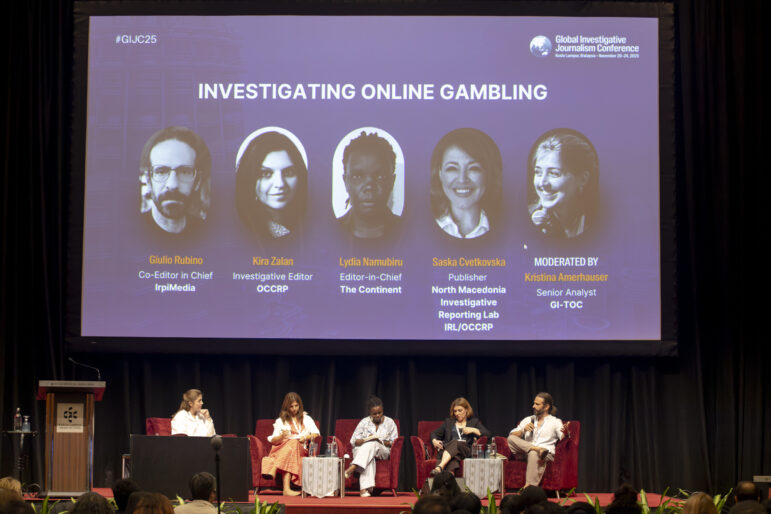
Speakers at the panel at the GIJC25 in Kuala Lumpur. Image: Suzanne Lee, Alt Studio for GIJN

Just how far reaching is the impact of online gambling? And who profits from lax regulation, jurisdictions that turn a blind eye to money laundered through gambling operations, and those that make a business out of those with addiction issues?
These were some of the issues discussed during the “Investigative Online Gambling” session at the Global Investigative Journalism Conference (GIJC25), which took place in Kuala Lumpur last month.
Giulio Rubino, co-founder and co-editor-in-chief of the Investigative Reporting Project Italy (IRPI), said that the stakes are huge, especially in relation to global sporting events like the 2026 FIFA World Cup. Online betting is booming — and is expected to make up a significant percentage of the US$150 billion experts think will be wagered on the event.
Gambling has always preyed on the vulnerable — particularly those struggling with mental health or addiction issues — but it has also in some cases been linked to transnational criminal networks that corrode government integrity and scaffold their gambling empire on illegal activities.
Rubino, together with Kira Zalan, investigative editor at OCCRP, Lydia Namubiru, editor-in-chief at The Continent, and Saska Cvetkovska, from Macedonia’s Investigative Reporting Lab (IRL), shared with the GIJC25 attendees how they investigated the connections between organized crime and online gambling, in a session moderated by Kristina Amerhauser, senior analyst at the Global Initiative Against Transnational Organized Crime (GI-TOC).
Online Gambling as Organized Crime Operation
Organized crime groups use online gambling both as a way of making, and hiding, money. First, they obtain gaming licenses. Some countries, such as Malta and especially Macedonia, provide them quite easily. Since all online gambling activities are transnational operations, once a group has a license from a country, they no longer need to operate there. They can launder and move money from one country to another, skewing the banking system.
Because of Macedonia’s weakened regulations on online gambling, it effectively provides “anonymity and regulatory evasion for anybody in the world that wants to launder money from drug trafficking, human trafficking, and so on,” Cvetkovska added.

Kira Zalan, investigative editor for the OCCRP. Image: Suzanne Lee, Alt Studio for GIJN
Once the framework is laid out on paper, the second stage is getting people to use the gambling platform. The more the better, since larger cash flows cover the money laundering operations and generate additional income for the organization. Online gambling operations seem more legitimate and obfuscate more money transfers when many users are betting.
One common tactic in places like Macedonia is pressuring brick-and-mortar gambling parlors to run their own businesses using the criminal organization’s electronic gambling platforms. It’s as if the mafia was forcing corner shops to sell the cigarettes they smuggle. Sometimes, once a service becomes widely known, criminals might simply pay people to place bets, just to create a cash flow that seems real. Once an online gambling platform is up and running as intended it can be extremely lucrative, generating hundreds of millions of dollars in profits.
The expert panel in Kuala Lumpur described multilayered criminal infrastructures behind online gambling, and offered practical tactics to help reporters expose those networks.
Setting up the system requires completing several stages and having teams focused on certain tasks.
If the operation is conducted from outside of Europe, but the criminals are at least partially based there, a third step might be necessary: finding appropriate online wallet services that can handle, for example, cryptocurrencies, and that avoid the banking system.
Once that’s in place, they basically have a private bank. There are no controls. “When gambling goes online it becomes a system of money laundering,” Rubino explained. “All the players have an account filled with money that works like cash in an account, and it becomes like an online banking system.”
After that, organized crime dedicates groups of people to run the system. “The tech teams purchase software designed for the gaming industry and adapt it as necessary,” said Zalan. “They have sales teams, with call centers in several countries giving people incentives to gamble, and they have finance teams, with people that support the payments that need to come in from the players to the criminal network.”
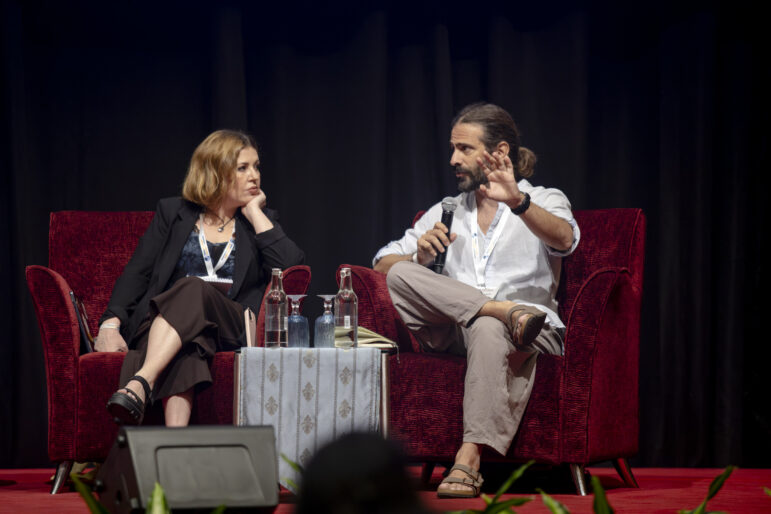
Giulio Rubino (right), co-founder and co-editor-in-chief of IrpiMedia, discussing the widespread impact of online gambling on global sports events like the upcoming FIFA World Cup. Image: Suzanne Lee, Alt Studio for GIJN
How to Uncover the Layers and Teams of Online Gambling Operations
There are a number of tactics used by investigative reporters to reveal some of the different stages or teams involved in online gambling, and the criminal organizations behind them. They include:
- Decide which part of the operation you want to focus on and adjust your approach accordingly. “Do you want to investigate the gambling scheme, the money laundering connected to it, [or] the power of the criminal network connected to the scheme? The game changes a little bit depending on what’s your main interest,” said Rubino.
- Take advantage of the fact that a great deal of the operation will be legal – this means reporters can access documents such as licenses, names of who got them, where, and how many they have. Cvetkovska uses ChatGPT to set up web scraping tools that collect information about the legal side of the operations, such as license and tax collection information.
- Use domain tools to know who registered a site. You might get a name and an address, for example, which are priceless clues.
- Zalan’s team did a lot of manual work when determining the corporate structure maze behind online gambling. Based on this experience, she said a single corporate service provider can sometimes front a network of thousands of gaming and shell companies. Keep in mind it’s common for platforms to reopen with different names after authorities take them down.
- Keep an eye out for anomalies. For example, to determine if a small physical gambling shop is a money laundering front, you might look at how many customers come in the shop. Cvetkovska and her team set up cameras facing some of the places they were interested in, and noticed that in some cases only a handful of people a day went into gambling shops that were simultaneously reporting yearly revenues of millions of dollars.
- Keep an eye out for political connections. Namubiru said it was common in Uganda to see family members and friends of officials or politicians own 5% of an online gambling operation.
Also, note that there is a murky line between online gambling and online scams. As a result, online gambling often targets the same WhatsApp and Facebook groups used to spread crypto scams and pyramid schemes, preying on the same types of victims.
The panellists said that even where online gambling activities are legal in your jurisdiction, it’s fair for investigative coverage to examine if the laws and regulations governing all this wagering are at the service of society.
“We sell hope,” the owner of a gambling business in Uganda said to Namubiru. But the people who need this hope are usually desperate for money. “It’s people who have such little exposure to money that they tend to have a bit of magical thinking about it,” he said.

This work is licensed under a Creative Commons Attribution-NoDerivatives 4.0 International License
Republish our articles for free, online or in print, under a Creative Commons license.
Republish this article
This work is licensed under a Creative Commons Attribution-NoDerivatives 4.0 International License
Read Next

GIJC25
The Scam Supply Chain: How to Uncover Transnational Fraud Operations
Scams now function as sprawling transnational criminal enterprises. But journalists can expose these networks by following inconsistencies, mapping operations, and collaborating across borders.

Organized Crime Reporting Tools & Tips
Latest Money Laundering Trends Journalists Should Watch For
A recent IRE conference panel focused on new money laundering strategies that make hiding illicit assets increasingly difficult to track.

GIJC23
The New Organized Crime: How to Catch Up With Criminals
An all-star team of five journalism experts shared their approaches to investigating the ever-evolving world of organized crime.

GIJC23 Reporting Tools & Tips
Follow the Money — and Enablers — When Investigating Kleptocracies and Mafia States
Veteran journalists explained how an industry of enablers is supporting a growing group of kleptocracies and mafia states around the world, and that following the money is a great way to track them.