
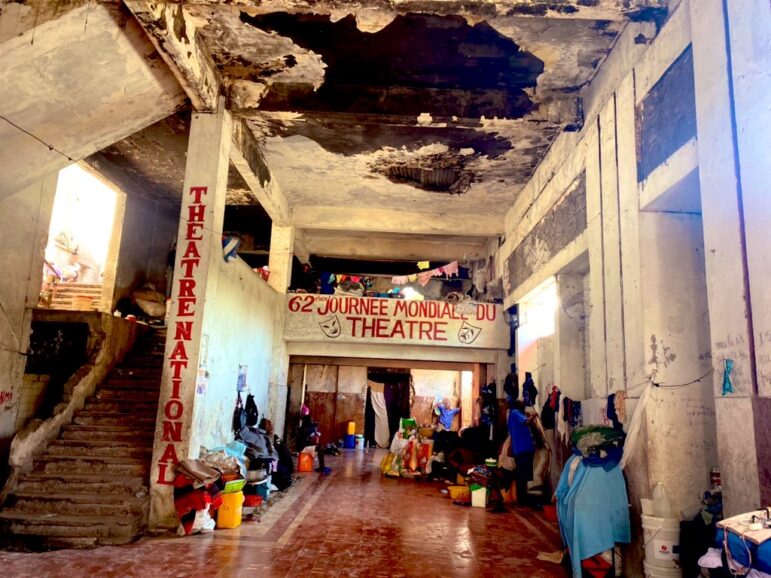
A Haitian theater destroyed in the 2010 earthquake currently serves as a shelter for people displaced by the ongoing violence or fleeing areas under the control of armed groups. Photo by Juan José Martínez D'Aubuisson and published with permission
‘Moving Just One Block in Port-Au-Prince Was Equivalent to Traveling Nearly 1,000km Elsewhere in the World’: The Challenges of Ethnographic Journalism in Haiti
Read this article in
For over a decade, the Salvadoran journalist and anthropologist Juan José Martínez D’Aubuisson has used the practice of ethnographic journalism to explore violence and how gang-related crime has impacted communities across the Americas.
His reporting from Honduras, the Dominican Republic, and Haiti, to mention some of his most recent work, has won awards: In 2024, he received the Ortega y Gasset Award from El País for The Moskitia: The Honduran Jungle Drowning in Cocaine, a piece documenting the destruction of Central America’s largest rainforest by drug trafficking. That same year, Massacre Border, his investigation into the violence faced by Haitians in the Dominican Republic, was shortlisted for an award from the True Story Festival. In 2025, his investigation Searching for Mikelson: An Apartheid in the Caribbean won the prestigious Gabo Award in the text category.
This year he published three in-depth pieces on Haiti. The first, Inhabiting a Corpse, published by El País, profiles the armed groups vying for power in the Haitian capital. The second, The City of the Living Dead, published in 5W magazine, describes the dynamics of the makeshift refugee camps in Port-au-Prince. Finally, The Massacre of the Grandparents, published by the BBC, details a mass execution committed by a criminal gang in Haiti.
We spoke to him about the complexities of reporting in places where every step and every question needs to be carefully thought through, and about why he is so committed to speaking to those who can be hard to reach because of all they have experienced. Our interview has been translated from the original Spanish and edited for length and style.
GIJN: When and why did you become interested in investigating Haiti?
Juan José Martínez D’Aubuisson: I got to know the Caribbean region during a study abroad program in Belize in 2006. That burst the provincialism, so to speak, of having lived in El Salvador my whole life.
Being in the region, with its deeply Caribbean history and an equally Caribbean social and cultural makeup, fascinated me. I got to know up close one of the world’s great driving forces. Even before the major European invasions, much of the American continent’s processes of occupation and colonization were structured through this region.
I spent seven years researching my book on the Caribbean region of Honduras, focusing on violence and gangs. Both these topics interest me greatly, and converged in Haiti. I studied the country before beginning my research in Port-au-Prince. I also made a series of trips to Mexico’s southern border, where I spent time with Haitian migrants, and later along the entire border region of Dajabón in the Dominican Republic.
GIJN: What surprised you while investigating in Haiti, compared to your work in other Latin American countries?
JJMD: The processes occurring in Latin America are also present in Haiti: deep-rooted institutional corruption, a history of chilling military dictatorships, US interference, mass migration, and the presence of youth gangs that end up becoming small armies controlling areas the state is unable or unwilling to control.
When it comes to the fieldwork, there is indeed a significant difference. In Central America, we somewhat understand ourselves as a mestizo [mixed-heritage] people, and though my anthropologist colleagues may disagree here, we share a common language and certain cultural codes. Those are things I didn’t experience in Haiti. So, working directly not only with gang members, but in general with victims, other types of sources, civil society organizations, and religious leaders in Haiti was complex.
Language is also a barrier. My Creole is poor. I know the basics, but I’m not fluent. So talking to people was very complicated, not just because of the language, but also because of a series of cultural codes.
GIJN: How did your status as a foreign journalist influence the way you reported on Haiti?
JJMD: In Latin America, I consider myself mestizo; in Europe, I’m brown; in Haiti, I’m white. That places me at the center of Haiti’s historical trajectory shaped by foreign peoples who have always come in to steal, plunder, and leave things worse than they found them. My skin color and my status as a foreigner were interpreted as a threat, to the point where there was one attempt to kill me and daily attempts to scare me during my stay in Haiti.
GIJN: How did you manage to report in these conditions?
JJMD: That’s what the method is for, and we had to insist on sticking to the work guide we developed before the trip: stick to the script, and keep going. If a source doesn’t answer, you try again, and try to convince them that we’re not there to steal from them, but to try to explain what is happening in that place and, ideally, to contribute some knowledge toward solving the problems. That is what I, at least, truly believe.
Try to convince them, speak honestly, and over time, people begin to perceive you as less of a risk — never as non-risk, but as a lower risk — and, for the most part, they eventually become more open.
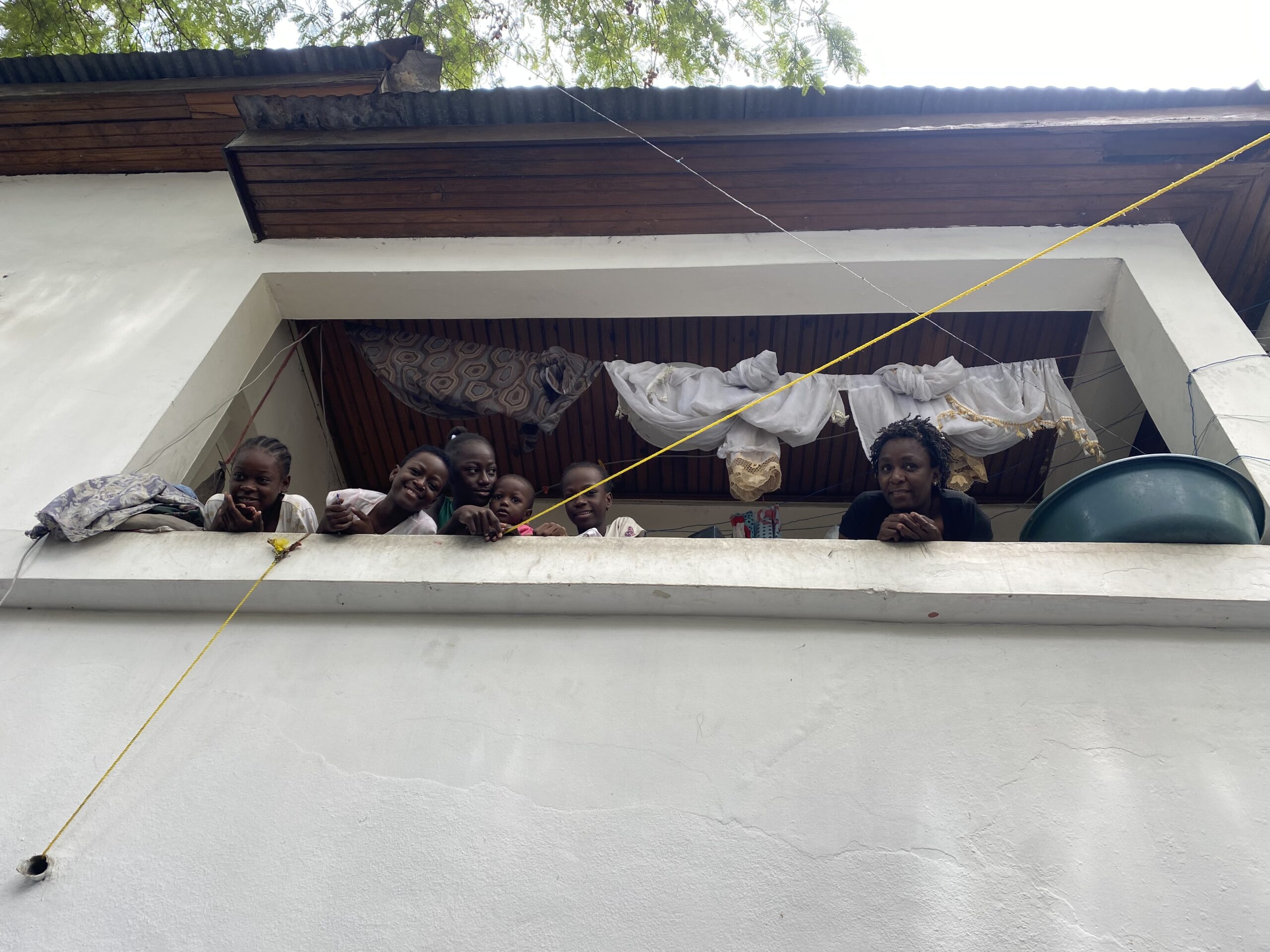
A former school in Port-au-Prince that now serves as a refugee camp. A woman who fled the Solino neighborhood looks out from the building’s second floor with her children, where they now live. Image: Courtesy of Juan José Martínez D’Aubuisson
GIJN: How difficult was it to gain access to the sources and communities featured in the report?
JJMD: Gaining access is complicated given the current context. In the case of the Dominican Republic, the Haitian communities living there are under siege, both by the state and by Dominican society, and therefore view everything as a risk, which puts them on alert. It is difficult and requires time, a lot of time… [you need to be] very clear, but above all, I think the key lies in remaining. You have to remain in these places for as long as necessary.
This principle also applies to the people and sources we ask to open their homes and lives to us. People have no reason to do so if they don’t know us. And while it’s true that they won’t get to know us in a couple of weeks or months, we can reach a middle ground of empathy and mutual knowledge where it’s no longer strange for these people to tell us things.
On the subject of physical accessibility, to reach Port-au-Prince I had to fly from Miami to Nassau, then to the Turks and Caicos Islands, and subsequently to Cap-Haïtien; from there, I took a helicopter to Port-au-Prince and then traveled by vehicle to Pétion-Ville, where I stayed for five weeks.
Moving just one block in Port-au-Prince was equivalent to traveling nearly 1,000 kilometers [621 miles] elsewhere in the world, due to the specific conditions of violence and lack of access in the city. It was difficult, but that is part of the endeavor of ethnographic journalism: being on the ground when the events we’re reporting on are taking place.
GIJN: What recommendations would you give to journalists who want to do investigative work in Haiti and protect themselves?
JJMD: I believe the best way to protect yourself while doing fieldwork is through prior research, the process of gathering background information before going. We need to know a place, to have studied what has been written about it, carefully read United Nations reports and academic literature about it and its inhabitants, and to have reviewed the work of other journalists and colleagues. We are almost never the first to arrive somewhere.
We need to understand the map of players involved. Who are the key people? How does power work? We can gain a general sense of this from afar by interviewing people who are there and who have written about these places.
If we’re clear on who’s in power, it’ll be harder to make mistakes. We’ll already know where we shouldn’t travel alone, which questions to avoid asking in public, how not to dress, which words not to use, and who to move around with. Is doing this preliminary work boring? Yes, I suppose it is for some people. It’s probably more entertaining to attend a journalist safety workshop where you dress up as a soldier and are taught to crawl on the ground escaping gunfire, but to be honest, that is far less useful.
GIJN: What security protocols did you implement for reporting in areas controlled by armed groups?
JJMD: I always work with my primary editor, José Luis Pardo Vieira, who is the editor and head of Dromómanos, a platform based in Mexico through which we’ve published all this material and work from other places. Together we’ve designed a security plan in which we stay in constant contact, and he has a long list of people to turn to if I don’t respond within a set timeframe.
We make daily calls to go over the day’s itinerary, once in the morning, once in the afternoon, and also once at night, because there’s often work to be done at night.
He and his team know where I’ll be, they know what I’m going there for, they know what questions I’ll ask, who I’ll speak with, and how I’ll move around, and they have a general idea of the range of decisions I would make, because we discussed them in long meetings before the trip. They know what I would do in a risky situation. They know whether I’m in a vehicle, and if I am, they know its license plate and characteristics. They have a general idea of which route I’d take to escape if anything happened.
That’s the protocol [and we have] a plan for each of those scenarios: calling the local police – they’ll have the number for the local security minister or the area’s police chief – and telling them who I am, where I am, who I’m with, why I’m at risk, and which institution I represent. They would also explain to them the trouble they’d face if something happened to me on their turf. These pre-established protocols provide you with a certain security, and that lets you know how far to go or not, and that there’s a team backing you up.
Now, having said all that, nothing exempts you from the risk of bad things happening to you. You have to… stay very concentrated, very focused on what you’re doing, and when faced with signs of danger, know whether to stop, flee, retreat, continue, hide, and so on.
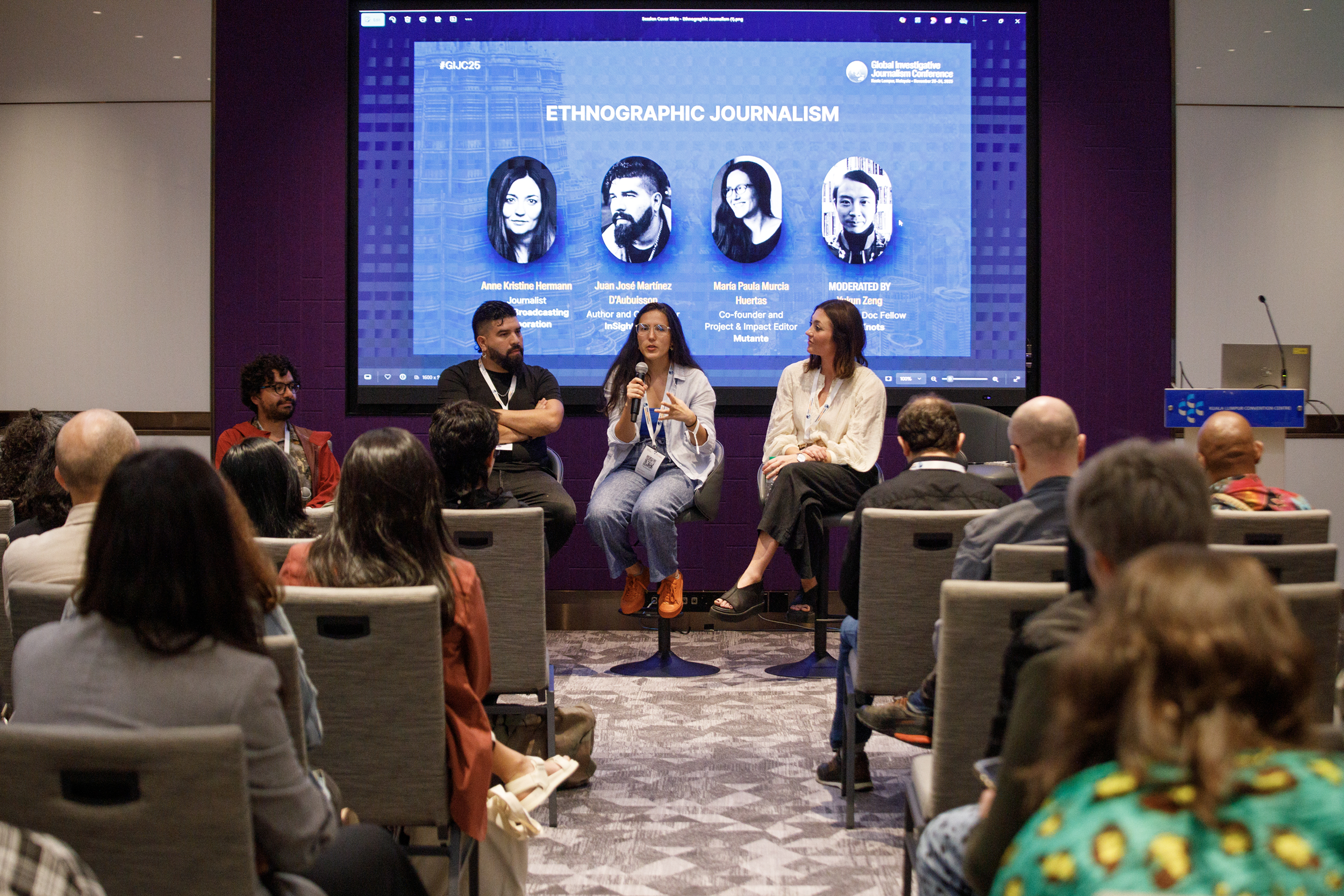
Juan José Martínez D’Aubuisson (second from the left) speaking at a GIJC25 panel on ethnographic journalism. Image: Alt Studio for GIJN
GIJN: Were there places or sources you decided not to approach for security reasons? How did you solve those limitations?
JJMD: There were many places I wished I could have gone to. For instance, I would have really liked to go to Wharf Jérémie, a place I wrote about in connection with a massive massacre, the largest [in the country] of the 21st century, where 207 people were killed. I reconstructed this massacre by speaking to survivors.
I would have loved to go there and speak with the warlord, but it wasn’t possible; there were no ways to get there. No one could accompany me, and I didn’t have a vehicle that could get me there. Moreover, if there was a guarantee, a certainty, it was that if I did manage to get there, I would be killed outright: not kidnapped, not insulted, but killed on the spot.
GIJN: Finally, how did you decide which personal stories to include in your investigations?
JJMD: That’s an interesting question. We include personal stories for two reasons.
One is the capacity these individual stories have to explain the broader sociocultural processes unfolding in those places; since we cannot explain these abstractly, we illustrate them through a specific person, family, or community. The other reason is to choose stories because they are extraordinary; stories so unique, so extreme that we want to document them, because of how rare it is for something like that to happen to someone.
Translation by Diego Courchay.
 Andrea Arzaba is GIJN’s Spanish editor and director of the Digital Threats project. She holds a master’s degree in Latin American Studies from Georgetown University in Washington D.C. and a BA from the Universidad Iberoamericana in Mexico City. Her work has appeared in Palabra, Proceso Magazine, Animal Politico, and 100 Reporters, among other media outlets.
Organized Crime Chapter 4 – Forced Disappearances

Investigating War Crimes

Introduction to Investigative Journalism

GIJC23 – Rewriting History: Investigations that Change Our Understanding of the Past

Combining Ethnography and Journalism Into an Award-Winning Investigation in Central America
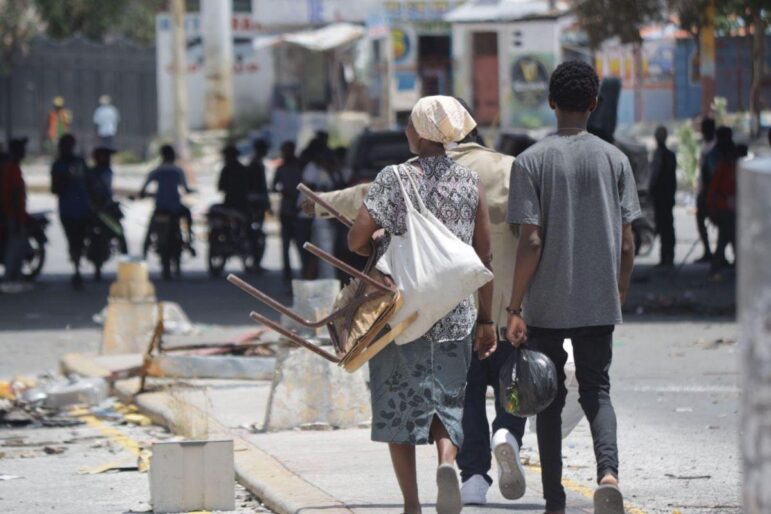
Seeking the Truth, in the Midst of a Country in Crisis: Haiti’s AyiboPost

After Pablo and El Chapo: How Investigative Outlets Are Covering Organized Crime in Latin America
How We Investigated the Hidden Costs of the World’s Farmed Seafood

This work is licensed under a Creative Commons Attribution-NoDerivatives 4.0 International License
Republish our articles for free, online or in print, under a Creative Commons license.
Republish this article
This work is licensed under a Creative Commons Attribution-NoDerivatives 4.0 International License
Read Next
How They Did It Methodology
Combining Ethnography and Journalism Into an Award-Winning Investigation in Central America
Two Salvadoran investigative journalists discuss their ethnographic reporting on the impact of the drug trade on the La Moskitia Indigenous region of Central America.
Member Profiles News & Analysis
Seeking the Truth, in the Midst of a Country in Crisis: Haiti’s AyiboPost
Being a journalist in Haiti means not only witnessing daily violence but also being a potential target, one news outlet remains a home for those who refuse to stop reporting.
How They Did It LATAM Focus News & Analysis
After Pablo and El Chapo: How Investigative Outlets Are Covering Organized Crime in Latin America
As organized crime in the region metastasizes, investigative journalism is rising to the challenge, using innovative ways to cover ever-changing threats.
How They Did It
How We Investigated the Hidden Costs of the World’s Farmed Seafood
Over the past five years, an international team of journalists at The Outlaw Ocean Project has examined the largely overlooked $313-billion food-for-feed aquaculture industry.