

Abdus Somad, a journalist for Indonesian publication Jaring.id, speaking at the session on investigating human trafficking at sea. Image: Lisa Marie David for GIJN
Exposing Forced Labor and Human Trafficking in the World’s Oceans
Read this article in

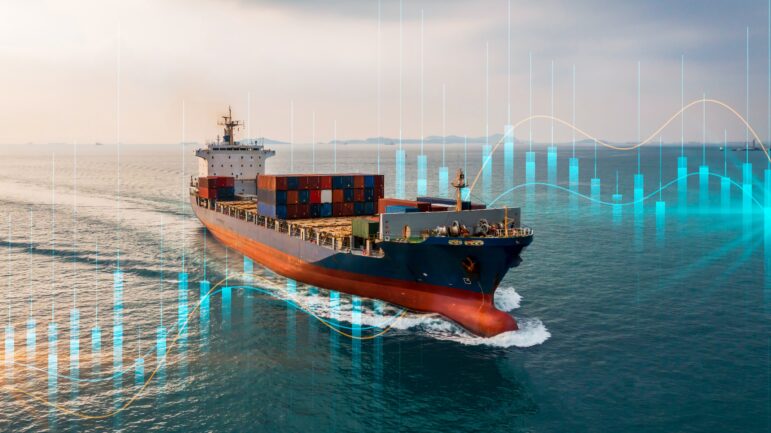

The maritime industry moves more than 80% of global trade. The sector is as vast as the oceans but jurisdiction — and therefore accountability — is often murky, with some vessels registered under “flag of convenience” states that obscure ownership and responsibility. That leaves workers vulnerable to exploitation, human trafficking, and forced labor, but the evidence to prove wrongdoing scattered across seas, corporate registries, and satellite data.
Trafficking at sea thrives on this invisibility. Ships slip into remote waters as “dark fleets,” workers become trapped for months, and records are fragmented or deliberately hidden.
At the Global Investigative Journalism Conference (GIJC25) in Kuala Lumpur in November, journalists on a panel entitled “Uncovering Human Trafficking at Sea” shared practical methods for breaking through these layers of deliberate obscurity. They also explained why maritime trafficking is so difficult to investigate, and what reporters can do about it.
The Ocean Itself Provides Cover
With support from the Pulitzer Center, Abdus Somad, a journalist for Indonesian publication Jaring.id investigated widespread illegal fishing in the country’s Arafura and Natuna seas in collaboration with Tempo. Here, satellite imagery showed vessels, including those linked to major companies and politically powerful figures, operating without licenses or hoarding a fish catch far beyond their quotas. The crew endured classic exploitative work conditions that included long hours and withheld wages. Some workers were so desperate that they tried to flee by jumping into the open sea.
To track ship movements, Somad used a variety of data sources, and he stressed that these platforms may need to be used in combination for comparison and verification purposes:
- Global Fishing Watch for tracking movement of fishing vessels (but he cautioned the site does not always capture offloading or real-time movement).
- Marine Traffic for monitoring a vessel’s movements over time and to establish suspicious patterns such as extended loitering, off-route detours, or voyages to high-risk ports.
- Copernicus, Planet Labs, and other satellite imagery websites to confirm if a vessel has docked or is at a certain port.
When Ships Go Dark
One of the most powerful methods for investigating trafficking is tracking ships through their Automatic Identification System (AIS) data, real-time information broadcast via VHF radio. Information such as a ship’s position, course, and speed is collected by land and satellite receivers for maritime traffic management.
But vessels engaged in nefarious activities such as illegal fishing and human trafficking often disable their AIS data to avoid detection. Many trafficking cases involve dark fleet ships, and this behavior is common on sanctioned tankers and ships smuggling weapons or wildlife.
When AIS goes dark, Somad and US-based investigative journalist Katie McQue suggested combining information gathered from open source satellite and ship tracking sites to:
- Look for patterns of disappearance. Ships often drop AIS near borders or high-risk zones.
- Examine the last known maritime courses to make inferences about likely destinations.
- Cross-reference port logs: some ports record arrivals without posting them publicly.
- Lastly, they say reporters should not overlook the images contributed by ship spotters and port photographers, and enthusiasts who upload timestamped images to social media platforms. These photos can help verify a ship’s presence in a port on a certain day, when AIS data is incomplete.
Another informal but rich source of information is social media platforms, which can be mined both for evidence and sources. Sailors often post on social media to keep families and loved ones updated on their lives at sea. These posts on Instagram, Facebook, and YouTube are full of photos from decks showing catch, ship interiors, living conditions, or even conflicts with agents and officers.
McQue suggests searching for nationality-based Facebook groups of seafarers, social media platforms of shipping companies, and YouTube channels of shipworkers. Even the comments section of social media channels can be mined for clues about unscrupulous shipowners and putting together names of crew with grievances.
Investigating Opaque Ownership
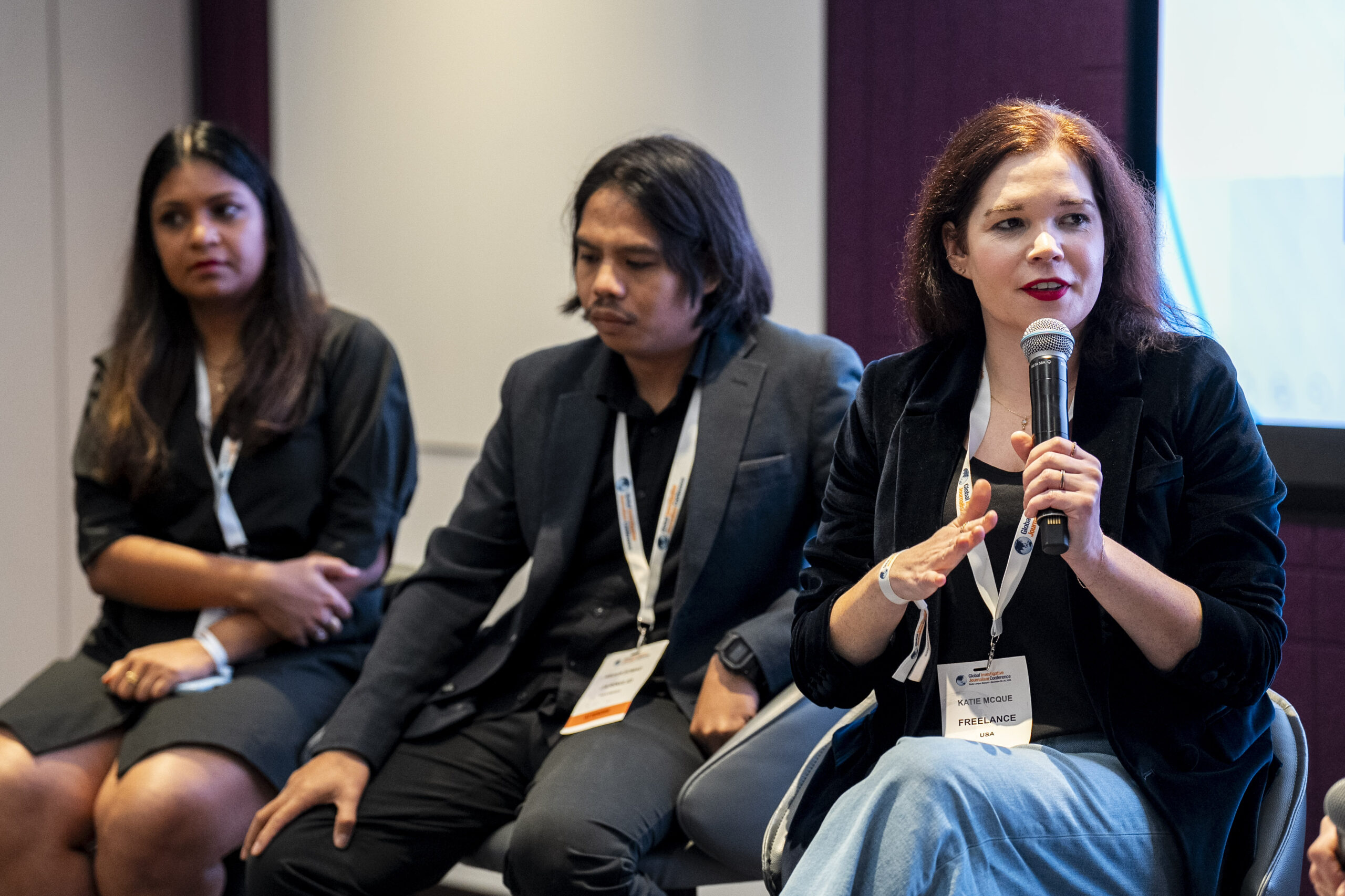
Katie McQue, right, speaking in Kuala Lumpur. Image: Lisa Marie David for GIJN
Shipowners frequently deny any responsibility for crew exploitation. They may claim the vessel is “bareboat chartered,” “operated by a third party,” or “not owned by us.”
McQue, who has investigated the abandonment of seafarers working on dark fleets, said that crew documents hold access to evidence that can establish employer and vessel ownership. These include:
- Seafarer employment agreements and documents, such as crew lists, can help identify people who were working on the vessel.
- Cargo manifests that may contain clues about smuggling.
- Insurance certificates.
- Vessel registration papers.
- WhatsApp or Telegram exchanges that can show coercion and threats from the employer.
- Safety reports and logbooks.
- Photos of the ship’s name, hull, and IMO ship identification number – a unique, permanent seven-digit identifier, prefixed with “IMO”. This number does not change regardless of name and flag changes.
Taking a Trauma-Centered Approach when Speaking to Victims
McQue maintains a database of sources, which includes sailors and fishermen she first made contact with on social media. “Since I’m approaching them on an informal line like a Facebook DM [direct message], I always tell them that I am a journalist.”
At times, McQue has come in contact with shipworkers who are trapped, have been abandoned, or injured. Many have been threatened by recruitment agents who hold their passports and can threaten their families back home. Interviewing under such circumstances requires careful ethical preparation and care.
“A lot of them are very traumatized, and some are embarrassed about their families back home finding out about their situation,” said McQue.
To establish realistic expectations, McQue outlines before the start of the interview that she cannot rescue anyone. Instead, she immediately provides contacts for the International Transport Workers’ Federation (ITF) who can provide assistance. “I give this at the beginning of the conversation so it’s not like a reward for talking to me,” she said.
McQue also discusses anonymity and, in some cases, reads back sensitive paragraphs so workers can ensure details won’t jeopardize their safety.
Building Explanatory and Narrative Formats around Complex Reporting
The multiple complexities of human trafficking at sea make it a niche reporting topic. According to Amruta Byatnal, Asia Editor at the Thomson Reuters Foundation’s Context News division, newsrooms can make investigations like trafficking at sea resonate with wider audiences by pairing rich, narrative reporting with accessible formats and creative storytelling.
“We have to meet people where they are at. If they want to read the shorter story, they can go read that. If they want to take a deeper dive, they can do that later,” Byatnal explained.
Audience analytics told the Context Newsroom Team that readers rarely go beyond 1,200 words so for McQue’s investigative report series, Dark Waters: Ships that Hide Crimes on the High Seas, the Context Newsroom focused on finding multiple entry points into a complex maritime world that can feel remote and technical. A key element of the investigation was uncovering how, in 2024, more than 3,000 seafarers were stranded on 230 ships linked to dark fleet operations.
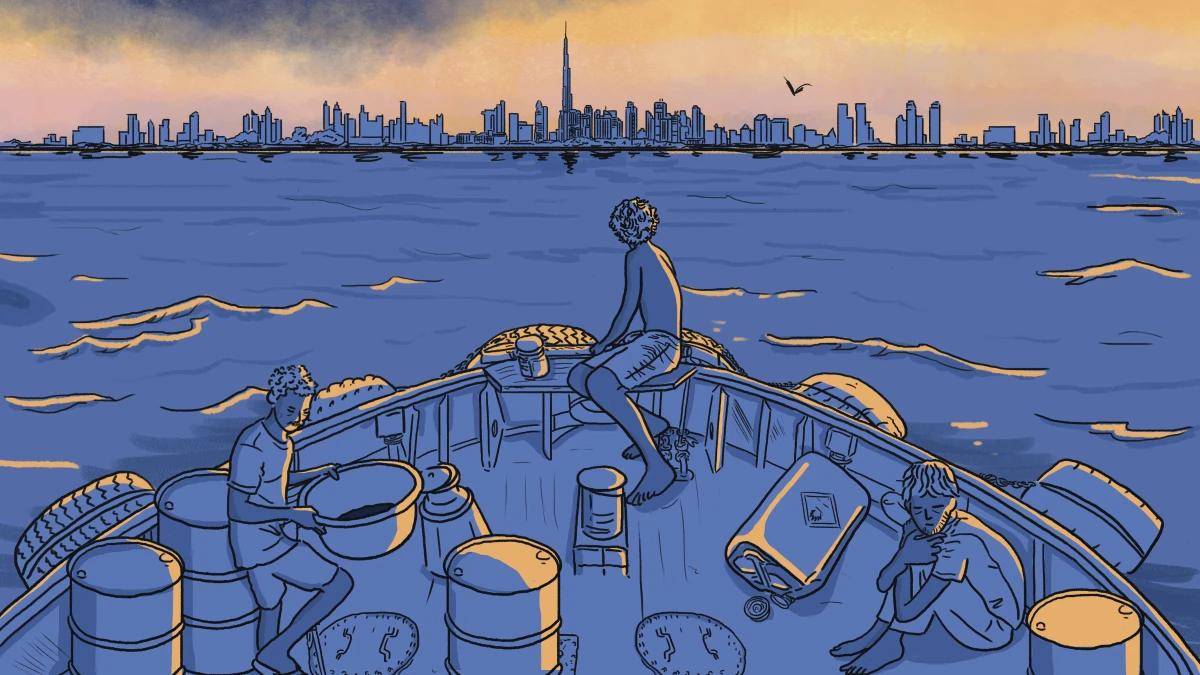
Illustrations by Karif Wat brought the story to life. Screenshot: Context / Thomson Reuters Foundation/
Strong illustrations helped humanize the story and draw readers in, while explainers broke down difficult and abstract concepts such as flags of convenience and dark shipping.
A mix of formats ensured the report reached diverse readers. Long-form features for those looking for a deep dive into details, shorter companion pieces for audiences who typically prefer shorter pieces, and Q&As and videos to highlight the reporters’ process and demystify the investigation.
Publishing the series over many months, rather than in a single burst, sustained interest and allowed each instalment to find its audience. After publication, the stories found new life through syndication on the Reuters news wire, where trade publications and smaller outlets picked them up. This long-tail distribution extended impact and ensured the investigation reached a wide audience.

This work is licensed under a Creative Commons Attribution-NoDerivatives 4.0 International License
Republish our articles for free, online or in print, under a Creative Commons license.
Republish this article
This work is licensed under a Creative Commons Attribution-NoDerivatives 4.0 International License
Read Next
News & Analysis
How We Turned Years of Reporting on the High Seas into a Podcast: Tips from Ian Urbina
The Outlaw Ocean Project — a nonprofit journalism organization that reports on the “watery two-thirds” of our planet — used material from several years of investigations on the high seas to create a new, seven-part podcast.
GIJC25
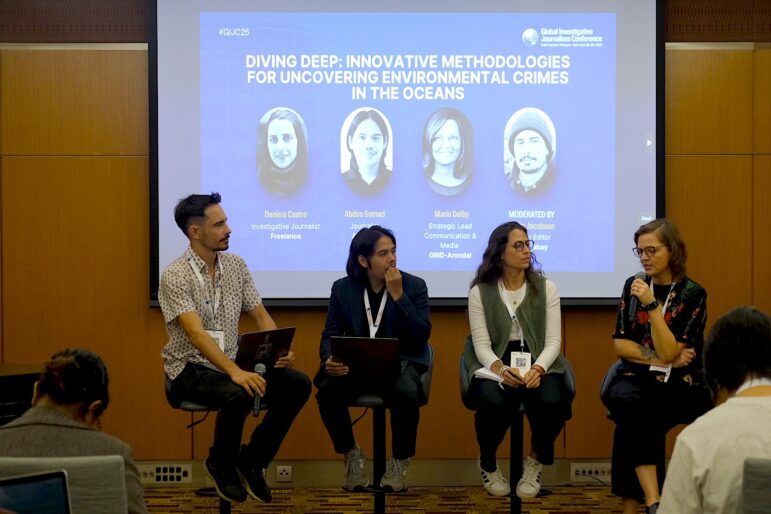
New Approaches for Investigating Environmental Crimes in the Ocean
At GIJC25, veteran journalists from Indonesia, Norway, and Colombia shared practical, replicable strategies for uncovering illegal fishing and maritime wildlife trafficking at sea.
Case Studies News & Analysis
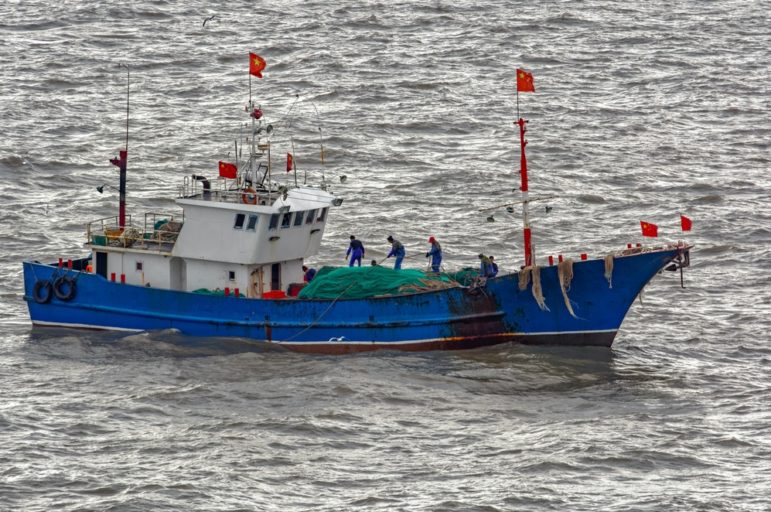
How an Award-Winning, Cross-Border Project Investigated on the Open Ocean
Fourteen newsrooms and independent journalists from 13 countries collaborated on the Oceans, Inc. project, to uncover stories about illegal fishing and forced slavery on the South China Sea and the oceans near Antarctica. Their cross-border reporting won the 2022 SOPA Award for Excellence in Reporting on the Environment.

Investigative Techniques News & Analysis
Exposing the Money Behind Environmental Destruction
The Pulitzer Center discusses how it has developed different methodologies to uncover environmental wrongdoing, adapted to the region, jurisdiction, and industry.