
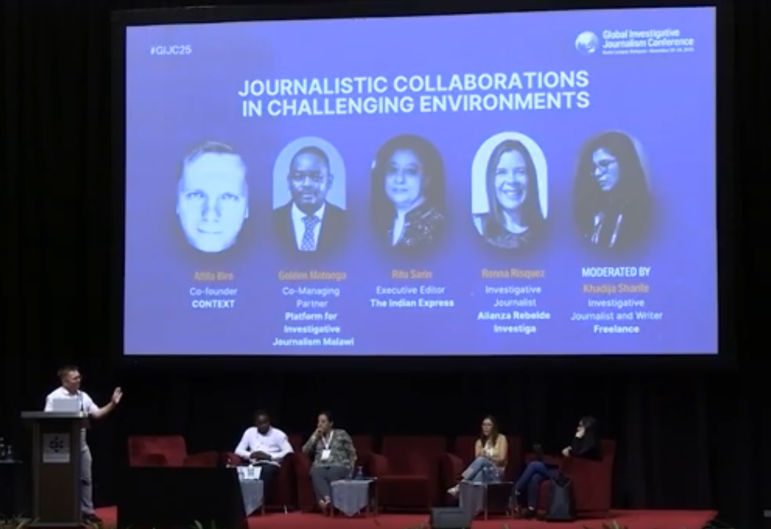
Image: GIJC25, YouTube
In March 2025, 238 Venezuelan men were arrested in the United States, accused of belonging to Tren de Aragua, a transnational organized crime syndicate from Venezuela. US President Donald Trump alleged that they were “some of the most violent savages on the face of the Earth.”
The men, who were between the ages of 18 and 46, were subsequently flown to El Salvador’s maximum security prison, the Center for Confinement of Terrorism (CECOT), where they were reportedly held incommunicado.
Their arrest and cross-border transfer unfolded across three governments with fraught human rights records: the US, El Salvador, and Venezuela. For reporters trying to find out who the men were and the basis for their arrest, the challenge was immense — particularly because of Venezuela’s repressive media landscape.
Currently, 16 journalists are imprisoned in Venezuela, and nearly 500 are in exile — and more than 400 media outlets have shut down in the country over the past two decades. As a result of these dire circumstances, investigative journalist Ronna Rísquez of Alianza Rebelde Investiga (ARI), a coalition of the Venezuelan outlets El Pitazo, Runrun.es, said that: “In Venezuela, collaborate or die.”
Risquez was speaking at a panel about cross-border investigations at the 14th Global Investigative Journalism Conference 2025 (GIJC25) in Malaysia. Rísquez, who also wrote a book about the inner workings of the Tren de Aragua, was joined by Golden Matonga, co-managing partner of the Platform for Investigative Journalism Malawi, Attila Biro, co-founder of CONTEXT, and Ritu Sarin, executive editor for The Indian Express. The panel was moderated by investigative journalist Khadija Sharife.
The panelists have worked on some of the most high profile cross-border investigations, including The Panama Papers and The Azerbaijani Laundromat, underscoring how stories that span countries require reporting networks that do the same. They described how collaboration helps distribute risk when exposing corruption or state abuse can carry personal and professional dangers, while also reinforcing the editorial backbone needed to verify complex transnational data and narratives.
“It’s very hard for any government to ignore a powerful story if it has been done by 10 or 20 other media outlets. There’s also a security in numbers and a comfort zone that everyone feels while collaborating, ” said Sarin, emphasizing how in some reporting contexts, solidarity is inseparable from safety.
Reconstructing Cross-Border Narratives
For Risquez and ARI, the multi-partner investigation into the 238 Venezuelan men became the coalition’s first major cross-border collaboration with US outlets, which included ProPublica, The Texas Tribune, and others. In total, six media organizations and more than 20 journalists across Venezuela, Chile, and the US worked for four months to reconstruct what had happened.
The team of journalists began by gathering information such as full names, birth dates, national ID numbers, migration histories, court records, and photographs to construct a narrative history about each detainee. They reviewed legal documents from five countries that included the US, Venezuela, Colombia, Peru, and Chile, tracing where each man had lived before reaching the United States. They cross-checked identity platforms, health records, and immigration databases, and compared names against leaked datasets of confirmed gang members. More than 150 interviews were conducted with relatives, lawyers, police officials, academics, and US security sources.
The result was a database with 238 rows with more than 60 columns. The volume of material was overwhelming. The team used AI tools and created their own chatbot to organize the data in a tabulated format that was then manually verified multiple times.
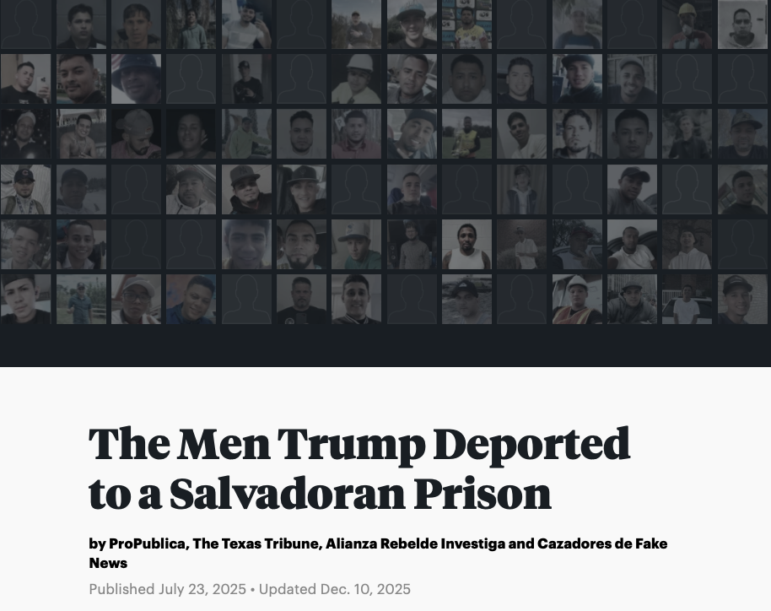
ARI partnered with ProPublica, The Texas Tribune, and other outlets to identify each of the 238 Venezuelan men sent to the CECOT facility in El Salvador. They found that many of them were not tied to the Tren de Aragua gang and a large majority had never been convicted of a crime, despite US President Donald Trump’s claims. Image: Screenshot, ProPublica
“Each history was an investigation. We had to reconstruct every case,” Rísquez explained.
Their investigation found the Trump administration knew that at least 197 of the men had not been convicted of crimes in the US. The ProPublica report, which detailed the personal narrative of the accused, showed that nearly half were expelled from the US while in the middle of their immigration cases, which should have protected them from deportation. Some were only days away from a final hearing.
Interviews with families, immigration documents, and court records showed the government relied heavily on tattoos the men had to link them to Tren de Aragua. Four months after publication, the men were released and flown to Venezuela as part of a prison swap with the US.
The weekly meetings that transformed the ARI newsdesk into a transnational newsroom with diverse perspectives had made an impact. “Collaboration, when several organizations come together to complete each other, enhances your work,” said Risquez.
Infrastructure and Influence of Disinformation
For Biro, co-founder of Romania’s CONTEXT, mapping and understanding the influence of disinformation is not only central to investigations, but can be the story itself.
For the recent Firehose of Falsehood project, 13 editorial teams from Central and Eastern Europe joined forces to investigate the Russian state–backed disinformation ecosystem and its amplification across Europe. Using in-depth data and metadata analysis combined with local reporting, the collaboration mapped pro-Kremlin, conspiracy, and alt-right websites across 13 countries, exposing how interconnected networks and proxies sustain the infrastructure of disinformation.
The work included analyzing more than 640,000 TikTok posts tied to distinct information operations, including election disinformation campaigns in Romania and beyond.
To handle that volume, reporters partnered with developers and academic experts to build custom software modeled on investigative workflows. This entailed breaking down their reporting process into small steps and translating it into code.
The collaboration evolved into The Fact Hub, part of the EU’s response to foreign interference and disinformation, particularly in the Eastern European nations of Romania, Moldova, Ukraine, and the Baltic States.
The Hub brings together investigative reporters, NGO experts, developers, and researchers, embedding technical expertise directly into journalism.
Through this structure, teams have monitored election interference in Moldova and mapped cross-border influence campaigns. For Biro, the workflows that emerged to examine algorithms mixed investigative journalism and technology and mirror how the disinformation networks are coordinated internationally.

This investigative project saw 13 teams from across Central and Eastern Europe expose the vast, Russian state-backed disinformation system online. Image: Screenshot, V Square
From Handshakes to Hard Rules
As cross-border investigations grow more complex, spanning cryptocurrency, spyware, corruption, and organized crime, informal “gentleman’s agreements” that early cross-border projects relied on are no longer enough. High-stakes collaborations demand structure — and formal negotiations.
Without clear arrangements and specific expectations, collaborations can unintentionally reproduce global power imbalances between better-resourced international newsrooms and smaller local partners, warned Matonga.
“We should envisage the possibility that there might be a legal action taken against the report. It should be mutually agreed who is going to shoulder the burden,” he cautioned.
Some suggestions for what should be included in these collaboration agreements.
- Budgets and compensation: Be transparent about how funding is distributed, who covers travel and security costs, and how contributors will be paid fairly.
- Roles and editorial control: Establish a clear editorial workflow and assign responsibility for reporting, editing, data analysis, visuals, and final sign-off.
- Communication channels and decision-making: Set secure channels, meeting schedules, and processes for resolving disagreements.
- Publication timing and credit: Decide embargo dates and attribution language early. “Be as generous as you can with credits,” Saran urged, “because after all, so many people are working on the investigation.”
Additionally, planning must also extend beyond and after publication.
- Spell out legal liability and risk management: Determine who handles lawsuits and how support will be provided in cases of retaliation.
- Create investigation-specific security protocols, especially after publication: Risquez said that the reporting environment in Venezuela requires her and her team to draft specific security protocols for each investigation. “Each territory, each situation has particular characteristics. Security planning must cover fieldwork, and what happens after reporters return home.”
As the investigation into disinformation networks showed, collaboration must expand beyond journalism.
“If we don’t collaborate, we will die as media. we need to get out of the media bubble and collaborate across disciplines. That might be something that you’re afraid of now, but if we don’t do that, we will be destroyed by big tech,” Biro warned. Newsrooms must not only collaborate with other journalists but also work across disciplines and work with software developers, academics, and other experts.
“That might be something that you’re afraid of now, but if we don’t do that, we will be destroyed by big tech,” Brio concluded.
You can watch the full GIJC25 panel below.
 Ana P. Santos is a journalist with over 10 years of experience. Her work has been published by Rappler, DW Germany, The Atlantic, and The Los Angeles Times. She specialized in reporting on gender issues related to sexual reproductive health, HIV, and sexual violence, and as the Pulitzer Center 2014 Persephone Miel Fellow, she reported on labor migration in Europe and the Middle East.

Introduction to Investigative Journalism: Collaborations

Distribution, Collaboration, and Freelancing: A GIJN Guide
Partnerships and Collaborations

GIJC23 – Holding Algorithms Accountable Through Collaboration
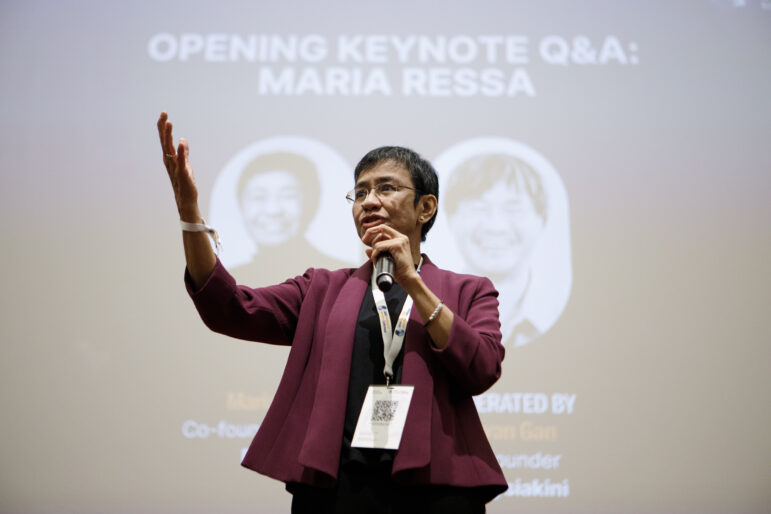
At GIJC25, Nobel Prize Laureate Maria Ressa Calls for ‘Radical Collaboration’ to Combat Disinformation and Preserve Press Freedom

Fighting State Capture Through Collaboration: How amaBhungane Has Redefined Investigative Journalism in Southern Africa

The Power of Collaboration: El CLIP and the Plan to Transform Latin America’s Investigative Ecosystem

The Top 10 Journalism Collaborations of 2025, according to the Center for Cooperative Media

This work is licensed under a Creative Commons Attribution-NoDerivatives 4.0 International License
Republish our articles for free, online or in print, under a Creative Commons license.
Republish this article
This work is licensed under a Creative Commons Attribution-NoDerivatives 4.0 International License
Read Next
GIJC25
At GIJC25, Nobel Prize Laureate Maria Ressa Calls for ‘Radical Collaboration’ to Combat Disinformation and Preserve Press Freedom
In her keynote address, the Rappler CEO issued an urgent call for the investigative reporting community to embrace creative solutions in pursuit of the facts and a sustainable future.
Member Profiles
Fighting State Capture Through Collaboration: How amaBhungane Has Redefined Investigative Journalism in Southern Africa
As well as playing an outsize role in exposing state capture and toppling South Africa’s former president, this newsroom is a champion for investigative journalism in the region.
LATAM Focus Member Profiles News & Analysis
The Power of Collaboration: El CLIP and the Plan to Transform Latin America’s Investigative Ecosystem
CLIP was founded by three leading journalists who shared the conviction that to mirror the transnational challenges journalists face in Latin America, the stories had to be cross-border too.
News & Analysis
The Top 10 Journalism Collaborations of 2025, according to the Center for Cooperative Media
Of note this year are projects tackling everything from cryptocurrency crime to climate action, from transnational repression to immigrant news infrastructure.