

A shot of the conference's namesake at the 2026 Harry Evans Investigative Journalism Summit, London. Image: Courtesy of Truth Tellers, the Harry Evans Investigative Journalism Summit
10 Things We Learned from the 2026 Harry Evans Truth Tellers Summit
Gather many of the world’s leading investigative reporters and editors in one place, and you are going to get some good stories. From Christo Grozev talking about spies and cat videos, to András Pethő on investigative reporting in Viktor Orbán’s Hungary and standing up for your principles as the press freedom environment darkens around you.
Truth Tellers — the Sir Harry Evans Investigative Journalism Summit — also featured a message of support from the Pope, a confession that Reuters Editor-in-Chief Allessandra Galloni keeps the stuffed messenger pigeons used by its early reporters “in the basement,” and news that Matthew Rhys — who played the Russian spy dad in “The Americans” — will play the legendary newspaper editor Evans in an upcoming BBC drama based on his life next year.
From accounts on investigating in Syria after the fall of a dictator, to standing up to tech bros, billionaires, and politicians that would sometimes rather silence the investigative reporting corps, here are some of the things we learned at this year’s gathering.
1. The threat to independent journalism is growing, even in the democratic world. Christiane Amanpour, CNN’s chief international anchor, said that previously many of the risks to reporters had come from “confronting leaders who simply want to kill the messenger and do not want to hear the truth” in the authoritarian world. But the situation is getting more complex: “Now in the democratic world we are under unacceptable threat from leaders who believe we are there to be sycophants and megaphones and bolster them. They don’t like it when we tell the truth,” she said. “We have to understand it’s not our job to be liked by any leader… It’s our job to serve the people, and to speak truth to power.”
2. Journalists need to stand up for the truth to combat mistrust. Patrick Radden Keefe, an investigative journalist at The New Yorker and author of “London Falling” and “Empire of Pain,” said there has been an assault “on reality itself,” caused in part by political leaders who have demonized the press, but also as technology and AI impact peoples’ understanding of what is real and what is manipulated. “I think we need to embrace the idea not just that truth is a defendable philosophical principle, but also that truth is a process, a way of doing your job and showing your work,” he said. “Hopefully, with a like-minded community of people doing this work, with integrity, and holding power to account, we can defend these principles that have gotten us this far.”
3. Write a little bit every day… even if you are in prison. Leopoldo López, the Venezuelan opposition leader, was sentenced to 14 years for taking part in protests against the Venezuelan dictatorship, and spent a number of years in jail before managing to escape the country. Much of that jail time was spent in a cell on his own, in 12 hours of darkness, with “very little contact” with other prisoners or the outside world. “In the beginning, I was able to read and write. They took that away. Having a pen and paper was something of great value. I was able to write a lot because to complain in a military prison, they say ‘do it by writing.’ So I would complain every day, they’d give you a pen and a piece of paper. That meant I could write.” In time, he said, he was able to write a book.
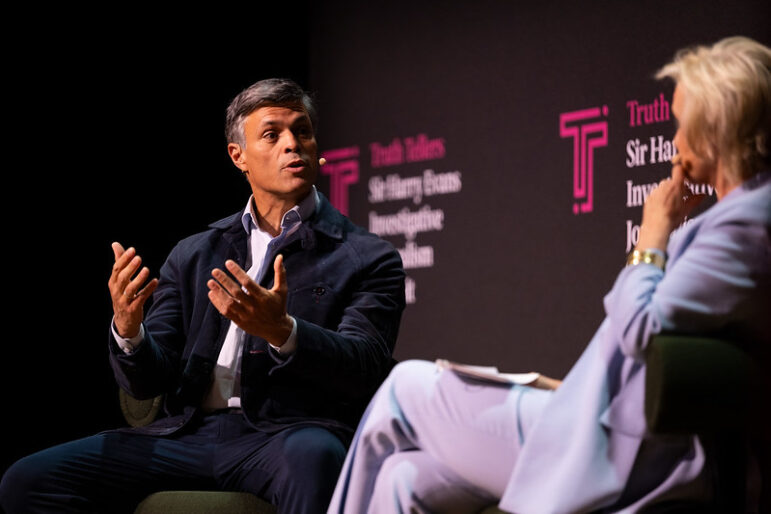
Leopoldo López, who was jailed for several years in Venezuela for protesting the Maduro regime, in conversation with moderator Tina Brown. Image: Courtesy of Truth Tellers, the Harry Evans Investigative Journalism Summit
4. It is always worth learning the tools of the trade, even if you are in a country where you can’t fully exercise them. Alia Ibrahim, the co-founder and CEO of Daraj, a Lebanese investigative site, said she was once asked by some of her students why they should learn how to be investigative journalists, especially living in a country where, at that time, it was so difficult to publish watchdog reporting. She told them: “We do it just to make sure we know how to do it if things get better. And we have actual accountability.” Recent reporting has seen Daraj ruffling feathers in Lebanon — and last year they were hit with 15 lawsuits. One exposé into the wealth of the country’s former central bank governor saw the most powerful man in the country being investigated in six countries and eventually being prosecuted. “In the Lebanese context, this was really the first time that someone who was largely untouchable, one of the most powerful men in Lebanon, was actually being questioned,” she said.
Similarly, András Pethő, founder and co-director of Direkt36, a Hungarian investigative journalism outlet that published exposés during the regime of former strongman President Viktor Orbán, said that there were lessons to be learned in how the Orbán regime had quickly and efficiently destroyed the press upon taking power, dismantling organizations linked to opposition voices and pressuring those that held them to account. “They built a whole ecosystem — we are not talking about just a few outlets leaning to the government — but an ecosystem of hundreds of digital outlets, print, radio, all local newspapers, acting in unison, in one voice, serving the government,” he explained. Only a small number of independent outlets managed to survive. “It was journalists, investigative journalism especially, that functioned as the last line of defense in democracy. All the other democratic institutions were collapsing and crumbling under pressure, we managed to stay and keep journalism alive.”
5. Know that even spies make mistakes. Christo Grozev — lead investigator of The Insider — says he used to have a complex system for tracking down Russian spies, using data from the “gray” market being sold by corrupt officials, but it’s becoming easier because of leaks. “Finding spies is not the problem, once you learn how to identify them, it becomes routine. But figuring out what they are up to is the problem and without that context there’s no story,” he said. Having said that, even spies trained in the art of subterfuge make some jaw-dropping mistakes. In one recent example, he said that after Ukrainian hackers targeted a Russian company that sold Kalashnikov machine guns, he was able to identify hundreds of spies whose identities had been hidden inside the company, thanks to a PowerPoint presentation which detailed their operation. “It’s rewarding, I have to say,” he joked. “Blunder after blunder.”
Speaking about a different story in which he revealed the identity of a Russian agent, he explained how re-releasing old stories in new formats — in this case on YouTube — could bring you new audiences. A video they did about an investigation into a Russian spy who infiltrated NATO — who they dubbed “cat woman” — received millions of views. “Normally my investigations would get a tenth of that. After the video, I got a call from someone in law enforcement from another country. I said ‘I sent you this four years ago?’ They said: ‘Yes, but nobody noticed.’… So my son’s idea to use cat videos as a conduit for serious stories has worked.”
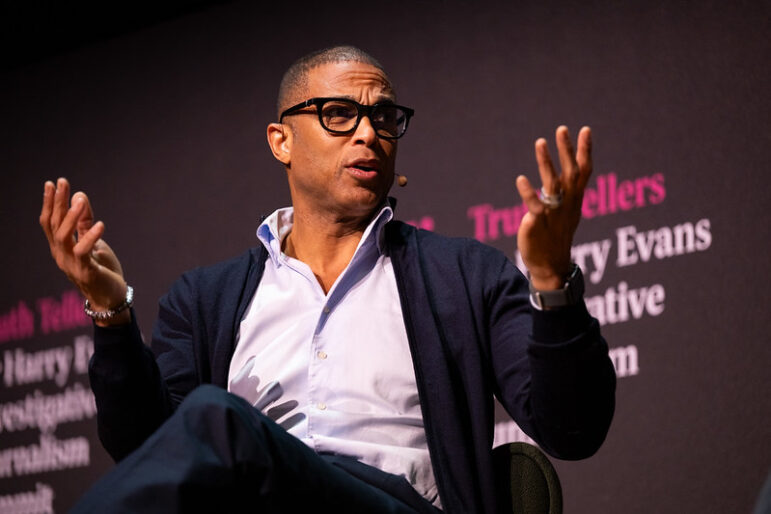
Independent journalist Don Lemon was recently arrested and later charged with civil rights violations for reporting on an anti-immigration protest in Minnesota. Image: Courtesy of Truth Tellers, the Harry Evans Investigative Summit
6. Free speech is worth defending. The former CNN anchor and now solo content creator Don Lemon — who was arrested at a church in Minnesota when reporting on immigration crackdowns in the US — had this to say on free speech: “The real thing that worries me is the attack on the First Amendment and on freedom of the press. The moment people start telling you — as they do in authoritarian countries — what you can report on, where you can report, the whole thing is over for press freedom,” he said. Asked his advice for reporters right now, he said they need to “push back against authoritarianism because that is the death of journalism.”
7. Doing it alone is stressful. Lachlan Cartright, the founder of Breaker Media, which covers media, power, and culture in downtown Manhattan, said stepping out on his own has been tough. “What little bit of savings I had for a down payment on an apartment in NYC, I used to start Breaker… The first four months, no joke, I was waking up screaming in the middle of the night, screaming my guts off with stress, thinking I was going to lose my life savings, thinking ‘Breaker is not going to make it.’” However, by the time of their first anniversary this past February, he could say that they are profitable.
“You live and die by your paid subscribers going up,” seconded his co-panelist Jim Waterson, the editor of London Centric, “and the fear they are going to walk away from you is real. The churn is very real… I haven’t taken a holiday since summer ‘24.” However, he said his project, which focuses on London, is now able to support two members of staff plus his position, with 5,000 people paying for a newsletter (though he still has to respond to tip-offs while trying to get his kids in the bath).
8. Seize the moment. Lori Hinnant, a Pulitzer Prize-winning investigative editor from Reuters, says that moments of political change come quickly, and reporters need to act fast. “The window is very, very small. These moments of transition are always the most amazing and seismic moments in journalism,” she said, speaking about a Reuters approach to investigating in Syria after the fall of Assad. “You have a very small window before the power consolidates again. During that window is when you can uncover what happened in the past and get a view on what is yet to come.
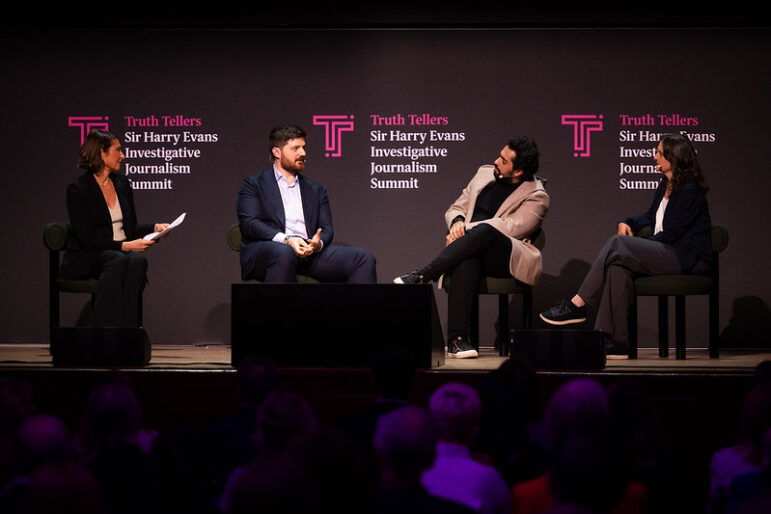
Discussing the window of opportunity for reporting in Syria after the fall of Bashar al-Assad (from left to right): BBC Europe Editor Katya Adler (moderator), Reuters correspondents Timour Azhari and Feras Delatey, and Reuters Investigative Editor for Europe Lori Hinnant. Image: Courtesy of Truth Tellers, the Sir Harry Evans Investigative Journalism Summit
When the team got into Syria, they wanted to find answers to what had happened to those who had disappeared under the old regime. “We started photographing documents from these offices that were just in chaos, trying to figure out if we could uncover what had happened to all the people who had disappeared under Assad. No one even knew how many people had been killed, had vanished, no one could see the paperwork,” she said. The team took the photographs, the data team categorized them, archived them, and started to see the same name, of a colonel, appearing in relation to the bodies. A tip-off about a mass grave “somewhere in the desert outside of Damascus” arrived around the same time, and through painstaking research, and by pouring over hundreds of satellite images dating back years to look at changes in the earth, they found “that this was not a mass grave for the newly dead, this was an entire conspiracy to empty one mass grave that had been exposed by human rights activists and shift thousands of bodies to a place where they thought no one would ever find them again.”
9. “There’s no better time to be a journalist” but… Nobel Peace Prize laureate Maria Ressa offered both a warning and a message of hope. “You are targeted if you are a journalist because you hold the line, because we determine fact from fiction, and none of the tech that rules our world is actually anchored in facts,” said Ressa, cautioning that the current fusion of state power with tech power is reaching a dangerous tipping point. But having spent years facing the threat of jail for the work her organization, Rappler, published in the Philippines, she said there are still signs that accountability reporting is working. “This is a time when we are not sure if journalism is going to survive, certainly our data is telling us it’s existential for us… but before I depress you all, it’s been a decade since the attacks on Rappler began… I am here. Out of the 11 cases, I have one left — so I have to ask the Philippine Supreme Court for approval to travel, after the Nobel thankfully they gave me permission to travel. The man who tried to jail me, Duterte, is in prison in The Hague.”
“Even as we talk about how difficult it is to be a journalist, there’s no better time to be a journalist… you have to throw out the way you’ve done things in the past and you rebuild better,” she said.
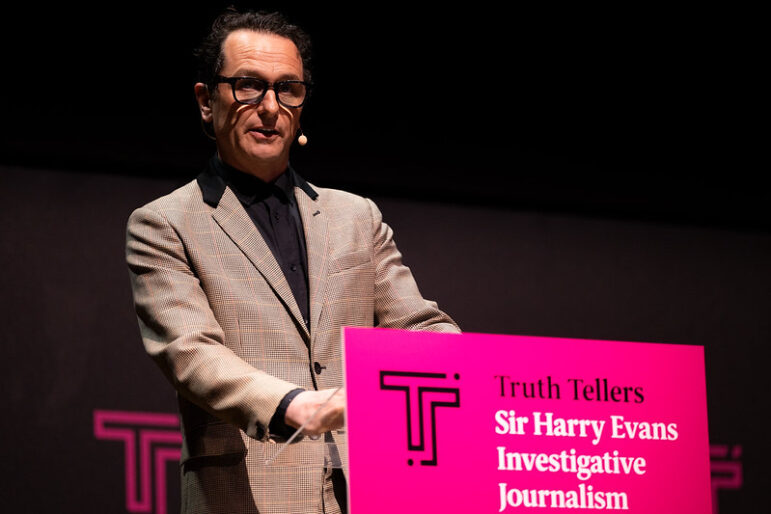
Actor Matthew Rhys, who will portray legendary editor Harry Evans in an upcoming BBC drama, addressed the conference, reading from Evans’ memoir. Image: Courtesy of Truth Tellers, the Sir Harry Evans Investigative Journalism Summit
10. Harry Evans’ words have stood the test of time. The conference ended with Matthew Rhys reading an excerpt from Evans’ memoir, “My Paper Chase,” which opened with young Evans coming across survivors of the Second World War battle of Dunkirk on a Welsh beach. The soldiers were “scattered about the sands,” “sprawling clumps of men.” As his dad spoke to them, a young Evans realized, with discomfort, that the great success of the battle being portrayed in the British papers was not the whole story. “What if you couldn’t trust a newspaper to tell the truth and nothing but the truth?” Rhys read. Rhys ended with these words from the book, some of which were adorning the walls of the conference as a kind of mantra: “No government can govern well without reliable independent reporting and criticism. No intelligence system, no bureaucracy, can offer the information provided by free competitive reporting. The cleverest agents of the secret police state are inferior to the plodding reporter of democracy. And so my conviction remains: Things are not what they seem on the surface. Dig deeper, dig deeper, dig deeper.”
 Laura Dixon is an associate editor at GIJN and a freelance journalist from the UK. She has reported from Colombia, the US, and Mexico, and her work has been published by The Times, The Washington Post, and The Atlantic. She has received fellowships from the IWMF and the Pulitzer Center.
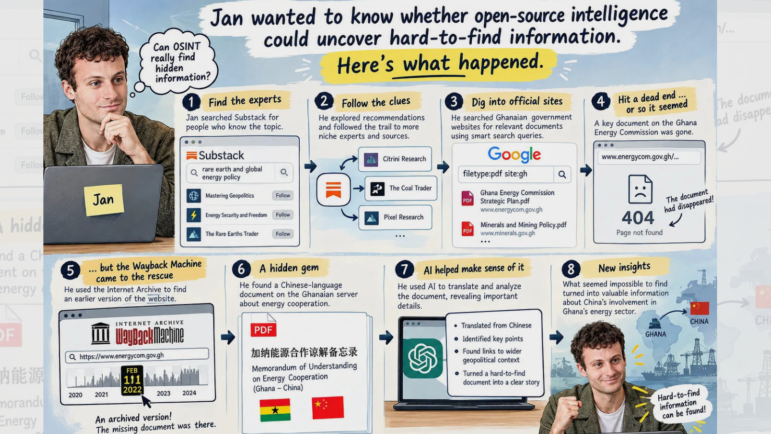
International Research Guide: How to Find Experts and Hidden Documents on Any Topic
Guide to Investigating Tech and AI in Modern Warfare
Turning Copernicus Satellite Data Into Public-Interest Climate Stories
10 Practical Tips for Verifying Scientific Claims

Journalism in the Crucible: Seven Key Takeaways from 2025 Harry Evans Truth Tellers Summit
At GIJC25, Nobel Prize Laureate Maria Ressa Calls for ‘Radical Collaboration’ to Combat Disinformation and Preserve Press Freedom

Reporters Without Borders: Amid Widespread Erosion of Democracy, 2026 World Press Freedom Index Drops to 25-Year Low
Why Investigative Reporters Should Look for the ‘Termites’ Eroding Democracy

This work is licensed under a Creative Commons Attribution-NoDerivatives 4.0 International License
Republish our articles for free, online or in print, under a Creative Commons license.
Republish this article
This work is licensed under a Creative Commons Attribution-NoDerivatives 4.0 International License
Read Next
News & Analysis
Journalism in the Crucible: Seven Key Takeaways from 2025 Harry Evans Truth Tellers Summit
In London, leading reporters and editors met to discuss the challenges reporters face today, from legal threats to security risks to a combative new president in the White House.
GIJC25
At GIJC25, Nobel Prize Laureate Maria Ressa Calls for ‘Radical Collaboration’ to Combat Disinformation and Preserve Press Freedom
In her keynote address, the Rappler CEO issued an urgent call for the investigative reporting community to embrace creative solutions in pursuit of the facts and a sustainable future.
Document of the Day Press Freedom
Reporters Without Borders: Amid Widespread Erosion of Democracy, 2026 World Press Freedom Index Drops to 25-Year Low
In its 25th edition, the Reporters Without Borders assessment notes a “widespread decline” in the global state of media freedom — but notes a few encouraging signs of optimism.
GIJC23 Reporting Tools & Tips
Why Investigative Reporters Should Look for the ‘Termites’ Eroding Democracy
Four editors — and veterans of the global push-back against autocracy — discussed effective methods for holding the enemies of democracy accountable.