
‘To Convince Someone to Speak, Explain How Their Responses Will Improve the World’: Investigating Power and Influence from Moldova
Read this article in
Founded in 2014, RISE Moldova describes itself as not just a newsroom but a community of investigative journalists, programmers, and activists. It is based in Chisinau, the capital of the Republic of Moldova, but its sources, collaborations, and topics often stretch across borders. Vladimir Thorik is the editor of RISE Moldova’s Russian-language version.
In Moldova, Russian is every ninth resident’s mother tongue, and an even larger share of the population uses it habitually, although just over 3% identify as ethnic Russian. Relations with Russia fluctuate depending on who is in power, but its influence casts a shadow over the country’s political climate, journalists’ investigative priorities, and Thorik’s own identity. “I am a Russian-speaking Ukrainian-Moldovan. I live in Moldova, I am an ethnic Ukrainian, but I speak Russian,” he says.
“Russia has discredited everything that Russianness and being Russian-speaking mean,” he continues. “But I have an understanding of the context in which Russia operates, and I have sources. We work with the environment surrounding pro-Putinist parties in Moldova and elsewhere. That’s why I focus, among others, on the topic of Russia’s influence.”
In their impactful 2020 investigation with Dossier Center about the Kremlin’s influence in Moldovan elections, Kremlinovici Leaks, the team used video footage, flight records, undercover reporting, and exclusive access to a mobile device previously used by their investigation’s subject, former president Igor Dodon, to communicate with Russian contacts. RISE tracked down eight undercover ‘election technology advisers’ from Russia seen meeting Moldovan politicians. RISE Moldova’s reporters explained at the time that an anonymous intermediary delivered the phone to them to analyze before taking it back. Dodon’s competitor Maia Sandu won the next election, was later re-elected, and is currently in office. Dodon is subject to an ongoing bribery trial. He denies the charges.
RISE collaborates with local, independent investigative newsrooms in Kyrgyzstan, Uzbekistan, Kazakhstan, Armenia, Georgia, Ukraine, and the Baltic States. The newsroom also maintains a database of ‘people of interest’ on the Open Sanctions website.
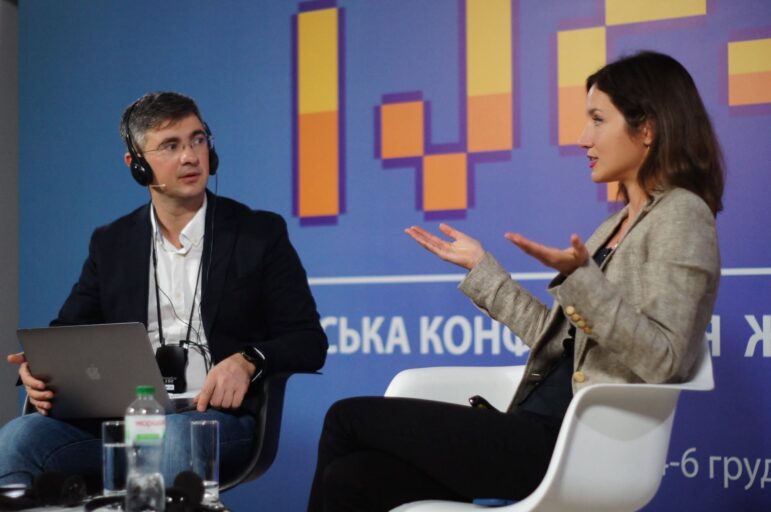
Photo: Courtesy of Thorik
In 2023, RISE Moldova was a finalist for the Daphne Caruana Galizia Prize for Journalism. In 2026, a large international consortium that RISE was part of received an IJ4EU Impact Award for Bad Practice, an investigation into doctors who continue to practice despite alleged wrongdoing.
Thorik’s beat — the movement of people and goods across borders, especially for illicit activity — has new geopolitical relevance. He has observed his longstanding professional interest in organized crime and his newsroom’s new focus on Russia’s influence operations blend and merge.
“Russian special services active locally have, over the past five years, been relying on organized crime for money transfers and using organized crime infrastructures, so to speak. An average Moldovan smuggler can be engaged for bribing officials: he will know how to do it, he will know how to pay off an official, how to convince them to take money and close their eyes when faced with some offence.”
“We understand that all Russian propaganda is about distorting real facts. And in journalism, we are in the business of facts,” Thorik says. “Studying our experience, neighboring countries can understand how Russia can influence their countries.”
GIJN: Of all the investigations you’ve worked on, which has been your personal favorite and why?
Vladimir Thorik: We published an investigative cycle named Kremlinovici. We started it back in 2020, and it continues. We explained how Russia employs special services to influence politicians and public opinion. It convinces us once again that there’s no such thing as soft power in Russia. There’s only bribery of local politicians and the buying of public opinion to spread its propaganda narratives.
We managed to access the former president’s phone. [This is how we found out] that the former president gave himself the nickname [as a chat alias] ‘Kremlinovici’— that this is how he felt about himself. I could easily verify the calendar of meetings in this phone, his flights to Moscow, which were on his phone, against my separately compiled dataset on his flights to Moscow.
Since then, Kremlinovici has become a neologism. We uncovered a new phenomenon — how Russia uses various foreign local political commentators. We studied how Russia conducts these [influence] campaigns, and this can be interesting to other countries that are also experiencing Russia’s influence.
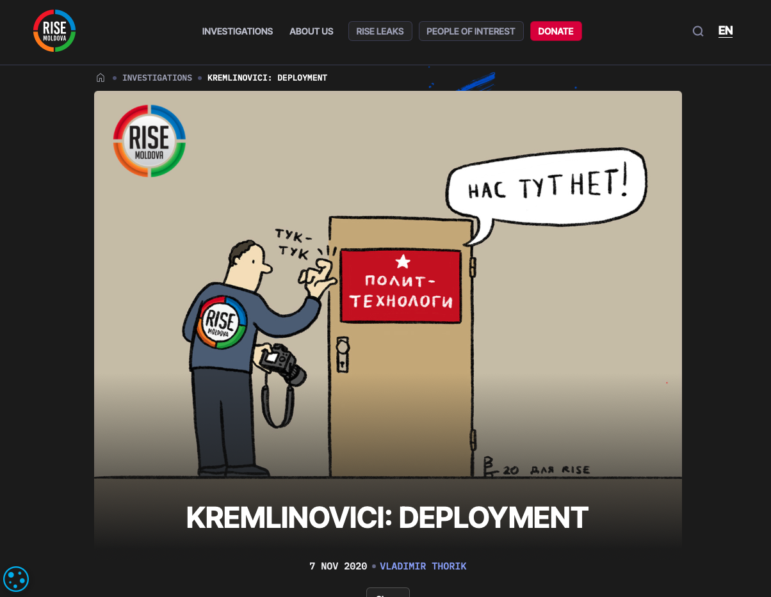
Vladimir Thorik’s Kremlinovici Leaks investigation revealed a new type of political influence campaign by the Russian government. Image: Screenshot, RISE Moldova
GIJN: What are the biggest challenges in terms of investigative reporting in your country?
VT: The main difficulty is related to the fact that Moldova is the poorest country in Europe and the least interesting country to the rest of the world. The greatest challenge is remaining relevant to the rest of the world and finding topics that interest partners in other countries. For this, we must find some kind of Moldova-linked schemes across Europe to show that organized crime and special services like Russia’s are using Moldova to influence other countries, to prove that Moldova is significant in money laundering, smuggling, and thus to convince colleagues to collaborate with us. Unfortunately, Moldova plays a role as a transit country for organized crime.
GIJN: What’s been the greatest hurdle or challenge that you’ve faced in your time as an investigative journalist?
VT: Remaining relevant is our most pressing challenge, given that we work in the context of a war. A couple of days ago I came back from Kyiv, seeing how the capital of Europe’s largest country is brimming with cars and people, but at the same time you see jet-powered military drones and rockets flying into the city. You see that a drone is within a 6-kilometer (3.7 miles) distance from you, but you are stuck in traffic next to a fuel tanker. Now the drone is within a 2-kilometer radius, now it’s within a 1-kilometer radius, and its trajectory shows that it’s flying right at you. It’s not necessarily flying at you, it may fly past you — and, surely, it did, as I’m here having this conversation. The threats that investigative journalists working in Ukraine face are a whole different level. That’s a threat to one’s physical survival.
Upon return to Moldova, you reassess your own threats in peacetime. You understand that the challenges are not court cases or intimidation by some madmen — the challenge is staying relevant in the context of working next to the frontline, under the influence of Russia and the consequences of Russia’s aggression against Ukraine. It’s our call to take up regionally important topics, given that Moldova does not exist in a vacuum — it exists in a regional context.
There’s a challenge of being irrelevant when you explain important topics like corruption if you lose sight of the regional context.
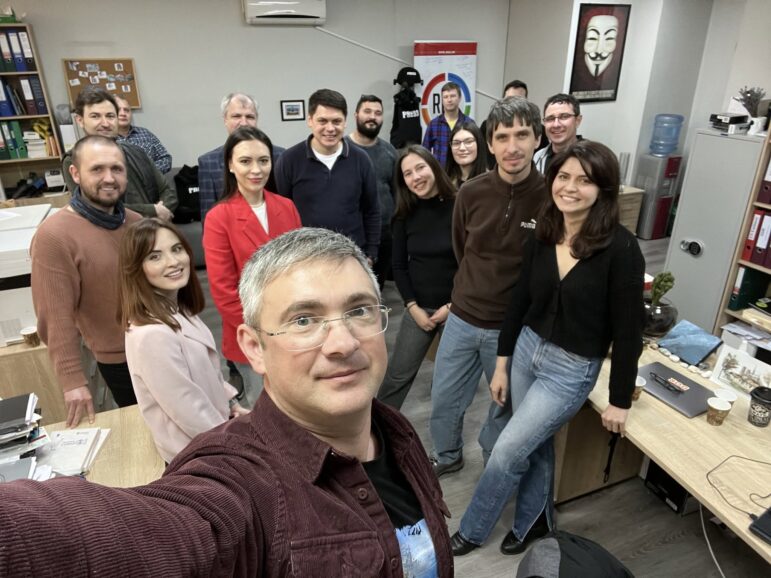
The RISE Moldova team. Photo: Courtesy of Thorik
GIJN: What is your best tip for interviewing?
VT: The greatest enemies of investigative journalists are laziness and cowardice. If a journalist is not too lazy to study large datasets the way one would sift sand for gold, and is not afraid to put questions to the most evil gangster, this journalist will be successful.
Many people, especially offenders, regret their choices, but their lives pushed them into organized gangs and such. For example, I once did a story about a Moldovan mercenary [fighting with pro-Russian separatists in Ukraine alongside Russian troops in the years before the full-scale invasion in 2022]. He was in combat against Ukraine in 2014-2015. How did I convince him to be interviewed? I told him, “Listen, do you actually like war?” He said no. “Give me an interview to help others not make the same mistake and not to enter this war.”
As a rule, a journalist must explain to the interviewee the importance of their responses for the world. You’re not eliciting their responses for yourself — it’s none of your business. You are together engaged in improving the world.
GIJN: What are the most helpful reporting tools, databases, or apps in your investigations?
VT: I don’t think that a single database can be a journalist’s lifesaver. A journalist, in my opinion, must collect diverse datasets. Even if today the data is of no use, looking at your data archive a couple of years later, you may find interesting answers and puzzle pieces you could not resolve.
It’s helpful for us to consolidate different datasets, such as border crossings. Sources help us with [access]. There are databases that show what people and what goods are crossing state borders. This way we could reveal, for example, when the former president Dodon went to Russia.
Of course, it’s worth using GetContact, PimEyes for face recognition, and so on. It’s worth checking out datasets, tools, and instruments that help identify people, company management, border crossings, and movement of goods across national borders.
A journalist should keep a personal archive with diverse datasets, which can also be shared with colleagues. Every journalist specializes in a certain theme. For example, I specialize in tracking how goods and people cross borders. Another colleague specialises in some internal economic aspects. Yet another specialises in tracking Russian mercenaries participating in war crimes. Sometimes, searching my datasets, I find some interesting and critically important materials for my colleagues. We can write to each other like we’re ChatGPT: “Is this company in your dataset?”
GIJN: What’s the best advice you have received thus far in your career, and what words of advice would you give an aspiring investigative journalist?
The most valuable advice I received from an older journalist at my newsroom at the time was, do what you can with what you have, where you are. That is, if you work in a city newspaper, you must inform your audience on what’s important for them. Once you transition to a national medium, you must use the instruments available to you better than anyone else, for the benefit of the national audience. If you stepped into the international market, you must develop your topic like no one else. You must write it up and prove it fully and precisely.
GIJN: Who is a journalist, in Moldova or globally, you admire, and why?
VT: Looking close to Moldova, there is the Romanian journalist Paul Radu. He’s excellent; he’s one of the founders of OCCRP and a great example of adopting innovation in investigative journalism. Paul Radu led the introduction of data visualization at OCCRP and went on to work on gamifying journalistic investigations. His striving to place investigative journalism in such a format is a great example of an innovative journalist.
The second journalist is Andrei Zakharov, who works brilliantly with databases. He’s a Russian journalist who has left Russia. I consider him interesting and important. These journalists are regionally and globally important — journalists worth following.
GIJN: What is the greatest mistake you’ve made and what lessons did you learn?
VT: Not exactly a mistake, but every time I am preparing an investigative story for publication, I am mistakenly livid at the fact-checker who demands proof for each statement. This naive question, “How do you prove it?” gets on one’s nerves. Every time, I’m ready to argue with the fact-checker, block their phone number, and stop talking to them. But every time the fact-checker finds mistakes and inaccuracies in our investigations. So this [angry] reaction is mistaken and inadequate.
It’s when you want to publish as soon as possible, but the fact-checker keeps making demands: how did you count this? How do you prove that this person was a mayor during this period? I can’t do much about anger at the fact-checker — I’m only human. But it’s much better to be angry in a newsroom than apologise to your audience later. So we don’t have mistakes, because we have a protocol for security and fact-checking, which we have adopted from OCCRP. This helps us avoid mistakes seen in other newsrooms.
GIJN: How do you avoid burnout in your line of work, individually and in a team?
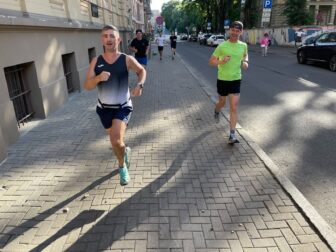
Photo: Courtesy of Thorik
VT: The first rule, ideally, is that you should rest before getting tired, that is, when you keep working and working, and fatigue hits, making you inefficient. It sounds banal, but it is important to maintain beneficial habits in life. For example, I run almost every day. In a week, I run 80-100 kilometers (50-62 miles). One must plan and maintain slots for sport and personal life. When one falls into depression, one’s efficiency drops to zero. To prevent this from happening, one must plan recovery and stay active.
I’ve run 15 kilometers today, but unfortunately, here I am, smoking. Then again, I would probably feel worse if I were smoking during this conversation without having run 15 kilometers.
GIJN: What about investigative journalism do you find frustrating, or do you hope will change in the future?
VT: Firstly, I am frustrated that some newsrooms do not fact-check their investigations. This results in inaccuracies and discredits investigative journalism itself. Fact-checking is even more important as we face deepfakes and manipulation of evidence. It is not enough to conduct a good investigation — you must be accurate and certain that you are not publishing falsehoods.
Secondly, it’s the emotional tone of some investigations and some personal reflections. In my opinion, this shouldn’t be done, as investigative journalism is about facts and not opinions. There are other genres for opinion journalism — columns, essays, political commentators’ opinions. Investigative journalists are not political scientists. But some journalists who call themselves investigative add their own assessment. That’s what’s different about quality journalism — facts must speak for themselves, without the author’s opinion or emotional hue.
 Daiva Repečkaitė is a freelance and investigative journalist and photographer currently based in Malta. She has contributed to major international publications including The Financial Times, The Guardian, Politico, OCCRP, EUobserver, and Foreign Policy
International Research Guide: How to Find Experts and Hidden Documents on Any Topic

Guide to Investigating Tech and AI in Modern Warfare
Turning Copernicus Satellite Data Into Public-Interest Climate Stories
10 Practical Tips for Verifying Scientific Claims

‘Obsession Is What Investigative Journalism Is Really About’
Can We Gamify That? The Innovators Turning Investigations on Spying Scandals and Vote Rigging into Video Games
Despite Detention and Forced Deportation, Still Investigating High-Level Corruption in Kyrgyzstan
Curiosity and the Long Road to the Truth: Lessons from an Award-Winning Portuguese Reporter

This work is licensed under a Creative Commons Attribution-NoDerivatives 4.0 International License
Republish our articles for free, online or in print, under a Creative Commons license.
Republish this article
This work is licensed under a Creative Commons Attribution-NoDerivatives 4.0 International License
Read Next
10 Questions
‘Obsession Is What Investigative Journalism Is Really About’
The investigative journalist — who has covered topics from ISIS to troll armies — talks to GIJN about his novel reporting methods and keeping investigative journalism alive in Turkey.
Can We Gamify That? The Innovators Turning Investigations on Spying Scandals and Vote Rigging into Video Games
From Colombia to Nigeria, outlets are finding new audiences by adapting watchdog reporting to create digital games.
10 Questions
Despite Detention and Forced Deportation, Still Investigating High-Level Corruption in Kyrgyzstan
Bolot Temirov has led fact-checking and investigative journalism efforts to uncover high-level corruption inside Kyrgyzstan.
10 Questions
Curiosity and the Long Road to the Truth: Lessons from an Award-Winning Portuguese Reporter
The journalist explains how he has built a career around long-form investigations, and delves into the process behind his recent book exposing the far-right in Portugal.