
Image: Deborah Lupton (Better Images of AI), Creative Commons BY 4.0 license
Techniques for Investigating Data Centers
Read this article in

Resource Guide
Tech Focus Project

Resource Guide Chapter
The Investigative Agenda for Tech and AI Journalism
Resource Guide Chapter
Radical Collaboration: Why It’s the Antidote to Big Tech

Resource Guide Chapter
Holding the Power of Big Tech Accountable
Resource Guide Chapter
Gabriel Geiger Shares Tips and Tools on Investigating Government Use of AI

Resource Guide Chapter
Making Tech Surveillance a Reporting Beat
Resource Guide Chapter
John Scott-Railton Shares Tips and Tools to Protect Yourself Digitally

Resource Guide Chapter
Investigating Location-Tracking Surveillance Systems

Resource Guide Chapter
Investigating Disinformation in the Age of AI
Resource Guide Chapter
Karen Hao on AI Narratives Reporters Should Deconstruct

Resource Guide Chapter
Leveraging AI and Technology to Investigate Power
Resource Guide Chapter
Tips for Using AI as a Reporting Tool to Uncover Wrongdoing
Resource Guide Chapter
Gina Chua on 4 Tips for Innovative Journalism in the Age of AI
Global Academy Webinars Resource Guide Chapter
Webinar: Detecting AI-Generated Content – Updated Tools and Techniques
Resource Guide Chapter
Athandiwe Saba Shares Practical Tips on Investigating Big Tech in Africa

Resource Guide Chapter
Investigating the Human Cost of Tech
Resource Guide Chapter
Techniques for Investigating Data Centers

Resource Guide Chapter
Credits and Acknowledgments


Bloomberg’s seminal data center investigation in 2025 — AI Is Draining Water from Areas That Need It Most — made the alarming finding that two-thirds of new data centers since 2022 have been built in water-stressed areas.
Data centers are remote data storage facilities whose massed rows of servers demand vast amounts of power and water for cooling, and a development boom driven by AI has already ballooned their number beyond 8,000 globally, and their investment outlook to US$3 trillion by 2030.
At the recent NICAR data journalism summit in the US, Bloomberg reporter Michelle Ma revealed that her colleague, data reporter Leonardo Nicoletti, obtained the water impact data in the following way: First, he mapped locations via a database of some 8,000 data centers obtained from market intelligence firm DC Byte — a service that shows planned and existing projects globally. Nicoletti then overlaid that onto open source water stress data from the World Resources Institute’s Water Risk Atlas, which also quantifies competition over water resources between different sectors.
Meanwhile, in February, Floodlight revealed that Elon Musk’s xAI was brazenly defying environmental regulations at its Mississippi data center — which is one of the largest such facilities in the US — by deploying a thermal drone to show that more than a dozen unpermitted gas turbines were spewing out pollution. (In March, a state environmental regulator granted xAI an official permit to operate the turbines, despite overwhelming local opposition.) Floodlight has also released a new short video documentary on that investigation.
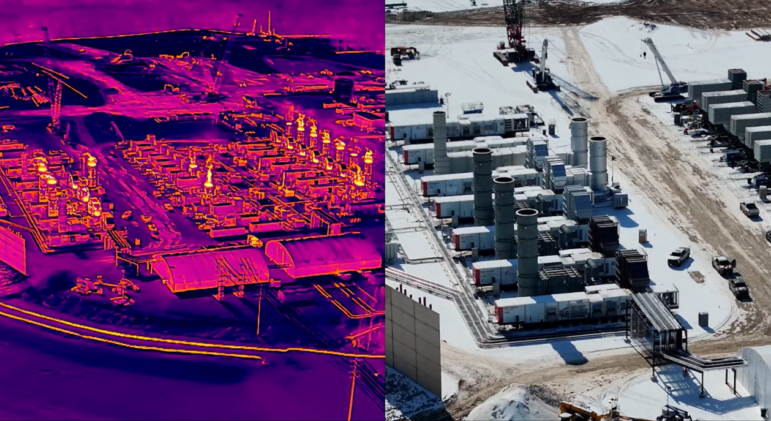
Thermal drone imagery shows unpermitted gas turbines spewing pollution at xAI’s Southaven Gas Plant in Mississippi. Image: Courtesy of Evan Simon, Floodlight
At a session on the topic at NICAR, Ma and two other speakers, Forbes reporter Phoebe Liu and Mirro Indy reporter Enrique Saenz, revealed that there are diverse approaches for digging into these resource-hungry facilities, which are often fast-tracked while bypassing normal building permissions, environmental regulations, and resident consent.
As the Bloomberg story noted: “Each time you ask an AI chatbot to summarize a lengthy legal document or conjure up a cartoon squirrel, it sends a request to a data center — and that strains an increasingly scarce resource: water.”
Because data center projects are so similar around the world, one central takeaway from the panel was for reporters to read existing investigations carefully and adapt their methodologies and sourcing patterns in their own global regions. For instance, Nicoletti said his analysis of global data showed that the US trend of data centers increasingly being located in water-stressed areas was similar around the world, and that reporters in various countries could pursue local stories on resource impacts based on this troubling pattern. (See his global chart, below.)
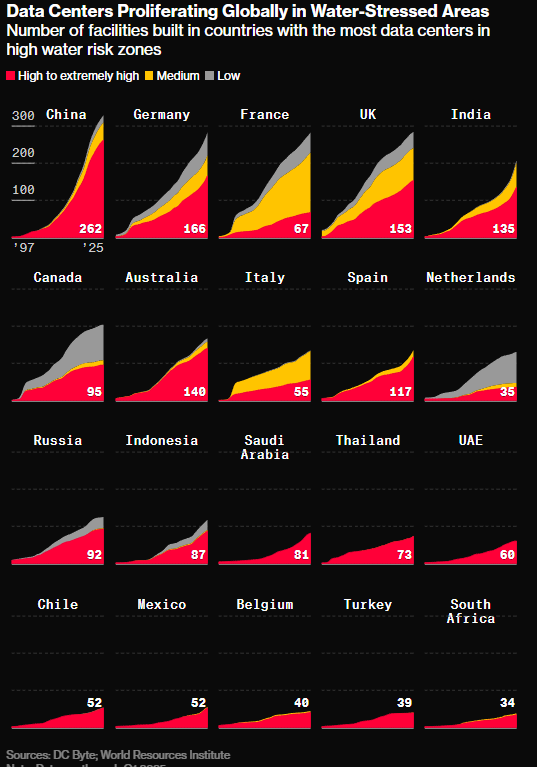
Bloomberg’s data analysis shows a global pattern in which data centers are increasingly sited in water-stressed areas around the world. Image: Screenshot, Bloomberg News
Indeed, the Bloomberg water story also revealed that “In China and India, an even greater proportion of data centers are located in drier areas compared to the US.”
Nicoletti’s analysis included the use of an algorithm to map water-stressed areas within a 30-mile (48-kilometer) radius of a data center, each of which was then assigned a maximum water stress score.
Researchers also note that these projects feature similar greenwashing claims, with dramatic contradictions on power sourcing between press release claims and actual installation, which often involves building their own gas-fired power plants. A recent report from Cleanview — which tracks clean energy and data center projects — noted the following: “Nearly every project we reviewed mentions renewables, hydrogen, or nuclear in its public announcements. But the equipment actually being installed in 2025 and 2026 is almost entirely gas-fired. Renewable capacity, where committed, is scheduled for 2028 or later. Nuclear is a decade away.” (Cleanview offers a free trial, and reporters can reach Cleanview researchers via this link.)
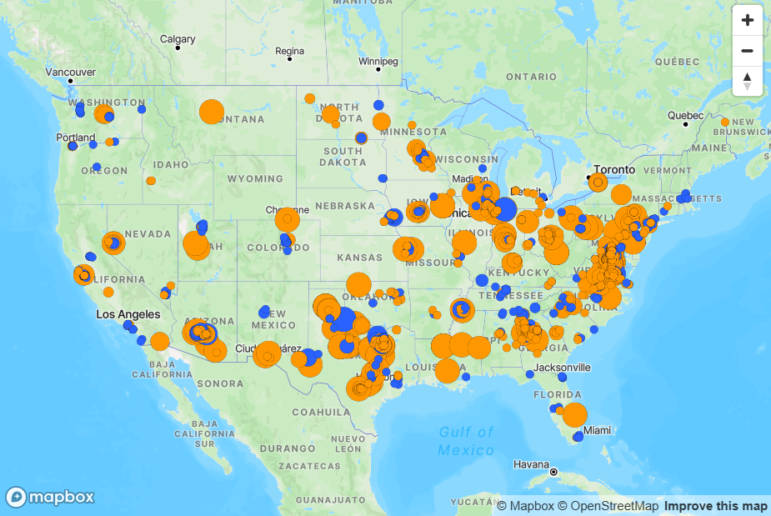
Journalists on the data center beat in the US recommend the Cleanview power projects data service, including maps like this one — showing both operational data centers (blue) and planned centers (orange). Image: Screenshot, Cleanview
Ma pointed out that it is no coincidence that award-winning data center stories tend to feature multiple bylines, and that reporters with complementary skills should team up to tackle this new industry.
“Each story we submitted for the Philip Meyer (data journalism) Awards had at least three reporters on it, with very different backgrounds and expertise,” she explained. “I’m a climate/clean energy beat reporter — but I don’t have a relationship with the hyperscalers. But Dina Bass does — reporting on Microsoft and Google every day. Leo, our data guy, can do all the Python scripts and the coding. We also have data visualization experts.”
In a separate interview, Floodlight reporter Evan Simon told GIJN that thermal imagery can not only reveal environment and legal violations — as it did at Musk’s xAI Southaven Gas Plant — but can also help change public understanding of the nature of these facilities.
“When most people think of a data center, I think they most often imagine a massive warehouse-like structure with no windows. In reality, they are increasingly looking like power plants, and thermal imaging really makes that much more clear,” Simon explained. “While thermal imaging doesn’t visualize specific pollutants the way expensive optical gas imaging can, it can tell you if energy-generating equipment — such as gas-powered turbines, diesel generators, etc. — are operating at the time.”
However, Simon revealed that thermal drones involve an onerous operating process, making them a rare use case, and ordinary thermal cameras a better bet for those who can access sites on the ground. “To lift the thermal drone in the air that day in Mississippi, I had to get a ‘Part 107’ drone license, log extensive practice flight hours, research the airspace, obtain all necessary permissions, locate a safe and legal place to fly the drone from, all before coordinating the thermal drone rental itself,” he explained. “There are aerial intelligence firms that a newsroom could hire to cut down on the time, but [that’s costly, and] it was important for our newsroom to control the chain of custody of the images.”
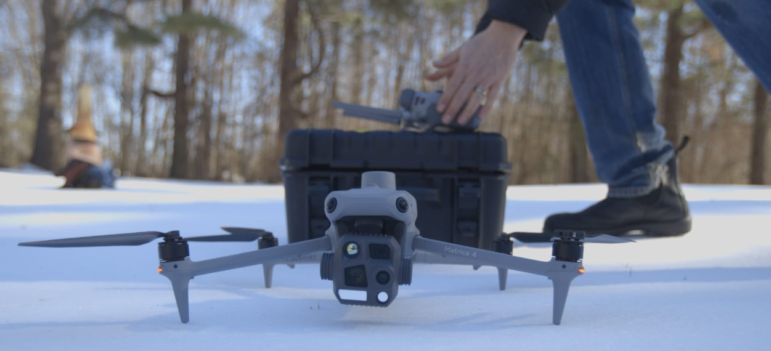
Floodlight’s sEvan Simon unpacks a rented thermal drone for his investigation into xAI data center operations. Image: Courtesy of Evan Simon
Panelists at NICAR suggested several places to start on these investigations:
- Smaller project partners. With information from “hyperscaler” companies — whether Microsoft or Google or Meta — often difficult to acquire, Ma said the myriad smaller partners on these projects offer good sourcing opportunities. “We had a relationship with one of the companies involved in one project, and they kind of tipped us off to the deal,” she recalled. “Even though you might have secretive parties, data centers need a lot of things: they need real estate; water; energy; batteries; lawyers; they’ll have relationships with the local utilities. Some of these interested third parties will talk to you, because they want press.”
- Research and data. Panelists noted that many university resource departments and civil society groups are actively researching this industry, and often write their own detailed explainers, like this one on water consumption trends in The Conversation. Reports from the International Energy Agency are helpful, while hydrologists, public health professors, collaborative media partners, and clean energy experts at universities have proven to be key sources in these investigations. And Ma stressed that market intelligence firms may be willing to share their proprietary data on data center development when approached by reporters.
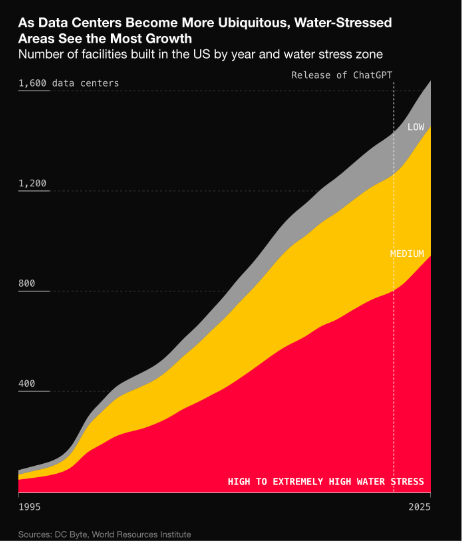
Composite data analyzed by Bloomberg showed the AI-driven data center build-out increasingly occurring in water-stressed areas. Image: Screenshot
- Data center entrepreneurs. Said Liu: “It’s also important to talk to the entrepreneurs behind these companies building the data centers. These are not just the hyperscalers and big tech, but also the pick-and-shovel players — the intermediaries that buy infrastructure from Nvidia, and lease it out to hyperscalers and smaller AI startups. Even if you’re skeptical about their personal motives, it’s important to speak to these people and understand how they think.” Liu said financial disclosures — such as SEC filings in the US — can also be helpful for revealing financing channels and tax breaks, “which means money from [taxpayers].” Liu added: “I found it’s a good use case for AI chatbots, to ask: ‘Can you help me break down this really legalese section of this SEC report,’ — and then to take that to an expert in the field to verify if that’s correct.” Other brainstorm questions include: Who is disproportionately profiting from the AI data center boom? How did they get there? Who might get left out and why? What are the risks?
- Tips and human sources. “Another way is just talking to people — and often you can get sources, because, like many of us, a lot of people are concerned AI will take our jobs,” Ma noted. A seemingly simple recent Bloomberg story on two dormant data centers attracted widespread attention because it showed that these facilities are so electricity-hungry that even Santa Clara, California — the global AI capital — had run out of power capacity for its own AI data centers. Ma said the story came from an offhand tip. “One of our colleagues had been talking to a real estate developer, and this person off-handedly mentioned that there were these two data centers in the same town as Nvidia that are fully built, but they can’t move in because they can’t get access to power. We went to the municipal utility, and said we heard they’ve applied for power but can’t get it, and they confirmed that was true.”
- Public records requests. Said Simon: “Once I’m interested in a facility, I tend to rely heavily on public records requests to state environmental agencies or local municipalities for their communications with the project’s owners or builders. Those troves provide a lot of excellent information on the road to construction, current status, on-site energy generation, the permitting process involved, and any public comments that have been submitted about them.”
- City council meetings and public complaints. At a local level, Saenz noted that opposition to data centers among residents often involves concerns about higher electricity costs, reduced air quality, and “just the way these things are pushed through,” with little notice or detail typically provided by developers. He said resident groups and environmental groups often merge within days of project announcements, and that their meetings offer rich leads for local reporters. “There has been fierce opposition to every single data center proposed in our area [Indianapolis],” said Saenz. “Because they file their applications in a very limited timeframe… there is the public suspicion that ‘they’re trying to trick us.'”
- Lawsuits and attorneys. The panel noted that lawsuits involving proposed data centers generally involve one of these: residents versus data centers; developers versus cities; or zoning disputes where municipalities sue developers or higher levels of government. Notably, Ma said data center opposition does not track with political affiliation, which underlined its importance as a local investigative topic. “When other big companies come into a small city, they’re taking up more resources but they’re often providing hundreds of workers,” Ma added. “Data centers are different, in that it’s giant real estate taking up a lot of resources, but how many people actually work at these centers, with their rows and rows of servers? That’s where you see a lot of local opposition.”
- Finding large property purchases via open source tools. Panelists noted that free tools such as OpenCorporates are useful for linking project entities with their ultimate owners. “Google is not going to buy a piece of land and say Google owns it; they will register things under LLCs with other names — often names that seem environmentally oriented,” Ma said. “So, instead, [a subsidiary such as] Deep Meadows Ventures LLC will apply for permits and zoning changes. Then you have the LLCs that own the properties themselves, which are often managed by data center developers that no one has ever heard of. If you find LLCs asking for massive zoning changes or buying large swathes of land, you can often check those with OpenCorporates.” Liu also noted that searching filetype:pdf with the project name, in parenthesis, in Google often surfaces planning documents and employment claims. Tip: if you find a mailing address from corporate filings, you can look up land ownership by mailing address through land parcel databases, such as ReGrid.
Saenz said it is important for local and regional outlets to accompany their investigations with simple explainers — such as Mirror Indy’s story What’s a Data Center, and Why Are We Building So Many? “It might seem like you’re babying people, but it turns out to be very helpful to break down the basics, even on the smaller centers: what’s the use of these centers, and what are their effects,” he added. Mirror Indy has also been inviting readers to in-person “chat ‘n chew” events to explain data centers and to hear reader concerns.
Likewise, Ma said it was important to explain power terms such as megawatt and gigawatt in context — perhaps in terms of the number of homes powered — and to do the same for tons of fossil fuel emissions.
Ma noted that water exploitation will likely continue to be an investigative focus: “What we found in talking to a lot of people is that clean and cheap energy is a much higher priority than water when it comes to siting data centers, because it is so cheap compared to real estate and energy. Then you combine that with the fact that the sunniest places with the most plentiful renewable resources tend to be the driest.”
 Rowan Philp is GIJN’s global reporter and impact editor. He was formerly chief reporter for South Africa’s Sunday Times. As a foreign correspondent, he has reported on news, politics, corruption, and conflict from more than two dozen countries around the world.

This work is licensed under a Creative Commons Attribution-NoDerivatives 4.0 International License
Republish our articles for free, online or in print, under a Creative Commons license.
Republish this article
This work is licensed under a Creative Commons Attribution-NoDerivatives 4.0 International License
Read Next
Resource Guide Chapter
Investigating the Human Cost of Tech
AI systems are often described as “cloud-based” or “virtual.” This narrative is not only misleading, it actively obscures the environmental, social, and political costs of these technologies.
Resource Guide Chapter
Holding the Power of Big Tech Accountable
Covering AI requires examining the power structures and decisions that shape how these systems are built and deployed, and who ultimately benefits from them.

GIJC25 News & Analysis
Tips to Investigate AI Labor Abuses in the Global South
Workers in East Africa and South Asia are now paid low wages to perform behind-the-scenes data tasks are used to power AI-driven facial recognition systems around the world.

How They Did It Research
How We Did It: Amnesty International’s Investigation of Algorithms in Denmark’s Welfare System
Amnesty Tech’s Algorithmic Accountability Lab led a sweeping probe into possible algorithmic bias and mass surveillance by Denmark’s welfare agency.