
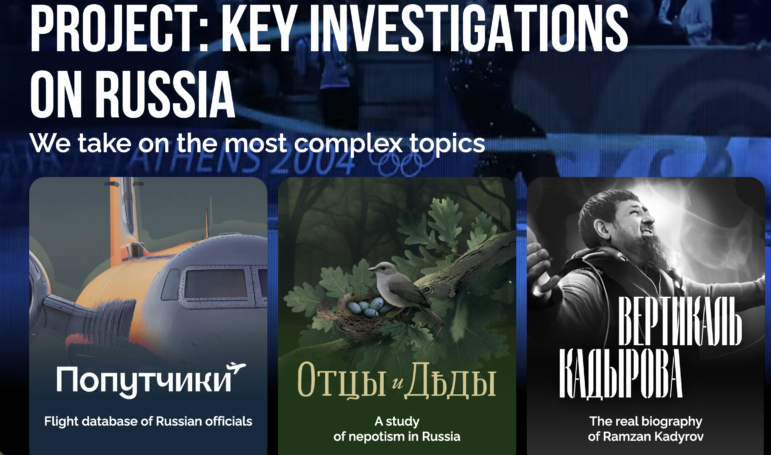
Image: Screenshot, Proekt
No Way Home: How Proekt Investigates Russia From Exile
Read this article in
The plane touched the ground after a long journey from Russia. Then, the photograph arrived.
Polina Machold was sitting in the back of a car in a different country, heading to an apartment she had rented remotely to start a new life — luggage shipped ahead, the move months in the planning — when she opened the image sent by her father. A subpoena had been slid under his door in Moscow at almost the precise moment Machold’s flight took off.
“It was like a fun spy movie,” she tells GIJN from Germany. The timing was almost too neat. Two weeks earlier, the investigative nonprofit she helped found, Proekt, had become the first media outlet in Russia to be branded an “undesirable organization” — a designation that turned working with it, or any other type of collaboration, into a potential crime. [Editor’s Note: as of publication, 441 organizations have been branded “undesirable” by the Russian Ministry of Justice, including GIJN.]
Machold got out. Others would have to do the same.
Proekt, which means “project” in Russian, had by then spent three years establishing itself as the first dedicated investigative newsroom in the country. Founded in 2018 by veteran journalist Roman Badanin and inspired by the US nonprofit ProPublica, the outlet initially set itself on a relentless goal of publishing one investigation a week.

Polina Machold, publisher of Proekt. Image: Courtesy of Proekt
“You wake up, throw some food in your mouth, and keep going,” Machold recalls, thinking of the days when the team worked day and night. Not a reporter herself, as publisher she has since played a vital role in lifting and sustaining Proekt. “I provide everything else except journalistic work. I’m in charge of IT, marketing, finance, HR, operations,” she explains.
From the beginning, the team did deep dives into the fortunes of oligarchs, the machinery of state propaganda, and President Vladimir Putin’s inner circle. Proekt’s reporting made it influential, and then, ultimately, intolerable to the Kremlin. The 2021 “undesirable” label was the price of that success; it forced the team to scatter across Europe and the United States.
Proekt was accepted as a GIJN member in 2024. Today, it reports on Russia from exile, part of a wider newsroom that also runs a daily-news sister outlet, Agentstvo, and reaches audiences inside a country its journalists can no longer safely enter.
Journalist Turned Entrepreneur
The nonprofit newsroom Machold helped build now runs on several clocks at once. As she pours an afternoon coffee in Germany, Proekt’s founder and editor-in-chief Badanin wakes up in California. In a sense, it is where the outlet began. When Badanin launched it in 2018, he was already an ocean away, finishing a fellowship at Stanford while assembling his first reporters inside Russia. A veteran of the country’s big newsrooms, he had spent two decades as a model product of the Russian media machine and never pictured himself signing the paychecks. The idea frightened Badanin, until it didn’t. “It’s a different kind of mindset,” he says. “And I was really afraid of becoming an entrepreneur until I decided — well, go fuck yourself, you need to start it anyway.”
Badanin’s career coincided with Putin’s rise to power. Having previously worked in academia, he drifted into journalism around the turn of the millennium “to feed his family” with — he laughs now — what was then a more profitable endeavor. At the same time, a little-known former intelligence officer was moving into the Kremlin, and their trajectories have run in parallel ever since.
Badanin rose through senior editing jobs as he watched the space for independent reporting narrow around him, year by year. Exposing the elite carried many risks, but also sparked his curiosity: “As a Russian journalist, almost everything you did was more of an investigative work, even dealing with the daily topics like Putin’s administration or the biggest business topics.”
Then came a breakthrough. In January 2019, Proekt published its first bombshell investigation — a deep dive into the official overseeing Russia’s vast state propaganda machine. It drew praise from colleagues and, more tellingly, a defamation campaign against Badanin and his team from the state media. Proekt’s emails were hacked. For its founder, that was the proof of concept. “They closely follow what we’re doing,” Badanin says he realized. “So it’s a huge result.”
Other early investigations mapped the same terrain. The team looked into alleged manipulation of Russia’s official statistics, the fortune of a woman reported to be a former partner of Putin’s, and the wealth of Chechen leader Ramzan Kadyrov. More recently, Proekt’s most popular investigation examined how Kadyrov built what the outlet describes as “a genuine sultanate inside Russia that is beyond the control of Russian laws.” So far, the story, published in 2024, has generated more than 25 million views on YouTube.
From the Brink of Collapse to Betting on Data
Even before Russia banned its operations, Proekt had to reinvent itself more than once throughout the years. But exile was unlike anything else Badanin and his team had faced before. The autumn of 2021 nearly finished them. Three problems landed at once. Along with dissolving the old legal entity and setting up a new one, Badanin also had to move his people physically out of Russia and keep the stories coming. “It was the toughest time in the history of Proekt,” he acknowledges. “I wasn’t confident we could survive.”
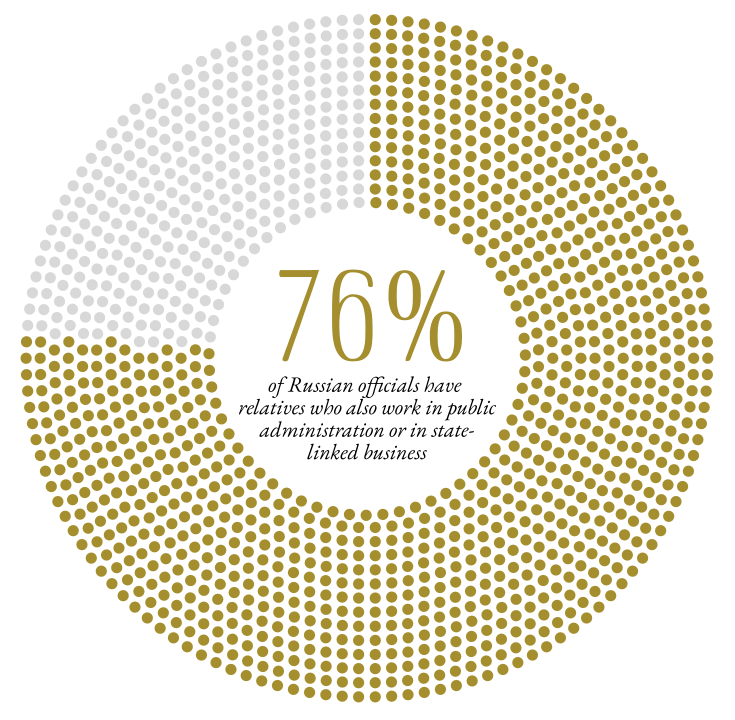
Forced into exile, Proekt has increasingly turned to data for its investigations, like its look at the nepotism across Russia’s government and ruling class. Image: Screenshot, Proekt
They did, but their journalism changed. Proekt now records around 15 million views on a monthly basis across its own channels, and at least 60% of the traffic comes from Russia. Still, cut off from home soil, the team lost not only its sources on the ground, but also direct contact with its readers inside the country. “All of this is inevitable,” Badanin says, almost matter-of-factly. The response was a deliberate bet on data. Increasingly, Proekt builds its investigations on leaks, state databases, records, everything from the national real-estate registry to airline passenger data. It is, Badanin argues, “the most convenient, most reliable, and still underestimated way to understand what’s going on in Russia.”
That bet was epitomized in Fathers and Grandfathers, an investigation published in November 2025 diving into the family dynasties of Russia’s ruling class. Built from the kinds of material Badanin describes, the project set out to trace how power in the country is increasingly handed down through bloodlines. For Badanin, it exposed something fundamental about the system: “They inherit us. It’s one of the most important features of Putin’s regime. They want to reproduce themselves as Russian rulers in a very physical way.” And he sees that instinct as its weak spot. “It looks like we found the most vulnerable part of this regime,” he says — a leadership whose grip, in his telling, is bound to nothing more durable than the physical longevity of the men at the top.
A Community in Exile
Badanin’s vision to do groundbreaking investigative journalism has been shared by other outlets also willing to go to great lengths to unveil corruption and crime in Russia. Proekt now operates alongside a cluster of exiled outlets chasing stories from the outside. Roman Dobrokhotov, founder and editor-in-chief of The Insider — an online publication specializing in journalistic investigations, fact-checking, and political analysis — counts Proekt among the most valuable of them.
“Proekt is one of many examples of small but dedicated teams that, when taken all together, are doing a very important job,” he says. “Together with Important Stories, Verstka, Dossier Center, and some others, they produce stories with high added value and as long as Russian audiences still have access to the internet through VPN, they reach millions of people, who are starving for real information in times of tough censorship.”
Exile has not weighed on every outlet the same way. For The Insider, Dobrokhotov says, moving abroad was akin to having a growth spurt. “We were 30 journalists, and now we are 70. We now publish around 100 investigations per year,” he notes. “More than 120 companies were sanctioned because of our investigations; most of them supplied the Russian military. Several spies were arrested, several military units of GRU were fully disclosed by us and had to stop their activities.”
Fighting for Survival
While Proekt’s reporting model had to adapt, its financial one came under even greater strain. Modeled on ProPublica, the outlet had always relied on institutional grants plus donations from readers, with no commercial arm by design. But the full-scale invasion of Ukraine in 2022 pushed a wave of exiled Russian journalists and organizations into the same funding pool, leaving donors themselves unsure of what and whom they were supporting. If that was not enough, the shutdown of USAID in 2025 opened massive budget gaps across the sector. Proekt was not funded directly by the agency, but the collapse rippled through the community. Now, more journalists are fighting for less money. “Shifts are happening. Tectonic shifts,” Machold says, noting that many now prioritize military spending at the expense of independent media outlets and civil society organizations.

Roman Badanin, Proekt’s founder and editor-in-chief. Image: Courtesy of Proekt
Proekt’s response has been cautious. Several months ago, it began selling advertising in its videos, but Machold frames the move as an adjustment rather than a change of course. The founding principle still holds. “We’re still not willing to spend resources on building a commercial activity,” she says, adding that it is “a bit weird to perceive a media business in exile, writing about Russia, as a lucrative commercial deal.” Survival, in her telling, is simply the condition in which the newsroom operates. It has had to let people go to cut losses, but she treats that as ordinary rather than alarming, the normal business of any organization. “We’re going to fight to survive as an outlet, as we always did,” she says. “It’s our modus operandi. It’s a normal state for us.”
Knowing the Real Story
Reporting on Russia has long been a precarious venture, but the danger only grows for those who keep going. The country ranks 172nd of 180 on Reporters Without Borders’ 2026 World Press Freedom Index. In its analysis of the media landscape, RSF notes that since the invasion of Ukraine, almost all independent publications have been banned, blocked, or — like Proekt — labeled “undesirable” or “foreign agents.” Another blow came in late October 2026, when Novaya Gazeta, Russia’s most prominent independent newspaper, announced it would close its operations under pressure from the Kremlin.
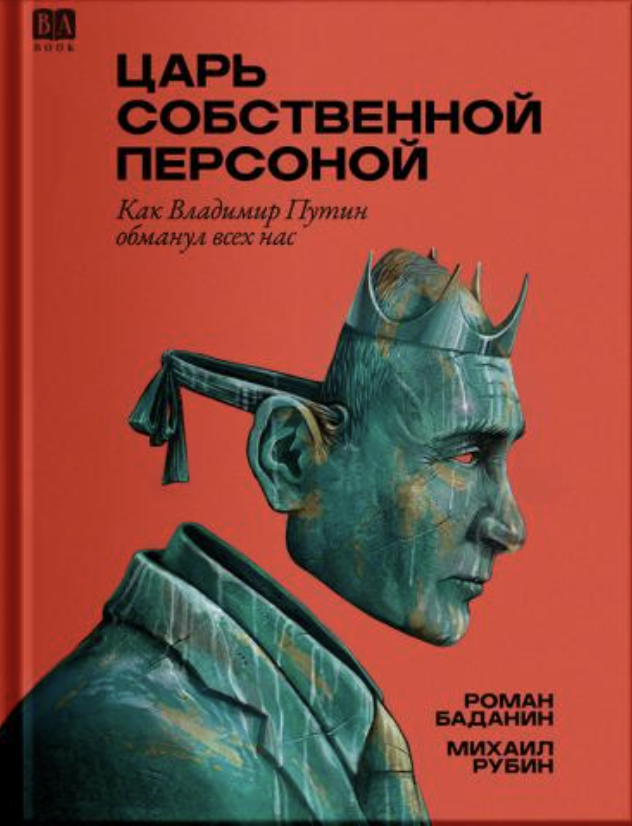
Badanin co-wrote a prize-winning biography on Putin’s web of corrupt deals across Russia and his personal campaign to recreate his legacy in the tsar’s image. Image: Screenshot.
At the forefront of this suppression stands Putin, whom Badanin has studied for decades. Together with Proekt’s deputy editor-in-chief Mikhail Rubin, he casts new light on the president’s rise to power in a recently published 800-page biography. “There is no need to create any kind of myths about Putin,” Badanin says. “It’s quite enough to know his real story.” “The Tsar in Propria Persona: How Vladimir Putin Deceived Us All” sets the president’s public image against a private world of corruption and cruelty. The book won the Grand Prix Strasbourg, a French literary award. At home in Rusia, it is banned.
The risks behind such reporting have never been abstract. This October also marked 20 years since the murder of Russian journalist Anna Politkovskaya, assassinated in her Moscow apartment building in 2006. Badanin remembers it vividly. “I started to understand that the job I’m doing is way more serious, way more dangerous, and way more important for the country than I thought,” he says.
Proekt keeps working anyway, scattered across time zones, chasing the next leak. “Human history matters,” Badanin says, and many Russians, he argues, no longer remember what their country looked like before Putin, how it got here, or what it cost. Insisting on that record, against a state that has spent years trying to make its people forget, may be the most stubborn act of all.
 Peter Georgiev is a reporter and editor for Panorama, a current affairs program on Bulgarian National Television. He is based in Sofia and covers current affairs, politics, technology, and disinformation. His work has been published by the Guardian, Deutsche Welle, Sky News, The Washington Post, and other outlets. He is a graduate of Newcastle University in the UK, and has an MA from the Missouri School of Journalism.

GIJC23 – Exiled Media: An Investigative Toolkit

GIJC23 – Exiled Media: Survival Strategies
Journalism In Exile: Reporting, Sourcing, and Managing Everyday Life Away From Home
Exiled Journalists’ Tips for Source Protection and Avoiding ‘Propaganda Creep’
IJ Spotlight: Russia Sanctions

Sanctions Evasion, Army Executions, and a Royal ‘Flying Palace’: 2025’s Best Investigative Stories from Eastern Europe, Central Asia, and the Caucasus

From Croatia to Uganda: GIJN Welcomes Six New Member Organizations
Journalism in Exile: How Newsrooms Can Balance Verification, Source Protection, and Credibility

This work is licensed under a Creative Commons Attribution-NoDerivatives 4.0 International License
Republish our articles for free, online or in print, under a Creative Commons license.
Republish this article
This work is licensed under a Creative Commons Attribution-NoDerivatives 4.0 International License
Read Next
IJ Spotlight News & Analysis
IJ Spotlight: Russia Sanctions
A deeper look into how news outlets around the world are reporting on Russia’s efforts to evade economic and financial sanctions following the country’s 2022 invasion of Ukraine.
Editor's Picks News & Analysis
Sanctions Evasion, Army Executions, and a Royal ‘Flying Palace’: 2025’s Best Investigative Stories from Eastern Europe, Central Asia, and the Caucasus
Despite numerous obstacles, journalists from the region continue their investigative work through partnerships, cooperation with civil society, and open source research.
Inside GIJN
From Croatia to Uganda: GIJN Welcomes Six New Member Organizations
Among our new members, a media training outlet in Uganda – GIJN’s first from the country — a UK-based newsroom investigating land use, and a Russian unit working in exile.
News & Analysis
Journalism in Exile: How Newsrooms Can Balance Verification, Source Protection, and Credibility
Operating a newsroom hundreds or thousands of miles away from a country presents a challenge: how do journalists deliver accurate, reliable news to audiences when reporters can’t safely be on the ground?