
Image: Shutterstock
IJ Spotlight: Russia Sanctions
The waves of sanctions against the Russian government, companies, and individuals in response to its full-scale invasion of Ukraine in 2022 are complex and constantly evolving. So, too, are the methods and networks that Russian entities and individuals use to evade sanctions or exploit gaps and loopholes in their enforcement.
Sanctions, in international relations, statecraft, and law, are often measures intended to replace or prevent military action. They can be imposed by individual countries or multilateral and regional institutions against other states or organizations. In the case of Russian sanctions in response to its February 2022 invasion, they are imposed by the US, the EU, the UK, and the G7, and include a sweeping set of financial, trade, diplomatic, and energy restrictions designed to reduce Russia’s ability to fight a war against Ukraine. These restrictions include disrupting weapons supply chains, hollowing out core industries related to the military, cutting the country off from global financial transactions, reducing energy revenues, and placing travel restrictions on high-level officials or individuals close to the Kremlin. The most recent EU sanctions package — its 22nd overall — is yet to be formally adopted but seeks to expand measures against crypto-assets, financial institutions, and military-industrial support networks. The US maintains sanctions implemented between 2022 and 2024, but the Trump administration is currently waiving new secondary sanctions and tariffs set to go into effect after the passage of the 2026 Graham Act.
The following investigations highlighted below dig into financial transactions and entities set up after Russian banks were cut off from international payment systems; the use of cryptocurrency; how to tell if a Russian company has divested or has just made its operational structure more opaque; a sophisticated criminal network exporting stolen cars to Russia; a niche industry of middlemen offering services to help hide financial transactions; and how Western parts are still imported for Russian weaponry. Taken together, these recent investigations show multiple fronts of a complex topic — and many angles from which to investigate the issue of Russia sanctions.
Western Parts in Russian Weapons
Investigation: Western Machinery at the Heart of Russian Arms Producers — The Kyiv Independent
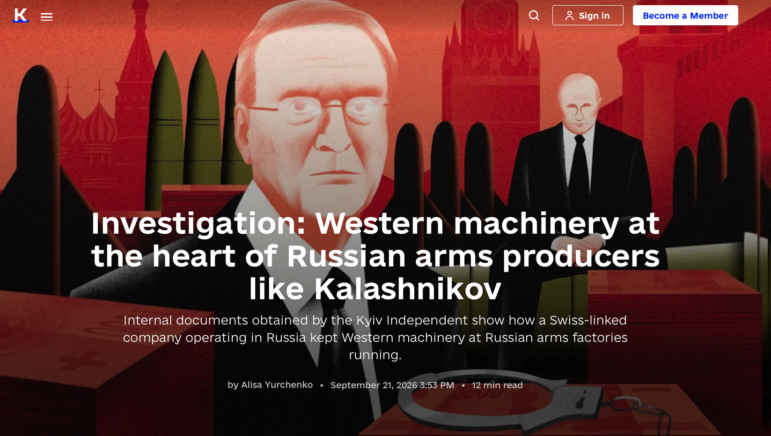
Image: Screenshot, Kyiv Independent
Russian defense companies have a “fleet of Western-made high-precision machinery to produce their lethal products,” writes the Kyiv-based newspaper, which obtained internal documents that revealed, “over 50 Russian defense companies operating Western industrial high-precision machinery — produced by Germany, Switzerland, and Sweden — to manufacture weapons used against Ukraine.”
Russia imported much of this machinery before its full-scale invasion, they note, but this machinery still requires maintenance and replacement parts. By analyzing customs data and leaked documents, the Kyiv Independent found that the replacement parts are being sourced from a single Russian supplier — the Russian arm of a Swiss company that for years exported European industrial machinery to Russia and now supplies the replacements needed for Russia’s war machinery. A leaked internal company document details contracts signed worth nearly US$3 million between this Russian arm and 87 Russian companies — 51 of which are in the defense sector — from 2024 to late 2025.
Thriving Black Market for Pickup Trucks
Russian Sanctions Are Fueling a Canadian Car Theft Epidemic — The New York Times
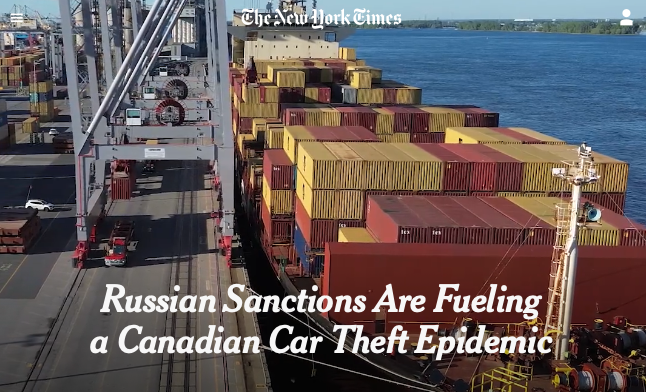
Image: Screenshot, The New York Times
Canada is in the midst of a years-long car theft epidemic, noted New York Times investigative reporters Jane Bradley and Michael Schwirtz. Thousands of cars disappear each year, and according to the Royal Canadian Mounted Police (RCMP), the thefts are fueled by a thriving black market for Western vehicles in wartime Russia — by far the top destination for stolen Canadian cars. Bradley and Schwirtz reveal a “sophisticated network of criminals that steals cars, hides them in shipping containers and sends them to Russia, often by way of the Middle East.”
In an accompanying interview with the Times discussing the methodology behind their investigation, Bradley explained that — aware that maritime shipping was the primary bottleneck for smuggling — she persuaded the Canada Border Services Agency to grant them access to a live port operation, so they could observe how thieves might bypass security to export containers. The Times’ sources included a Russian national in a Ukrainian jail held on charges of involvement in the international car theft scheme, who pointed out that the theft network already existed, but sanctions have increased demand and profit.
The reporters also obtained Interpol data — 4,798 reports of stolen Canadian vehicles found in Russia between February 2024 and July 2026 — that was confirmed by two law enforcement officials, and also analyzed open source and satellite imagery. They also note that law enforcement agencies, including Interpol, are currently trying to trace whether any of these cars are being used on overseas battlefields — a propaganda video released by a Russian defense ministry-controlled channel appeared to show a line of Dodge Ram trucks at a Russian drone factory — but officials have not been able to track them.
A7 — Russia’s Alternative Financial System
Since Russia’s February 2022 invasion, Western nations have severed more than 70 major Russian banks’ access to SWIFT, the encrypted messaging system that enables international financial transfers. (Also known as a BIC code, it’s used to identify a bank in international transfers and is typically 8–11 characters long.) ICIJ, The New York Times, and the Financial Times have looked into various aspects of A7, a Kremlin-backed Moscow financial firm launched in late 2024 as an alternative to SWIFT.
Kremlin Payment Firm A7 Has Been Pumping Billions in ‘Untraceable’ Cash into Global Financial System — ICIJ / Proekt
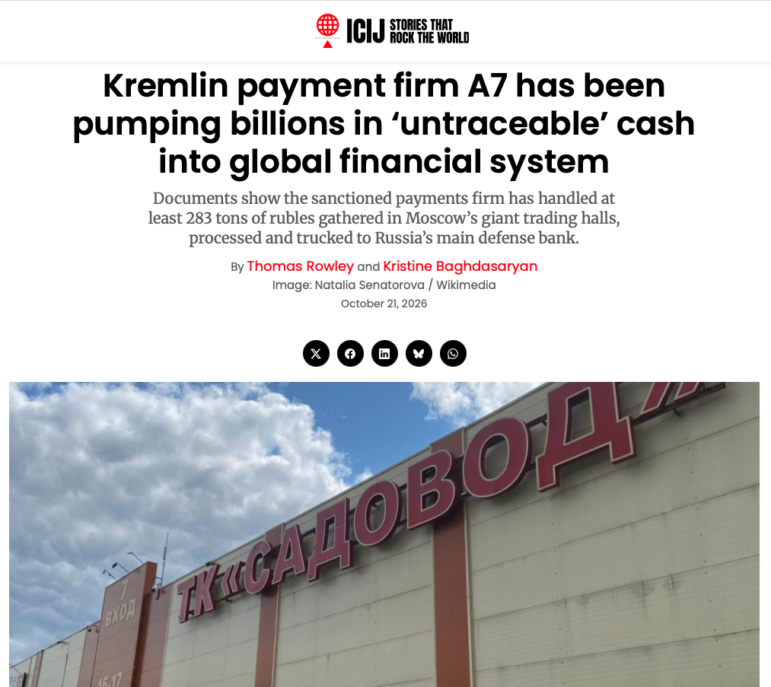
Image: Screenshot, ICIJ
The ICIJ and a Russian partner, Proekt, investigated the “industrial cash machine that is A7” — tracing bags full of Russian rubles deposited at the sprawling Sadovod market hall in Moscow to global transactions. Their investigation found that “between November 2024 and July 2025, A7 processed at least 283 tons of cash rubles, worth more than US$14 billion.”
As part of its launch, A7 integrated a number of informal payment brokers at Moscow markets. Ultimately, while Western governments and banks try to trace A7 money flows through the international banking system, their investigation found that much of the origin of A7 money is untraceable. According to leaked internal records and various sources, a huge portion of A7’s original payments originate not from conventional bank transfers but from literally “hundreds of tons” of cash rubles that are collected at wholesale markets and other businesses around the Russian capital. (A7 did not respond to a request for comment from ICIJ, and in public statements has denied US allegations of wrongdoing.)
The rubles are taken to an A7 processing center and then on to a Russian bank, according to leaked payment documents. Payments are then made through a number of shell companies and intermediaries overseas. “This ecosystem of market brokers converted importers’ cash into conventional bank transfers or crypto, most often bound for China,” they note. Chinese exports to Russia have surged since 2022 as Russia has looked for new sources of goods.
Kremlin-Backed Forgery Scheme Moved $6.9 Billion Through Global Banks and accompanying editorial — Financial Times
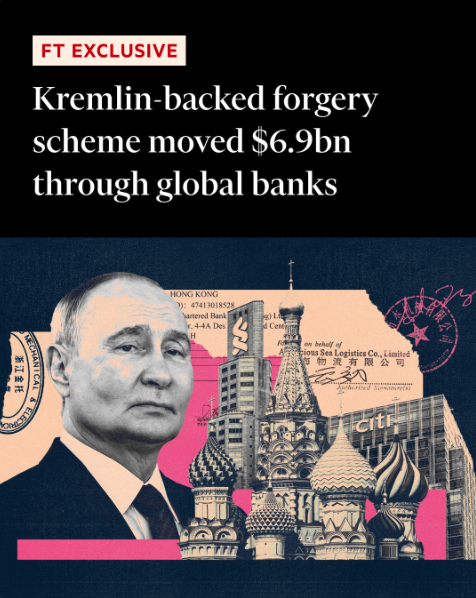
Image: Screenshot, Financial Times
For this investigation, FT investigative journalists obtained hundreds of thousands of files from inside A7 to reveal how it used a “vast document forgery operation” to funnel more than US$6.9 billion through the international banking system, despite sanctions on Russia.
The FT editorial published alongside the investigation notes that anti-money laundering controls rely heavily on verifying documents such as invoices: “The A7 case shows how an industrial-scale forgery operation — using thousands of fake stamps and software to strip out Cyrillic lettering — was able to spoof the system.” The FT editorial concludes that while it is bad news that Russia has evaded sanctions by using “old-school money laundering techniques” — the good news is that it has not been able to create a viable alternative to the traditional cross-border payments system.
The ‘Monster’ Behind Russia’s Global Effort to Evade Western Sanctions — The New York Times
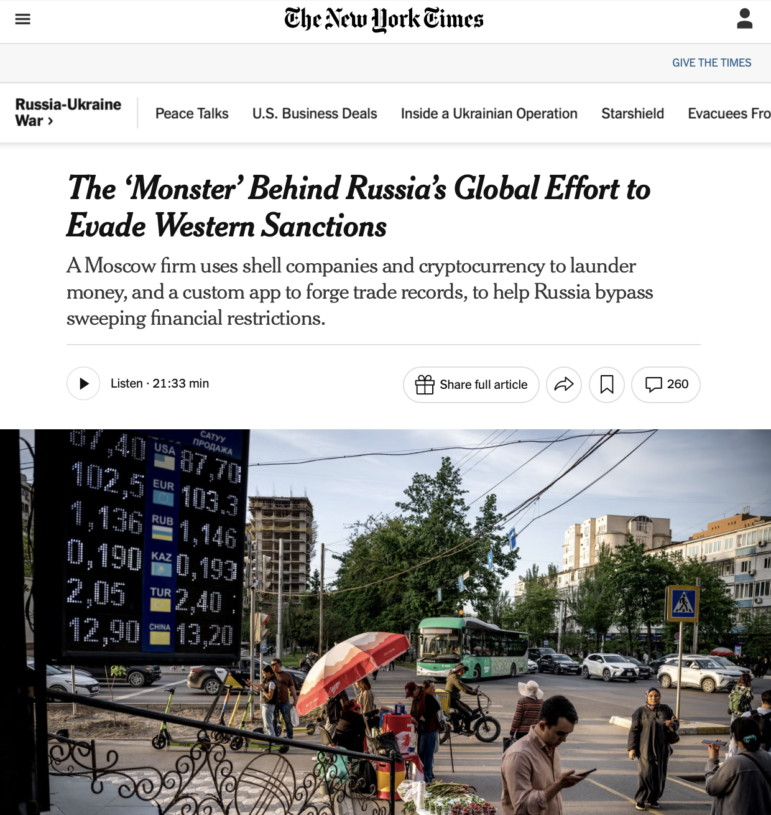
Image: Screenshot, The New York Times
In its own investigation into A7, The New York Times revealed how, backed by Russian state interests, the scheme routes billions through shell companies in places such as Kyrgyzstan and the UAE, forging invoices via a custom app to buy military components. Reporter Aaron Krolik “examined thousands of documents, analyzed internal software and spoke to current and former employees of A7, a Moscow firm that is integral to Russia’s efforts to evade Western sanctions.” He found that funds or sales proceeds are routed through intermediaries, then converted into other currencies or Tether, the stablecoin pegged to the US dollar, allowing A7 clients to make purchases without sanctions-related restrictions. “Internal records show that A7 has a team dedicated to creating new shell companies when operational issues arise,” notes Krolik — underscoring that it’s a constant challenge to identify and investigate these companies.
The Financial Times and The New York Times subsequently reported that the US was placing sanctions on A7 for its alleged role in assisting Iran and cybercriminals with illicit transactions: US Puts Sanctions on Kremlin-backed Fintech A7 for Allegedly Assisting Iran — Financial Times; Called a ‘Criminal Organization,’ a Russian Financial Firm Faces New US Sanctions — The New York Times
Import Workarounds
Russia-focused outlet The Insider has extensively covered instances of workarounds to sanctions on imported items — from racehorses to weapons.
The Regime’s Optics: Despite Sanctions, Russia is Advancing Quantum and Laser Technologies for Military Use
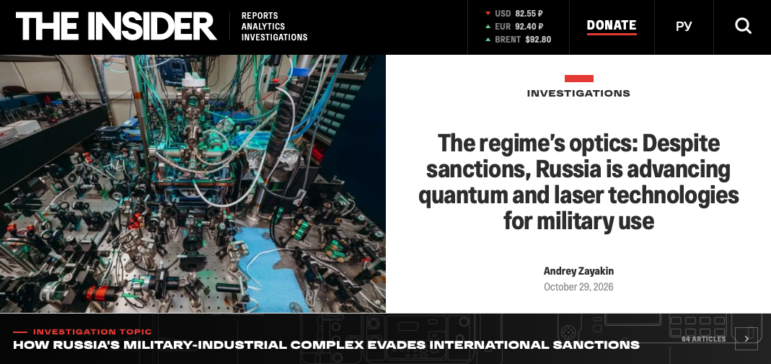
Image: Screenshot, The Insider
Analyzing component imports and court records, The Insider found that even under sanctions, Russia continues to import “advanced measuring instruments, components, and materials for optics and quantum electronics,” suggesting that Russia wants to develop advanced laser technologies and possibly quantum computers that, if successful, could alter the international balance of power. Russia imports sophisticated industrial laser equipment mostly from China, they noted, but around 10% of this equipment is manufactured in Germany, Italy, Switzerland, Japan, the United States, and Israel. Imported equipment often does not have the point of origin listed.
Copy-Paste from Brussels: The EU’s Error-Riddled New Sanctions Package was Generated with an LLM
The Insider also found that the EU’s October 12, 2026 sanctions package had errors that bear traces of having been generated by a large language model (LLM). It noted that the document contains “numerous errors” such as listing companies that no longer exist, the use of pseudonyms instead of real names, and the mixing of Latin and Cyrillic characters. While they allow that errors are inevitable in a document of 1,500 pages, they argued that the “mixing of alphabets within a single word is more consistent with errors that occur in text generated by neural networks, especially when a task requires several languages to be handled at once.”
A Stable Workaround: Despite Sanctions, European Horses Keep Reaching the Kremlin Elite
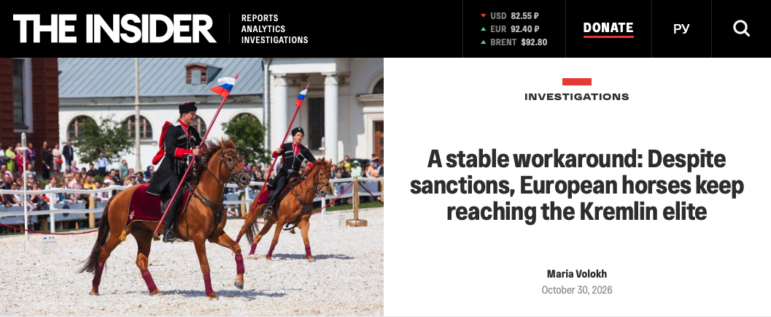
Image: Screenshot, The Insider
Elite European racehorses worth hundreds of thousands of euros are still finding their way into Russian stables: In 2022, the EU banned exports to Russia of horses — classified as luxury goods — worth more than €300 (US$335). But via customs records, The Insider found eight horses imported in 2024 — some declared at a couple of thousand euros a piece, although the actual value could reach millions: “From 2025 onward, information on such shipments disappeared from customs databases, but European horses have continued to turn up in Russia nevertheless.” Sources told The Insider that the horses come in through Lithuania and Kazakhstan at transport costs of €10-12,000 (US$11-13,200) — and violate EU sanctions.
Tracking Corporate Divestiture
Covert Control: What a US Fraud Case Reveals About Post-Sanction Divestments — OCCRP ‘Signals’ newsletter (subscription only)
Thousands of Russian companies have had to cease operations across Europe and North America under expanding Western sanctions since Russia’s full-scale invasion of Ukraine, noted the OCCRP’s ‘Signals’ newsletter: “Many opted to completely divest any Russian links through a legitimate change in corporate ownership. But some chose to change who owns a company on paper while covertly retaining operational authority.”
The OCCRP analyzes a recent US fraud case against a digital forensics company to show how it is possible to investigate whether Russian businesses and entities have divested — including guidance on how to tell whether there has been a genuine transfer of control, or something else. US prosecutors alleged that a digital forensics company presented itself and its software production as an independent American company to US government customers — including the Secret Service and the National Computer Forensics Institute — but that it was actually owned and controlled by five Russian nationals through a holding company.
OCCRP pinpointed the questions investigators should ask to find out what about a company has actually changed — related to management, financial authority, economic interests, governance, and holding companies, and recommends getting familiar with the distinction between ownership and control.
The news outlet also suggested looking at the timing of any company changes and relevant enforcement guidelines — though it also noted that sanctions evasion methods continue to evolve. Recent guidance by the UK’s Office of Financial Sanctions Implementation (OFSI) “identifies recent divestments, including those made in possible anticipation of or response to sanctions” as a reason to look into whether former owners retain relationships or influence; the US Treasury’s Office of Foreign Assets Control (OFAC) has issued a “list of red flags” that could show transactions used to evade sanctions.
‘Sanctions Busting Middlemen’
‘There Will be No Trace’: Russia’s Sanctions-Busting Middlemen Tout Services on Telegram — OCCRP
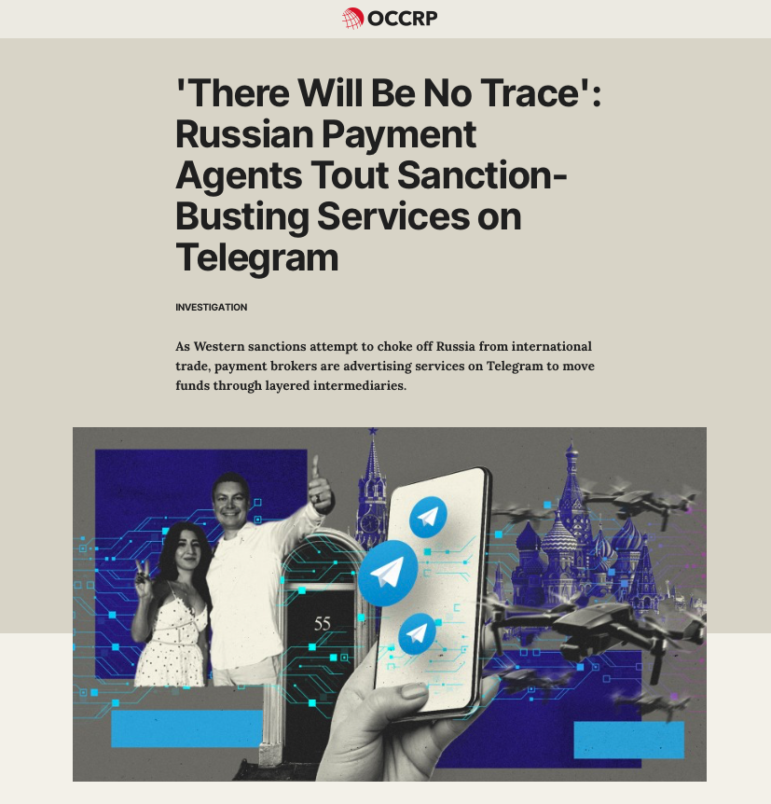
Image: Screenshot, OCCRP
The OCCRP reported that the waves of sanctions enacted since 2022 by the US, the EU, and the UK have given rise to a “shadowy industry of payment providers — some of whom openly advertise their assistance in dealing with sanctions or obscuring Russian involvement in transactions.” OCCRP partners SourceMaterial and Delfi went undercover and exchanged messages with several advertised payment providers on the messaging service Telegram — Russia’s most popular platform, which allows anonymous use.
In one example, an undercover journalist posed as a Russian businessman and sought help making a payment to a German drone supplier, telling the service representative that it was important that the German bank not realize the funds originate in Russia; the service provider claimed: “There will be no trace of the Russian company, and the payment will be successful.” (Under current EU sanctions, both exporting drones to Russia, except in rare exceptions, and assisting with evading restrictions are illegal.)
The reporting also found that most of the advertised entities existed only on Telegram, and were not listed in Russian or other corporate databases. The team did not complete any actual transactions, but five services agreed to help them by routing the Russian money through companies in Hong Kong, Dubai, or Indonesia, and multiple intermediaries. “From a law enforcement perspective, payment systems are currently one or two years ahead of regulators when it comes to developing mechanisms for sanctions circumvention,” explained Ilia Shumanov, a managing partner at TriTrace Investigations, which helps corporate clients to map ownership structures and expose sanctions breaches.
The investigation also scrutinized Russia’s use of the cryptocurrency A7A5 — launched by A7 and now under UK and EU sanctions — which has served as a “dedicated financial artery for Russian trade.” The EU has started targeting platforms that trade A7A5.

Alexa van Sickle is a journalist and editor with experience across digital and print journalism, publishing, and think tanks and nonprofits. Before joining GIJN, she was senior editor and podcast producer for the foreign correspondence and travel magazine, Roads & Kingdoms
Investigating Russia and the War in Ukraine

Follow the Money: Investigating Shell Companies

GIJC23 – Best Investigations on Russia’s War on Ukraine

Remotely Investigating Russia’s Devastation of Mariupol

Investigating Russia’s Proliferating Use — And Supply — Of Attack Drones Against Ukraine

Reporting on Russia from the Outside — From Investigating Ukraine to AI-Powered Analysis
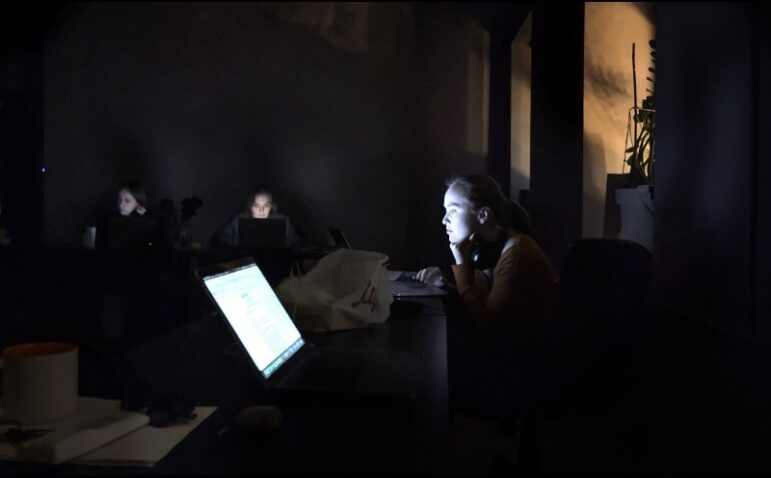
Report and Survive: Ukraine’s Young Journalists Investigate Through the War’s Most Brutal Winter

Reporting on War Crimes in Ukraine’s Occupied Territories

This work is licensed under a Creative Commons Attribution-NoDerivatives 4.0 International License
Republish our articles for free, online or in print, under a Creative Commons license.
Republish this article
This work is licensed under a Creative Commons Attribution-NoDerivatives 4.0 International License
Read Next
Investigative Techniques Methodology
Investigating Russia’s Proliferating Use — And Supply — Of Attack Drones Against Ukraine
A cross-border investigation into Russia’s use of drones in Ukraine includes how drones are assembled despite sanctions, and cooperation with Tehran to produce UAVs on Russian soil.
GIJC23
Reporting on Russia from the Outside — From Investigating Ukraine to AI-Powered Analysis
From cultivating sources to verifying information, the challenges of investigating Russia from outside the country are numerous.
News & Analysis
Report and Survive: Ukraine’s Young Journalists Investigate Through the War’s Most Brutal Winter
Russia’s attacks on energy infrastructure, waged during the coldest winter in memory, have pushed Ukrainian journalists to their limits. But still they persevere.
GIJC25
Reporting on War Crimes in Ukraine’s Occupied Territories
Ukrainian newsrooms combine OSINT, satellite imagery, and intercepted conversations to report on frontline regions that are off limits due to the war.