

Image: Shutterstock
8 Reporting Tips for Cold-Contacting Insiders
When it comes to approaching unfamiliar potential sources, reporters usually get just one shot. Either that first request works — or you’re out. For good.
These outreach attempts are often ignored or “ghosted” because they are boring, pushy, or vague. It’s an unfortunate point of failure in many investigations: Not getting enough help from knowledgeable witnesses, former employees, and industry insiders, and not hearing their perspectives in the stories.
We offer you some ways to approach potential sources, to connect with the people who could tell you what really happened. Our advice applies to one type of interview— developing a source — but not to the other types: interviewing a traumatized victim, getting a quote from a public-relations spokesman, interviewing politicians on the record. We are addressing the context of investigative interviewing: you are looking for guidance from a source to get to the bottom of a story.
We are Stefanie and Jim, a working reporter and a professor of investigative reporting. We teach the human side of investigative reporting — in Hamburg, in Berlin, in Riga, in Geneva, and for 19 years, in a Columbia Journalism School classroom.
The key that unlocks the cooperation of real insiders is being — and showing yourself to be — a three-dimensionally human, trustworthy, hardworking, interesting, curious reporter.
Here’s our advice.
1. Don’t Just Request, Offer
Let’s start at the beginning: The subject line of the email that introduces you to a potential source. Reporters often use “Request for an interview” in that line.
If you request something — information, a meeting, a conversation — the person might feel put on the spot by a perceived obligation. Instead, it’s better if you can offer something that might lead to an interesting conversation, along the lines of “May I tell you more about my project?” “Can I run this by you”? or “I can give you an example of what I found so far.”
You won’t want to share your biggest secret or something shocking, but some leads, some details you’ve dug up already, that show you’ve actually been working on this topic and prove you are not blindly firing out interview requests.
You are looking for the start of a real conversation, not a tense Q&A. Your questions and requests can come later.
2. Be Personal
Particularly in a time of AI, it helps build trust to show you’re a real human. In an email or over the phone, as you describe the reporting you’re doing, you must be a little personal.
You can identify an aspect of the story that particularly fascinates you. Or offer to tell how you came upon this story idea. Or ring some other bell with this source, based on the research you’ve done about them. And, yes, we advise you to do some research before approaching a potential source.
Some of our favorite lines start with “I also do/have/am…” or “I’ve become fascinated by x or y…” or “I want to explain how my background put me on the road to this story.”
The opposite of showing your humanity is coming off like a robot. For example, we feel it sounds to formulaic when an introductory email — to a complete stranger, after all — begins, “I hope this email finds you well.” We advise thinking of an email’s opening with the same care that you would devote to the lead of a story. You can simply get right to the point of who you are and why you’re approaching them.
You can also take opportunities to be personal by mentioning any overlaps or coincidences between you and the source. Have you lived in the same place? Been to the same event? It’s OK, and not “stalking,” if you looked at the potential source’s LinkedIn or website before sending out these lines, and that you care to speak to this specific person.
Showing yourself to be a three-dimensional human works particular magic in our age of artificial intelligence.
3. Be Interesting
The message behind reporters’ introductory emails is often: “Hey [Potential Source], I find you interesting, so I guess we’ll be talking.” The ghosting (no response whatsoever) is the source’s response, in effect: “Yeah, but I don’t find you interesting.”
Bring up something specific you’ve discovered that you find fascinating but don’t fully understand. Your message is: I’m working hard, but I need your help. The conversation can be driven forward by cool things you have read and heard that you don’t completely “get.”
If you repeat one source’s allegation to another, make clear you are not making the allegation; you are just trying to confirm or deny its veracity as part of your reporting process.

Stefanie Dodt (left) and Jim Mintz (right). Image: Courtesy of Alfrēds Ulmanis
4. Offer Confidentiality
When you approach a potential source, you are not looking for quotes; you are looking for guidance. If your cold approach succeeds, in its best case, you will be connected to someone who can guide you further inside the secret world of a company or an institution you’re researching. So, quotes are simply not relevant here (yet). It helps to make that clear early in your approach. Our favorite lines are: “We can of course speak off the record,“ or “I’m not looking to quote you.”
You may be hesitant because you think you’ll need to quote someone in your story later. We suggest you consider that if things go really well, this source might do something much better: By going beyond what you know to ask about, by telling you stories you hadn’t heard before, or by sharing documents you didn’t know existed. If you’re in an on-the-record setup, this stranger is very unlikely to do any of that with you.
Once off-the-record sources explain what really happened (hopefully with names, dates and amounts), you can firm up the story from there.
5. Don’t Be Scary
Name the topic you want to talk about truthfully, but strategically. At the beginning, hold back your speculation about wrongdoing, and lead with what you’re learning, what you need help on, what interests you. Show yourself to be the reporter you are: open-minded, listening, curious, hard-working. The opposite of scary.
Some of our favorite lines are: “Here’s what I need help on” and “I’m trying to understand why…” or “Could you give me a briefing on the pressures that x, y, and z are under?”
And, in case you need to hear this, you may want to lighten up. You don’t enhance trust by seeming rude or brash. Hard-hitting and cynical can come off as arrogant and closed-minded. It doesn’t make you less serious to be friendly.
6. Value the Source’s Expertise
A source may have no particular reason to open up to you, but still find it interesting to do so, flattering even. It’s a nice feeling to be approached for one’s knowledge and expertise.
You can build on those warm feelings by showing sources you value them. If the person has a long record working in a specific field, then tease the expertise that stands out for you. If the person likes to write or speak about a specific area of their work, then quote back to them one sentence that stood out to you.
7. Show Curiosity
A key to approaching insider sources is being curious. Curiosity signals that you are listening and open-minded, ready to hear whatever this person has to say. In other words, while we have already recommended sharing cool things you’ve learned, we also want you to explain what you don’t know.
Be humble about your need for guidance to go deeper into the story. No one likes to talk to reporters who have already made up their mind about good guys and bad guys. One of our favorite lines is: “I’m trying to get to the bottom of….”
We urge this curious, open-minded, humble approach even with people at the center of a story who may be caught up in wrongdoing. Instead of “confronting” anyone, simply offer to explain what your reporting shows so far, with genuine openness and commitment to get the facts right. If they reject your less-formal approach, you can always follow up with a no-surprises letter later.
The spirit that attracts great sources is that your investigative reporting seeks to understand, not to judge.
8. Be Direct and Open
Don’t forget the basics. Introduce yourself properly — who are you, who do you work for, what’s your role?
Add your personal data: Homepage, LinkedIn, Instagram, whatever you have to show you’re a real human. Include links to previous stories if they are connected to this topic. Offer different forms of contact, perhaps including leaving your cell phone number or the ability to switch to different, secure messaging platforms.
Try to meet personally as soon as possible. You might include a gentle, proposed meet-up like: “I’d love to explain this further… I’m actually going to be near you next Monday; would there be a convenient location for you to meet for coffee?”
And set the tone of your communications to the source’s tone. Take a last look at the person’s social profiles — are you being polite/familiar, formal/informal enough?
Developing sources is a human–to-human effort, and we will each have our own ways of doing it. We hope these tips give you some ideas to stir into your own.
Stefanie Dodt is an ARD television correspondent in Geneva, where she is responsible for television coverage and investigative reporting from Switzerland, as well as reporting on the international organizations based there. Previously, Dodt spent over a decade working as an investigative journalist and filmmaker for the public German broadcaster, being based in Berlin and New York City.
Jim Mintz has spent his life conducting investigations and training investigators. For 19 years, he has been an adjunct professor of investigative reporting at Columbia Journalism School. After he retired from Mintz Group, a global investigation company, he founded SEEK Initiative, based in Berlin, to build a movement of citizen investigators.
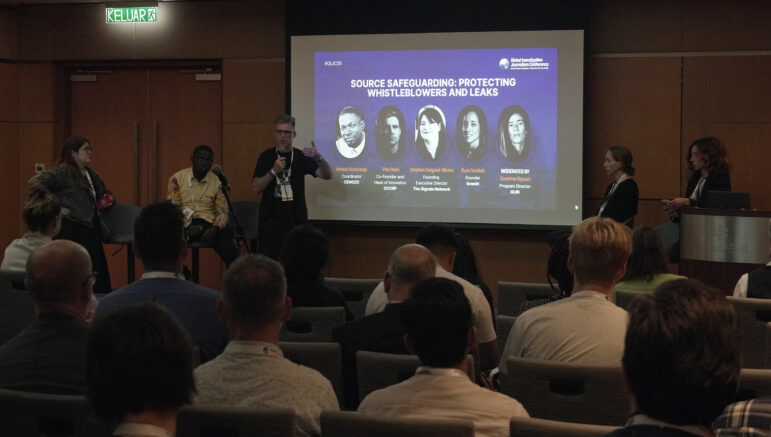
Expert Advice to Keep Your Sources and Whistleblowers Safe

GIJC23 – Working with Hackers

The Diplomat, the Chameleon, the Bloodhound: Understanding Newsroom Personalities

GIJN’s Guide to Undercover Reporting

Getting Documents, Dealing with Whistleblowers, and Staying Safe

Tips and Tools for Investigating Leaks

Reporter’s Notebook: How to Track Down People Who Don’t Want to Be Found

‘To Convince Someone to Speak, Explain How Their Responses Will Improve the World’: Investigating Power and Influence from Moldova

This work is licensed under a Creative Commons Attribution-NoDerivatives 4.0 International License
Republish our articles for free, online or in print, under a Creative Commons license.
Republish this article
This work is licensed under a Creative Commons Attribution-NoDerivatives 4.0 International License
Read Next
Resource Guide Chapter
Getting Documents, Dealing with Whistleblowers, and Staying Safe
This section of the GIJN/NAJA guide covers how to make official requests for information, how to work with whistleblowers, and how to protect yourself.

Tips and Tools for Investigating Leaks
Frederik Obermaier
Reporter’s Notebook: How to Track Down People Who Don’t Want to Be Found
OCCRP’s research director offers up a series of tips and techniques to help reporters safely and effectively build a profile of whoever they are looking for.
10 Questions
‘To Convince Someone to Speak, Explain How Their Responses Will Improve the World’: Investigating Power and Influence from Moldova
Award-winning journalist Vladimir Thorik discusses reporting in an oft-overlooked part of Europe and how he approaches exposing the long reach of Russia on his native country and its neighbors.