
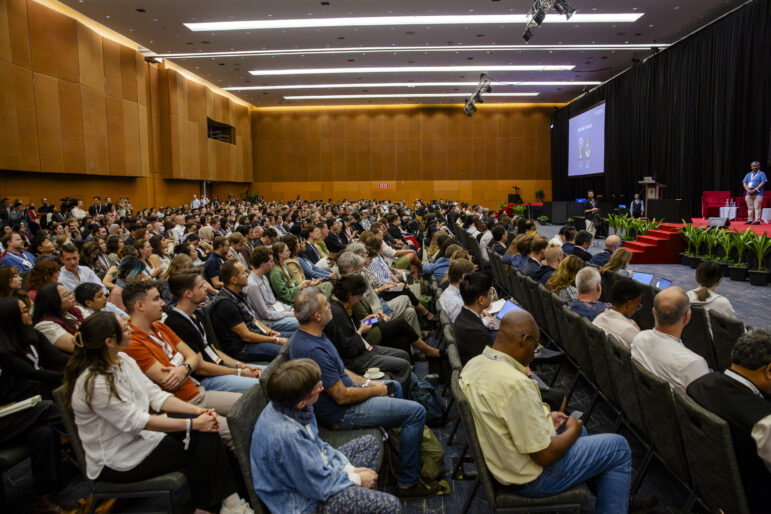
The crowd listening to the keynote address at GIJC25. Image: Suzanne Lee, Alt Studio for GIJN
Changing the Journalism Community and Beyond, Part I: How GIJN’s Global Conferences Have Made an Impact Around the World

Investigative journalists across the globe have an incredibly difficult job. GIJN strives to provide the tools, techniques, and professional connections to both make their work easier as well as provide a material edge to their accountability reporting. In this first installment of a two-part series, we have gathered personnel anecdotes, one-on-one feedback, and survey responses to better understand and document the broad ripple effects of our biennial Global Conferences within the investigative journalism community and the work that they do..
After GIJC25 in Kuala Lumpur, Malaysia, 90% of attendees rated the event as very or extremely useful and 97% said they would plan on returning to a future conference. Additionally, 280 of 347 post-conference survey respondents, nearly 81%, revealed that GIJN had helped build their investigative capacity.
To learn more, GIJN followed up on the detailed testimonies of five reporters who have come to past Global Conferences to better understand and hear, in their own words, how these events have furthered their journalism.
María Paula Murcia Huertas — projects and impact editor at Mutante (Colombia)
“GIJC25 brought outstanding opportunities of networking, advanced conversations for collaboration and fundraising, frameworks and angles for new stories, and relevant ideas for products that I can apply within my newsroom,” Huertas said. “The most impact for me has come through the conference. Not only the conference itself but everything that happens around it: the resources that speakers share, the relations that you can build by attending, and by paying attention to what happens on site.
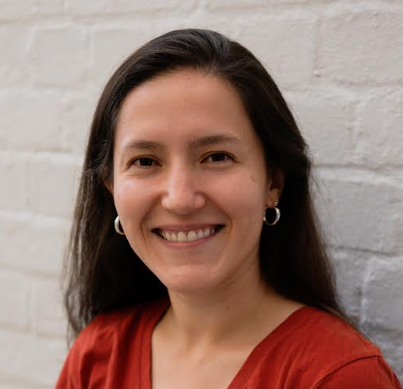
María Paula Murcia Huertas. Image: Courtesy of Huertas
“I would also like to add something that has been deeply relevant and that is great proof of impact,” she added. “Following the conference, Emily Kennedy, director of the Centre for Anthropology and Journalism, became aware of Mutante (the newsroom I co-founded) and of my work and reached out to me, included some of our journalistic work in the library of the Centre, and invited me to speak about Mutante’s ethnographic journalism at the 2026 Engage Journalism Conference.
“This is very important for us, not only for the visibility of our work, but for the recognition of the legitimacy of our contributions within a very specific and emergent field which is the intersection between journalism and anthropology,” Huertas explained. “In a world that has privileged the hyperspecificity of the disciplines, merging different methodologies and disciplines can sometimes feel lonely, so becoming aware of a network of people that work in this interdisciplinary field feels revolutionary.”
Şeriban Alkış — independent investigative reporter and the former editor of Kapsül Bülten (Turkey)
“As a freelance journalist, I often find it difficult to identify and reach the right sources for stories outside Turkey. One concrete benefit of attending GIJC 2025 was the network of journalists I met there,” Alkış said. “While working on a story about declining trust in the media, I wasn’t sure whom to speak to in Greece. I contacted Greek journalists I had met at the conference, and their help enabled me to find sources and complete the story.
“The support of GIJN Turkish editor Pınar Dag has also meant a great deal to me. Through the opportunities and information she shares, she helps independent journalists stay informed about training and fellowships. Just as importantly, she encourages us to apply and take part. For someone working freelance, that encouragement and sense of connection can make a real difference. I’m grateful to Pınar and GIJN for both the practical help and the relationships that have grown from it.”
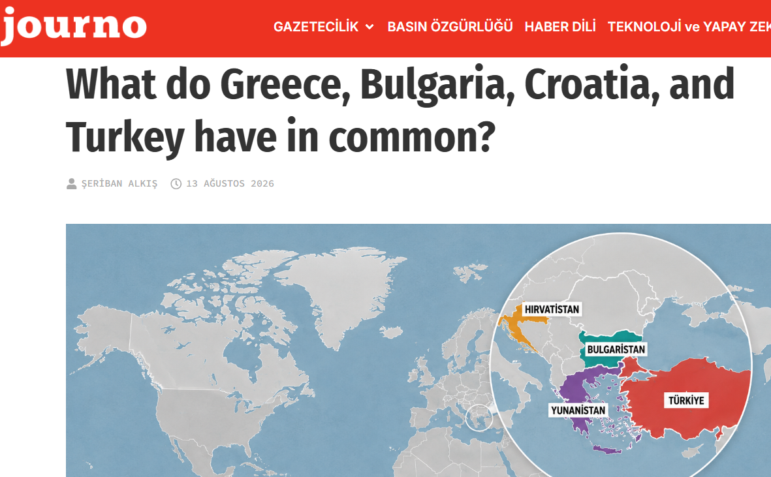
This piece by Şeriban Alkış explored why the proportion of residents who avoid news is much higher in these four countries than global averages. Image: Screenshot, journo
Jóhannes Kr. Kristjánsson — editor-in-chief, Reykjavik Media (Iceland)
“At all seven GIJC conferences I have attended, I have met journalists with whom I have stayed in touch — and who have stayed in touch with me,” Kristjánsson recounted.
“At my very first conference, in Lillehammer in 2008, I met Sven Bergman, Joachim Dyfvermark and Fredrik Laurin, who received the Daniel Pearl Award for their investigation into illegal cod fishing in the Barents Sea. Since then, we have helped each other on numerous journalistic investigations and projects. Without a doubt, the biggest was the Panama Papers investigation in 2016, which we worked on together. We have met several times at GIJC conferences and most recently in Gothenburg in 2023.
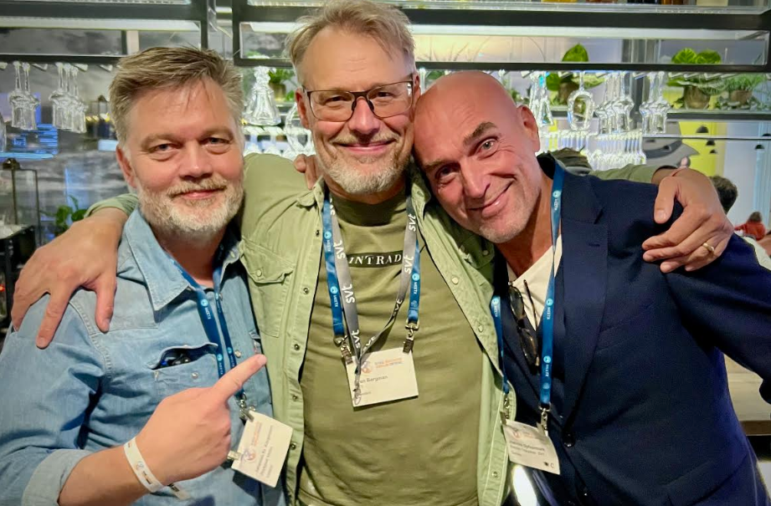
Johannes Kr. Kristjansson (left), Sven Bergman (center), and Joachim Dyfvermark at the GIJC2023 in Gothenburg. Image: Courtesy of Kristjansson
“I also met Nils Hanson, who was the editor of SVT’s investigative journalism programme Uppdrag granskning, at a GIJC conference. Over the years, I have often turned to him for advice on stories I have been working on. In my opinion, Nils is one of the most respected investigative journalists in the world. He has always been generous with his advice and has introduced me to other journalists who have been able to help me with my investigations. And his lecture in Lillehammer — ‘The ABC of Investigative Journalism’ — remains the best lecture on investigative journalism I have ever attended.
“Several times a year, I receive a phone call or an email from one of these colleagues asking me to look into something for them here in Iceland,” he adds. “And whenever I need information from another country, I know I can reach out to them. I have also hosted several of these colleagues when they have visited Iceland, either on holiday or for work.
“This is one of the most valuable things I have gained from attending the GIJC conferences: the relationships, friendships and professional connections I have built with journalists from all over the world.”
Katerina Topalova — environmental journalist (North Macedonia)
“I’m an environmental journalist from North Macedonia, and I want to say how fascinated and inspired I was by GIJC25,” Topalova said. “I attended all the environmental and climate-related panels, and the experience was truly transformative for my reporting and for the cross-border investigations I am currently involved in.
“The conference sparked several new story ideas, especially around data-driven environmental monitoring and the impact of conflicts on ecosystems. It also introduced me to new methodologies — such as advanced open-source environmental verification and collaborative spatial data analysis — that I have already started adapting in my newsroom.
“GIJC has also connected me with journalists working on similar issues in the Western Balkans and beyond, opening possibilities for future collaboration on topics like water and soil pollution, environmental crime, and the long-term consequences of extraction industries. I am very open to being contacted for further discussion or to speak about environmental investigations in the Balkans, cross-border collaboration, or approaches to translating scientific and environmental data into accessible storytelling.”
Polash Datta — founder, Dataful (Bangladesh)
“Dataxplainer — the first data journalism initiative in Bangladesh — opened to the public in January 2026. It is an initiative by Dataful, which I founded in 2018. I have been a journalist since 2001 and left conventional journalism in 2016 to do data journalism and initiated Dataful with funding from friends and family. Since 2022, we have been making data readily accessible and providing training on data-driven reporting to journalists on climate.
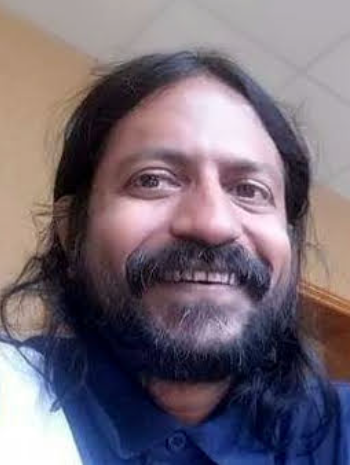
Bangladeshi data journalist Polash Datta. Image: Courtesy of Datta
“Four things happened for me as a result of GIJC25.
“One: There was the conference app where attendees were posting about their interests, arrivals, etc. I got introduced to the research head from Import Genius. We discussed Dataxplainer and he offered access to Bangladesh-related business data from their hub.
“Two: A collaboration has begun with a research organisation on developing a cross-border story pitch.
“Three: Another collaboration for developing a Southeast Asian online data journalism learning platform has begun. I knew a data journalism trainer, who is based in Thailand now, for the last few years whom I met in person during this conference. He had been planning to launch a data journalism learning platform in his country as I was working on one from my country. We thought we could transform it into a regional initiative with joint effort. Then, I informed another data journalist from Pakistan about our plan. Upon returning from the conference, I connected with data journalists from Nepal and Sri Lanka. Currently, we are preparing for our first online meeting to discuss the idea further. [GIJN Board Chair and data journalism professor] Brant Houston has kindly agreed to help us with some course material based on his book.
“Four: Traditionally, we were planning to publish only data reports/stories on Dataxplainer. But in Cheryl’s session [“Using Data for Local Investigations”] she talked about the story recipe that seemed to be more engaging with readers. We are expecting to implement this idea with Cheryl’s help.”
 Rowan Philp is GIJN’s global reporter and impact editor. Rowan was formerly chief reporter for South Africa’s Sunday Times. As a foreign correspondent, he has reported on news, politics, corruption, and conflict from more than two dozen countries around the world, and has also served as an assignments editor for newsrooms in the UK, US, and Africa.

This work is licensed under a Creative Commons Attribution-NoDerivatives 4.0 International License
Republish our articles for free, online or in print, under a Creative Commons license.
Republish this article
This work is licensed under a Creative Commons Attribution-NoDerivatives 4.0 International License
Read Next
Awards, Grants, & Fellowships GIJC23
Global Ripple Effect: How GIJC23 Impacted GIJN Fellows Around the World
At GIJC23, GIJN sponsored more than 100 fellows from dozens of developing and transitioning countries.

GIJN Impact
How Digital Threats Training Has Powered Innovative Cyber Investigations Around the World
Alumni of GIJN’s four Digital Threats training courses have produced a number of exposés on online scams and political disinformation, from India to Kenya to the Philippines.

GIJN Impact News & Analysis
GIJN in 2025, by the Numbers
The year 2025 was a groundbreaking moment for the Global Investigative Journalism Network. Here are some of the key metrics from all of our work around the world last year.