
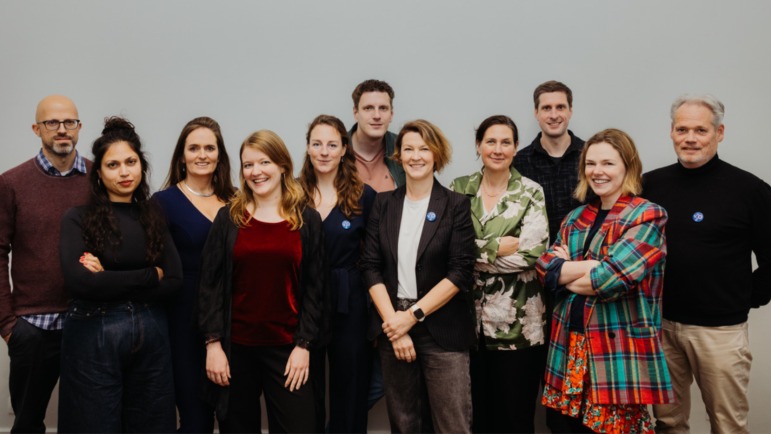
The VVOJ team in early 2026 (board and staff, from left to right): Jef Poortmans, Sharyfah Bhageloe, Marcia Nieuwenhuis, Mira Sys, Willemijn Sneep, Chris Bakker, Débora Votquenne, Anne Peetoom, Pieter Van Maele, Els Onink (bureau), Rick van Dijk (bureau). Image: Courtesy of VVOJ
How GIJC27 Co-Host VVOJ Packs a Regional Punch in Growing Investigative Journalism
How Many Journalists Does It Take to Fill an Olympic Swimming Pool? GIJN’s Guide to Size and Number Comparisons
Investigative Journalism Week 2026 Resources
International Research Guide: How to Find Experts and Hidden Documents on Any Topic

Guide to Investigating Tech and AI in Modern Warfare
The judging priorities for the annual awards conferred by De Vereniging van Onderzoeksjournalisten (VVOJ) — the Dutch-Flemish Association of Investigative Journalists — help explain why this small organization plays an outsized role in promoting quality investigative reporting in the region and beyond.
Rather than rewarding impact, its De Loep (“The Magnifying Glass”) Prize particularly honors innovation in the investigative digging process, and encourages newsrooms to practice “radical transparency” with their methodology to promote reader trust and “stifle any potential criticism.” This was well illustrated, for instance, by its recent recognition of the use of satellite imagery, sanctions lists, and ship registers by reporters at the popular Dutch newspaper NRC for its Putin Refuels in Zeeland investigation.
In addition, its unique Vliegwiel (“Flywheel”) Award specifically rewards editors who take the risk of allowing beat reporters time away from their daily beats to pursue long-term investigations that may or may not pan out.
Despite having just two part-time operational staff and eight board members, VVOJ has harnessed a relentless focus on the resources watchdog reporters in Western Europe need most — especially time, new skills and partners, and document access — to become a regional force for accountability and public transparency since its founding in 2002, and which has now grown to a membership of 800 investigative journalists.
VVOJ will celebrate its 25th anniversary next year when it also co-hosts the next Global Investigative Journalism Conference in Rotterdam (GIJC27) — an event likely to draw nearly 2,000 watchdog reporters and editors from well over 100 countries. It will be the second time VVOJ has co-hosted the world’s premier gathering of investigative journalists, alongside Global Investigative Journalism Network, having previously done so at the third GIJC in 2005, in Amsterdam.VVOJ will be hosting GIJC27 in coordination with regional partners Free Press Unlimited and Journalismfund Europe.
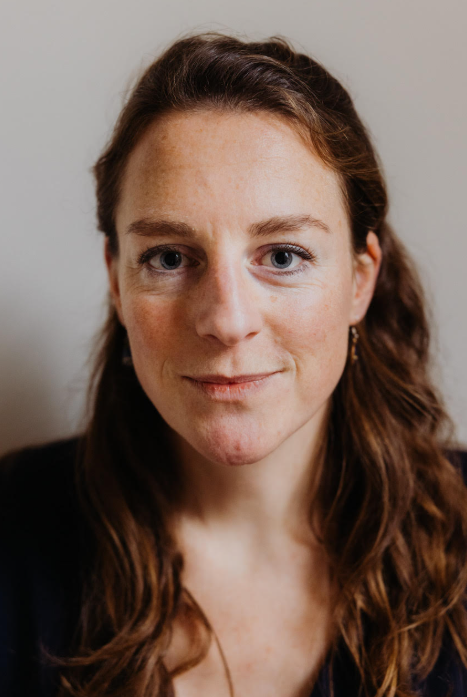
VVOJ Board Vice Chair Willemijn Sneep. Image: Courtesy of Sneep
Remarkably, VVOJ — which was also one of the earliest members of GIJN — routinely attracts up to 500 journalists to its own annual, two-day investigative journalism conference.
According to its board vice chairperson, Willemijn Sneep, the nonprofit association punches above its weight because of a culture of volunteerism and a shared mission to boost investigations as a proportion of all published stories in every newsroom.
“We have very active volunteers among our members: organizing committees for the content of the yearly conference; volunteers for the Loep Prize committee; for the regional days where we gather and share knowledge,” says Sneep.
“The board itself is very active, operating different teams and working groups,” adds Débora Votquenne, board chair of VVOJ. “Then we have very active members who make those work. We say ‘VVOJ is for and from investigative journalists.’ It’s very bottom-up.”
Unusually for a journalism training association, VVOJ also has a stated lobbying role: advocating for open access to public documents, for legislation to combat nuisance SLAPP suits, and for the creation of new investigative journalism research units at universities.
“The lobbying role is difficult for international colleagues to grasp,” explains Wubby Luyendijk, an award-winning investigative reporter at NRC, and the former head of its investigations desk. “But in the Netherlands, we’ve grown up with a culture of ‘poldering’: discussing something until everyone agrees. I see no problem with that role, as long as you make your wishes known openly and transparently to everyone.”
A newly released VVOJ survey found that an astonishing 48% of the 147 independent journalists in the Netherlands and Belgium polled had experienced legal pressure in the past two years as a result of their work — despite the widely admired free press reputation of the region. From the survey, 46 respondents reported that they had been threatened with legal action, and a further 24 had been involved with legal proceedings stemming from a story. Notably, VVOJ found significant self-censorship arising from these threats and SLAPP actions, noting that: “A third say they have become more cautious with subsequent publications. In over a quarter of cases, a publication was modified, toned down, or rewritten. Four respondents decided against publication altogether.”
This reflects another feature of VVOJ’s DNA: providing both a safe space for collaboration and unguarded, in-person knowledge-sharing, and also uncomfortable truths and industry introspection about problems within the field.
Indeed, the theme of its 2026 conference, in Antwerp on November 20 and 21, is “The Uncomfortable Reality: an honest and urgent look at the state of our profession.”
“People want practical knowledge from their colleagues, but people also want to discuss stories that went wrong, or got a lot of critique,” says Sneep. “Our community feels safe enough to be honest with peers, and defend why you made difficult choices. I think that is really valuable.”
Adds Votquenne: “All of us struggle to get attention and revenue, but at the conference it’s like we are all colleagues, and there is this huge generosity from journalists to share their experience and know-how, and what you shouldn’t do.”
Annual Conference
VVOJ’s annual conference roughly follows the model of GIJC events, offering dozens of practical workshops and panels, networking events, and headlining trainers such as the region’s own world-renowned cyber sleuth Henk van Ess. It typically runs on six tracks: top stories; data; basic skills; newsroom management; pioneering techniques; and an annually chosen themed topic. They are supplemented by regular masterclass events.
Kristof Clerix, an investigative reporter with Belgian weekly news magazine Knack, is among the hundreds of investigative journalists whose projects and careers have been sharpened by VVOJ’s training.
“I was lucky to get in touch with the VVOJ community at a very early stage in my journalism career,” says Clerix. “I just love the positive energy of the gatherings, the creativity and inspiration, the open exchanges, and especially the hands-on tips and tricks. In my daily work, I often use FOIA, Excel, OSINT, etcetera. All those things I picked up at VVOJ conferences.”
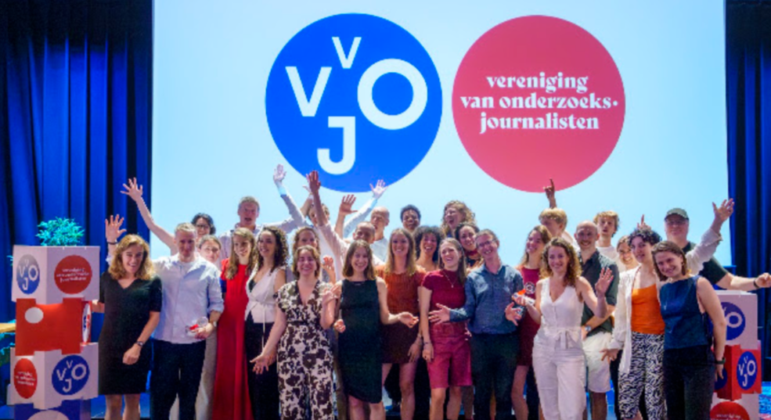
Winning journalist teams celebrate their prizes at VVOJ’s annual De Loep Awards 2026. Image: Courtesy of VVOJ
Coen van de Ven, editor of De Groene Amsterdammer, adds: “Once a year, for 48 hours, we bury the hatchet between newsrooms and learn from one another — across the boundaries of competition, countries and generations. At that annual conference, I’ve found partners for collaboration and discovered new ideas for stories.”
Says Votquenne: “We were in Kuala Lumpur (GIJC 2025) and Gothenburg (GIJC 2023) and at Perugia and Dataharvest, so we try to see what works for others, but we do organize a survey after each conference to see what was appreciated most, so we do customize. For example, AI techniques are moving so fast, so we try to keep up with things to inform everyone, but at the same time helping with skills to use new platforms for investigations; for example, a practical workshop on something like (research organizing tool) Notion.”
VVOJ communicates via a weekly emailed newsletter to 2,000 recipients. With the exception of some online workshops held during the COVID-19 pandemic — all of its training is done in-person, and conducted everywhere from conference halls to newsroom cellars, university classrooms, and even public cafes.
“Its a long-term plan to have an [online] editorial section; as a bureau, we don’t currently have the time as we are two part-timers,” explains Rick van Dijk, coordinator of VVOJ. “Anyway, we think meeting and training in person is better, because participants can talk and collaborate on future projects, and they can speak freely, as it’s not recorded. It’s a safe, close environment for all our activities.”
Funding
Votquenne says the association itself is funded by annual membership fees of €70 (US$81), sponsorships for events, and project grants. “We don’t have structural funding, so we depend on a lot of project funding,” she explains.
Sneep adds: “We don’t really have individual donors, so its membership fees and then mostly specific funds for investigative journalism or for democracy and media, or for events,” Sneep adds.
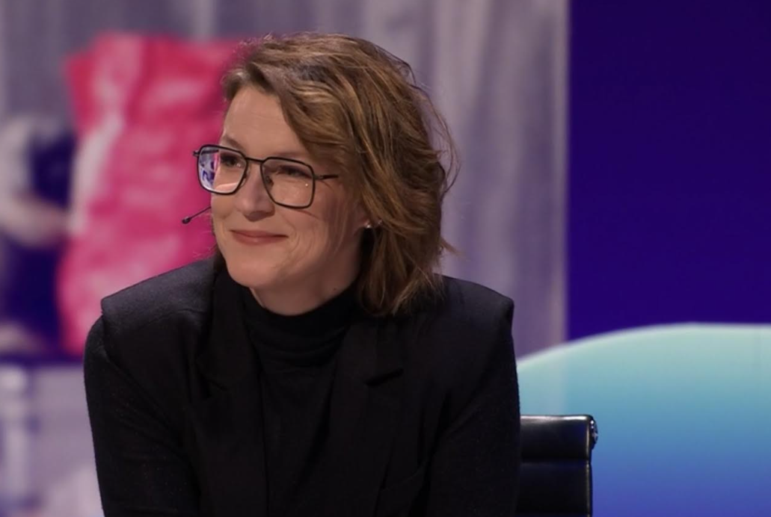
VVOJ Board Chair Débora Votquenne. Image: Courtesy of Votquenne
However, she says many outlets and VVOJ members in The Netherlands benefit from robust public funding, including a €7 million (US$8 million) government grant that is disbursed to successful independent media applicants with no government strings attached.
“We have had more right-wing governments, and yet The Netherlands managed to get a really significant budget dedicated to investigative journalism, which is non-negotiable, and has even been enhanced,” Votquenne explains.
“I think the world can learn from the public funding model here, where there is a lot of money for investigative journalism,” says Sneep. “The government does not have any say in where this money goes, and it is absolutely independent.”
Wubby Luyendijk believes that this government funding — which began disbursement in 2018 via the Dutch Journalism Fund (SVDJ) and the Dutch Fund for In-depth Journalism — was a major catalyst that allowed many outlets and independent reporters to maximize VVOJ training in their projects.
“That was the moment when VVOJ received a new impetus,” she says. “Young, often freelance, investigative colleagues received grants and came to learn from experienced veterans. Investigative collectives were set up, and collaborations were established, both between editorial teams and between newspapers and radio and television broadcasters.”
She adds: “The prevailing model of competition gave way to one of collaboration. This is also reflected in VVOJ’s conference in the autumn and the annual De Loep awards ceremony in late spring.”
Cheerleading for Accountability Reporting
In 2025, VVOJ’s lobbying and fundraising efforts led to the creation of the first research chair position in investigative journalism at Vrije Universiteit Amsterdam.
“We kind of made it happen, and gathered the funding from diverse sources and all the important people to make this important position happen,” explains Sneep.
Currently held by Professor Nikki Sterkenburg, the goal of this position is “to scientifically research and increase the democratic relevance and societal impact of investigative journalism.” Sneep hopes a similar professorship might be established in Belgium soon.
“We want the importance of investigative journalism to be top of mind for every government or parliament representative; at the same time, at the top of mind for the workforce, so it is an evident choice for media to invest in investigative journalism,” says Votquenne. “We want to ensure that journalists don’t have to fight this fight to able to do investigative reporting alongside their other reporting, so they can focus on their investigations. We want to do that for them.”
It is striking that board members and staff — past and present — all speak about the need to persuade people about the importance and indispensability of accountability reporting.
Former VVOJ director Margo Smit — who is currently news ombudsperson for the Dutch NPO public broadcasting system and vice chair of GIJN’s board — says that, in addition to growing the craft, the association sometimes has to “play defense” by persuading editors under financial pressures to preserve long-term work.
“I see this at the big broadcasters: the minute they get budget cuts, what they look at is the people not doing the daily news: ‘Maybe you can do a project less?’” she laments. “That’s problematic.”
Asked about the Flywheel Award for brave editors, Votquenne says the most anonymous members of investigative teams everywhere — editors — need much more recognition.
“We have to get editors on our side; we have to validate their work and the risks they take, because while a reporter has to fight to get the time to do investigations, there is an editor on top of it who has to ultimately wage the same fight,” she notes. “They get very little public recognition for what they do, but if they provide this space, they give their reporters wings.”
Growing the Craft
Coen van de Ven cautions that more work needs to be done to promote diversity in the region’s watchdog community, but concedes that there has been recent progress.
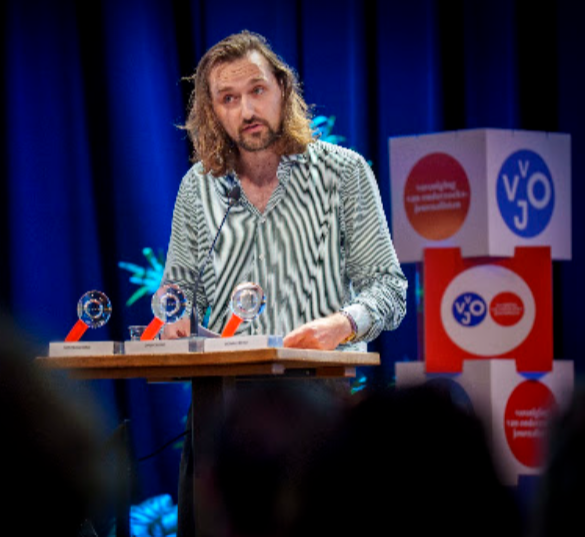
Fellow Dutch journalist and De Groene Amsterdammer editor Coen van de Ven delivers the keynote address at De Loep Awards 2026. Image: Courtesy of VVOJ
“Obviously, there should be a constant effort to make the association more inclusive, more accessible and more diverse,” says Van de Ven. “Over the last 10 years, this has been a success when it comes to the inclusion of younger people and women, but the job is not done yet.”
In a keynote speech at the Loep Awards in June, Van de Ven provided a personal anecdote to show how VVOJ acts as a career springboard for young reporters: “I returned from abroad in 2016 as a 23-year-old student and wanted to get back into journalism. The then-director of VVOJ smuggled me into the Leuven (Belgium) Congress for free, where, in exchange for two moderation assignments, I was able to explore the world of investigative journalism. I met my current colleagues at that conference. I approached one of them, and … a week later I was sitting there for an interview. The association is exactly as fun, vibrant, and interesting as the efforts of its members, and, because of those efforts, it is still a stepping stone for 23-year-olds who want to get into investigative journalism.”
One of the VVOJ programs to promote entry into investigative reporting is called START, where – three or four times each year – a small group of students and young reporters get to gather together to hear from experienced investigators.
“Winning the VVOJ encouragement award for young journalists in 2005 definitely was a boost for me, and an encouragement to continue with investigative reporting,” says Clerix. “Later on we also won the Loep Award for collaborative projects such as LuxLeaks and The Paradise Papers. It’s a prestigious prize in Belgium and the Netherlands.”
Co-hosting GIJC27
“What an honor that the Global Investigative Journalism Conference is to be held in the Netherlands next year,” says Luyendijk. “It’s the perfect opportunity for investigative journalists from all over the world to meet, inspire one another, and learn from each other. Take, for example, the session from from the New York Times (at GIJC25) in Gothenburg: they carried out groundbreaking and award-winning visual investigations into the war crimes in Bucha, Ukraine. Since then, OSINT research has been part of our newspaper’s journalistic toolkit when it comes to war reporting.”

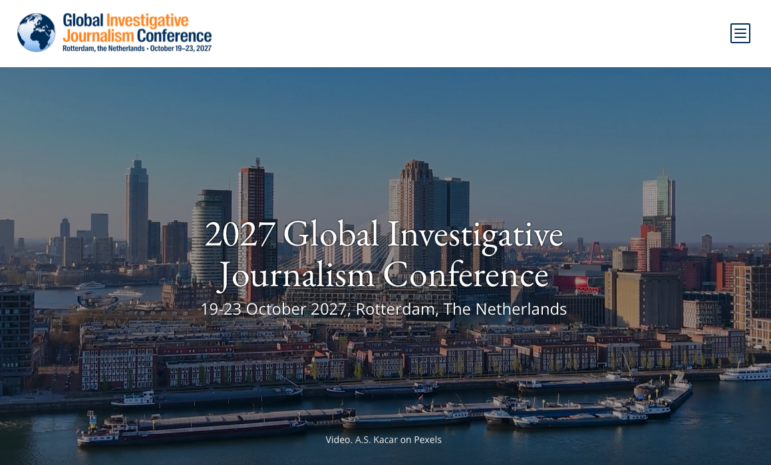
In 2027, VVOJ will play host to a Global Investigative Journalism Conference for the second time in history, this time in Rotterdam, The Netherlands. Image: GIJN
Given that VVOJ itself was in its infancy when it co-hosted the third GIJC in Amsterdam in 2005, Sneep says the event in Rotterdam feels like coming full-circle. “It’s so cool; we are so happy to be co-hosts for GIJC27,” she says.
Votquenne agrees. “It makes you very humble, because you see the importance of the work being done worldwide,” she adds. “We at VVOJ are fighting for investigative journalism in the Netherlands and Flanders, but this battle is nothing compared to what so many reporters face in the rest of the world; where many have to fear for their lives and their families. The democratic importance of the work they do makes us very humble ahead of next year’s Global Conference.
“It’s also like a present we can give to our members who weren’t able to go to Kuala Lumpur, and link with this worldwide community.” Votquenne adds: “I think of [GIJN executive director] Emilia Diaz-Struck’s words from Kuala Lumpur: ‘I feel energized!’ That’s how we hope we’ll feel after that event. You go home with ideas; a lot of energy.”
 Rowan Philp is GIJN’s global reporter and impact editor. Rowan was formerly chief reporter for South Africa’s Sunday Times. As a foreign correspondent, he has reported on news, politics, corruption, and conflict from more than two dozen countries around the world, and has also served as an assignments editor for newsrooms in the UK, US, and Africa.
How Many Journalists Does It Take to Fill an Olympic Swimming Pool? GIJN’s Guide to Size and Number Comparisons
Investigative Journalism Week 2026 Resources
International Research Guide: How to Find Experts and Hidden Documents on Any Topic
Guide to Investigating Tech and AI in Modern Warfare

In 2027, Global Investigative Journalism Conference Heads to The Netherlands
GIJC27: Website Launched and Dates Confirmed for 15th Global Investigative Journalism Conference
Call for Ideas: Send Us Your Panel and Workshop Recommendations for GIJC27
How Survivors Helped The Marshall Project Investigate Youth Residential Treatment Centers

This work is licensed under a Creative Commons Attribution-NoDerivatives 4.0 International License
Republish our articles for free, online or in print, under a Creative Commons license.
Republish this article
This work is licensed under a Creative Commons Attribution-NoDerivatives 4.0 International License
Read Next
GIJC27
In 2027, Global Investigative Journalism Conference Heads to The Netherlands
The 15th Global Investigative Journalism Conference will be held in 2027 in the Netherlands, co-hosted by GIJN and VVOJ (The Dutch-Flemish Association of Investigative Journalists).
GIJC27
GIJC27: Website Launched and Dates Confirmed for 15th Global Investigative Journalism Conference
The next Global Investigative Journalism Conference will be held in Rotterdam, and will feature the latest reporting tools and techniques, cutting-edge workshops, and extensive networking.
GIJC27
Call for Ideas: Send Us Your Panel and Workshop Recommendations for GIJC27
To create the most inclusive and impactful global conference for investigative journalists, we are now soliciting great ideas for sessions for GIJC27. Send us your proposals!
How They Did It
How Survivors Helped The Marshall Project Investigate Youth Residential Treatment Centers
A team of reporters worked with survivors of youth residential treatment centers to create a toolkit to help others find records about themselves and pursue accountability for abuses.