

This investigation traced how Peruvians have been recruited by Russia to fight in the war in Ukraine. Image: Screenshot, ABC (Spain)
Peruvians Fighting for Russia, Israel’s Illegal Settlements, Mali’s Drone War, and the Data Center Heat Effect
An ABC (Spain) investigation has exposed a network that lured Peruvians to fight for Russia in Ukraine, reconstructing how recruiters targeted men in financial difficulty with promises of security jobs and signing bonuses. Our roundup of the Top 10 in data journalism, looking at stories from September 9 to 24, also includes The Straits Times’ mapping of how Indonesia’s food self-sufficiency drive threatens its forests, IStories’ estimates of United Russia’s real support in the State Duma elections, Bellingcat and Jeune Afrique’s geolocation of drone strikes by Mali’s junta, and The Economist’s analysis of how male managers’ first-born daughters affect women’s pay.
Peruvians Recruited by Russia for War in Ukraine
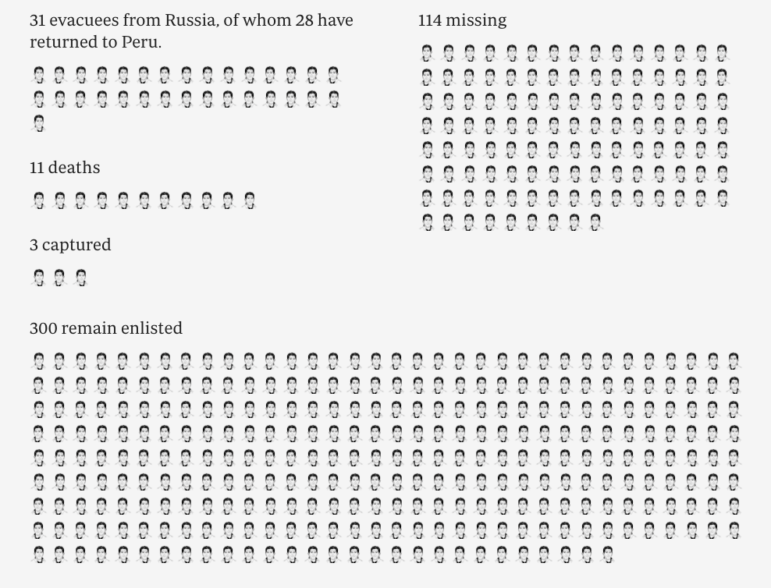
Image: Screenshot, ABC (Spain)
Russia has continuously drawn foreign recruits into its war in Ukraine. An ABC investigation based on interviews with families, lawyers, and former recruits reconstructed a network that lured Peruvians to Russia to fight for its forces. The team tracked the process from recruitment and travel to military enlistment, documenting how recruiters targeted men in financial difficulty with promises of security jobs, signing bonuses of up to US$20,000 and monthly salaries of more than US$2,000. A pictogram visualized the known outcomes of 459 Peruvians identified by Peru’s Foreign Ministry, showing those who remain enlisted, are missing, have died, were captured, or were evacuated. The reporting also mapped recruitment routes and documented how promissory notes, confiscated phones, and restricted communication helped control recruits after arrival.
US Data Center Heat Waste
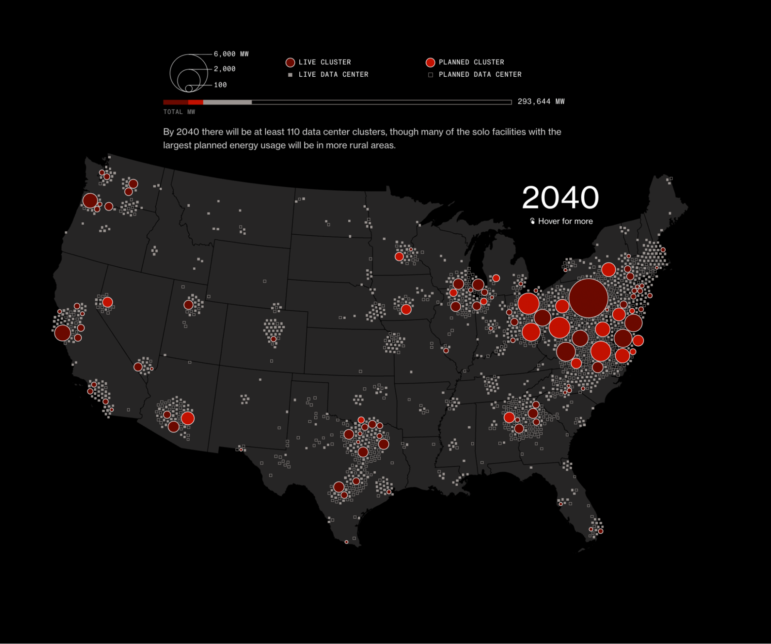
Image: Screenshot, Bloomberg
Servers in data centers need huge amounts of electricity, and nearly all of that power becomes waste heat. A single facility could use over 50 megawatts of energy, roughly equivalent to the heat generated by 54,000 homes. Bloomberg used thermal imagery to show cooling units in Phoenix, Arizona reaching over 100° F (38°C) as hot air was pushed out of the CyrusOne data center. Recent studies detected warming up to 500 meters (164 feet) downwind of data centers, and emerging research suggests these plumes could become a major driver of the urban heat island effect, compounding where these facilities are concentrated. A map of individual and clustered data centers by capacity shows that a third of US facilities were built in clusters, most of the 88 existing ones close to urban areas, with 23 more expected by 2040, mostly in cities. If every proposed facility is built, the sector’s energy use would roughly quadruple to over 290 gigawatts, according to Bloomberg.
Social Media Targets Brazil’s Female Political Candidates
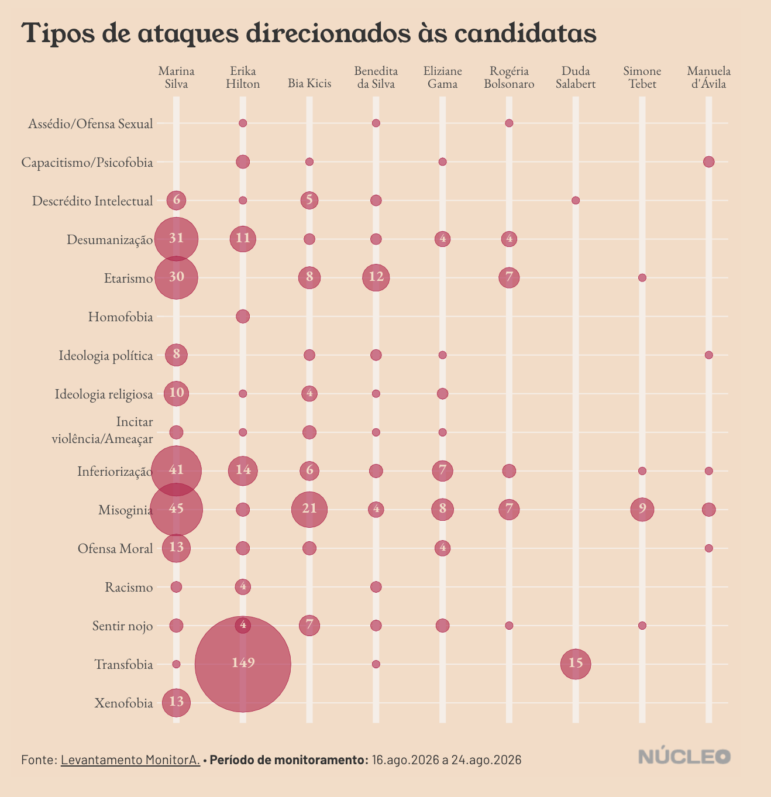
Image: Screenshot, Nucleo
With Brazil’s general election approaching on October 4, Nucleo analyzed 6,124 comments posted on the profiles of 60 female and 27 male candidates on X, YouTube, and TikTok, between August 16 and 24, based on a survey by MonitorA, an observatory of gender-based political violence on social media during elections. The analysis found that female Senate candidates were the target of six in 10 offensive comments. Marina Silva, a former senator now running for the Senate in São Paulo, accounted for 32% of offensive comments directed at female candidates on X. The project combined text comments with images such as memes, which were manually classified as insults or attacks. A bubble chart shows attack types by candidate, while a word cloud shows the most common terms used against female candidates.
Fighting Over Jade in Myanmar
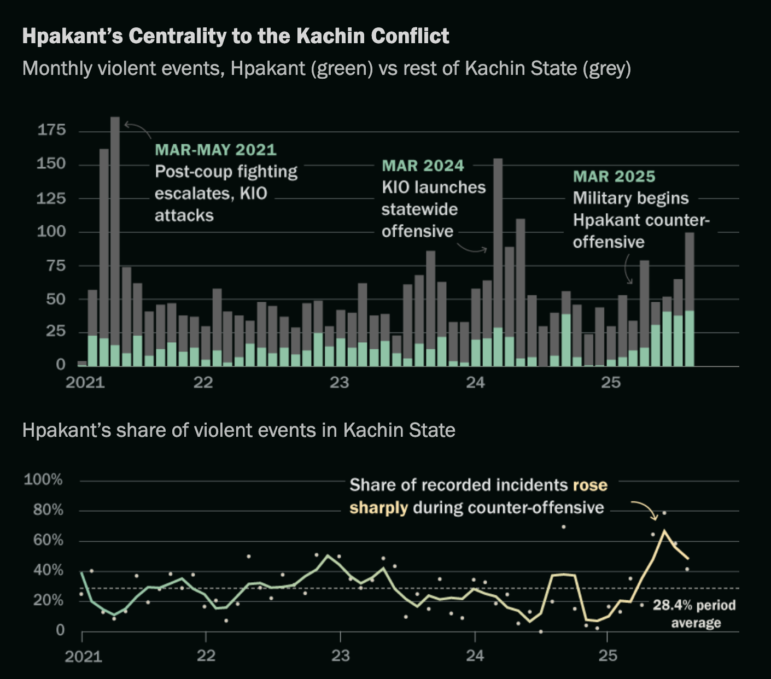
Image: Screenshot, Crisis Group
Control of Myanmar’s jade trade has become an important stake in fighting around Hpakant, where the military and the Kachin Independence Organization (KIO) and its allies are competing for one of the country’s most lucrative industries. The International Crisis Group examined how the conflict has reshaped it since the 2021 coup in Myanmar. Drawing on satellite imagery, ACLED conflict and night-light data, and interviews, the analysis found that mining has not expanded significantly, but signs of continued extraction are evident across the jade belt. A column and line chart compares monthly violent events in Hpakant with the rest of Kachin State, while maps visualize smuggling routes before and after the coup, with night-light data showing activity shifting from the mines to urban areas after the coup.
How Russian Votes Could Be Falsified
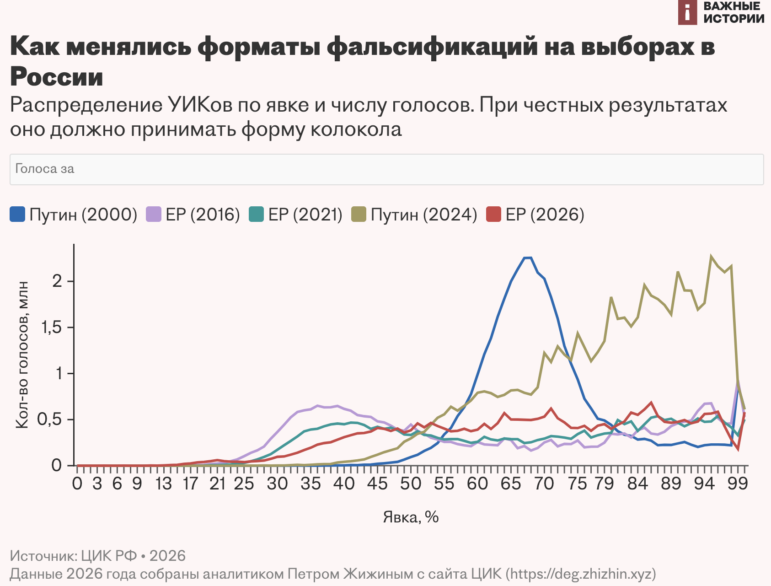
Image: Screenshot, Stories
Russia’s State Duma elections, held September 18 – 20, gave United Russia, the ruling pro-Kremlin party, about 58% of the vote, according to preliminary Central Election Commission results. But an analysis by IStories suggests its real support was no higher than 35%. Using results from 94% of polling stations and a statistical method developed by electoral analyst Sergei Shpilkin, the outlet found that the party’s vote share rose with turnout instead of staying steady, a pattern it ties to ballot stuffing. Charts plotted polling stations by turnout and vote share, and line charts compared turnout patterns across elections from 2000 to 2026, where analysts cited that fair voting should form a bell curve. The story also referenced two adjacent polling stations where turnout jumped from 7% and 17% all the way up to 100% in the final two hours of voting on September 20, and independent exit polls abroad that put United Russia at 5.5%, against more than 45% in the official results.
Mali’s Drone War Campaign
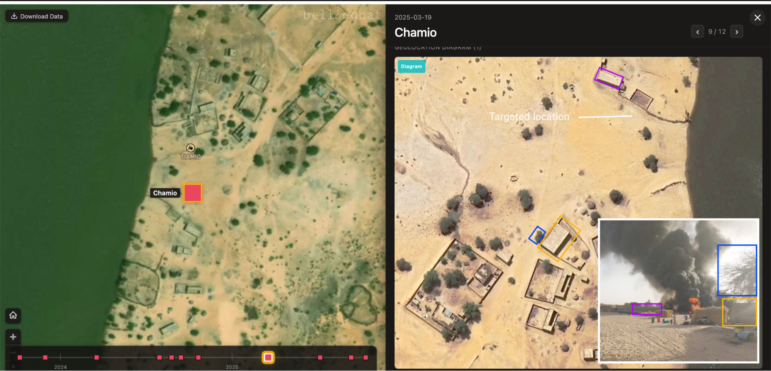
Image: Screenshot, Bellingcat
Mali’s junta acquired its first Turkish-made Bayraktar TB2 drones in late 2022, and has regularly broadcast footage of drone strikes on national television, describing them as “precise” attacks on “terrorists and their logistics.” But a joint investigation by Bellingcat and Jeune Afrique found that the strikes were frequently carried out in civilian areas. Bellingcat geolocated more than a dozen strikes in northern Mali, many hitting vehicles or areas of commercial activity, with civilian deaths and injuries reported in some cases. Reporters compared locations in the footage with satellite imagery and plotted the strikes on an interactive map, adding that they make up only a fraction of the total.
Millions of Missing ‘Charitable’ Donations to Ukraine
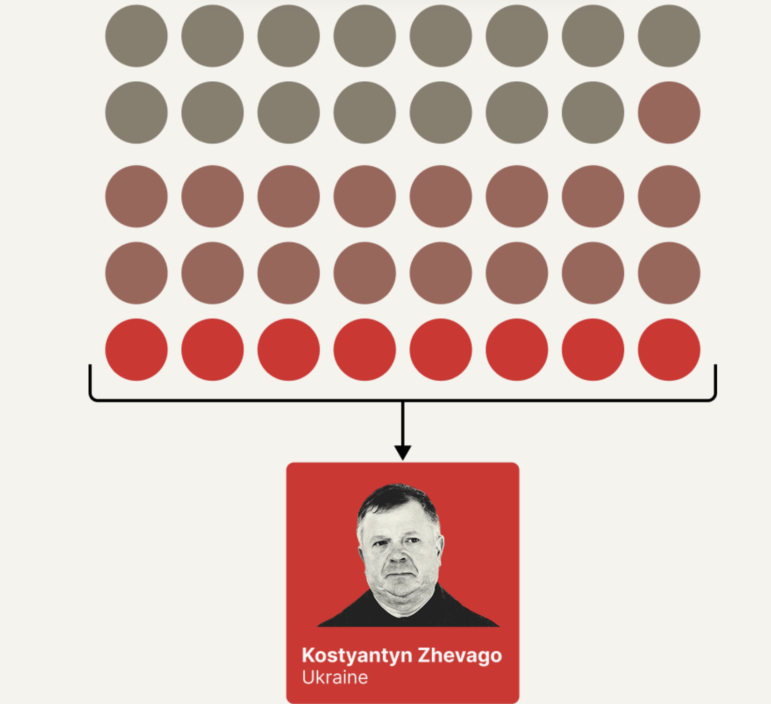
Image: Screenshot, OCCRP
Ferrexpo, a Swiss-based Ukrainian iron ore company listed on the London Stock Exchange, donated more than US$110 million to Blooming Land, a charity based near its iron ore mines in central Ukraine, between 2013 and 2018, according to an unpublished forensic report obtained by OCCRP. Investigators analyzed bank records, internal charity documents, and corporate filings to trace the money, finding that roughly US$74 million was “not used for its intended purpose” and was instead transferred through Blooming Land’s sub-funds to two Ukrainian companies, before moving on to dozens of other firms. OCCRP mapped the transactions in a flow chart and checked them against corporate records, which confirm that then-CEO Kostyantyn Zhevago controlled or held shares in eight of the 43 recipients and is suspected by a Ukrainian state agency of controlling two dozen more. Separate banking records showed that in 2015, six of the recipients flagged in the report sent similar or near-identical amounts to his Finance and Credit Bank, directly or through other firms. The bank was declared insolvent later that year, but lawyers for Zhevago claimed that he “has no relation” to Blooming Land and that “assumptions” about the misuse of the funds “were not confirmed.”
Growing Illegal Israeli Settlements in Palestine
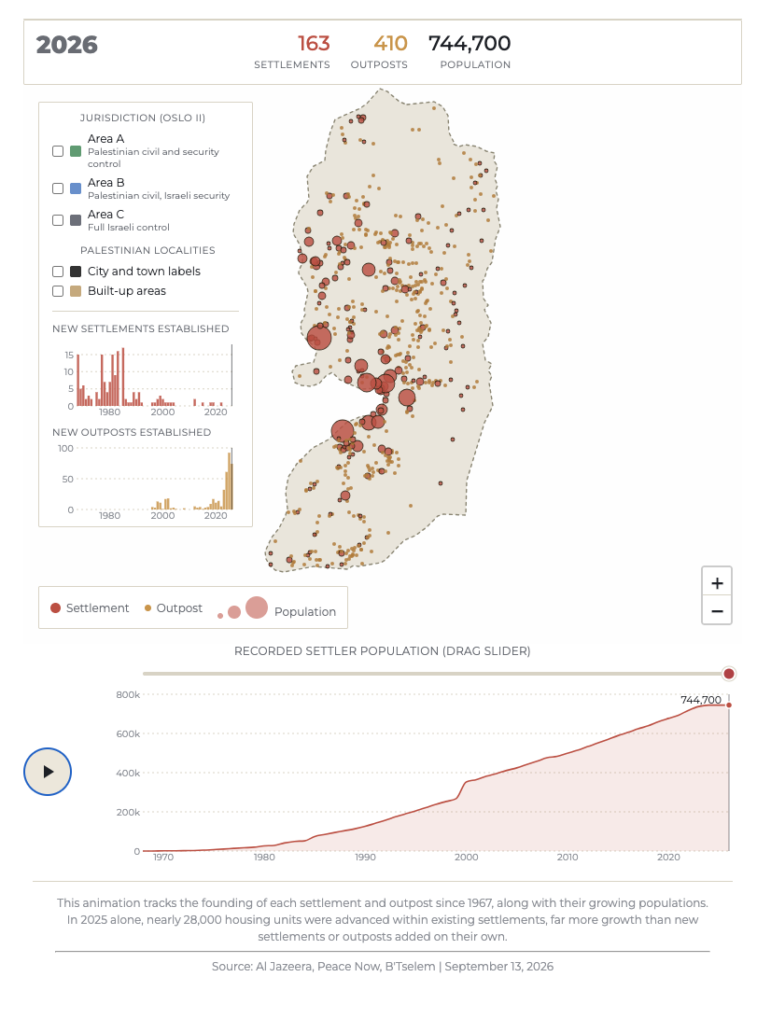
Image: Al Jazeera
Israel’s illegal settlements in the occupied West Bank and East Jerusalem have expanded over six decades, with settler populations and outposts reaching record levels. Using data from Peace Now, which monitors settlements, and human rights center B’Tselem, Al Jazeera traced the growth of each settlement and outpost, showing how scattered communities developed into a wider network connected by roads and highways. A timeline map tracked the spread of settlements from the 1960s onward, while a line chart showed the rise in the settler population, reaching 744,700 by 2024. [Editor’s Note: This column’s author also works for Al Jazeera, so this selection was independently reviewed and approved by GIJN’s editorial team.]
Indonesia’s Food Self-Sufficiency and Forest Crisis
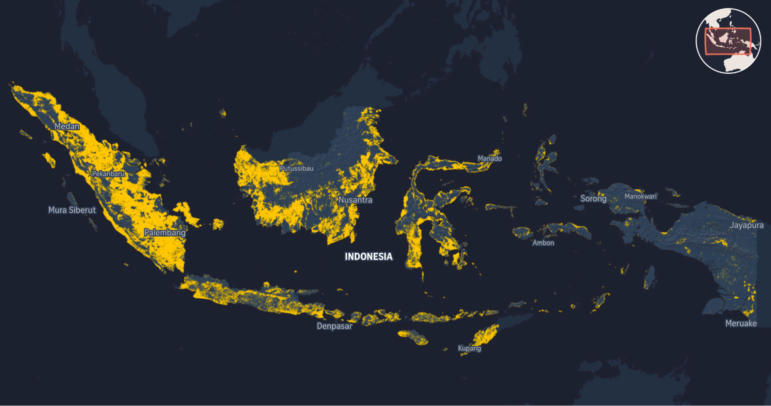
Image: Screenshot, The Straits Times
Indonesia, which has the world’s third-largest area of tropical rainforest, is pushing a campaign to achieve food, energy, and water self-sufficiency. But those national goals are, in turn, eating into those forests, even as earlier food estate projects have largely failed to deliver the food boom they promised. The Straits Times used satellite imagery, land-use data, and forest-loss estimates to map how much forest land the government has set aside for its three main programs, finding that 20.6 million hectares are reserved for them, 8.8 million of which is natural forest. In Kalumpang, Central Kalimantan on the island of Borneo, Planet Labs images showed about 200 hectares of galam forest cleared in 2025 for a rice scheme, which was left idle. Nationwide, forest loss jumped 66% in 2025 to 433,751 hectares, concentrated in Sumatra and Kalimantan.
Influence on Women’s Pay from Managers Who Have Daughters
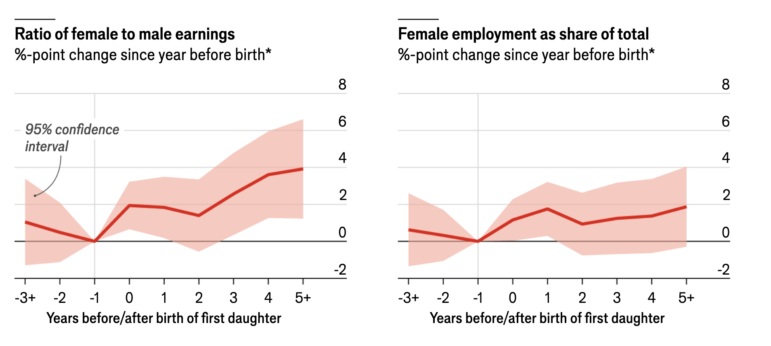
Image: Screenshot, The Economist
A study found that having a daughter can change how male managers treat women in the workplace. Published in the Review of Economic Studies, the research by Nina Smith and Maddalena Ronchi used administrative records covering every worker and company in Denmark from 1992 to 2017. The Economist visualized the findings, showing that when male managers had their first daughter, women’s earnings ratio — their pay in relation to men’s — at their firms rose by 4.1%, while the share of women employed at the company rose by 4.5%. Line charts tracked changes in women’s pay and employment before and after a first daughter, with 95% confidence intervals. The shift began immediately after the birth and lasted while the manager remained at the firm.
Hanna Duggal is the writer of GIJN’s fortnightly Top 10 in Data Journalism column, and a data journalist at AJ Labs, the data, visual storytelling, and experiments team of Al Jazeera. She has reported on issues such as policing, surveillance, and protests using data, and reported for GIJN on data journalism in the Middle East, investigating algorithms onTikTok, and on using data to investigate tribal lands in the US.

Guide to Investigating Tech and AI in Modern Warfare
Turning Copernicus Satellite Data Into Public-Interest Climate Stories
10 Practical Tips for Verifying Scientific Claims

Reporter’s Guide to Investigating Cryptocurrency

Rare Earth Rivalry, Falling Birth Rates, Violence in the Sahel, and 70 Years of Eurovision Lyrics

Cheap Drones Reshaping Warfare, Strait of Hormuz as Energy Chokehold, Starvation Strategy in Sudan, an Iceberg’s Final Journey
Four Years of Russia-Ukraine War, Sudan’s Child Soldiers on TikTok, India’s Untreated Tap Water, and Waning US Influence at the UN

US Science Research Cuts, Shadow Fuel from Iran, Trump’s Crypto Wealth, and Mapping Below Antarctica’s Ice

This work is licensed under a Creative Commons Attribution-NoDerivatives 4.0 International License
Republish our articles for free, online or in print, under a Creative Commons license.
Republish this article
This work is licensed under a Creative Commons Attribution-NoDerivatives 4.0 International License
Read Next
Data Journalism Top 10
Rare Earth Rivalry, Falling Birth Rates, Violence in the Sahel, and 70 Years of Eurovision Lyrics
Also highlighting China’s squid fishing fleet off Argentina, how redistricting is shaping America’s midterms, and why 2.1 billion people still lack safe drinking water.
Data Journalism Top 10
Cheap Drones Reshaping Warfare, Strait of Hormuz as Energy Chokehold, Starvation Strategy in Sudan, an Iceberg’s Final Journey
Our round-up also highlights India’s highly polluted Yamuna River, a flash flood in Argentina’s Bahía Blanca, and how good (or bad) humans are at identifying AI-generated music.
Data Journalism Top 10
Four Years of Russia-Ukraine War, Sudan’s Child Soldiers on TikTok, India’s Untreated Tap Water, and Waning US Influence at the UN
Our round-up of the best in recent data journalism also highlights medical exam pass rates in Brazil, access to quality water in India, and the cost of competing in the Winter Olympics.
Data Journalism Top 10
US Science Research Cuts, Shadow Fuel from Iran, Trump’s Crypto Wealth, and Mapping Below Antarctica’s Ice
Our round-up of the best in recent data journalism also highlights a deadly train accident in Spain, new migration patterns from Venezuela, and Japan’s nuclear power resurgence.