
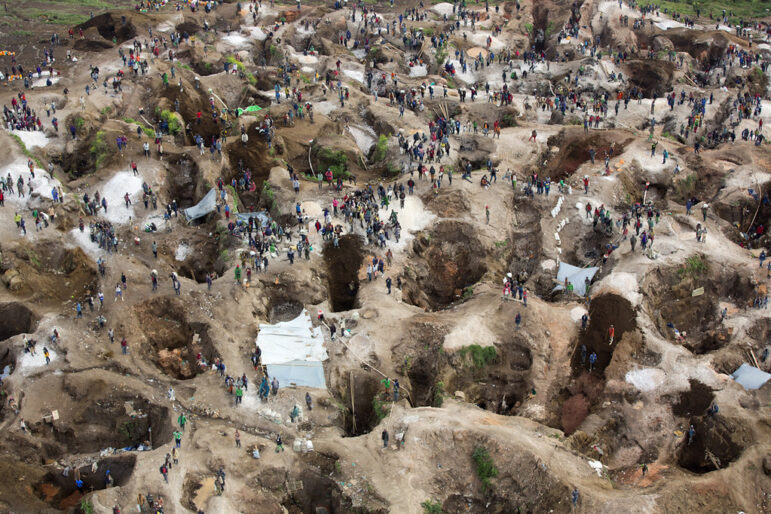
Luwowo Coltan mine near Rubaya, North Kivu. Photo: MONUSCO/Sylvain Liechti/ Creative Commons License BY-SA 2.0
Journalists in Africa and South America Are Mapping the Mines Devouring the World’s Rainforests
In the Amazon and Congo rainforests, investigative journalists are using satellite imagery and artificial intelligence (AI) to expose groups that operate in secret, extracting gold and minerals from some of the world’s most remote regions.
In the Amazon, journalists have mapped thousands of sites where armed groups are clearing forests to mine gold. In the Congo, journalists are identifying areas where artisanal miners use buckets and shovels to illegally extract cobalt and copper.
The projects are on separate continents but face similar challenges: limited resources, dangerous terrain and powerful interests that want to keep their activities hidden. Now, journalists working with the Amazon Mining Watch and Africa Mining Watch projects are sharing strategies to automate parts of their investigations and build cross-border networks to strengthen their reporting.
Amazon Mining Watch delivered results in a fraction of the time of previous approaches, & in ways vastly more accessible to people who need the data. https://t.co/1yibXzl7kT pic.twitter.com/5RpZLFm6Uu
— Earth Genome (@EarthGenome) June 13, 2024
“We are facing the same story under the same constraints,” Jacopo Ottaviani, a senior strategist at project partner Code for Africa, told LatAm Journalism Review (LJR). “Both regions supply raw material to economies elsewhere. Both have environmental reporters working on thin budgets under real physical risk. Both face actors with an interest in these sites staying unmapped.”
From the Amazon to Africa
Both initiatives receive support from the same two organizations — the Pulitzer Center and the nonprofit Earth Genome — but operate independently. Amazon Mining Watch began in 2022 after cross-border investigations in Brazil and Venezuela used a machine-learning model to identify illegal mines and airstrips using satellite imagery.
That initial effort led to major investigations. One was Deforestation Runways: The Expansion of Illegal Mining in the Amazon by Brazilian journalist Hyury Potter for The Intercept, which mapped clandestine airstrips linked to illegal activity in the Brazilian Amazon. Another was Furtive Corridor by Venezuelan journalist Joseph Poliszuk for Armando.info and El País, which identified strategic points in smuggling networks used to transport illegal cargo by air out of the Venezuelan jungle.
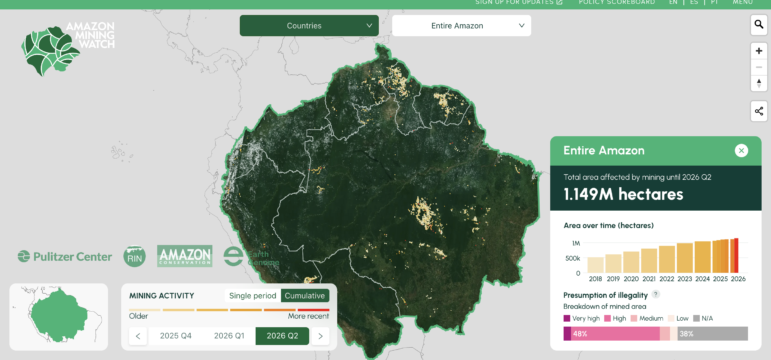
Image: Screenshot, Amazon Mining Watch
Amazon Mining Watch now covers all nine countries in the Amazon basin. The project, co-founded by Brazilian journalist Gustavo Faleiros, who also helped create InfoAmazonia, caught the attention of Ottaviani of Code for Africa.
“I had a light bulb moment and I felt like this is gonna be amazing if you make it also in Africa,” Ottaviani said during a presentation at the Gabo Festival in Bogotá, Colombia, last month. “I said, ‘OK, this technology would work very well in places like the Congo or in South Africa, where illegal mining is very common and labor exploitation and geopolitical issues are all intertwined.’”
Ottaviani reached out to Faleiros, but bringing the methodology to Africa required more than simply replicating the tool.
The South American platform was designed primarily to detect changes in the landscape associated with gold mining. In Africa, by contrast, the diversity of minerals is greater: In addition to gold, there is cobalt, copper and coltan. Mining methods and landscapes also vary. Africa Mining Watch focuses on six countries in the Congo basin and 10 countries in West Africa.
“Each of those elements looks different from orbit, and we started with very few labeled African examples,” Ottaviani told LJR.
The African journalism ecosystem also presents different challenges. Newsrooms work in English, French, and Portuguese and, according to Ottaviani, rarely report on events beyond their national borders.
The Technology Detects Patterns. Journalists Find the Stories
Africa Mining Watch launched this year, holding its first event in April, when the Pulitzer Center and Earth Genome hosted a seven-hour virtual “mapathon” that trained 25 journalists from several African countries to use Earth Index, the technology behind Amazon Mining Watch and Africa Mining Watch. The system is an AI-powered planetary search engine that can identify visual features in satellite imagery.
Participants learned to identify and label signs of mining activity in their own regions, helping add information from their investigations to the new platform.
Abdullah Tijani, editor-in-chief of Nigerian news outlet The Liberalist and one of the “mapathon” participants, fed the platform images he had taken while reporting a story about terrorist groups enslaving residents to work in illegal mines in Nigeria. Using those images, Earth Index detected dozens of other sites with similar terrain patterns. Tijani verified 51 of them.
“I was able to get those mining sites that are still under the control of terrorists, which due to security reasons I was not able to visit,” Tijani told LJR. “It really contributed greatly to my story.”
The example highlights how technology cannot produce an investigation on its own, Ottaviani said.
“Machine learning can tell you where something is happening at continental scale, and that is where its usefulness ends,” he said. “Journalists establish who is behind it and what it costs people.”
A data cross-check, for example, might show that a mining operation is located within Indigenous territory, but that does not necessarily mean the activity is illegal, he added. Journalists and NGO observers provide the context needed to interpret the information generated by the machine.
Community and Consistency
With the launch of Africa Mining Watch, its Amazon counterpart is adopting lessons from across the Atlantic, including how to manage a user community and document its methodology. The Amazon does not have a mining-journalism network as organized as the one Code for Africa has built, Faleiros said.
The African project also developed a toolkit with background information on mining in Africa, data sources and ideas for potential story angles.
For Faleiros, those elements reflect a more explicit effort to support journalists’ professional development.
Journalist Jonas Kiriko of the Democratic Republic of Congo said Code for Africa has remained in contact with him since the “mapathon.” Kiriko said he will develop one of the first investigations conducted entirely using the methodology and support of Africa Mining Watch, focusing on illegal artisanal mining in the protected Congolese area known as the Kivu-Kinshasa Green Corridor.
“They ask us to share what we are doing, if we have any project on mining in Africa, they are willing to help,” Kiriko told LJR. “I think that’s a good start to creating a network of journalists working with Africa Mining Watch.”
Amazon Mining Watch faces the challenge of building that same level of engagement with its network of journalists across the Amazon.
“We’ve built a great platform, but we have not managed to create consistent journalistic coverage,” Faleiros said. “It’s very difficult to get a news outlet or journalists to pay attention and produce a story about this data every three months. Obviously, it would be very interesting to have people traveling and doing fieldwork, but journalists don’t even have time to do some data analysis.”
For now, Amazon Mining Watch launched the Panorama newsletter last year, offering quarterly reports on regional data and trends related to illegal mining and other environmental challenges in the Amazon.
Editor’s Note: This story was originally published by LatAm Journalism Review and is reposted here with permission. This text was translated with the assistance of AI and reviewed by Jorge Valencia
 César López Linares began his career at the Mexican newspaper REFORMA, and has written for publications such as TODO Austin, Texas Music Magazine, and The Austin Chronicle. He previously wrote about innovation in journalism for the Gabo Foundation in Colombia and currently reports for the Knight Center’s LatAmJournalism Review digital magazine.
Investigating Illegal Mining: Tips on Angles, Sourcing, and Post-Publication

GIJN Webinar: Investigating the Extractives Industry in Africa

Guide to Investigating Tech and AI in Modern Warfare
Turning Copernicus Satellite Data Into Public-Interest Climate Stories
How They Did It: Uncovering a Vast Network of Illegal Mining in Venezuela

Pollution, Corruption, and Illegal Gold Mining: Investigating Nigeria’s Water Crisis
Turning the Threat to a Distant Glacier into a Local Story Through Data Visualization
How The Washington Post Combined Data and Human Stories to Cover Hurricane Helene’s Aftermath

This work is licensed under a Creative Commons Attribution-NoDerivatives 4.0 International License
Republish our articles for free, online or in print, under a Creative Commons license.
Republish this article
This work is licensed under a Creative Commons Attribution-NoDerivatives 4.0 International License
Read Next
How They Did It Methodology
How They Did It: Uncovering a Vast Network of Illegal Mining in Venezuela
A behind-the-scenes look at a reporting collaboration that uncovers the vast scale of illegal mining and illicit smuggling in Venezuela’s Amazon region.
Getting the Story Out How They Did It
Pollution, Corruption, and Illegal Gold Mining: Investigating Nigeria’s Water Crisis
Investigative journalist and filmmaker Anu Adelakun discusses her investigation into the forces behind water scarcity and pollution in Africa’s most populous democracy.
Climate Data Journalism
Turning the Threat to a Distant Glacier into a Local Story Through Data Visualization
New York Times climate and environmental graphics reporter Mira Rojanasakul discusses how her team visualized the sea level rise threat from the melting Thwaites Glacier in Antarctica.
Data Journalism
How The Washington Post Combined Data and Human Stories to Cover Hurricane Helene’s Aftermath
From Storybench, Washington Post climate reporter Brady Dennis is interviewed about his immersive story on Hurricane Helene and the importance of combining data and human experience.